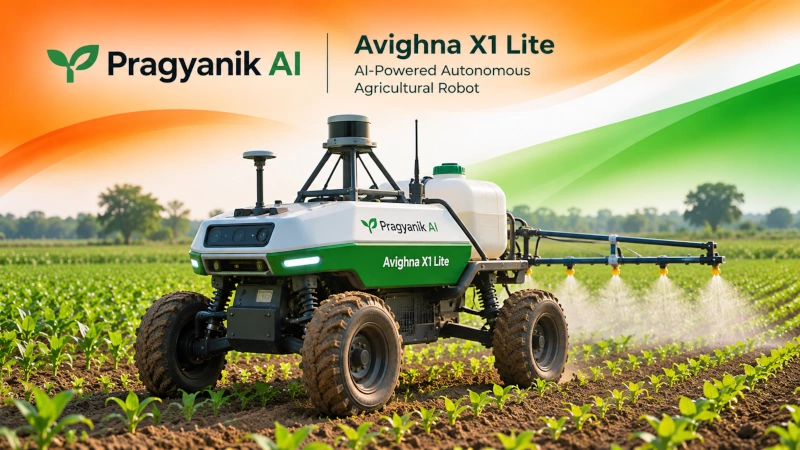
Indore-based agricultural technology startup Pragyanik AI has developed Avighna X1 Lite, a compact autonomous agricultural robot designed to perform precision weeding, targeted spraying, seeding and fertiliser application. The battery-powered robotic platform combines artificial intelligence, computer vision, high-precision satellite navigation and LiDAR sensing to automate routine farming operations while reducing dependence on manual labour and conventional agricultural machinery.
Developed specifically for the requirements of small and medium-sized Indian farms, Avighna X1 Lite represents the company’s initial step towards a broader family of autonomous agricultural machines. Pragyanik AI has completed the development of its first working prototype and commenced field trials to evaluate robotic movement, autonomous navigation and agricultural operations under practical farming conditions. The company is simultaneously developing a larger and more capable version, Avighna X1, intended to support a wider range of agricultural tasks through interchangeable equipment modules.
Avighna X1 Lite: A Compact Robot Designed for Indian Farming Conditions
Unlike large agricultural robots developed primarily for extensive mechanised farms, Avighna X1 Lite has been designed with India’s fragmented agricultural landscape in mind. Many Indian farmers cultivate relatively small holdings where conventional large-scale equipment can be expensive, difficult to manoeuvre or unsuitable for narrow crop rows.
The robot features a compact chassis measuring approximately three feet by two feet, supported by a four-wheel-drive traction system. Its relatively small dimensions allow it to navigate confined agricultural spaces, while adjustable working width and ground clearance are intended to accommodate different crops and field conditions.
According to published specifications, the platform is designed to carry approximately 100–150 kilograms of payload and operate for around eight to ten hours on a battery charge. The proposed system also supports solar-assisted charging, providing an additional option for managing energy requirements in agricultural environments.
The compact architecture is particularly relevant to farmers cultivating vegetables, horticultural crops and other row-planted agricultural products. Such operations frequently require repeated weeding, spraying and nutrient application, making them suitable candidates for specialised robotic assistance.
Artificial Intelligence Enables Precision Weed Identification
One of the principal technologies being developed for Avighna X1 Lite is an artificial intelligence-based vision system capable of distinguishing weeds from cultivated crops. Conventional weed management frequently involves manual labour, mechanical intervention or the application of herbicides across relatively large areas.
Pragyanik AI’s approach seeks to use computer vision to identify unwanted vegetation and direct treatment towards selected locations rather than applying chemicals uniformly across an entire field. Cameras capture images of the surrounding crop area, while AI-based processing is intended to distinguish vegetation patterns and support decisions about where agricultural treatment is required.
This approach creates opportunities for more selective weed management. By directing spraying towards identified targets, precision agriculture systems can reduce unnecessary chemical application and minimise contact with surrounding crops.
The same visual-processing architecture can support additional agricultural operations, including crop monitoring and the identification of conditions requiring field intervention. These capabilities form part of Pragyanik AI’s broader effort to develop a multifunctional robotic platform rather than a machine dedicated to a single activity.
GNSS-RTK and LiDAR Provide Intelligent Field Navigation
Autonomous agricultural machinery requires accurate positioning and environmental awareness to move safely through fields without damaging crops or encountering obstacles. Avighna X1 Lite incorporates technologies intended to address both requirements.
The platform uses Global Navigation Satellite System positioning supported by Real-Time Kinematic corrections, commonly known as GNSS-RTK. This technology improves positioning accuracy by correcting errors in satellite navigation signals using reference data, enabling agricultural machines to follow more precise routes than conventional satellite positioning alone would permit.
High-precision navigation is especially valuable during seeding, spraying and mechanical weeding, where maintaining the correct distance from crop rows is essential. Accurate positioning can also support repeated operations along established field paths.
LiDAR, or Light Detection and Ranging, provides a complementary sensing capability. By measuring distances to surrounding objects using laser-based sensing, the system can construct information about its immediate environment and identify potential obstacles.
The robot’s navigation architecture is intended to combine positioning data, LiDAR measurements and camera-based observations to plan routes and adjust movement. This integration is important because agricultural environments are rarely uniform. Uneven ground, changing vegetation, irrigation channels and unexpected obstacles require more adaptable navigation than conventional fixed-route automation.
One Robotic Platform for Multiple Agricultural Operations
A distinguishing feature of the Avighna development programme is its modular design. Pragyanik AI intends to use interchangeable attachments that allow a single robotic chassis to perform different agricultural operations instead of requiring farmers to purchase a separate machine for each task.
The planned applications include mechanical weeding, targeted chemical spraying, precision seeding, granular fertiliser application and selected pest-control activities. Each operation requires a different working mechanism, but the underlying robotic platform can share navigation, power, sensing and control systems.
For weeding, the robot can be equipped with mechanisms designed to operate between crop rows. Precision spraying modules can direct agricultural treatments towards selected areas, while seeding attachments can use navigation data to support consistent placement and spacing.
Granular fertiliser application represents another potential use. By linking material dispensing to the robot’s location and movement, the system is intended to support more controlled application of agricultural inputs.
The modular concept is particularly important for smaller farms because it allows expensive components such as batteries, drive systems, sensors and onboard computers to be used across multiple agricultural operations. This approach could improve equipment utilisation and make robotic technology more economically practical.
Reducing Dependence on Manual Agricultural Labour
Labour availability has become an important operational concern in several agricultural regions of India. Seasonal shortages, increasing wages and the physically demanding nature of tasks such as weeding and spraying can complicate farm management.
Autonomous agricultural robots offer an alternative method of performing selected repetitive operations. Once a field has been mapped and the required task configured, a robotic platform can potentially undertake routine movement and treatment activities with reduced direct human involvement.
For smaller farming operations, the principal benefit is not necessarily the complete replacement of agricultural labour. Instead, automation can help farmers manage time-sensitive activities, improve the consistency of field operations and allocate available workers to tasks requiring greater human judgement.
Precision spraying may also reduce unnecessary expenditure on agricultural chemicals by concentrating treatment where it is required. Battery-powered operation can offer an alternative to diesel-powered equipment for suitable applications, while the use of a common robotic chassis across different tasks can reduce duplication of machinery.
These benefits form the technological and economic objectives of Pragyanik AI’s development programme. The current field trials are intended to evaluate how effectively the prototype performs under real agricultural conditions.
From Avighna X1 Lite to the Full-Scale Avighna X1
Avighna X1 Lite represents the initial prototype within Pragyanik AI’s larger autonomous agricultural robotics programme. The company is developing the full-scale Avighna X1 as a more powerful modular platform intended for heavier agricultural operations.
The proposed larger machine is being designed around a 12-horsepower configuration, with a targeted payload capacity of approximately 500–600 kilograms. The company has also outlined an intended operating duration of eight to ten hours, depending on the final system configuration and operating conditions.
The distinction between the two models is important. Avighna X1 Lite is the early working platform used to test robotic mobility, navigation and the integration of agricultural equipment. Avighna X1 is intended to extend these capabilities through a more substantial chassis and additional operating capacity.
Pragyanik AI has indicated that development and integration of advanced robotics, GNSS-RTK, LiDAR, artificial intelligence-based vision and modular agricultural mechanisms for the larger platform are targeted for completion by the end of 2026.
Together, the two platforms form part of the company’s effort to establish an indigenous agricultural robotics architecture that can be adapted to different farm sizes and operating requirements.
Pragyanik AI: An Emerging Indigenous Agricultural Deep-Tech Company
Founded in 2025, Pragyanik AI Private Limited is headquartered in Indore, Madhya Pradesh. The company is led by founder and Chief Executive Officer Mukesh Rai and co-founder and Chief Technology Officer Manoj Kumar Patel.
Its development activities span artificial intelligence, agricultural robotics, precision navigation and industrial automation. The company’s engineering approach combines mechanical systems, embedded electronics, software and sensor integration to develop technology products suited to Indian operating conditions.
Pragyanik AI’s agricultural technology portfolio extends beyond autonomous field robots. It has also developed Drona, a GNSS-based precision land-levelling system intended to improve the accuracy of agricultural field preparation.
Precision land levelling helps establish more uniform field surfaces, enabling better irrigation-water distribution and supporting efficient agricultural operations. The company’s Drona system uses satellite-based positioning and correction technology to guide land-levelling activities.
Pragyanik AI has reported successful field trials of its land-levelling technology and is using its experience with precision positioning as a foundation for developing more advanced autonomous agricultural machinery.
The startup has also received support through India’s technology incubation ecosystem. Its development activities were recognised in the Department of Science and Technology’s Annual Report 2025–26, which identified Pragyanik AI as an enterprise nurtured by the DAVV Incubation Centre in Indore under the National Initiative for Developing and Harnessing Innovations programme.
Making Agricultural Robotics Accessible to Small Farmers
Affordability remains one of the most important considerations in the adoption of agricultural robotics in India. Advanced autonomous machines can involve considerable investment in sensors, navigation systems, mechanical components and specialised software.
Pragyanik AI is addressing this challenge through compact hardware, modular equipment and an emphasis on indigenous engineering. The company is also exploring equipment ownership and shared-use models that could make robotic agricultural services more accessible.
Farmer Producer Organisations and Custom Hiring Centres could provide practical channels for adopting such technology. Under shared-use arrangements, farmers may be able to access automated weeding or spraying services without individually purchasing a complete robotic system.
This approach is particularly relevant to India’s agricultural structure, where smaller holdings often limit the economic viability of expensive machinery. Shared equipment can improve machine utilisation across multiple farms while allowing operators to specialise in maintenance, configuration and technical support.
The combination of compact design, multifunctional attachments and service-based deployment could therefore provide an important pathway for introducing autonomous agricultural systems into smaller farming communities.
Advancing India’s Precision Agriculture and Agricultural Robotics Ecosystem
The development of Avighna X1 Lite reflects the increasing participation of Indian deep-technology startups in agricultural mechanisation. Artificial intelligence, computer vision, satellite navigation and robotics are beginning to create new opportunities for improving field operations beyond conventional tractor-based equipment.
For Indian agriculture, these technologies are particularly relevant where farmers must manage rising input costs, labour availability and the efficient use of water, fertilisers and crop-protection chemicals.
Indigenous agricultural robots can also create opportunities for domestic manufacturers of sensors, embedded electronics, precision components and specialised farm equipment. A growing ecosystem of robotics developers could strengthen collaboration between engineering institutions, agricultural researchers and farming communities.
Pragyanik AI’s progress from precision land-levelling technology to an autonomous agricultural robot illustrates how specialised engineering capabilities can be extended into more complex agricultural applications.
The Avighna X1 Lite prototype provides a foundation for evaluating these technologies under practical farming conditions, while the larger Avighna X1 programme seeks to develop a more versatile autonomous platform.
By focusing on the requirements of Indian farms rather than simply adapting machinery designed for large overseas agricultural operations, Pragyanik AI is contributing to the development of a distinct domestic approach to precision farming.
Its work demonstrates how indigenous artificial intelligence and robotics research can be directed towards practical agricultural challenges, creating opportunities for more precise, resource-efficient and technologically advanced farming across India.
You may also like
-
India Confirms E20 Petrol Quality Compliance Across 27 States After Testing 893 Samples
-
IIT Kanpur-Incubated ScaNxt Secures Investment to Expand AI-Powered Soil Testing and Precision Agriculture
-
Kashmir Saffron of Jammu & Kashmir: The GI-Tagged Heritage of India’s Precious Golden Spice
-
Indian-Founded Robotics Startup Ottonomy Raises $4.2 Million to Expand Autonomous Healthcare and Industrial Logistics
-
India’s Railgun Programme: DRDO Advances Next-Generation Artillery Technology in Pune
