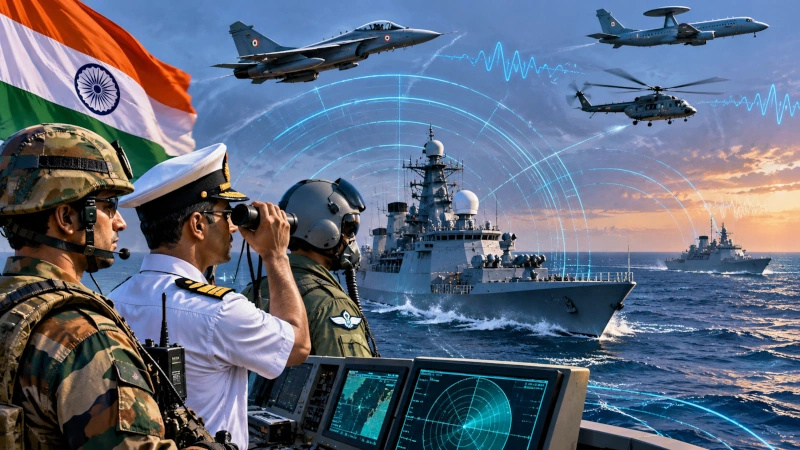
India’s Armed Forces have successfully completed the maritime phase of a Tri-Service Electronic Warfare Exercise, validating integrated electronic warfare capabilities involving the Indian Army, Indian Navy and Indian Air Force. The exercise represents an important development in strengthening joint operational preparedness and the ability of the three services to conduct coordinated operations in the electromagnetic environment during maritime missions.
Headquarters Integrated Defence Staff (HQ IDS) announced the successful completion of the maritime phase on November 7, 2026. The exercise was witnessed by the Chief of Defence Staff (CDS), the Chief of Integrated Defence Staff to the Chairman Chiefs of Staff Committee (CISC), and other senior defence officials. The official announcement confirmed that all three services had participated in validating integrated electronic warfare capabilities at sea.
The exercise highlights the increasing importance of electromagnetic spectrum operations in modern warfare, where detecting, protecting and managing electronic communications, radar emissions and other electromagnetic signals have become essential to military effectiveness. By bringing together capabilities from the Army, Navy and Air Force, the exercise demonstrated India’s emphasis on coordinated operations across different military domains.
Tri-Service Electronic Warfare Capabilities Validated at Sea
According to Headquarters Integrated Defence Staff, the maritime phase of the exercise was conducted successfully, with the three services validating their ability to undertake integrated electronic warfare operations in the maritime domain. The exercise brought together capabilities associated with different operating environments, demonstrating the importance of coordinated military action in situations where electronic systems play a decisive operational role.
Electronic warfare involves the military use of electromagnetic energy to identify, monitor, protect against or interfere with electronic systems employed by an adversary. These operations can include detecting radar transmissions, monitoring electromagnetic activity, protecting communication networks and employing electronic countermeasures against hostile systems.
In a maritime environment, electronic warfare assumes particular importance because naval operations depend heavily on radar, communications, surveillance equipment and electronically guided weapon systems. Coordinated electronic warfare activities can improve situational awareness while helping military forces protect their own systems against electronic interference and hostile detection.
The successful validation of integrated capabilities therefore represents an important contribution to the Armed Forces’ preparedness for contemporary maritime operations. The exercise also reinforces the operational value of bringing together specialised capabilities from different services under a coordinated command and control framework.
Strengthening Joint Operations Across the Three Services
One of the significant aspects of the exercise was the participation of the Indian Army, Indian Navy and Indian Air Force in a common electronic warfare activity at sea. Each service operates electronic systems designed for its particular operational environment, ranging from land-based surveillance and communications equipment to airborne sensors and naval electronic warfare platforms.
Integrating such capabilities requires effective communication, coordination and a shared understanding of the electromagnetic environment. Information obtained through electronic surveillance can contribute to a broader operational picture, enabling commanders to assess potential threats and coordinate appropriate responses across participating forces.
The maritime phase provided an opportunity to validate this integrated approach within a naval operational setting. It also highlighted the importance of interoperability, allowing different military organisations to employ their capabilities in support of common operational objectives rather than functioning as separate entities.
The involvement of senior military leadership, including the CDS and CISC, underscored the importance attached to joint operations and the continued development of integrated military capabilities. These efforts form part of India’s wider emphasis on improving coordination among the three services and strengthening the effectiveness of joint military operations.
Electronic Warfare and the Changing Nature of Naval Combat
Modern naval warfare increasingly depends on the ability to operate effectively within a contested electromagnetic environment. Warships, maritime patrol aircraft, helicopters, unmanned systems and coastal defence installations employ electronic sensors and communication systems to monitor surrounding areas, identify threats and coordinate military responses.
An adversary attempting to disrupt these systems may employ electronic jamming, deception, interference or other electronic warfare techniques. Such activities can affect communications, radar performance, navigation and the exchange of operational information between military platforms.
Effective electronic warfare capabilities help counter these challenges by supporting electromagnetic surveillance, electronic protection and, where operationally authorised, electronic attack. They also contribute to the ability of naval forces to identify potentially hostile activity without relying exclusively on conventional visual or radar surveillance methods.
For India, which maintains extensive maritime interests across the Indian Ocean Region, strengthening electronic warfare preparedness is an important element of naval operational effectiveness. The ability to coordinate electronic warfare activities between naval, air and land-based forces can support maritime domain awareness, coastal security and the protection of military assets operating at sea.
The latest exercise reflects this broader operational requirement by placing integrated electronic warfare capabilities within a tri-service maritime framework.
Importance of Electromagnetic Spectrum Operations
The electromagnetic spectrum has become an important operational domain in contemporary military planning. Radar systems, tactical communication networks, satellite links, navigation equipment and many advanced weapon systems depend on access to different parts of the spectrum.
Military effectiveness therefore requires more than possessing advanced electronic equipment. Armed Forces must also understand the electromagnetic environment, coordinate the use of their own systems and maintain operational continuity when confronted with interference or attempts to disrupt electronic communications.
Integrated electronic warfare operations help address these requirements by enabling participating forces to develop a coordinated approach to electromagnetic surveillance, protection and countermeasures. Such coordination is particularly important during joint missions involving multiple platforms operating simultaneously across land, sea and air.
The maritime phase of the Tri-Service Electronic Warfare Exercise demonstrated the Armed Forces’ focus on developing this integrated approach. It also highlighted the importance of electronic warfare in supporting traditional military capabilities, including maritime surveillance, air defence, surface operations and coordinated command and control.
The official announcement did not disclose the specific electronic warfare equipment, participating naval platforms, operational scenarios or technical parameters evaluated during the exercise. The confirmed achievement was the successful validation of integrated electronic warfare capabilities involving the three services in a maritime environment.
Advancing India’s Joint Military Preparedness
India has been placing increasing emphasis on joint military planning and coordinated operational capabilities as part of the modernisation of its Armed Forces. The establishment of the Chief of Defence Staff and the continuing development of integrated defence structures have strengthened institutional mechanisms for cooperation among the Army, Navy and Air Force.
Joint exercises provide an important means of translating these organisational arrangements into operational practice. They allow participating forces to evaluate common procedures, identify coordination requirements and improve their ability to function together during complex military situations.
Electronic warfare is particularly well suited to such integration because electromagnetic activities can affect several operating domains simultaneously. A maritime mission may require coordination between naval platforms, airborne surveillance systems, coastal installations and other military assets, making the exchange of electronic information and the management of electromagnetic activity important components of operational planning.
The successful maritime validation demonstrates the emphasis being placed on these capabilities within India’s joint military preparedness. It also reflects the Armed Forces’ recognition that effective coordination in the electromagnetic environment is becoming as important as interoperability in conventional combat operations.
Strengthening Maritime Security Through Integrated Capabilities
The successful completion of the maritime phase of the Tri-Service Electronic Warfare Exercise marks another step in India’s efforts to strengthen joint operational capabilities and maritime preparedness. By validating electronic warfare operations involving all three services, the Armed Forces have demonstrated their focus on integrating specialised military capabilities within a common operational framework.
The exercise is significant because modern maritime security depends not only on warships, aircraft and conventional weapons, but also on the ability to monitor, protect and operate effectively across the electromagnetic spectrum. Coordinated electronic warfare capabilities provide an additional dimension to naval preparedness by supporting situational awareness, communication security and operational resilience.
As India continues to modernise its Armed Forces and strengthen joint operational structures, exercises of this nature contribute to the development of increasingly integrated military capabilities. The successful validation at sea reinforces the importance of electronic warfare as a fundamental component of India’s maritime defence preparedness and its ability to safeguard national interests across the maritime domain.
You may also like
-
India’s Railgun Programme: DRDO Advances Next-Generation Artillery Technology in Pune
-
Bharat Forge Receives Bulk Production Clearance for Indigenous ATAGS, Manufacturing to Begin in FY2026–27
-
Sigma Advanced Systems Reports ₹2,315 Crore Defence Orders in Artillery and Anti-Drone Technologies
-
BEL Begins Production Preparations for ₹30,000 Crore Indigenous QRSAM Programme
-
India, Philippines in Advanced Talks for $800 Million BrahMos Missile Deal
