GI Heritage of India Series | Maharashtra | Agricultural Geographical Indication
In the agricultural landscapes of Maharashtra’s Marathwada region, where generations of farmers have cultivated crops under the influence of the southwest monsoon, turmeric has emerged as an important source of livelihood and regional identity. Among the agricultural products associated with this region, Vasmat Haldi, also known as Basmat Turmeric, occupies a distinctive position because of its connection with the farming communities of Hingoli district and the extensive turmeric trade centred around Basmat.
Known locally as Halad, turmeric is deeply embedded in Maharashtra’s culinary traditions, religious ceremonies and agricultural economy. In Hingoli, however, its importance extends well beyond household consumption. The crop supports a network of farmers, agricultural traders, processors, transport operators and rural enterprises, contributing significantly to the district’s economic activities.
The recognition of Vasmat Haldi as a Geographical Indication (GI) on 30 March 2024 formally acknowledged its geographical identity and agricultural reputation. The registration placed it among Maharashtra’s recognised regional turmeric products, alongside Waigaon Turmeric from Wardha and Sangli Turmeric from western Maharashtra.
Historical Origins: Turmeric Cultivation in Marathwada
Turmeric has been cultivated in the Indian subcontinent since ancient times, acquiring importance as a culinary spice, ceremonial substance and ingredient in traditional systems of medicine. Its widespread use across different regions reflects the longstanding relationship between Indian agricultural practices and the cultural traditions surrounding cultivated plants.
In Maharashtra, turmeric became particularly important because of its extensive use in domestic cooking and religious ceremonies. The spice developed a strong association with auspicious occasions, marriage rituals, household worship and traditional preparations used for personal care.
The Marathwada region, historically associated with the Deccan and its changing political and commercial networks, developed agricultural systems adapted to seasonal rainfall and the availability of fertile cultivated soils. Turmeric became one of the commercial crops grown in suitable areas where farmers could maintain the moisture and soil conditions required for its development.
Hingoli’s agricultural history is closely associated with the wider farming traditions of Marathwada. The district was previously part of Parbhani district before being established as a separate administrative district in 1999. The cultivation and marketing of turmeric in the Basmat region therefore developed within a broader agricultural and commercial landscape that predates the present district boundaries.
Over successive generations, farmers in the Basmat region accumulated knowledge concerning rhizome selection, planting schedules, irrigation, harvesting and post-harvest processing. These practices helped establish turmeric as a recognised agricultural commodity and contributed to the development of regional trading networks.
Although the available official records establish the longstanding importance of turmeric cultivation in Hingoli, they do not identify a precise historical date for the beginning of Vasmat Haldi cultivation. Its heritage is consequently best understood through the continuity of regional agricultural practices, rather than through an unsupported claim of origin in a particular ancient dynasty.
Geographical Origin: The Turmeric-Growing Belt of Hingoli
Vasmat Haldi derives its name from the Basmat or Vasmat region of Hingoli district in Maharashtra. The area lies within Marathwada, a major agricultural region of the Deccan Plateau characterised by warm climatic conditions, seasonal monsoon rainfall and extensive cultivation of field and horticultural crops.
Basmat is one of the principal agricultural and commercial centres of Hingoli district. Its surrounding villages support the cultivation of turmeric alongside other important crops, including soybean, cotton, pulses and cereals.
The district’s agricultural environment is influenced by the southwest monsoon, which supplies much of the rainfall required for crop establishment and vegetative growth. Turmeric cultivation also depends on suitable irrigation facilities because the crop requires adequate soil moisture over a relatively long growing period.
The presence of black soils in substantial parts of Marathwada provides opportunities for cultivating a range of commercial crops. These soils possess moisture-retaining properties, although appropriate drainage is important for turmeric because prolonged waterlogging can damage underground rhizomes.
The geographical reputation of Vasmat Haldi is associated with the cultivation and marketing practices of the Basmat region. Its registered geographical identity should be understood according to the boundaries and product specifications recorded with India’s Geographical Indications Registry, rather than as a designation automatically covering every turmeric crop grown in Maharashtra.
Botanical Identity and Distinctive Characteristics
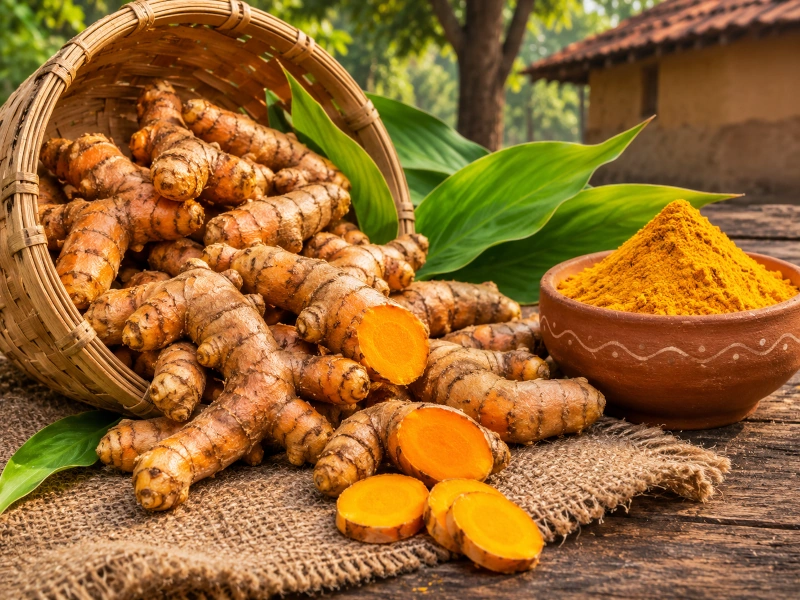
Vasmat Haldi belongs to the species Curcuma longa L., a perennial herbaceous plant of the family Zingiberaceae. The plant is cultivated primarily for its underground rhizomes, which contain the natural pigments and aromatic compounds responsible for turmeric’s characteristic colour, flavour and fragrance.
Botanical name: Curcuma longa L.
Family: Zingiberaceae
Common name: Turmeric
Marathi name: Halad
GI-registered name: Vasmat Haldi (Turmeric)
Principal geographical association: Basmat, Hingoli district, Maharashtra
The turmeric plant develops broad green leaves from an underground rhizome system consisting of a central mother rhizome and several lateral branches commonly described as fingers. These rhizomes form the commercially valuable portion of the crop and are harvested after the plants reach maturity.
Turmeric quality is assessed through several characteristics, including rhizome size, internal colour, aroma, curcumin concentration, moisture content and suitability for processing. These factors influence the commercial acceptance of dried turmeric fingers and ground turmeric powder.
The reputation of Vasmat Haldi is closely connected with the regional turmeric-growing environment and the established agricultural and commercial practices of the Basmat area.
It is important to distinguish the GI-registered product from individual turmeric cultivars. Different varieties of Curcuma longa may be cultivated in the wider Hingoli district, while the use of the protected geographical name is governed by the registered GI specifications.
Curcumin Content and Scientific Characteristics
Turmeric owes its familiar yellow-orange colour primarily to naturally occurring compounds known as curcuminoids. Curcumin is the best-known member of this group and is an important parameter in the scientific evaluation of turmeric quality.
A study published by the Indian Council for Research on International Economic Relations (ICRIER), titled Making India the Global Hub for Turmeric, reported a curcumin content of approximately 3.4% for Vasmat Haldi in its comparative assessment of GI-recognised turmeric products.
This figure provides a useful reference for understanding the chemical characteristics of turmeric marketed under the Vasmat name. However, the curcumin concentration of an agricultural product is not necessarily identical across all harvests, since it may vary according to cultivar, growing conditions, maturity, storage and processing.
The ICRIER study also compared Vasmat Haldi with several other GI-recognised turmeric products, including Erode Turmeric, Kandhamal Haladi, Lakadong Turmeric and Waigaon Turmeric.
Such comparisons demonstrate the diversity of India’s turmeric-growing regions. Different geographical areas produce turmeric with varying chemical and physical characteristics, providing opportunities for specialised cultivation, processing and quality-based marketing.
Apart from curcuminoids, turmeric contains volatile aromatic compounds that contribute to its characteristic fragrance. The proportions of these constituents can influence the flavour and sensory qualities of the dried spice.
Scientific evaluation of these characteristics is particularly important in commercial markets where buyers increasingly examine turmeric according to measurable quality parameters.
Climate, Soil and the Agricultural Environment
The agricultural conditions of Hingoli district are shaped by the seasonal climate of the Deccan Plateau. Summers are generally hot, while the southwest monsoon brings rainfall during the principal agricultural growing season.
Turmeric requires warm conditions and adequate moisture for healthy development. The crop performs particularly well in soils that allow underground rhizomes to expand while maintaining suitable moisture levels.
In the Basmat region, farmers cultivate turmeric under agricultural conditions influenced by monsoon rainfall and available irrigation infrastructure. Irrigation becomes particularly important during periods of insufficient rainfall and during the later stages of crop development.
Black soils are common across parts of Marathwada and contribute to the region’s agricultural productivity. Their capacity to retain moisture can be beneficial, although turmeric fields require proper drainage to prevent rhizome rot and other moisture-related problems.
Soil preparation is therefore an important aspect of cultivation. Farmers employ appropriate land preparation and planting arrangements to facilitate drainage, irrigation and underground rhizome development.
The interaction between these environmental conditions and established farming practices contributes to the agricultural identity of the Basmat turmeric-growing region.
Traditional Cultivation: From Rhizome to Harvest
Turmeric cultivation begins with the selection of healthy planting material. Unlike crops grown primarily from botanical seeds, turmeric is propagated vegetatively through pieces of underground rhizomes.
Farmers select suitable mother rhizomes or fingers from previous harvests, ensuring that the planting material possesses healthy buds capable of producing vigorous new plants.
The selected rhizomes are planted in prepared fields, commonly using ridges, furrows or raised beds according to soil conditions and irrigation arrangements.
Planting is generally aligned with the regional agricultural calendar, particularly the period surrounding the onset of the southwest monsoon. Where irrigation facilities are available, planting dates may be adjusted to suit local cultivation practices.
The crop requires careful management during its growing period. Adequate moisture encourages leaf development and the enlargement of underground rhizomes, while excessive water accumulation can adversely affect plant health.
Farmers use organic manure, balanced fertilisation and other soil management practices to maintain productivity. Weed control, disease management and suitable irrigation remain important throughout the growing season.
Turmeric generally requires several months to reach maturity, with the precise duration varying according to the cultivated variety and environmental conditions.
As the crop approaches maturity, its leaves begin to turn yellow and gradually dry. These visible changes indicate that the rhizomes have reached a stage suitable for harvesting.
The knowledge required to manage planting material, irrigation and crop maturity forms an important part of the agricultural expertise developed by turmeric-growing communities in Hingoli.
Harvesting, Curing and Traditional Processing
Harvesting turmeric requires careful removal of the underground rhizomes to minimise damage and preserve the quality of the crop.
Once the plants reach maturity, farmers lift the rhizomes from the soil and separate them from the remaining foliage and roots. The harvested material is cleaned to remove adhering soil and other impurities before further processing.
Fresh turmeric contains considerable moisture and cannot ordinarily be stored for extended periods in the same manner as properly dried turmeric. It therefore undergoes curing and drying to prepare the rhizomes for commercial storage and marketing.
Curing commonly involves boiling or steaming the cleaned rhizomes until they reach the appropriate degree of softness. This treatment helps develop the characteristic appearance of processed turmeric and prepares the material for drying.
After curing, the rhizomes are dried until their moisture content is sufficiently reduced. Traditional drying relies heavily on sunlight, although mechanical and improved drying methods can provide greater control over processing conditions.
The drying period depends on the size of the rhizomes, prevailing weather and the method employed. Proper drying is essential because excessive residual moisture can encourage spoilage during storage.
Once dried, the turmeric may be polished to remove rough outer surfaces and improve its commercial appearance. The rhizomes are then sorted and graded according to size, colour, cleanliness and other market requirements.
Finished turmeric may be sold as whole dried fingers, mother rhizomes or ground powder. These different commercial forms allow the crop to enter household markets, spice-processing enterprises and larger distribution networks.
Culinary Heritage: Turmeric in Maharashtrian Cuisine
Turmeric is one of the fundamental spices used in Maharashtrian cooking. Its distinctive colour and earthy aroma contribute to a wide variety of traditional preparations, ranging from everyday vegetable dishes to elaborate festive meals.
Known as Halad, turmeric is commonly incorporated into lentil preparations, vegetable curries, rice dishes, pickles and regional spice mixtures. Its colour gives many dishes their familiar golden appearance, while its flavour complements other ingredients used in Maharashtrian cuisine.
Turmeric is particularly important in the preparation of traditional dishes containing pulses and vegetables. It is often added during the initial stages of cooking, allowing its flavour and colour to become incorporated into the finished preparation.
Fresh turmeric rhizomes are also used in certain seasonal recipes and pickles, while dried turmeric powder remains the most familiar household form.
The spice’s culinary importance extends across the wider Deccan region, where it is used extensively in the cuisines of Maharashtra, Telangana and Karnataka.
For the turmeric-growing communities of Hingoli, the crop therefore connects agricultural production with a culinary tradition shared across much of India.
Cultural Significance: Halad in Maharashtrian Traditions
The cultural importance of turmeric in Maharashtra is particularly evident in marriage ceremonies, religious observances and traditional household practices.
The Halad ceremony is among the most recognisable rituals associated with Maharashtrian weddings. During this ceremony, turmeric paste is applied to the bride and groom as an expression of auspiciousness, prosperity and preparation for married life.
Turmeric also appears in ceremonial practices associated with household worship, seasonal festivals and important family occasions. Its golden colour has traditionally been associated with purity, prosperity and positive beginnings.
In certain religious traditions, turmeric is used in preparing ceremonial substances and in rituals associated with worship. Turmeric-coloured threads and other objects also feature in customary practices observed by different communities.
The cultural significance of turmeric is not confined to Maharashtra. Across India, the spice occupies an important place in religious symbolism, traditional medicine and household customs.
In Hingoli, where turmeric cultivation is economically important, these cultural associations add another dimension to the crop’s regional identity. Vasmat Haldi represents both an agricultural commodity and a continuation of the broader Indian tradition surrounding turmeric.
Turmeric in Ayurveda and Traditional Medicine
Turmeric has been incorporated into Indian medical traditions for centuries. In Ayurveda, it is known as Haridra and appears in numerous classical formulations and traditional preparations.
Ayurvedic literature describes turmeric in relation to several traditional uses, including digestive health, skin care and the management of certain inflammatory conditions. Turmeric has also been used in household preparations and customary personal-care practices.
Modern scientific research has examined curcumin and other turmeric constituents for their antioxidant activity and effects on biological pathways associated with inflammation.
These investigations have contributed to growing scientific interest in turmeric and its possible applications in food science, nutrition and pharmaceutical research.
However, the presence of curcumin in turmeric does not establish that ordinary dietary consumption can prevent or cure particular diseases. Traditional applications and modern clinical evidence must be considered separately when evaluating medicinal claims.
The scientific importance of Vasmat Haldi is consequently best understood through its agricultural characteristics, documented chemical composition and potential applications in food processing and further research.
Hingoli: An Important Centre of India’s Turmeric Economy
Hingoli has emerged as a prominent turmeric-producing and trading district in Maharashtra. Its agricultural economy is supported by extensive turmeric cultivation, processing activities and commercial relationships with buyers operating across different parts of India.
The Hingoli District Administration identifies turmeric as a major agricultural product and describes the district as an important centre of the national turmeric industry.
The district administration’s official profile also highlights the scale of turmeric cultivation and the contribution of turmeric trading and exports to the local economy.
Basmat plays an important role within this regional agricultural system. Farmers, traders, processors and warehouse operators participate in a commercial network through which harvested turmeric moves from agricultural fields to markets and processing establishments.
Turmeric trading supports several related activities, including transportation, drying, grading, storage, grinding and packaging. These services create economic opportunities beyond the cultivation of the crop itself.
The growth of organised marketing and processing facilities also creates opportunities for improving product quality and establishing stronger commercial relationships between farmers and buyers.
For the communities of Hingoli, turmeric therefore represents an important element of both agricultural production and regional economic development.
Agricultural Research and the Balasaheb Thackeray Haridra Research and Training Centre
The establishment of the Balasaheb Thackeray Haridra Research and Training Centre in the Basmat region marked an important development in the institutional support available to turmeric farmers.
According to the Hingoli District Administration, the centre was established in October 2022 to support research, training and the development of turmeric cultivation.
The institution maintains a collection of 36 turmeric varieties, including recognised types such as Salem, Pratibha and Phule Swaroopa.
The availability of different cultivars provides opportunities for studying characteristics such as crop duration, productivity, rhizome development, curcumin concentration and suitability for particular agricultural conditions.
Research into turmeric cultivation is especially important because farmers face several production challenges, including fluctuating rainfall, rhizome diseases, irrigation requirements and the cost of planting material.
Scientific guidance concerning soil management, disease prevention, efficient irrigation and improved processing methods can help farmers strengthen productivity and maintain consistent quality.
The research centre also represents an opportunity to connect traditional agricultural knowledge with modern scientific investigation.
Its involvement in the GI recognition process further illustrates the importance of institutional support in documenting and preserving regionally distinctive agricultural products.
The Journey Towards Geographical Indication Recognition
The formal process of securing GI recognition for Vasmat Haldi began with an application filed on 20 October 2021.
The application was submitted jointly by Kurundkar Farmers Producer Company Limited and Surya Farmers Producer Company Limited, both associated with the turmeric-producing region of Hingoli.
The application was assigned Number 785 under Class 31, covering agricultural goods.
The supporting documentation included information concerning the product’s geographical origin, historical background, cultivation practices and distinctive characteristics. These materials were examined as part of the registration process administered by India’s Geographical Indications Registry.
The application appeared in Geographical Indications Journal Number 185, with an official availability date of 29 November 2023.
Following the completion of the registration process, the Geographical Indications Registry issued Certificate Number 577 on 30 March 2024, formally recognising the product under the name Vasmat Haldi (Turmeric).
The registration was an important milestone for the farming communities of Hingoli. It provided formal recognition to the geographical reputation associated with turmeric cultivated in the Basmat region.
The official registration is valid until 19 October 2031, subject to the applicable renewal provisions under India’s Geographical Indications legislation.
GI Registration Details at a Glance
| Particular | Details |
|---|---|
| Registered GI name | Vasmat Haldi (Turmeric) |
| State | Maharashtra |
| District | Hingoli |
| Principal geographical association | Basmat/Vasmat region |
| Product category | Agricultural |
| Classification | Class 31 |
| Botanical species | Curcuma longa L. |
| Common Marathi name | Halad |
| GI application number | 785 |
| Applicants | Kurundkar Farmers Producer Company Limited and Surya Farmers Producer Company Limited |
| Application filing date | 20 October 2021 |
| GI Journal | Number 185 |
| Journal availability date | 29 November 2023 |
| GI certificate number | 577 |
| GI registration date | 30 March 2024 |
| Registration valid until | 19 October 2031 |
| Reported curcumin content | Approximately 3.4% |
| Important research institution | Balasaheb Thackeray Haridra Research and Training Centre |
| Commercial forms | Fresh rhizomes, dried turmeric fingers and turmeric powder |
The official registration establishes the product’s legal identity under India’s Geographical Indications framework. Its geographical scope and technical requirements are governed by the registered specifications and supporting documentation.
GI Protection and Regional Agricultural Identity
Geographical Indication recognition provides a legal framework for protecting products whose qualities, reputation or characteristics are associated with a particular geographical origin.
For Vasmat Haldi, this recognition strengthens the connection between the product’s name and the agricultural region from which it derives its identity.
The registration helps distinguish qualifying turmeric associated with the specified geographical area from products that may be marketed under the same name without satisfying the applicable requirements.
GI protection also creates opportunities for farmers and producer organisations to strengthen the commercial recognition of their agricultural products.
The participation of authorised users, producer organisations and quality-monitoring institutions can contribute to improved traceability and more reliable product identification.
These measures are important because the commercial value of a geographical name depends on maintaining the relationship between the recognised product and its actual place of origin.
By documenting this connection, GI recognition also contributes to the preservation of regional agricultural knowledge and the traditional practices associated with cultivation.
Economic Opportunities and Value Addition
The commercial importance of Vasmat Haldi extends beyond the sale of freshly harvested rhizomes.
Turmeric can be marketed in several forms, including dried fingers, graded whole rhizomes, processed powder and other appropriately manufactured spice products.
Value addition through cleaning, curing, drying, grading, grinding and packaging creates opportunities for local enterprises and farmer producer organisations to participate more directly in the agricultural value chain.
Improved processing infrastructure can help maintain product quality and reduce post-harvest losses. Hygienic drying facilities, suitable storage systems and modern grading equipment are particularly relevant to turmeric because the quality of the final product depends substantially on post-harvest handling.
Quality-based marketing also creates opportunities for producers to communicate the geographical identity and documented characteristics of Vasmat Haldi to buyers.
The presence of the Haridra Research and Training Centre in the region provides an additional institutional foundation for agricultural innovation and farmer training.
Together, research, processing and geographical identification can strengthen the position of Basmat’s turmeric producers within India’s wider spice economy.
Preserving Traditional Knowledge and Crop Diversity
The agricultural heritage of Vasmat Haldi is closely connected with the knowledge developed by farming families over successive generations.
Traditional cultivation requires an understanding of seasonal rainfall, planting material, soil moisture, crop maturity and post-harvest processing. These practices represent accumulated agricultural experience adapted to the conditions of the Marathwada region.
The preservation of suitable planting material is particularly important because turmeric is propagated through rhizomes. Farmers maintain continuity between growing seasons by selecting healthy rhizomes for subsequent cultivation.
Agricultural research can complement these practices through the evaluation of crop varieties, improved disease management and the development of more efficient cultivation methods.
The collection of turmeric varieties maintained by the Haridra Research and Training Centre provides opportunities to examine the diversity of cultivated turmeric and identify characteristics relevant to farmers.
The preservation of agricultural diversity is important for maintaining options in crop improvement, particularly under changing climatic and environmental conditions.
Vasmat Haldi consequently represents not only a commercial product but also part of a broader agricultural heritage involving local expertise, cultivated plant diversity and regional farming traditions.
Future Prospects: Strengthening Marathwada’s Turmeric Economy
The GI recognition of Vasmat Haldi provides opportunities to strengthen the relationship between agricultural production, regional identity and quality-based marketing.
Farmers and producer organisations can benefit from stronger product identification, improved traceability and the development of processing facilities capable of supplying consistently graded turmeric.
Research into crop productivity, disease management and irrigation efficiency can support more sustainable cultivation while helping farmers manage the challenges associated with seasonal rainfall.
The expansion of farmer training and access to suitable planting material can also contribute to improved crop quality and agricultural productivity.
Processing and marketing initiatives can encourage greater participation by local enterprises in the turmeric value chain, creating opportunities for employment and regional economic development.
The continued involvement of farmers, producer companies, research institutions and government agencies can help preserve the agricultural identity associated with Vasmat Haldi while supporting the development of Hingoli’s turmeric industry.
Vasmat Haldi: A Golden Symbol of Marathwada’s Agricultural Heritage
The story of Vasmat Haldi reflects the enduring relationship between agriculture, geography and regional economic identity.
From the fields of Basmat to the turmeric markets of Hingoli, the crop connects generations of farming knowledge with an extensive commercial network supporting cultivation, processing and trade.
Its importance in Maharashtrian cuisine, religious traditions and household practices adds a cultural dimension to an agricultural product already recognised for its economic significance.
The Geographical Indication recognition granted in March 2024 formally acknowledged this regional identity and created a framework for protecting the reputation associated with the product.
The presence of the Balasaheb Thackeray Haridra Research and Training Centre further demonstrates the importance of connecting traditional agriculture with scientific research and modern crop management.
Together, these developments highlight the potential of geographically identified agricultural products to preserve regional heritage while creating new opportunities for farming communities.
Vasmat Haldi stands as a golden expression of Maharashtra’s Marathwada region, where generations of agricultural knowledge, established trading traditions and modern scientific initiatives have combined to create a distinctive identity within India’s turmeric heritage.
References
- Geographical Indications Registry, Government of India: Vasmat Haldi (Turmeric), Application Number 785, Certificate Number 577, registered on 30 March 2024.
- Office of the Controller General of Patents, Designs and Trade Marks: Geographical Indications Journal Number 185, dated 29 November 2023.
- Geographical Indications Registry: Original application and supporting documents submitted by Kurundkar Farmers Producer Company Limited and Surya Farmers Producer Company Limited on 20 October 2021.
- District Administration, Hingoli, Government of Maharashtra: Turmeric Capital of India, official district profile and information concerning Vasmat Haldi.
- District Administration, Hingoli: Balasaheb Thackeray Haridra Research and Training Centre, establishment and agricultural research activities.
- Agricultural and Processed Food Products Export Development Authority (APEDA): Maharashtra Geographical Indications, Vasmat Haldi registration details.
- Indian Council for Research on International Economic Relations (ICRIER): Making India the Global Hub for Turmeric, comparative analysis of India’s GI-recognised turmeric products, curcumin content and agricultural value chains.
- Tamil Nadu Agricultural University: Agritech Portal, turmeric cultivation, plant characteristics, processing and post-harvest management.
- Geographical Indications of Goods (Registration and Protection) Act, 1999: Government of India.
You may also like
-
Tata Power Renewables Commissions 100.8 MW Wind Energy Project in Maharashtra
-
Hindustan Zinc Approves ₹80,000 Crore Expansion to Nearly Double Metal Production Capacity
-
Cochin Shipyard Signs MoU with Netherlands’ Damen Shipyards for Future Shipbuilding Projects
-
India Joins US and Eight Nations in Declaration to Secure AI Supply Chains
-
India’s PLI Schemes Achieve 76% of Investment Target and 64% of Production Goal
