Warcraft in the Puranas Series | Mārkaṇḍeya Purāṇa — Devī Māhātmya, Chapters 9–10
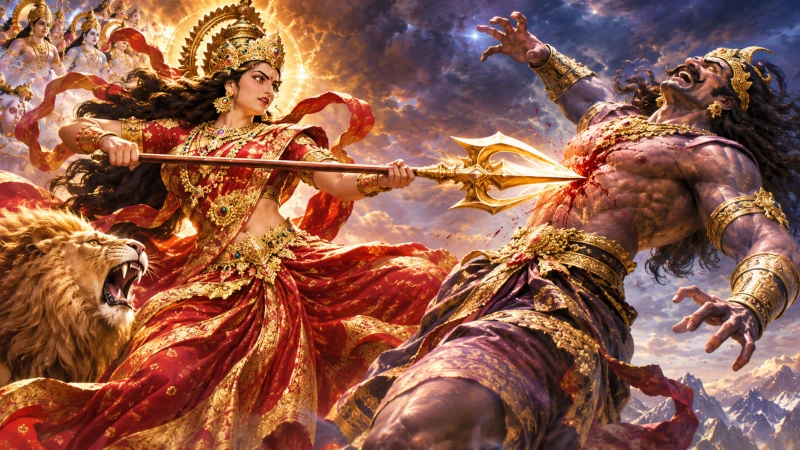
The final confrontation between Goddess Durgā and Śumbha represents one of the most extraordinary episodes of individual combat described in the Purāṇic tradition. After the destruction of enormous armies, the defeat of powerful commanders, and the deaths of formidable warriors including Caṇḍa, Muṇḍa, Raktabīja and Niśumbha, the conflict reaches its decisive conclusion in a direct encounter between the Goddess and the surviving ruler of the Asuras. What follows is not merely another exchange of celestial weapons, but a remarkable progression through missile warfare, the destruction of individual weapons, close combat, and an aerial struggle that culminates in Śumbha’s death.
The tenth chapter of the Devī Māhātmya, contained in the Mārkaṇḍeya Purāṇa, presents this encounter as the culmination of a prolonged campaign against the forces that had displaced the Devas from their rightful positions. From the standpoint of military interpretation, the episode explores several enduring principles of warfare: the consequences of losing experienced commanders, the importance of neutralising an adversary’s weapons, the ability to adapt when combat conditions change, and the necessity of defeating the central authority sustaining an aggressive campaign.
The Strategic Crisis: Śumbha’s Army Reaches the Point of Collapse
By the time Śumbha personally confronts the Goddess, the military system supporting his supremacy has suffered a succession of devastating defeats. Dhūmralocana has been destroyed, Caṇḍa and Muṇḍa have fallen, and Raktabīja’s extraordinary ability to multiply himself through spilled blood has been overcome through a coordinated intervention by the Goddess and Kālī. These victories have systematically eliminated some of the most formidable combatants available to the Asura leadership.
The death of Niśumbha, described in the ninth chapter, represents an especially significant loss. As Śumbha’s brother and principal companion in conquest, Niśumbha is more than another battlefield commander. His destruction removes a powerful figure from the Asura leadership at a moment when the wider army is already suffering enormous casualties. The tenth chapter opens with Śumbha witnessing his brother’s death and the continuing destruction of his forces, circumstances that provoke him into a furious confrontation with Durgā.
From a strategic perspective, Śumbha’s position has become increasingly precarious. His military strength has been reduced, his principal commanders have been eliminated, and the campaign has shifted from offensive domination to a desperate struggle to preserve his own supremacy. Although the scripture does not describe a formal command structure or detailed battlefield dispositions at this stage, the repeated destruction of senior warriors provides a clear narrative of progressive military disintegration.
Śumbha’s Challenge: An Attempt to Question the Goddess’s Strength
Rather than immediately beginning the final engagement, Śumbha attempts to undermine the legitimacy of the Goddess’s victories. He accuses Durgā of displaying arrogance despite depending upon the assistance of other goddesses. His accusation focuses on the presence of the divine powers that had fought beside her throughout the preceding battles.
The challenge introduces a psychological dimension to the encounter. Śumbha seeks to portray the Goddess’s collective strength as evidence of personal weakness, suggesting that her achievements cannot be attributed to her own capabilities. In military terms, this resembles an attempt to diminish an opponent’s battlefield reputation by questioning the source of their effectiveness.
The Goddess responds by revealing the fundamental nature of the powers that had accompanied her. She declares that she alone exists and that the other goddesses are manifestations of her own divine energy. Brahmāṇī and the other divine forms then merge into her body, leaving Ambikā standing alone before Śumbha.
This moment carries profound theological significance within the Devī Māhātmya. The apparently separate divine powers are revealed as expressions of one supreme Śakti. From a military-analytical standpoint, the scene can also be understood as a dramatic demonstration of unified capability. The Goddess does not lose her power when the other forms disappear; their withdrawal reveals that the strength previously displayed through multiple manifestations originates from a single source.
The Opening Engagement: Celestial Weapons and Counter-Weapons
With the divine manifestations withdrawn, the battle begins before the assembled Devas and Asuras. The scripture describes a terrifying exchange involving showers of arrows, sharp weapons and powerful celestial missiles. Both combatants demonstrate extraordinary offensive capabilities, and neither initially secures an immediate advantage.
The Goddess launches hundreds of divine weapons against Śumbha, but the Asura ruler counters them with weapons capable of neutralising their effects. Śumbha then releases his own celestial missiles, which the Goddess destroys through fierce utterances and manifestations of divine power. The engagement therefore begins with an exchange of attacks and countermeasures rather than an immediate physical confrontation.
This opening phase is particularly interesting from the perspective of warfare because it emphasises the relationship between offensive weapons and defensive responses. Both combatants possess powerful means of attack, but the effectiveness of those weapons depends upon whether they can penetrate the opponent’s defences.
The narrative illustrates a principle familiar to military strategy: the possession of formidable offensive capabilities does not automatically guarantee battlefield superiority when an adversary possesses effective countermeasures. The celestial weapons belong to the sacred narrative, but the underlying relationship between attack, interception and adaptation provides a useful framework for understanding the engagement.
The Destruction of Śumbha’s Weapons: Systematic Reduction of Combat Capability
As the battle intensifies, Śumbha attempts to overwhelm the Goddess with hundreds of arrows. Durgā responds by cutting his bow with her own arrows, depriving him of his principal ranged weapon. Śumbha immediately takes up a spear, but the Goddess destroys it with her discus before he can employ it effectively.
Undeterred, Śumbha draws his sword and takes up a magnificent shield adorned with the brilliance of a hundred moons. He advances towards the Goddess, seeking to close the distance and engage her directly. Caṇḍikā responds with accurate archery, cutting apart both the sword and the shield as he approaches.
The loss of these weapons significantly changes the character of the encounter. Śumbha has already been deprived of his bow and spear, and his attempt to transition into sword combat has now been defeated. The scripture also describes him as having lost his horses and charioteer, further reducing the advantages associated with his original mode of fighting.
Śumbha next seizes a formidable mace and advances once again. The Goddess destroys this weapon with sharp arrows, leaving the Asura ruler without the successive weapons he has attempted to employ.
The sequence demonstrates an important battlefield principle: defeating an opponent does not always require immediately striking the opponent’s body. The progressive destruction of weapons, protective equipment and supporting assets can reduce combat effectiveness until the adversary is forced into an increasingly disadvantageous position.
In this episode, the Goddess repeatedly prevents Śumbha from exploiting the capabilities associated with his chosen weapons. Her responses are not identical in every engagement; she employs arrows against the bow, sword, shield and mace, while using her discus against the spear. The narrative thereby presents a succession of weapon-specific countermeasures that steadily narrow Śumbha’s available options.
Close Combat: Śumbha Abandons His Weapons
Despite the destruction of his weapons, Śumbha refuses to withdraw. He rushes towards the Goddess with his fist raised, abandoning the exchange of missiles and conventional weapons for direct physical combat. The transition marks another important change in the battle, as the conflict moves from armed engagement to a contest of bodily strength.
Śumbha strikes the Goddess upon the chest with his fist. She immediately retaliates with a powerful blow from her palm, striking him in the chest and throwing him to the ground. The Asura ruler nevertheless rises again, demonstrating remarkable determination even after suffering repeated defeats.
This phase highlights the resilience of Śumbha as an individual warrior while also revealing the deteriorating nature of his position. He continues to attack with extraordinary aggression, but the initiative increasingly belongs to the Goddess. Every attempt to regain an advantage has been met with an effective response, forcing him to rely upon progressively fewer means of attack.
The confrontation also illustrates the distinction between determination and tactical superiority. Śumbha’s willingness to continue fighting is undeniable, but persistence alone cannot overcome an adversary who repeatedly neutralises his attacks and maintains control over the engagement.
The Celestial Duel: Combat Moves into the Sky
The most extraordinary phase of the battle begins when Śumbha suddenly seizes the Goddess and leaps high into the sky. The conflict, which has already passed through several stages of weapon-based fighting, now moves into an aerial environment where the two combatants engage in direct physical struggle.
The Devī Māhātmya specifically states that Caṇḍikā fights in the sky without any support. This detail distinguishes the encounter from ordinary descriptions of warriors fighting from chariots, riding celestial mounts or exchanging missiles across great distances. The Goddess and Śumbha wrestle directly in midair, astonishing the Siddhas and sages who witness the confrontation.
The passage is one of the most remarkable descriptions of celestial combat in the Purāṇic tradition. Rather than presenting aerial warfare as an exchange between flying vehicles or missile-bearing platforms, the text depicts two supernatural combatants exercising their powers in an environment beyond the limitations of ordinary human warfare.
From an analytical standpoint, the change of environment introduces another dimension to the struggle. Śumbha attempts to alter the conditions of combat by carrying the Goddess into the sky, potentially seeking an advantage through a sudden change in the nature of the engagement. Yet Caṇḍikā remains fully capable of fighting under these new circumstances, denying him any decisive benefit from the transition.
The episode therefore offers a powerful illustration of adaptability. An effective combatant must remain capable of responding when the enemy changes the environment, method or intensity of the engagement. The Goddess demonstrates complete command of the confrontation even after the battle has moved from the ground into the heavens.
The Decisive Turning Point: Śumbha Is Hurled to Earth
The aerial struggle continues for an extended period before the Goddess finally gains control over her opponent. She lifts Śumbha, whirls him around and throws him violently towards the earth. The action ends the aerial phase of the encounter and returns the combatants to the ground.
Śumbha survives the fall and once again charges towards Caṇḍikā with his fist raised. Even after losing his army’s principal commanders, his weapons, his supporting battlefield assets and the aerial struggle, he continues his attempt to destroy the Goddess.
The final attack, however, provides no opportunity for recovery. As Śumbha advances, the Goddess pierces him in the chest with her śūla, the divine spear or trident described in the text. The blow throws him to the ground, where he falls lifeless. The scripture describes his final collapse as shaking the earth together with its oceans, islands and mountains.
The decisive strike concludes the battle through the destruction of the surviving Asura ruler. Unlike the earlier stages of the campaign, which required the defeat of numerous commanders and the neutralisation of exceptional battlefield abilities, the final encounter centres upon a single opponent whose death ends the immediate conflict.
From a strategic perspective, the outcome demonstrates the importance of decisive action after an adversary’s combat capabilities have been progressively reduced. The Goddess does not merely repel Śumbha’s attacks or force him to retreat. She brings the engagement to a definitive conclusion, eliminating the central figure responsible for the campaign against the Devas.
The Military Principle: Neutralising Capabilities Before Delivering the Decisive Blow
The battle against Śumbha is especially valuable for military interpretation because of its clearly identifiable progression. The Goddess first demonstrates that her apparently separate supporting powers originate from a unified source. She then withstands celestial missile attacks, neutralises successive weapons, defeats the Asura ruler in close combat, adapts to an aerial engagement and finally delivers the decisive strike.
This sequence illustrates the relationship between combat capability, tactical adaptation and battlefield initiative. Śumbha repeatedly attempts to introduce a new weapon or method of attack, but the Goddess prevents him from translating those changes into a sustainable advantage. Each unsuccessful transition reduces his practical options while strengthening her control over the engagement.
An important distinction must nevertheless be maintained between the scriptural account and modern military interpretation. The Devī Māhātmya describes a supernatural confrontation involving divine manifestations, celestial missiles and aerial wrestling. It does not present a technical manual prescribing sequential disarmament or formal doctrines of aerial combat. The military lessons arise from analysing the narrative’s progression, rather than treating its extraordinary events as descriptions of historically verifiable warfare.
Modern Military Parallel: Countermeasures, Adaptability and Decisive Engagement
Modern warfare provides several useful parallels to the principles illustrated by this episode. Contemporary military operations increasingly involve layered systems of attack and defence, in which the effectiveness of missiles, aircraft, armoured vehicles and other weapons depends upon their ability to overcome opposing countermeasures. A technically powerful weapon may become ineffective when an adversary possesses the means to detect, intercept or neutralise it.
The destruction of Śumbha’s successive weapons offers a conceptual comparison with the systematic reduction of an adversary’s operational capabilities. Modern military forces may seek to suppress air defences, disrupt communications, neutralise weapons platforms or restrict mobility before undertaking decisive operations. Although the technological circumstances are entirely different, the common strategic principle lies in reducing the opponent’s available means of resistance.
The aerial confrontation introduces a second parallel involving adaptability across changing combat environments. Modern armed forces must coordinate capabilities across land, air, sea, space and the electromagnetic spectrum. An opponent may attempt to shift the conflict into an environment where it expects to possess an advantage, making adaptability and the preservation of operational effectiveness essential qualities.
The final confrontation also underlines the relationship between tactical success and strategic objectives. Destroying individual weapons or defeating isolated units does not necessarily end a conflict. Decisive results require military operations to achieve the broader purpose for which they were undertaken. In the Devī Māhātmya, that purpose is the defeat of the Asura power that has overturned the rightful order of the three worlds.
The Restoration of Dharma: Victory Beyond the Battlefield
The death of Śumbha produces consequences extending far beyond the immediate battlefield. The Devī Māhātmya describes the disappearance of disturbing celestial omens, the clearing of the sky and the return of rivers to their natural courses. The Devas rejoice, Gandharvas sing, Apsarases dance, and the atmosphere becomes peaceful once again.
These descriptions establish that the significance of the Goddess’s victory is not confined to the destruction of a powerful enemy. The defeat of Śumbha represents the restoration of cosmic harmony after a prolonged period of disorder and oppression. The conflict has been fought not for territorial expansion or personal ambition, but to end a condition in which the rightful balance of existence has been disrupted.
This distinction is central to understanding the dharmic character of warfare in the narrative. The Goddess possesses overwhelming power, yet that power is exercised to overcome destructive domination and restore stability. Her victory demonstrates that the highest purpose of righteous force is not the perpetuation of conflict, but the establishment of conditions in which peace and order can prevail.
One of the Greatest Warcraft Moments in the Puranas
The final duel between Devī and Śumbha stands among the most dramatic battle narratives of the Devī Māhātmya because it combines a prolonged military campaign with an extraordinary individual confrontation. The progressive destruction of the Asura commanders establishes the strategic setting, while the final engagement demonstrates the Goddess’s ability to counter every weapon and method employed against her.
The encounter moves through distinct phases of combat, beginning with celestial missiles and progressing through the destruction of weapons, unarmed fighting and an astonishing aerial struggle. At every stage, Śumbha attempts to recover the initiative, but the Goddess responds with superior adaptability and control. His final defeat brings the entire campaign to its conclusion.
The enduring military lesson of this Purāṇic episode lies in the relationship between strength, adaptability and decisive action. Superior capability is demonstrated not simply through the possession of powerful weapons, but through the ability to overcome changing threats, deny the adversary effective options and achieve the ultimate objective of the conflict.
Above all, the battle expresses the central message of the Devī Māhātmya: divine power manifests in many forms, but its purpose remains unified. The destruction of Śumbha is therefore both a magnificent celestial victory and a profound affirmation that the restoration of Dharma is the highest purpose of righteous strength.
References
Primary text: Mārkaṇḍeya Purāṇa, Devī Māhātmya, Chapter 10 — Śumbhavadha (The Slaying of Śumbha).
Chapter 9: The death of Niśumbha and the destruction of the remaining Asura forces establish the immediate context of the final battle.
Chapter 10, Verses 2–8: Śumbha challenges the Goddess, who withdraws the divine manifestations into herself.
Chapter 10, Verses 10–19: The exchange of celestial weapons and the systematic destruction of Śumbha’s bow, spear, sword, shield and mace.
Chapter 10, Verses 20–25: Close combat, the ascent into the sky, and the aerial wrestling encounter.
Chapter 10, Verses 26–28: Śumbha’s final charge and death at the hands of the Goddess.
Chapter 10, Verses 29–32: The restoration of peace and cosmic harmony following Śumbha’s destruction.
Editorial note: This article examines a sacred Purāṇic narrative through the interpretive framework of military strategy. Its modern parallels explain conceptual similarities and do not imply that the supernatural combat described in the scripture constitutes a documented historical military engagement.
You may also like
-
Lakṣmaṇa’s Mission to Kiṣkindhā: Enforcing Alliance Commitments Without Breaking the Partnership
-
The Coronation of Sugrīva: Political Legitimacy and the Responsibilities of an Alliance
-
The Battle Against Raktabīja: Battlefield Proliferation, Tactical Adaptation and Kālī’s Decisive Countermeasure
-
The Rāma–Sugrīva Alliance: How Mutual Interests Created a Strategic Partnership
-
UNESCO Recognises Mahabharata, Arthashastra and Rajatarangini Manuscripts, Taking India’s Asia-Pacific Heritage
