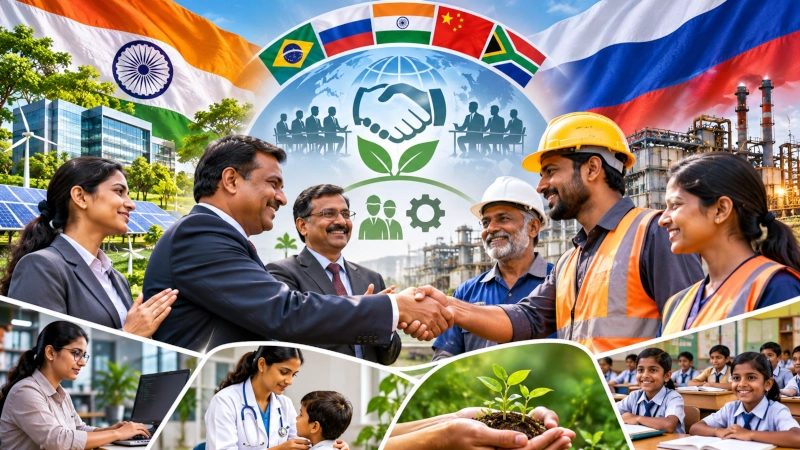
India’s efforts to promote responsible business practices, strengthen workers’ welfare and encourage sustainable corporate development have received international attention, with Russian researchers highlighting the country’s emerging model of cooperation between employers, trade unions and government institutions. A new study examining responsible business practices across BRICS countries has identified India’s joint roadmap for responsible business conduct as an important initiative aimed at improving employment conditions, expanding social protection and integrating ethical business principles into corporate operations.
The assessment forms part of the Digest of Responsible Business Conduct in BRICS Countries, prepared by the Responsible Business Laboratory at Russia’s National Research University Higher School of Economics in collaboration with the D. I. Mendeleev Institute for Demographic Policy. The research examines how major emerging economies are incorporating social responsibility, environmental sustainability and employment-related considerations into their business development frameworks.
The Russian researchers have drawn particular attention to India’s approach, which combines statutory corporate social responsibility obligations with voluntary cooperation between employers and workers. The study also examines how responsible business practices are extending beyond large corporations to micro, small and medium enterprises, reflecting the increasing importance of inclusive economic development within India’s expanding industrial and entrepreneurial ecosystem.
Indian Employers and Trade Unions Establish Joint Roadmap
A central feature of the Russian assessment is India’s Bipartite Roadmap on Responsible Business Conduct for Decent Work, formally launched on January 29, 2026, following a year-long consultation process facilitated by the International Labour Organization.
The initiative brought together leading employers’ associations and workers’ organisations to identify common priorities for improving business practices and employment conditions. The consultations were designed to establish a shared framework through which companies and workers could cooperate on issues affecting workplace standards, social protection and sustainable industrial development.
The roadmap emerged from a series of discussions conducted during 2025, including capacity-building workshops for trade unions and employers’ organisations. These consultations examined international labour standards, responsible business principles and the practical challenges faced by enterprises operating within increasingly complex domestic and international supply chains.
An important milestone was reached on September 11, 2025, when representatives of seven employers’ organisations and seven workers’ organisations participated in a structured dialogue that produced agreement on a draft roadmap. The document subsequently received support from participating organisations before its formal launch in January 2026.
The initiative represents a collaborative approach to responsible business conduct, recognising that improvements in workplace standards and sustainable business practices require cooperation between enterprises, employees and relevant institutions.
Seven Priorities Address Employment and Sustainable Development
The roadmap highlighted in the Russian research identifies seven broad areas for coordinated action, encompassing employment conditions, workplace safety, social dialogue, social protection, environmental responsibility, adaptation to technological change and community development.
Fair remuneration and decent working conditions form an important part of the framework. These principles recognise the importance of ensuring that economic expansion is accompanied by appropriate employment standards and opportunities for workers to participate in productive and secure employment.
Occupational safety and health constitute another priority, reflecting the need for businesses to maintain safe working environments and reduce workplace hazards. These considerations are especially relevant to manufacturing, construction, mining, logistics and other sectors involving substantial physical and industrial activity.
The roadmap also emphasises dialogue between employers and employees, encouraging cooperation in addressing workplace concerns and improving labour relations. The expansion of social protection forms a related priority, with attention to improving access to benefits and safeguards for workers across different categories of employment.
Environmental responsibility and adaptation to the digital economy are increasingly important components of the initiative. Businesses are encouraged to consider the environmental consequences of their activities while preparing employees for technological changes affecting industrial production, business services and employment requirements.
The framework additionally recognises the relationship between enterprises and the communities in which they operate. By encouraging engagement with local populations and supporting socioeconomic development, responsible business practices can contribute to improvements extending beyond individual workplaces.
International Labour Organization Recognises India’s Collaborative Approach
The International Labour Organization has acknowledged the development of India’s Bipartite Roadmap as an important example of cooperation between employers’ and workers’ organisations.
On February 18, 2026, the roadmap was presented in the presence of ILO Director-General Gilbert F. Houngbo, providing international recognition to the collaborative process undertaken by Indian social partners.
The ILO emphasised that the initiative had emerged through sustained dialogue and identified practical measures for promoting responsible business conduct across enterprises and their supply chains.
The roadmap is intended to support capacity-building activities, institutional dialogue and policy advocacy aimed at translating responsible business principles into practical workplace improvements.
The initiative also recognises the importance of extending responsible business practices to smaller enterprises, which account for a substantial share of economic activity and employment in India.
By encouraging cooperation across enterprises of different sizes, the roadmap seeks to make responsible business conduct a broader component of economic development rather than an activity confined to large corporations.
India’s Corporate Social Responsibility Framework Attracts Attention
The Russian study also highlights India’s statutory framework for corporate social responsibility, established under Section 135 of the Companies Act, 2013.
India was among the first countries to introduce a comprehensive legislative requirement for qualifying companies to allocate a prescribed share of their profits towards corporate social responsibility activities.
Under the framework, companies meeting specified financial thresholds are required to comply with CSR provisions. These include companies with a net worth of at least ₹500 crore, annual turnover of at least ₹1,000 crore or net profit of at least ₹5 crore during the immediately preceding financial year.
Qualifying companies are generally required to spend at least 2% of their average net profits from the three immediately preceding financial years on eligible CSR activities, calculated according to the applicable provisions of the Companies Act.
The legislation also establishes requirements relating to corporate governance, CSR policies, reporting and the treatment of unspent CSR amounts. Provisions concerning the constitution of CSR committees apply according to the statutory criteria.
The framework has created a structured mechanism through which qualifying businesses contribute financial resources towards activities such as education, healthcare, environmental sustainability, rural development and other eligible social initiatives.
The Russian researchers identified this statutory approach as a distinctive feature of India’s responsible business model, particularly when compared with systems that rely more extensively on voluntary corporate commitments.
Responsible Business Practices Extend Beyond Large Corporations
The Russian assessment draws attention to an important evolution in India’s responsible business landscape: the increasing emphasis on extending good business practices to smaller enterprises and supply chains.
Historically, formal CSR programmes were associated primarily with large corporations possessing the financial resources and organisational structures required to undertake substantial social development initiatives.
However, responsible business conduct encompasses a broader set of principles than statutory CSR expenditure. It includes employment conditions, worker safety, business relationships, environmental management and the social consequences of commercial activities.
The Bipartite Roadmap seeks to extend these principles to micro, small and medium enterprises, recognising their importance in India’s manufacturing, services and employment sectors.
Smaller businesses frequently operate as suppliers, contractors and service providers to larger enterprises. Improvements in workplace standards and responsible business practices across these supply chains can therefore contribute to the wider effectiveness of corporate responsibility initiatives.
The roadmap’s emphasis on capacity building and institutional cooperation is intended to help participating organisations develop practical approaches suited to enterprises with different levels of resources and operational complexity.
This broader framework complements India’s statutory CSR system by encouraging responsible conduct as part of everyday business operations.
Employment Generation and Formalisation Support Responsible Growth
The Russian study also examines India’s efforts to encourage formal employment through government initiatives designed to support workers and employers.
Among the programmes highlighted is the Pradhan Mantri Viksit Bharat Rozgar Yojana, an employment-linked incentive scheme with an approved financial outlay of ₹99,446 crore.
The programme aims to facilitate the creation of more than 3.5 crore employment opportunities over two years, with particular attention to first-time entrants into the formal workforce.
Under the scheme, eligible first-time employees registered with the Employees’ Provident Fund Organisation can receive financial incentives linked to their wages, subject to prescribed conditions. Employers can also receive incentives for creating additional employment and maintaining eligible workers in sustained employment.
The programme places particular emphasis on manufacturing, where eligible employers can receive extended support for additional employment generation.
The scheme complements the broader responsible business agenda by encouraging formal employment arrangements and supporting the expansion of social security coverage.
While employment incentives and responsible business conduct operate through different mechanisms, both address the relationship between economic growth, workforce participation and improvements in employment conditions.
Russian Study Highlights Corporate Contribution to Community Development
The BRICS responsible business digest also examines examples of corporate initiatives undertaken by Indian companies to support communities surrounding their operations.
One example highlighted in the Russian assessment is JK Tyre, the Indian tyre manufacturer that undertakes corporate social responsibility programmes involving healthcare and education.
According to information cited in the study, the company’s social initiatives reached more than 130,000 people during the latest reporting year covered by the research.
Such programmes illustrate how corporate social responsibility expenditure can support development activities in communities associated with industrial operations.
For companies operating manufacturing facilities across different regions, local engagement can involve education, healthcare, environmental programmes and other initiatives intended to address community requirements.
These activities represent one aspect of responsible business practice, complementing measures undertaken within enterprises to improve employment conditions and workplace standards.
The inclusion of Indian corporate examples in the Russian research demonstrates international interest in how businesses combine commercial operations with social development initiatives.
India’s Experience Examined Alongside Other BRICS Economies
The Russian study places India’s responsible business framework within a broader comparison of practices across major BRICS economies.
The digest examines national approaches adopted in India, Russia, China, Brazil and South Africa, considering the relationship between government regulation, corporate practices and social development objectives.
The research covers mechanisms through which companies are encouraged or required to consider environmental, social and governance responsibilities as part of business operations.
India’s model receives attention for combining statutory CSR expenditure requirements with employer-worker cooperation and government programmes supporting formal employment.
The comparison provides an opportunity for researchers and policymakers to examine how different countries are addressing common challenges associated with industrial development, workforce protection and sustainable economic growth.
The findings also contribute to discussions within BRICS concerning inclusive development, responsible global supply chains and the role of enterprises in strengthening economic and social resilience.
BRICS Cooperation Places Greater Emphasis on Decent Work
The attention given to India’s responsible business roadmap is consistent with broader discussions on employment and social development within BRICS.
During India’s 2026 chairship, BRICS members placed emphasis on strengthening social protection, improving employment opportunities and preparing workforces for technological and economic changes.
The BRICS Labour and Employment Ministers’ discussions addressed labour market formalisation, women’s participation in employment, skills development and cooperation in emerging sectors.
The grouping also advanced initiatives involving skills mapping and capacity building, reflecting the importance of preparing workers for changes associated with digital technologies, green industries and evolving patterns of employment.
These priorities are closely related to the principles contained in India’s Bipartite Roadmap, particularly its emphasis on workplace cooperation, social protection and adaptation to the digital economy.
India’s experience provides an example of how dialogue between employers and workers can contribute to the development of shared priorities for responsible economic activity.
International Recognition Highlights India’s Evolving Business Framework
The Russian assessment of India’s Responsible Business Conduct Roadmap reflects growing international interest in the country’s efforts to combine industrial expansion with social responsibility and workforce development.
The framework brings together several complementary elements, including statutory corporate social responsibility obligations, voluntary cooperation between employers and workers, and government initiatives encouraging formal employment.
The Bipartite Roadmap represents an important institutional development because it establishes shared priorities through dialogue between organisations representing business and labour interests.
Its emphasis on fair employment, workplace safety, social protection, environmental responsibility and skills adaptation reflects the changing requirements of an economy undergoing rapid industrial and technological transformation.
By extending responsible business principles to smaller enterprises and supply chains, the initiative also seeks to broaden participation in practices that support sustainable commercial development.
The recognition of these developments by Russian researchers contributes to the international examination of India’s economic and institutional experience, particularly within BRICS discussions on employment and responsible business conduct.
India’s emerging model demonstrates how statutory corporate responsibility, employer-worker cooperation and employment development initiatives can form complementary elements of a broader approach to economic growth. The attention given to this framework in international research highlights the increasing relevance of India’s experience in discussions concerning responsible enterprise development, workers’ welfare and sustainable industrial progress.
You may also like
-
Indian Companies’ Overseas Investments Surge 41% to ₹16.71 Lakh Crore, UAE Emerges as Major Destination
-
India Plans World’s Highest Railway Station on ₹1.31 Lakh Crore Bilaspur–Leh Railway Corridor
-
India Crosses 65 Lakh Rooftop Solar Installations Under PM Surya Ghar Yojana
-
Indian Startup Aina Unveils AI Smart Ring with Context-Aware Controls
-
India’s Startup Revolution Enters a New Era as Growing Number of Companies Achieve Profitability
