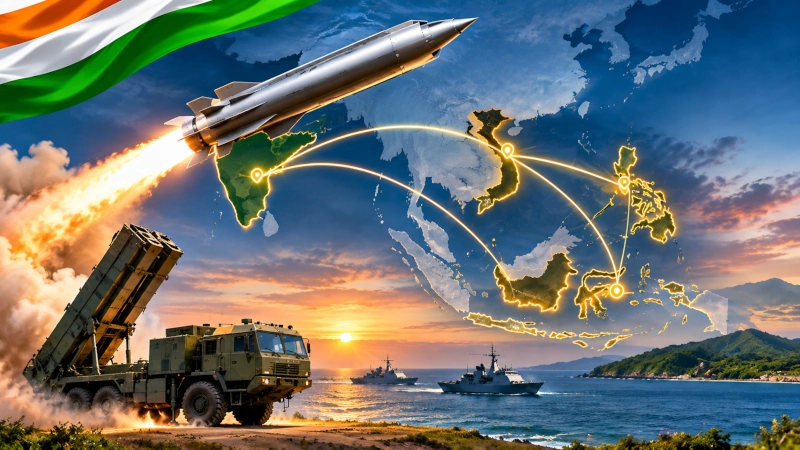
A new strategic geography is emerging across the Indo-Pacific as India’s BrahMos supersonic cruise missile expands its presence beyond the Indian Armed Forces into the defence establishments of Southeast Asian nations. From India’s maritime approaches in the Bay of Bengal and Andaman Sea to Indonesia, Vietnam and the Philippines, the growing adoption of BrahMos is creating a network of precision-strike capabilities across some of Asia’s most strategically important waters. Although these systems remain under their respective national commands, their expanding geographical presence is increasingly relevant to the regional military balance involving China.
The development represents an important transformation in India’s defence diplomacy. BrahMos, originally developed through cooperation between India’s Defence Research and Development Organisation and Russia’s NPO Mashinostroyenia, has evolved from a nationally operated weapon system into a significant defence export with implications for maritime security across Southeast Asia. The Philippines has already received BrahMos missile systems, while Vietnam and Indonesia have concluded procurement agreements with India. The expanding customer network reflects growing interest among maritime nations in strengthening their ability to defend coastlines, territorial waters and strategically important sea approaches.
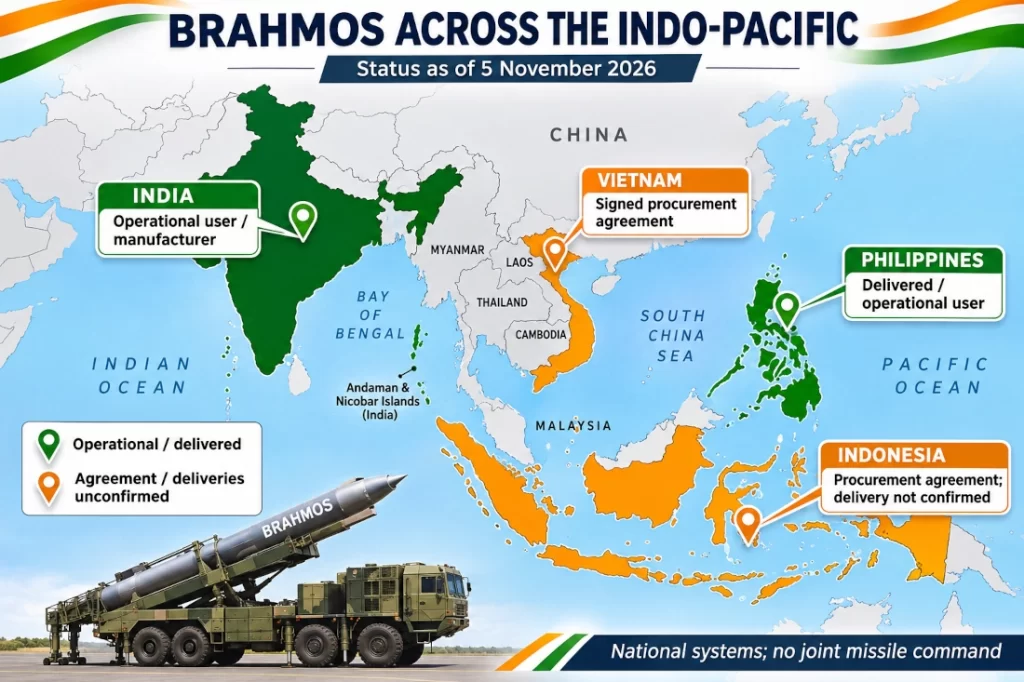
The concept of a Arc of Brahmos describes this emerging geographical relationship. It is not a formally announced Indian military strategy or a combined missile command, but a developing pattern in which India’s indigenous defence manufacturing capabilities are contributing to the independent deterrence requirements of several countries situated along important Indo-Pacific maritime routes. The result is a wider distribution of supersonic coastal defence capabilities in a region experiencing considerable changes in its naval balance.
Andaman and Nicobar Islands Anchor India’s Eastern Maritime Presence
India’s Andaman and Nicobar Islands occupy an important position near the western approaches to the Strait of Malacca, one of the world’s most significant maritime transportation corridors. The island chain provides India with a strategically valuable location for maintaining maritime awareness and conducting military operations across the eastern Indian Ocean.
The Andaman and Nicobar Command is India’s only operational tri-service theatre command, integrating elements of the Army, Navy and Air Force. Its geographical position allows India to maintain a military presence near maritime routes connecting the Indian Ocean with the South China Sea and the wider Pacific.
On December 1, 2025, the Indian Army successfully conducted a BrahMos combat missile launch in the Bay of Bengal through a coordinated mission involving Southern Command and elements of the Andaman and Nicobar Command. The exercise validated the missile’s precision-strike capabilities and demonstrated the ability of different military formations to coordinate operations in India’s eastern maritime environment.
The significance of the Andaman and Nicobar Islands extends beyond missile operations. Their location near major shipping routes makes them important for maritime surveillance, naval deployments and the protection of India’s eastern approaches. As BrahMos capabilities expand among Southeast Asian partners, India’s military presence in this region forms the western geographical foundation of the emerging network.
Indonesia Extends the BrahMos Network Towards the Maritime Crossroads
Indonesia occupies a strategically important position between the Indian and Pacific Oceans, with its extensive archipelago overlooking several maritime passages connecting the two regions. Its geography includes important sea routes associated with the Malacca, Sunda and Lombok straits, making maritime security a central component of the country’s defence planning.
In July 2026, India and Indonesia concluded an agreement enabling Jakarta to acquire the BrahMos supersonic cruise missile system, marking another significant development in India’s defence cooperation with Southeast Asia. The agreement followed earlier negotiations concerning Indonesia’s requirements for strengthening its coastal and maritime defence capabilities.
The Indonesian acquisition is particularly relevant because of the country’s extensive coastline, numerous islands and responsibility for securing maritime approaches across a geographically dispersed national territory. Mobile coastal defence missile systems can provide additional options for protecting important maritime areas while complementing naval vessels, aircraft and surveillance infrastructure.
From India’s perspective, the agreement strengthens an established relationship with a major Southeast Asian country positioned near the eastern approaches to the Indian Ocean. It also expands the international customer base of BrahMos and creates opportunities for long-term defence cooperation involving training, technical assistance and logistical support.
The Indonesian agreement contributes to the geographical spread of BrahMos capabilities, although the precise locations and operational status of future Indonesian missile units have not been publicly established.
Vietnam Brings BrahMos to the Western South China Sea
Vietnam represents another important component of the emerging BrahMos network because of its geographical position along the western coast of the South China Sea.
The country possesses an extensive coastline and significant maritime interests in waters that have become central to territorial disputes and regional security concerns. Its defence modernisation efforts have included strengthening maritime surveillance, naval capabilities and coastal defence systems.
On May 30, 2026, India’s Defence Secretary Rajesh Kumar Singh publicly confirmed that an agreement had been signed to supply BrahMos missiles to Vietnam. The announcement marked a significant development in bilateral defence cooperation and established Vietnam as another confirmed international customer for the missile system.
The acquisition is strategically important because coastal missile systems can strengthen Vietnam’s ability to protect designated maritime areas and support the defence of its coastline. Supersonic anti-ship weapons provide additional capabilities for responding to hostile naval activity and increase the complexity of maritime operations in contested environments.
India and Vietnam have maintained defence cooperation involving military training, naval engagements and support for defence equipment. The BrahMos agreement adds a technologically advanced weapon system to this relationship and reflects the increasing importance of India as a defence supplier to regional partners.
Vietnam’s geographical position means that its future BrahMos capabilities would form an important part of the wider distribution of such systems across Southeast Asia. However, a signed procurement agreement should not be confused with completed deliveries or operational deployment, for which detailed public confirmation remains limited.
Philippines Establishes BrahMos Presence on the Eastern Edge of the South China Sea
The Philippines has become the most visible international example of BrahMos entering Southeast Asian military service.
In January 2022, Manila signed a contract worth approximately $375 million to acquire three BrahMos shore-based anti-ship missile batteries from India. The agreement represented India’s first major international sale of the missile system and established an important defence manufacturing relationship between the two countries.
The Philippine Marine Corps subsequently received BrahMos equipment and incorporated the system into its coastal defence structure. The acquisition provides the Philippines with a precision-strike capability intended to strengthen the defence of its maritime approaches and support the protection of its territorial interests.
The missile system is particularly relevant to the Philippines because of its archipelagic geography and the importance of the South China Sea to its national security. Shore-based anti-ship missiles can complement naval and air assets by increasing the options available for defending maritime areas from land.
The strategic significance of the Philippine acquisition extends beyond the original contract. It demonstrates India’s ability to supply sophisticated missile technology to an international customer while establishing an accompanying relationship involving training, maintenance and long-term technical support.
The Philippines’ BrahMos programme has therefore become a prominent example of India’s expanding defence industrial and diplomatic presence in the Indo-Pacific.
November 2026: Philippines Moves Towards a Major Expansion
A significant development emerged on November 5, 2026, when Philippine Defence Secretary Gilberto Teodoro confirmed that Manila wanted to acquire additional BrahMos cruise missile systems from India.
Speaking virtually at the third Delhi Defence Dialogue on November 4, Teodoro stated that the Philippines was interested in increasing its BrahMos inventory and had communicated additional requirements to Indian authorities. He also emphasised the importance of India’s confidence in the Philippines as a responsible operator of advanced military equipment.
According to reporting published on November 5, India and the Philippines are in advanced discussions concerning a potential additional purchase of approximately five BrahMos systems, involving nearly 60 missiles. The proposed agreement could be valued between $700 million and $800 million, substantially exceeding the value of the original 2022 contract.
The proposed acquisition reflects the importance the Philippines attaches to strengthening its coastal defence network. Additional missile systems would provide greater flexibility in protecting maritime approaches and supporting the country’s defence modernisation programme.
For India, another substantial contract would strengthen the commercial position of BrahMos Aerospace and expand the long-term defence relationship with Manila. The negotiations also demonstrate how an initial defence export can develop into a continuing strategic partnership involving additional requirements and technological cooperation.
As of November 5, however, the proposed expansion remains under negotiation and has not been announced as a completed procurement agreement.
The Strategic Geography of a BrahMos Garland
The geographical distribution of BrahMos capabilities across India and its Southeast Asian customers creates a distinctive pattern in the Indo-Pacific.
India’s eastern maritime presence provides access to the Bay of Bengal and approaches to the Andaman Sea. Indonesia occupies important passages connecting the Indian and Pacific Oceans, while Vietnam faces the western South China Sea. The Philippines lies along the eastern side of that maritime region.
These locations are significant because they surround or overlook maritime routes that are important to regional naval movement, commercial shipping and international trade.
China’s expanding naval capabilities and maritime activities have increased the importance of coastal defence systems for several Southeast Asian countries. BrahMos offers these nations a means of strengthening their independent conventional deterrence capabilities without requiring the acquisition of large numbers of additional warships.
The resulting strategic geography can be visualised as a developing garland of missile-equipped maritime powers extending from the eastern Indian Ocean into the South China Sea.
However, the individual BrahMos systems remain national assets operated according to each country’s defence requirements. Their deployment does not establish a combined military command, an automatic mutual defence arrangement or an Indian-controlled missile network.
The strategic significance lies in the wider availability of advanced coastal defence capabilities among countries that maintain their own security policies while cooperating with India on defence technology.
Why BrahMos Matters in the Maritime Balance with China
BrahMos is among the world’s fastest operational supersonic cruise missile systems, travelling at approximately Mach 2.8 to Mach 3. Its high speed, precision guidance and ability to engage maritime targets make it an important weapon for conventional naval warfare.
The missile can be deployed from land-based launchers, surface warships and aircraft, providing operational flexibility across different military environments. Its anti-ship capability is particularly relevant to coastal defence because it enables land-based forces to engage designated maritime targets within the system’s operational range.
For countries operating in geographically complex maritime environments, mobile anti-ship missile batteries can strengthen defensive capabilities without depending entirely on large naval platforms.
The presence of BrahMos systems in several Southeast Asian countries increases the number of regional forces possessing advanced supersonic maritime strike technology. This development is relevant to China’s naval planning because such capabilities must be considered alongside the wider range of military systems operated by regional countries.
Nevertheless, missile capability alone does not determine maritime superiority. Effective employment depends on surveillance, target identification, communications, command systems, training and the ability to operate within a broader military framework.
The strategic value of BrahMos therefore lies not simply in the missile’s speed or range but in its integration into national defence systems capable of supporting maritime security and deterrence.
India’s Defence Exports Become Instruments of Strategic Partnership
The expansion of BrahMos exports reflects a wider transformation in India’s defence manufacturing industry.
Historically, India relied heavily on imported military equipment to meet the requirements of its Armed Forces. Over the past decade, greater emphasis on indigenous manufacturing, defence research and industrial investment has supported the development of more sophisticated domestically produced weapon systems.
BrahMos occupies an important position in this transition because it combines advanced missile technology with an established manufacturing and production ecosystem in India.
On October 18, 2025, Defence Minister Rajnath Singh and Uttar Pradesh Chief Minister Yogi Adityanath flagged off the first batch of BrahMos missiles manufactured at the integration and testing facility in Lucknow. The facility forms part of the Uttar Pradesh Defence Industrial Corridor and represents an important investment in domestic missile production.
The expansion of manufacturing infrastructure supports both the requirements of the Indian Armed Forces and the growing international demand for BrahMos systems.
The Ministry of Defence also signed a contract worth ₹661.50 crore with BrahMos Aerospace on October 6, 2026, for fire-control systems and launchers intended for Indian Navy warships. The procurement, under the Buy (Indian-IDDM) category, includes a minimum indigenous content requirement of 68%.
These developments demonstrate how India’s missile manufacturing industry is strengthening its technological and production capabilities while expanding its international commercial presence.
BrahMos Diplomacy Reflects India’s Strategic Autonomy
India’s growing defence relationships with Southeast Asian countries are consistent with its longstanding emphasis on strategic autonomy and independent foreign policy.
New Delhi maintains substantial economic relations with China while also developing defence partnerships with countries concerned about maritime security in the Indo-Pacific.
The export of BrahMos systems to the Philippines, Vietnam and Indonesia reflects India’s willingness to participate more actively in regional security cooperation through defence technology and industrial partnerships.
These arrangements also demonstrate that India’s strategic influence increasingly extends beyond traditional diplomatic engagement to include the supply of sophisticated military equipment.
For recipient countries, cooperation with India provides an additional source of advanced defence technology and opportunities to diversify procurement relationships. For India, the agreements strengthen bilateral ties and create long-term institutional engagement between defence establishments.
The resulting network does not require the participating countries to adopt identical positions towards China. Each country retains its own diplomatic priorities, security assessments and operational control over its military assets.
This distinction is important because the emerging BrahMos geography is based on overlapping national security interests and independent procurement decisions rather than a formally established anti-China military alliance.
A New Dimension in India’s Indo-Pacific Strategy
The growing international presence of BrahMos reflects the convergence of India’s defence manufacturing capabilities, maritime security interests and diplomatic relationships across Southeast Asia.
The Philippines has already established a BrahMos coastal defence capability and is considering a substantial additional purchase. Vietnam has concluded a procurement agreement with India, while Indonesia has also entered into an arrangement to acquire the missile system.
Together with India’s existing BrahMos capabilities and continuing investment in missile manufacturing, these developments demonstrate the expanding regional significance of an advanced weapon system developed through Indo-Russian cooperation.
The strategic geography is particularly noteworthy. India’s eastern maritime approaches, Indonesia’s position between two oceans, Vietnam’s extensive South China Sea coastline and the Philippines’ archipelagic defence requirements create a series of geographically distinct locations where BrahMos capabilities are becoming increasingly relevant.
As these systems enter service and national defence networks develop around them, they will contribute to a more distributed regional maritime deterrence environment.
The Arc of BrahMos: From Indian Missile to Indo-Pacific Strategic Influence
The evolution of BrahMos from an Indian military weapon into an internationally exported coastal defence system represents an important development in India’s emergence as a defence technology supplier.
Its expanding presence across Southeast Asia demonstrates how indigenous defence manufacturing can contribute to international partnerships while strengthening the independent military capabilities of recipient countries.
The emerging Arc of BrahMos is best understood as a developing strategic geography rather than a completed military formation. Some elements are already operational, others are covered by signed procurement agreements, and additional acquisitions remain under negotiation.
For China, the wider availability of supersonic anti-ship missiles among Southeast Asian maritime nations adds another consideration to the regional security environment. For India, the development strengthens its role as a defence industrial partner and expands the diplomatic significance of its technological capabilities.
From the eastern Indian Ocean to the South China Sea, BrahMos is gradually becoming more than a missile system. It is emerging as a link between India’s defence manufacturing ambitions and the maritime security requirements of Indo-Pacific nations, forming a strategic garland of independent deterrence capabilities across one of the world’s most consequential maritime regions.
You may also like
-
India, Philippines in Advanced Talks for $800 Million BrahMos Missile Deal
-
Bharat Dynamics Strengthens India’s Indigenous Missile Manufacturing Capabilities Through Pralay Programme
-
Lakṣmaṇa’s Mission to Kiṣkindhā: Enforcing Alliance Commitments Without Breaking the Partnership
-
Indian Air Force Achieves World’s Highest IL-76MD Landing at Strategic Nyoma Airfield in Ladakh
-
India and Rwanda Explore Solar Energy Cooperation in Irrigation, Cold Storage and Agricultural Processing
