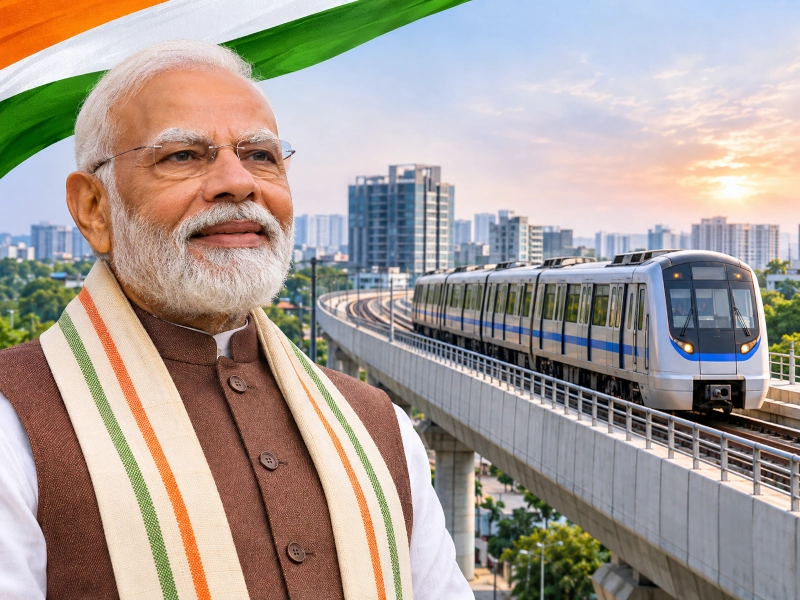
Prime Minister Narendra Modi has highlighted the remarkable transformation of India’s urban transportation infrastructure over the past twelve years, acknowledging the expansion of the country’s operational Metro rail network from just 248 kilometres across five cities in 2014 to nearly 1,200 kilometres spanning 26 cities in 2026. Describing the development as a fundamental improvement in the everyday lives of millions of Indians, the Prime Minister emphasised that modern public transportation infrastructure is central to building more productive, accessible and economically vibrant cities.
In a message shared on social media platform X on November 5, Prime Minister Modi drew attention to the accelerated pace of Metro development under his government, contrasting the limited geographical coverage of the network in 2014 with its present nationwide footprint. He noted that more than one crore passengers now travel on India’s Metro systems every day, demonstrating the growing importance of reliable mass transportation in meeting the mobility requirements of an expanding urban population.
The Prime Minister particularly emphasised that the significance of this infrastructure transformation extends well beyond the construction of railway corridors and stations. By reducing commuting times, improving accessibility and providing dependable public transportation, Metro networks are creating opportunities for millions of citizens to spend less time navigating congested roads and more time with their families, workplaces and communities.
Prime Minister Acknowledges Transformation in Urban Mobility
Highlighting the scale of India’s Metro expansion, Prime Minister Modi questioned how long emerging urban centres such as Pune would have needed to wait for modern rapid transit infrastructure if the country had continued developing Metro networks at the pace witnessed before 2014. He suggested that several cities might have faced delays extending into decades, describing such a situation as unacceptable for a rapidly developing nation.
The Prime Minister observed that India possessed only 248 kilometres of Metro lines across five cities in 2014, while the network has now expanded to nearly 1,200 kilometres across 26 cities. The development represents an increase of approximately five times in operational network length and a substantial expansion in the number of urban centres benefiting from Metro connectivity.
Explaining the broader purpose of these investments, Prime Minister Modi stated that the impact of Metro development goes beyond infrastructure statistics. He highlighted the practical benefits of reduced traffic congestion, shorter journeys, improved productivity and greater economic opportunities, describing these improvements as central to the government’s vision for the transformation of urban India.
His remarks also underline a wider approach to infrastructure development in which public investments are evaluated not merely by the physical assets created but by their contribution to improving citizens’ quality of life and enabling greater economic participation.
India Emerges Among the World’s Three Largest Metro Networks
The expansion of India’s Metro infrastructure has established the country among the world’s three largest Metro rail networks, reflecting sustained investment in urban transportation and the growing capabilities of India’s infrastructure development ecosystem.
According to official government figures, the operational Metro network reached approximately 1,155 kilometres across 26 cities by March 2026. More recent figures released by the Ministry of Housing and Urban Affairs placed the network at approximately 1,185 kilometres, bringing the country closer to the 1,200-kilometre milestone highlighted by the Prime Minister.
The pace of Metro commissioning has also increased considerably. Government data indicate that the average rate of commissioning rose from approximately 0.68 kilometres per month before 2014 to nearly six kilometres per month in subsequent years. This acceleration reflects the expansion of project execution capabilities, greater institutional experience and sustained investment in mass rapid transit infrastructure.
The geographical expansion of Metro services has been equally significant. While Metro connectivity was concentrated in a limited number of major urban centres in 2014, the network now serves cities across different regions of India, including established metropolitan areas and rapidly developing regional economic centres. This wider distribution is gradually extending the benefits of modern mass transportation beyond the country’s largest cities.
Daily Metro Ridership Crosses One Crore Passengers
One of the most significant indicators of the transformation in India’s urban mobility is the substantial increase in Metro passenger traffic. According to government data, daily ridership has risen from approximately 28 lakh passengers in 2013–14 to more than 1.15 crore in 2026, representing a major expansion in the use of organised urban mass transportation.
The growing passenger volumes demonstrate how Metro systems have become an essential component of everyday commuting for office workers, students, professionals, entrepreneurs and families. Reliable train frequencies, dedicated transportation corridors and predictable journey times provide commuters with alternatives to road-based transportation, particularly in cities where growing vehicle ownership has increased pressure on existing road networks.
Metro connectivity also contributes to improved access to employment, educational institutions, healthcare facilities and commercial centres. By connecting residential areas with major economic destinations, rapid transit systems can expand the range of opportunities available to citizens while reducing the difficulties associated with long-distance urban commuting.
Prime Minister Modi’s acknowledgement of the human benefits of Metro expansion is particularly relevant in this context. Time saved during daily journeys represents an important improvement in quality of life, allowing citizens to devote more attention to family responsibilities, education, professional development and personal well-being.
Pune Metro Development Reflects the Government’s Urban Infrastructure Vision
The Prime Minister’s remarks follow the inauguration and foundation stone laying of Metro projects worth approximately ₹21,800 crore in Pune on November 3, 2026. The projects form part of continuing efforts to strengthen public transportation infrastructure in one of India’s important information technology, automobile manufacturing, education and innovation centres.
Addressing the occasion, Prime Minister Modi emphasised that improved transportation connectivity increases the economic efficiency of cities by reducing the time required for people to travel between residential neighbourhoods, workplaces and commercial establishments. He linked these improvements to the wider growth of the national economy, observing that more productive cities create opportunities benefiting workers, businesses and households.
The Pune projects illustrate the growing importance of Metro transportation in supporting regional economic development. The Hinjawadi–Shivajinagar corridor is particularly relevant because of its role in connecting Pune’s major information technology employment areas with the wider urban transportation network, while additional Metro development is intended to improve connectivity between established neighbourhoods and expanding parts of the city.
During the November 3 programme, the Prime Minister also highlighted the expansion of Metro infrastructure in Maharashtra. He noted that the state’s operational network had grown from approximately 10–11 kilometres in 2014 to nearly 175 kilometres, with more than 680 kilometres under construction and investment exceeding ₹2.5 lakh crore associated with ongoing development.
Sustained Public Investment Supports Metro Expansion
India’s expanding Metro network has been supported by increased government expenditure on urban transportation infrastructure. Official data show that annual budgetary support for Metro development rose from approximately ₹5,798 crore in 2013–14 to ₹29,550 crore in 2025–26, reflecting the growing priority assigned to mass rapid transit systems within the country’s infrastructure development strategy.
Government estimates also indicate that approximately ₹3.7 lakh crore was invested in Metro expansion over twelve years. These investments support the construction of elevated and underground corridors, stations, depots, signalling systems, electrical infrastructure and other facilities required for operating modern urban railway networks.
Metro construction additionally generates economic activity across engineering, construction, manufacturing and service industries. Projects create demand for civil engineering expertise, electrical equipment, railway systems, construction materials and skilled technical personnel, while their eventual operation supports employment in transportation management, maintenance, security and associated services.
The development of Metro infrastructure has also created opportunities for Indian manufacturers and technology providers participating in the railway supply chain. Domestic capabilities in rolling stock, traction equipment, signalling, telecommunications and railway infrastructure are increasingly relevant as the country continues expanding its urban transit systems.
Metro Rail Strengthens Sustainable Urban Development
The expansion of Metro rail services is also an important component of India’s efforts to develop more environmentally sustainable transportation systems. Electrified mass transit offers cities an opportunity to transport large numbers of passengers efficiently while reducing dependence on individual motor vehicles and conventional road-based commuting.
Metro systems can contribute to lower traffic congestion, improved energy efficiency and reduced transport-related pollution when they attract passengers away from private vehicles and integrate effectively with other public transportation services. Their contribution to sustainable mobility is particularly important as Indian cities experience continued population growth, economic expansion and rising transportation demand.
India has also demonstrated technological innovation through landmark urban transportation projects. The inauguration of Kolkata’s underwater Metro tunnel beneath the Hooghly River in 2024 represented a major engineering achievement, while Kochi’s Water Metro introduced an innovative model of electric and hybrid water-based public transportation connecting island communities.
These developments highlight the diversification of India’s urban mobility infrastructure, with conventional Metro corridors, regional rapid transit systems and water-based transportation services contributing to more integrated and accessible public transport networks.
Better Connectivity Supports Economic Productivity and Financial Well-Being
The economic significance of Metro connectivity extends beyond the direct savings achieved through faster travel. Improved transportation networks can strengthen labour mobility, expand access to employment centres and make commercial districts more accessible to consumers, workers and businesses.
A study released by the Economic Advisory Council to the Prime Minister in January 2026 also examined the relationship between Metro connectivity and household financial behaviour. According to the government’s account of the findings, improved access to Metro infrastructure was associated with better household loan repayment discipline and reduced financial stress, suggesting that transportation improvements can influence broader dimensions of household economic well-being.
These findings reinforce the importance of reliable urban transportation as an economic enabler. By helping individuals manage commuting requirements more efficiently, Metro connectivity can reduce some of the daily burdens associated with employment and urban living, while providing greater flexibility in accessing opportunities across different parts of a city.
Prime Minister Modi’s emphasis on productivity and family time therefore reflects a broader understanding of infrastructure as a means of improving both economic outcomes and social well-being.
Building the Urban Infrastructure of Viksit Bharat
India’s continuing Metro expansion forms part of the broader national objective of developing modern, efficient and economically competitive cities under the vision of Viksit Bharat. As urban centres become increasingly important contributors to manufacturing, services, technology and entrepreneurship, the availability of dependable public transportation will play a central role in supporting their growth.
The government’s urban mobility strategy increasingly emphasises integrated transportation networks that connect Metro systems with buses, conventional railways and other modes of public transport. Improvements in first-mile and last-mile connectivity, accessibility and passenger information systems are intended to make these networks more convenient for commuters while expanding the practical reach of major transportation investments.
The development of modern Metro infrastructure also represents a long-term investment in the functioning of Indian cities. Well-connected urban regions can support the emergence of new commercial districts, improve access to established employment centres and facilitate more balanced development across expanding metropolitan areas.
Prime Minister Narendra Modi’s acknowledgement of India’s Metro expansion on November 5, 2026, brings attention to one of the country’s most substantial urban infrastructure transformations since 2014. The growth from 248 kilometres across five cities to nearly 1,200 kilometres across 26 cities, accompanied by daily ridership exceeding one crore passengers, illustrates the scale at which modern public transportation has become part of India’s development trajectory.
More importantly, the Prime Minister’s message places citizens at the centre of this transformation. By connecting faster transportation with greater productivity, improved access to opportunities and more time for families, he has highlighted the broader purpose of infrastructure development: creating cities that function more efficiently while improving the everyday lives of the people who live and work in them.
You may also like
-
Hyderabad Startup Perceptyne Develops Semi-Humanoid Robotic Platform for Precision Industrial Automation
-
India’s Steel Consumption Nears 100 Million Tonnes as Domestic Demand Grows 7.5% in April–October 2026
-
Indian Fintech Startup Decentro Launches Advanced UPI Soundboxes with Dynamic QR and Contactless Payment Capabilities
-
OneStack Enables Indian Cooperative Banks to Access UPI Network Directly Through Indigenous Banking Technology
-
IIT Bombay-Incubated Peppermint Robotics Raises ₹100 Crore to Expand Indigenous Robot Manufacturing and Global Operations
