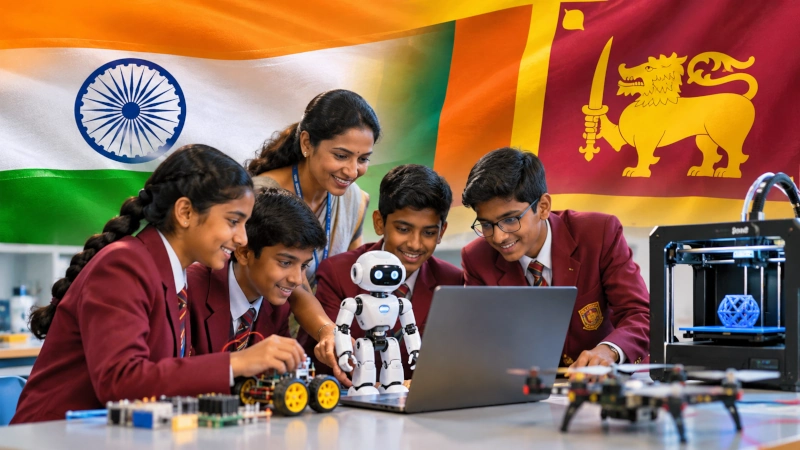
India’s Atal Innovation Mission (AIM), operating under NITI Aayog, has extended its school-level innovation model to Sri Lanka by providing technical expertise, specialised curricula and training support for a state-of-the-art Tinkering Laboratory inaugurated at Nalanda College in Colombo. The initiative represents an important development in India–Sri Lanka educational cooperation, introducing advanced technologies and practical innovation-based learning to young students.
The laboratory, established at the Innovation Center of Nalanda College, provides students with opportunities to explore robotics, artificial intelligence, 3D printing and digital manufacturing. Facilitated by the High Commission of India in Sri Lanka, the collaboration draws upon India’s experience in developing Atal Tinkering Laboratories across thousands of schools, where students are encouraged to move beyond conventional classroom instruction and develop practical solutions to real-world challenges.
The development was reported by Akashvani News on 4 November 2026 and reflects the growing importance of science, technology and innovation within India’s educational partnerships with neighbouring countries.
Bringing India’s Atal Tinkering Laboratory Model to Sri Lanka
The newly inaugurated facility builds upon the educational approach pioneered by India’s Atal Innovation Mission, which seeks to develop creativity, critical thinking and technological capabilities among school students through practical experimentation. Rather than limiting learning to textbooks and theoretical instruction, the model encourages students to design, construct, test and improve their own technological solutions.
India’s Atal Tinkering Laboratories have been established as dedicated innovation spaces equipped with tools and technologies that introduce students to engineering, electronics, computational thinking and scientific problem-solving. These laboratories provide opportunities for young learners to understand how technologies operate and apply their knowledge through collaborative projects.
At Nalanda College, the new laboratory incorporates this approach into Sri Lanka’s educational environment. Students will be able to work with emerging technologies while developing skills associated with design thinking, experimentation and interdisciplinary learning. The facility also creates opportunities for teachers and educational institutions to introduce practical technology-based activities into conventional teaching methods.
The collaboration is particularly significant because it transfers India’s experience in building a nationwide school innovation ecosystem into an international educational partnership. By sharing technical knowledge, curriculum resources and training expertise, the Atal Innovation Mission is supporting the development of similar learning opportunities beyond India’s borders.
Advanced Technologies to Strengthen Practical STEM Education
The laboratory at Nalanda College is equipped to introduce students to several technologies that are increasingly important in modern scientific and industrial applications. Robotics provides opportunities to understand mechanical systems, sensors, automation and programming, while artificial intelligence introduces learners to computational methods that enable machines to perform increasingly complex tasks.
The inclusion of 3D printing and digital manufacturing technologies allows students to explore the process of converting ideas and digital designs into physical objects. These capabilities are particularly valuable in engineering education because they connect theoretical concepts with practical design, prototyping and experimentation.
Together, these technologies support an integrated approach to science, technology, engineering and mathematics education. Students can apply knowledge from multiple disciplines within a single project, developing skills in problem-solving, teamwork, computational thinking and technical communication.
Such laboratories also provide a foundation for nurturing entrepreneurial thinking among young learners. By encouraging students to identify problems and develop practical responses, innovation-based education can introduce them to the processes involved in product development, technological improvement and the creation of useful solutions.
High Commission of India Facilitates Educational Collaboration
The High Commission of India in Sri Lanka played an important role in facilitating the establishment of the laboratory, bringing together Indian technical expertise and Sri Lankan educational institutions.
Addressing the inauguration, India’s High Commissioner to Sri Lanka, Santosh Jha, highlighted the expanding dimensions of cooperation between the two countries. He observed that India and Sri Lanka have continued to add new layers to their longstanding friendship and described the collaboration as a reflection of their shared aspirations and commitment.
The initiative brings together Nalanda College and Atlas Axillia, the learning-focused subsidiary of Sri Lankan conglomerate Hemas Holdings. The participation of an educational institution, a private-sector organisation and India’s Atal Innovation Mission illustrates how international cooperation can connect government-supported innovation programmes with local institutions and industry expertise.
Former Sri Lankan international cricketer Mahela Jayawardene, an alumnus of Nalanda College, also attended the inauguration. He expressed appreciation for India’s assistance in establishing the facility, recognising the opportunities it would provide to students.
The involvement of multiple stakeholders demonstrates a collaborative approach to educational development, combining institutional support, technology access and practical learning resources within a common framework.
India’s Atal Innovation Mission Reaches Beyond National Borders
Established under NITI Aayog, the Atal Innovation Mission is one of India’s flagship initiatives for promoting innovation and entrepreneurship. Its programmes seek to develop an innovation-oriented mindset among students, researchers and entrepreneurs while strengthening institutional support for technological development.
The Atal Tinkering Laboratory programme is a major component of this effort. According to official Atal Innovation Mission data, India has established 10,000 laboratories across the country, reaching more than 1.1 crore students and supporting the development of over 16 lakh innovation projects.
These laboratories operate across 35 states and Union Territories and cover 722 districts. More than 6,200 Mentors of Change have participated in the programme, helping students develop practical skills and gain exposure to emerging technologies.
The initiative has also encouraged participation from government and government-aided schools, making advanced technological learning more accessible to students from different educational and socioeconomic backgrounds.
India’s experience in implementing this programme on a large scale provides an established foundation for international collaboration. The laboratory in Colombo demonstrates how the knowledge, training methods and institutional practices developed through Indian educational programmes can support similar initiatives in neighbouring countries.
Education and Technology Become Important Pillars of India–Sri Lanka Cooperation
The establishment of the Tinkering Laboratory reflects the increasing significance of educational and technological cooperation in India–Sri Lanka relations. While bilateral engagement has traditionally included trade, infrastructure, connectivity, cultural exchanges and development assistance, emerging technologies are creating additional opportunities for collaboration.
Practical education in robotics, artificial intelligence and digital manufacturing is particularly relevant as both countries seek to prepare younger generations for technological changes affecting industry, research and employment.
By supporting advanced learning facilities in Sri Lanka, India is contributing to the development of technological skills while strengthening people-to-people and institutional relationships. Such initiatives create opportunities for students and educators to participate in a shared environment of scientific learning, creativity and experimentation.
The collaboration also highlights the role of India’s domestic development programmes in its wider regional partnerships. Educational models developed to address national priorities can offer useful approaches for neighbouring countries facing similar challenges in expanding access to practical, technology-oriented learning.
Strengthening Regional Innovation Through Educational Partnerships
The inauguration of the advanced Tinkering Laboratory at Nalanda College represents a meaningful extension of India’s innovation-led educational initiatives into Sri Lanka. By combining technical expertise from the Atal Innovation Mission with the participation of Sri Lankan educational and private-sector institutions, the project establishes a platform for young students to engage directly with technologies shaping the modern world.
The laboratory provides an opportunity to introduce students to the practical applications of artificial intelligence, robotics, digital manufacturing and engineering design at an early stage of their education. It also reinforces the importance of developing creativity, experimentation and problem-solving abilities alongside conventional academic knowledge.
For India, the initiative demonstrates how an indigenous educational innovation programme can contribute to international cooperation through the sharing of knowledge, institutional experience and technological resources. For Sri Lanka, it creates additional opportunities to nurture young innovators and strengthen practical science and technology education.
The project adds a new dimension to the India–Sri Lanka partnership, placing young learners, emerging technologies and collaborative innovation at the centre of educational cooperation between the two neighbouring countries.
You may also like
-
NCERT Introduces Personal Finance and Entrepreneurship in Class 9 Social Science Textbooks
-
India and Russia’s Tatarstan Expand Cooperation in Higher Education, Scientific Research and Industrial Skills
-
India Pledges Protection for Medical Students in Uzbekistan Against Exploitation
-
India Sets Guinness World Record with Nearly 2.88 Lakh Student Innovation Project Submissions
-
NLC India Opens 1,067 Apprenticeship Opportunities in Technical and Professional Fields
