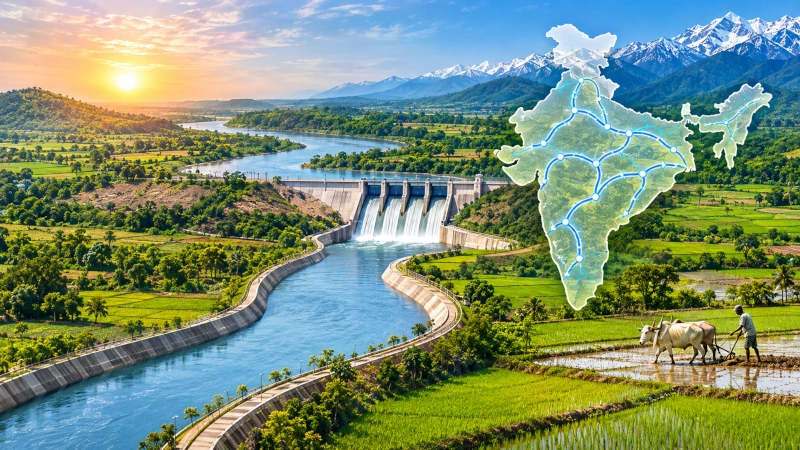
India’s ambitious programme to interlink major river systems has reached an important stage, with the Ken–Betwa Link Project under implementation, the Modified Parbati–Kalisindh–Chambal project advancing through interstate agreements and technical appraisal, and the proposed Godavari–Cauvery water-transfer network progressing through detailed project planning. However, nearly five decades after the formulation of the National Perspective Plan, much of the wider river interlinking programme remains at the feasibility, planning or consultation stage, reflecting the considerable technical, financial, environmental and interstate challenges involved in transferring water between major river basins.
The Ministry of Jal Shakti’s comprehensive status report, published on August 10, 2026, confirms that 30 river-linking projects have been identified under the National Perspective Plan, comprising 16 links in the Peninsular Rivers Development Component and 14 in the Himalayan Rivers Development Component. The National Water Development Agency (NWDA) is responsible for planning and coordinating these projects, which are intended to improve irrigation, drinking-water availability and water-resource management in regions experiencing shortages. The Ministry’s latest review, conducted on October 27, 2026, reiterated the need to accelerate implementation and resolve administrative and technical bottlenecks affecting major water infrastructure projects.
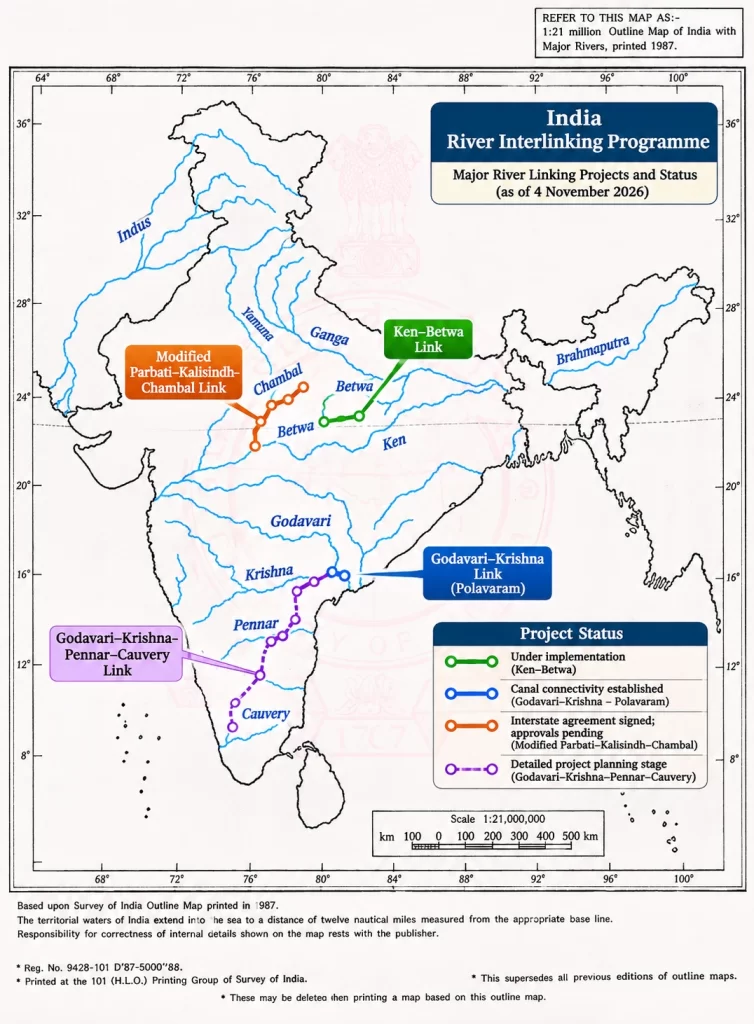
Despite progress in technical studies, the programme is not yet a completed or fully sanctioned national network of interconnected rivers. Ken–Betwa remains the only designated priority link under the National Perspective Plan that has formally entered implementation, while the Godavari–Krishna connection incorporated into the Polavaram Irrigation Project is being developed under a separate National Project framework. The remaining proposals are at different stages of assessment, approval and interstate negotiations, making it essential to distinguish completed feasibility studies from projects that have received construction approval.
National Perspective Plan: The Vision Behind India’s River Interlinking Programme
The National Perspective Plan for Water Resources Development was formulated in 1980 to examine the possibility of transferring water from river basins assessed as having surplus resources to regions facing deficits. The concept emerged from concerns about the uneven geographical and seasonal distribution of rainfall, recurring droughts, agricultural dependence on monsoons and the need to improve long-term water availability.
India’s river systems differ substantially in their hydrological characteristics. Himalayan rivers receive water from monsoon rainfall and, in some basins, snow and glacier melt, while many peninsular rivers experience considerable seasonal variations associated with the southwest and northeast monsoons. These differences have encouraged proposals for storage reservoirs, canals, barrages and other infrastructure that could redistribute water between selected basins.
The programme envisages two broad geographical systems. The Himalayan component examines links involving rivers such as the Brahmaputra, Ganga, Ghaghra, Gandak, Kosi and Yamuna, while the peninsular component includes proposals involving the Mahanadi, Godavari, Krishna, Pennar, Cauvery, Ken, Betwa and several western-flowing river systems.
The objective is not to construct a single uninterrupted canal connecting every major Indian river. Instead, the National Perspective Plan consists of individual inter-basin transfer proposals, each requiring separate assessments of water availability, engineering feasibility, environmental impacts, economic viability and interstate agreement.
A fundamental consideration is that the designation of a river basin as water-surplus does not necessarily establish that water will remain available for transfer throughout the year. Water availability depends on seasonal rainfall, upstream use, environmental flow requirements, reservoir operations and future climatic conditions. Consequently, the long-term viability of individual links depends on detailed hydrological evaluation rather than assumptions based solely on annual river discharge.
Overall Status: 30 Identified Links, but Construction Remains Limited
Planning under the river interlinking programme has advanced substantially since the National Perspective Plan was introduced. The NWDA has completed Pre-Feasibility Reports for all 30 identified links and Feasibility Reports for 26, providing a technical foundation for assessing proposed water transfers and determining which projects warrant more detailed investigation.
Official publications differ slightly in their aggregate count of completed Detailed Project Reports. The Ministry’s December 2025 annual review reported 14 DPRs, including one intra-state link project, while a parliamentary reply issued on February 5, 2026, reported 13 completed DPRs. The August 2026 status report provides project-by-project information without reconciling that difference in its summary. The most reliable current assessment is therefore that detailed planning has advanced for a substantial number of links, but relatively few have progressed to implementation approval.
The following table summarises the programme’s position as established by official government publications.
| Component | Official status |
|---|---|
| Total river links identified | 30 |
| Peninsular component | 16 links |
| Himalayan component | 14 links |
| Pre-Feasibility Reports completed | 30 |
| Feasibility Reports completed | 26 |
| Detailed Project Reports completed | 13–14 reported, depending on the official count and inclusion of an intra-state project |
| Designated priority links | Five links organised into three principal project groups |
| Priority projects under implementation | Ken–Betwa |
| Separate National Project incorporating a river link | Polavaram Irrigation Project |
| Principal unresolved requirements | Interstate agreements, technical appraisal, statutory clearances, financing and rehabilitation |
The government has designated five links as priorities, comprising the Ken–Betwa project, the Modified Parbati–Kalisindh–Chambal project and three connected links collectively described as the Godavari–Cauvery project. These priorities reflect efforts to concentrate administrative and technical resources on proposals considered suitable for advancing towards implementation.
However, the designation of a project as a priority does not automatically mean construction has begun. The present programme contains projects ranging from commissioned water-transfer infrastructure to proposals that have not progressed beyond preliminary studies.
Ken–Betwa: India’s Flagship River Interlinking Project Moves into Construction
The Ken–Betwa Link Project represents the most advanced major development under the National Perspective Plan. Designed primarily to address water shortages in the Bundelkhand region of Madhya Pradesh and Uttar Pradesh, the project proposes transferring water from the Ken basin into the Betwa basin through the construction of a major dam, a connecting canal and associated irrigation infrastructure.
The government approved the project in December 2021 at an estimated cost of ₹44,605 crore, and Prime Minister Narendra Modi laid its foundation stone on December 25, 2024. The principal engineering works include the 96.7-metre-high Daudhan Dam on the Ken River and a 216.465-kilometre canal extending towards Barua Sagar near Jhansi. The wider project incorporates the Lower Orr Project, Kotha Barrage, Bina Complex Multipurpose Project and additional irrigation and water-supply works in the two participating states.
The project’s intended benefits include drinking-water supply for approximately 62 lakh people and electricity generation through 103 MW of hydropower and 27 MW of solar installations. Government publications have presented irrigation figures of both 10.62 lakh hectares and approximately 11.88 lakh hectares, reflecting differences between project descriptions and the scope of benefits reported. These figures should not be treated as identical without reference to their respective definitions.
Construction and Financial Progress
The project has moved beyond planning into physical implementation, although its major components are at different stages. The Ministry of Jal Shakti’s August 2026 project backgrounder confirmed that construction of the Daudhan Dam was underway, while work on the main link canal had not yet begun. The Lower Orr Project, Kotha Barrage and Bina Complex Multipurpose Project were also reported to be under construction, with detailed planning for additional state-specific works continuing.
By July 2026, cumulative expenditure had reached ₹12,445.85 crore against the approved estimated project cost of ₹44,604.99 crore. This represents substantial financial progress, although expenditure alone cannot establish the percentage of physical construction completed because land acquisition, rehabilitation, environmental measures and civil engineering works have different cost structures and implementation schedules.
The project remains officially scheduled for completion in 2030. The October 27 review specifically examined progress on the Daudhan Dam and link canal, with the Union Jal Shakti Minister directing officials to identify bottlenecks and strengthen implementation monitoring. The review did not announce a revised overall completion date.
Rehabilitation and Environmental Protection
The Ken–Betwa project also involves substantial land acquisition, rehabilitation and ecological management obligations. The proposed Daudhan reservoir affects forest landscapes associated with the Panna Tiger Reserve, making biodiversity protection, habitat management and compliance with environmental clearance conditions central to implementation.
The government has prepared an Environmental Impact Assessment and an Integrated Landscape Management Plan covering catchment treatment, biodiversity conservation, ecological monitoring and related environmental management measures. Rehabilitation activities are being undertaken under the applicable land acquisition legislation and a special rehabilitation package approved by the Madhya Pradesh government.
According to the Ken–Betwa Link Project Authority’s rehabilitation dashboard, compensation disbursements as of September 30, 2026, had reached ₹315.55 crore against awards of ₹327.65 crore in Panna district and ₹785.39 crore against awards of ₹817.01 crore in Chhatarpur district. These represent disbursement rates of approximately 96.30% and 96.13%, respectively.
Although these figures indicate substantial progress in paying assessed awards, they do not establish that every affected household has completed relocation or livelihood restoration. The project’s long-term assessment will depend not only on engineering completion and water delivery but also on the effectiveness of rehabilitation and ecological safeguards.
Modified Parbati–Kalisindh–Chambal Project: Rajasthan and Madhya Pradesh Advance Towards Implementation
The Modified Parbati–Kalisindh–Chambal (MPKC) project represents another major priority under India’s river interlinking programme. It seeks to improve the utilisation of water resources in the Chambal river system by integrating proposed infrastructure in Madhya Pradesh with the Eastern Rajasthan Canal Project, which was originally developed to address irrigation and drinking-water requirements in eastern Rajasthan.
The project brings together proposed developments in the Kuno, Parbati and Kalisindh sub-basins with infrastructure intended to supply water to selected districts and agricultural regions. Its implementation would require coordination between the two state governments because changes in reservoir operations and water distribution could influence water availability across the connected river systems.
The Union government, Rajasthan and Madhya Pradesh signed a Memorandum of Understanding on January 28, 2024, followed by a Memorandum of Agreement on December 5, 2024. These agreements established an institutional framework for moving the project forward and represented an important step in addressing interstate concerns that had complicated earlier planning.
According to the Ministry of Jal Shakti’s December 1, 2025, parliamentary statement, Detailed Project Reports for the Rajasthan components had been completed and submitted to the Central Water Commission for techno-economic appraisal. The Ministry also clarified that a proposal to include the Eastern Rajasthan Canal Project as a National Project was not under consideration at that time, and that funding decisions remained subject to the applicable appraisal and approval procedures.
The August 2026 national status report continued to identify the implementation agreement as the principal achievement for the Modified PKC link. It did not confirm that the entire project had received final construction sanction or entered the implementation stage recognised for Ken–Betwa. This distinction is important because individual state-level works and preparatory activities should not be confused with final approval of the complete interstate river-linking scheme.
Godavari–Cauvery Link: A Major Southern Water-Transfer Proposal Awaiting Interstate Consensus
The proposed Godavari–Cauvery link is among the most extensive planned water-transfer systems in peninsular India. It seeks to connect the Godavari, Krishna, Pennar and Cauvery river systems through a sequence of linked infrastructure projects intended to support agricultural and other water requirements in parts of southern India.
The priority arrangement consists of three principal links: Godavari (Inchampalli)–Krishna (Nagarjunasagar), Krishna (Nagarjunasagar)–Pennar (Somasila), and Pennar (Somasila)–Cauvery (Grand Anicut). These links were examined collectively to create a system through which water could move across successive river basins.
The NWDA has completed detailed project planning for the proposed transfer. However, concerns relating to the construction of major storage infrastructure, particularly the proposed Manibhadra and Inchampalli dams, have affected the original approach. Consequently, the agency examined an alternative first phase involving the diversion of unutilised Godavari waters without relying on the complete original network of proposed reservoirs.
The government subsequently updated the combined Godavari–Cauvery project documentation, modifying the proposed terminal point of the link canal to the Manimukhta River, a tributary of the Vellar located near the Cauvery basin. This revision illustrates how the programme continues to evolve in response to technical assessments and discussions among the participating states.
Despite the completion of the relevant Detailed Project Reports, the government has not confirmed commencement of construction for the complete Godavari–Cauvery link system. The principal outstanding issue remains agreement among the concerned states regarding the availability, allocation and transfer of water, together with the financial and statutory approvals required before implementation.
The proposal carries considerable importance for southern India’s water-resource planning, particularly in regions where irrigation and drinking-water systems experience substantial seasonal pressure. Nevertheless, its eventual benefits will depend on whether the proposed transfers can be sustained without compromising existing water requirements and environmental obligations in the source basins.
Polavaram and the Godavari–Krishna Link: Progress Under a Separate National Project
The Godavari (Polavaram)–Krishna (Vijayawada) link occupies a distinct position within India’s river interlinking programme because its development has been incorporated into the Polavaram Irrigation Project in Andhra Pradesh.
Although originally identified as part of the National Perspective Plan, the link was subsequently taken up under the Indirasagar Polavaram Project. Following the reorganisation of Andhra Pradesh, the Polavaram Irrigation Project was recognised as a National Project under the Andhra Pradesh Reorganisation Act, 2014, with implementation involving the Andhra Pradesh government and the Polavaram Project Authority.
The Ministry of Jal Shakti confirmed in December 2025 that water connectivity through the link canal had been established. Its August 2026 report further identified the Godavari–Krishna connection as part of the broader Polavaram development and described the planned transfer of 80 thousand million cubic feet of Godavari water to the Krishna basin.
The wider project envisages irrigation benefits covering approximately 7.2 lakh acres, stabilisation of irrigation across an additional 23.5 lakh acres, drinking and industrial water supply, and 960 MW of hydropower generation. The government reported cumulative central assistance of ₹20,658 crore for the Polavaram Irrigation Project.
These benefits and financial figures relate to the wider Polavaram scheme rather than exclusively to the river-linking canal. The establishment of canal connectivity is a significant achievement, but it should not be interpreted as confirmation that all irrigation, power-generation and associated infrastructure under the broader Polavaram project has been completed.
Other Peninsular River Links: Detailed Studies Advance, but Implementation Remains Limited
Beyond the three principal priority groups, the NWDA has examined several inter-basin transfer proposals involving the Mahanadi, Krishna, Pennar, Cauvery and western-flowing rivers. These projects are intended to address different regional water requirements, ranging from irrigation in drought-prone areas to urban drinking-water supply and the redistribution of seasonal river flows.
The Mahanadi–Godavari link, involving Odisha and Andhra Pradesh, has completed its Feasibility Report. An alternative alignment involving the Mahanadi, Rushikulya and Godavari systems has also been examined. However, the proposed infrastructure depends on assessments of basin water availability and interstate agreement, and the project has not entered implementation.
Several links involving the Krishna and Pennar systems have progressed further in technical planning. These include the Krishna (Srisailam)–Pennar and Krishna (Almatti)–Pennar proposals, both of which have completed Detailed Project Reports. The Cauvery (Kattalai)–Vaigai–Gundar project in Tamil Nadu has also completed its DPR, providing a technical basis for further appraisal.
The western river-linking proposals demonstrate the difficulty of converting technically studied projects into agreed investments. The Damanganga–Pinjal project, associated with water supply to Mumbai, and the Par–Tapi–Narmada proposal involving Gujarat and Maharashtra have completed DPRs but have been removed from the government’s priority-link classification.
Their removal from priority status does not necessarily mean that every associated water-supply or irrigation proposal has been permanently abandoned. It does mean, however, that these links should not be presented as active priority projects under the current national programme.
The Bedti–Varda proposal in Karnataka has also completed a DPR, while the Netravati–Hemavati link has remained at the Pre-Feasibility Report stage. The Ministry’s August 2026 statement explained that further studies on the latter were not pursued because implementation of Karnataka’s Yettinahole project was assessed as leaving no surplus water available in the Netravati basin for the proposed diversion.
This assessment is particularly important because it illustrates that water availability calculations are not permanent. Changes in existing projects, water consumption and upstream development can alter the feasibility of a link even after preliminary investigations have been completed.
Kerala’s Pamba–Achankovil–Vaippar Proposal Remains at Feasibility Stage
The Pamba–Achankovil–Vaippar river-linking proposal concerns the transfer of water between river systems associated with Kerala and Tamil Nadu. The project has long been included among the 16 peninsular links identified under the National Perspective Plan, but the government’s August 2026 status report continues to classify it at the Feasibility Report stage.
The proposal is particularly sensitive because Kerala’s western-flowing rivers support complex ecological systems and local water requirements, while the proposed transfer is intended to benefit water-deficient areas in neighbouring Tamil Nadu. Any movement towards implementation would require a detailed assessment of water availability, ecological consequences, seasonal river flows and the interests of communities dependent on the existing river systems.
As of November 4, 2026, no new final interstate implementation agreement or construction commencement announcement for the Pamba–Achankovil–Vaippar link could be established from the official records examined. The completion of a Feasibility Report therefore represents technical investigation rather than approval to construct the project.
Kerala’s position within the wider interlinking programme underscores the importance of considering regional hydrology and environmental conditions rather than evaluating proposed transfers exclusively through the potential benefits to receiving areas. The long-term consequences of river diversion must be assessed for both the source and destination basins.
Himalayan River Linking: Major Proposals Remain in Planning
The Himalayan component comprises 14 identified links involving river systems across northern and northeastern India. Unlike several peninsular proposals that connect relatively well-defined reservoir and canal systems, Himalayan river-linking projects must account for large and complex catchments, variable river discharge, sediment transport, flood behaviour, difficult terrain and, in some cases, international river relationships.
The proposed Kosi–Ghaghra, Gandak–Ganga, Ghaghra–Yamuna and Sharda–Yamuna links are intended to examine water transfers involving the Ganga basin and its tributaries. The Sharda–Yamuna project has completed a Detailed Project Report, while several other links have completed Feasibility Reports.
Further proposals include the Yamuna–Rajasthan, Rajasthan–Sabarmati, Chunar–Sone Barrage and Sone Dam–Southern Tributaries of the Ganga links. Their potential implementation would depend on technical assessment, water availability and coordination among the states concerned.
The Manas–Sankosh–Teesta–Ganga proposal is among the most substantial links examined in northeastern India. It forms part of the broader concept of transferring water through the eastern and northern river systems towards other regions. Its Feasibility Report has been completed, but it has not progressed into an approved construction programme.
The Ministry of Jal Shakti has also reported systems studies involving the Manas–Sankosh–Teesta–Ganga, Farakka–Sundarbans, Ganga–Damodar–Subarnarekha and Subarnarekha–Mahanadi links. Research institutions including IIT Guwahati, NIT Patna, NIT Warangal and the National Institute of Hydrology have participated in these investigations.
Some Himalayan proposals have been dropped from the national programme. The Kosi–Mechi link identified under the original Himalayan component was dropped, although a separate Kosi–Mechi intra-state project is being pursued in Bihar. The alternative Jogighopa–Teesta–Farakka proposal has also been dropped.
These distinctions are important because similarly named projects may belong to different planning frameworks. The progress of an intra-state irrigation project should not automatically be treated as implementation of the original interstate or international river-linking proposal.
Project-Wise Status of All 30 River Links
The following classification is drawn from the Ministry of Jal Shakti’s 10 August 2026 parliamentary statement. It identifies the most advanced publicly reported stage for each link and preserves the distinction between completed studies, agreements and construction. Alternative alignments are included within their parent projects rather than counted as additional links.
Peninsular Component — 16 Projects
| No. | River-linking project | Status |
|---|---|---|
| 1 | Mahanadi–Godavari | Feasibility Report completed; alternative alignment also studied |
| 2 | Godavari (Polavaram)–Krishna (Vijayawada) | Link canal completed under the separate Polavaram framework |
| 3 | Godavari (Inchampalli)–Krishna (Nagarjunasagar) | DPR completed for alternative alignment |
| 4 | Godavari (Inchampalli/SSMPP)–Krishna (Pulichintala) | DPR completed |
| 5 | Krishna (Nagarjunasagar)–Pennar (Somasila) | DPR completed for alternative alignment |
| 6 | Krishna (Srisailam)–Pennar | DPR completed |
| 7 | Krishna (Almatti)–Pennar | DPR completed |
| 8 | Pennar (Somasila)–Cauvery (Grand Anicut) | DPR completed for alternative alignment |
| 9 | Cauvery (Kattalai)–Vaigai–Gundar | DPR completed |
| 10 | Parbati–Kalisindh–Chambal | Implementation agreement signed for modified scheme |
| 11 | Damanganga–Pinjal | DPR completed; removed from priority status |
| 12 | Par–Tapi–Narmada | DPR completed; removed from priority status |
| 13 | Ken–Betwa | Under implementation |
| 14 | Pamba–Achankovil–Vaippar | Feasibility Report completed |
| 15 | Bedti–Varda | DPR completed |
| 16 | Netravati–Hemavati | Pre-Feasibility Report completed; further studies not pursued |
Himalayan Component — 14 Projects
| No. | River-linking project | Status |
|---|---|---|
| 1 | Kosi–Mechi | Original NPP proposal dropped |
| 2 | Kosi–Ghaghra | Feasibility Report completed |
| 3 | Gandak–Ganga | Feasibility Report completed |
| 4 | Ghaghra–Yamuna | Feasibility Report completed |
| 5 | Sharda–Yamuna | DPR completed |
| 6 | Yamuna–Rajasthan | Feasibility Report completed |
| 7 | Rajasthan–Sabarmati | Feasibility Report completed |
| 8 | Chunar–Sone Barrage | Feasibility Report completed |
| 9 | Sone Dam–Southern Tributaries of Ganga | Draft Feasibility Report completed |
| 10 | Manas–Sankosh–Teesta–Ganga | Feasibility Report completed |
| 11 | Jogighopa–Teesta–Farakka | Alternative proposal dropped after preliminary study |
| 12 | Farakka–Sundarbans | Feasibility Report completed |
| 13 | Ganga (Farakka)–Damodar–Subarnarekha | Feasibility Report completed |
| 14 | Subarnarekha–Mahanadi | Feasibility Report completed |
The tables demonstrate an important distinction in the programme’s progress. India has substantially advanced the preparation of engineering and feasibility documentation, but completed reports have not automatically translated into sanctioned construction. Projects such as Ken–Betwa, which have progressed into implementation, remain exceptions within the wider national programme.
The status of the originally identified 30 links should also not be confused with the progress of separate state-level irrigation or river-transfer schemes. Some projects that share geographical areas or river names operate under different approvals, financing arrangements and implementation authorities.
Environmental Challenges: River Ecology, Forests and Biodiversity
Large river-transfer projects can alter river flows, sediment movement, floodplain processes and the ecological conditions upon which aquatic and terrestrial species depend. Their environmental implications extend beyond the immediate locations of dams and canals because changes in water availability can influence ecosystems downstream of the diversion point.
The construction of reservoirs may involve forest submergence, the displacement of communities and changes in existing habitats. Canal alignments can also require land acquisition, crossings of natural drainage systems and modifications to agricultural landscapes. These effects vary considerably between projects and must be evaluated according to local ecological and geographical conditions.
In the case of Ken–Betwa, concerns involving the Panna Tiger Reserve have made biodiversity management particularly important. The project’s Integrated Landscape Management Plan provides for catchment treatment, habitat conservation and long-term ecological monitoring, but the effectiveness of such measures will depend on their implementation and subsequent environmental outcomes.
The availability of water for transfer must also be assessed after accounting for environmental flows needed to sustain the source river. Removing water from a basin without adequate consideration of downstream ecological requirements can affect wetlands, aquatic habitats and communities dependent on existing river conditions.
Climate variability adds another dimension to these assessments. Changes in monsoon behaviour, rainfall distribution and the frequency of extreme weather events could influence the volume and seasonal timing of water available in both source and receiving basins.
The government’s requirement for environmental assessment therefore represents a necessary part of project appraisal rather than an administrative formality. Sound decisions require consideration of both the anticipated development benefits and the potential environmental and social costs.
Interstate Water Sharing Remains a Major Implementation Challenge
One of the most persistent difficulties confronting river interlinking is the need to obtain agreement among states whose water requirements, agricultural systems and development priorities may differ. A basin identified as possessing transferable water at the national planning level may also support existing irrigation, drinking-water, industrial and ecological requirements within the state where the water originates.
Interstate negotiations must therefore address not only the proposed volume of water to be transferred but also the conditions under which transfers would take place. Seasonal availability, drought-year allocations, reservoir operations, future water demand and the distribution of financial responsibilities can all influence negotiations.
The Ken–Betwa project demonstrates the importance of reaching an institutional agreement before moving to implementation. Conversely, the continued planning-stage status of the Godavari–Cauvery proposal illustrates the difficulties that can arise when multiple states are involved in a complex sequence of proposed water transfers.
The Modified Parbati–Kalisindh–Chambal project occupies an intermediate position. Rajasthan and Madhya Pradesh have reached a formal agreement with the Union government, but the broader project must still complete the remaining technical, financial and statutory processes before the full scheme can be treated as sanctioned for implementation.
These differences suggest that the programme’s pace will depend as much on cooperative water governance as on civil engineering capabilities. Large-scale river interlinking cannot be implemented sustainably through infrastructure development alone; it requires agreements that participating states regard as technically credible and administratively workable.
Financing and Economic Viability of River-Linking Projects
The financial scale of river interlinking represents another important consideration. Projects involving large reservoirs, extensive canals, pumping systems and associated infrastructure require substantial investment, often extending over several years before their principal benefits become available.
Ken–Betwa alone has an approved estimated cost of approximately ₹44,605 crore. The costs of other proposed links will depend on their final engineering designs, land requirements, environmental safeguards, construction schedules and financing arrangements.
A comprehensive economic assessment must consider both the direct benefits of improved irrigation and water supply and the long-term costs of operating and maintaining the infrastructure. Pumping-intensive systems may require considerable electricity, while reservoirs and canals need continuing maintenance, sediment management and monitoring.
The economic benefits of irrigation also depend on the effectiveness of water distribution after the main infrastructure is completed. The construction of a canal does not automatically ensure that farmers receive dependable water at the field level. Command-area development, local distribution networks, efficient irrigation practices and agricultural planning are essential to translating infrastructure investment into improved productivity.
A further consideration is whether smaller or complementary water-management measures could achieve some objectives at lower financial or environmental cost. Watershed restoration, groundwater recharge, rainwater harvesting, wastewater reuse, irrigation efficiency and local storage improvements may be important alternatives or supporting measures, depending on regional circumstances.
River interlinking should therefore be assessed as one component of national water-resource management rather than as a substitute for conservation, groundwater management and improvements to existing infrastructure.
October 2026 Review: Government Calls for Faster Implementation
The latest significant central government review identified during this assessment took place on October 27, 2026, when Union Jal Shakti Minister C. R. Paatil chaired a meeting to examine the progress of major water-resource programmes and the work of institutions operating under the Department of Water Resources, River Development and Ganga Rejuvenation.
The meeting included presentations from the National Water Development Agency, Ken–Betwa Link Project Authority, National Institute of Hydrology and other organisations responsible for water infrastructure, river-basin management and research. The discussions specifically examined work on the Daudhan Dam and the Ken–Betwa link canal, alongside the progress of other departmental projects.
The Minister directed officials to identify and resolve obstacles affecting project execution and strengthen coordination with state governments. Particular emphasis was placed on monitoring implementation, following up on administrative decisions and ensuring that projects advance according to their approved schedules.
The review establishes that river interlinking remains an active government priority. However, it did not announce construction approval for additional national priority links, a new nationwide completion deadline or a comprehensive revision of the National Perspective Plan.
Consequently, the August 2026 parliamentary status statement remains the principal official reference for assessing the position of all 30 identified projects, supplemented by subsequent project-specific reports and implementation records.
What Must Happen Before India’s River Interlinking Network Can Expand?
The next phase of the programme will depend on the ability of the Union and state governments to convert technically studied proposals into projects that satisfy the necessary economic, environmental and administrative requirements.
For Ken–Betwa, the immediate priorities include advancing construction of the Daudhan Dam, commencing the main canal works, completing associated irrigation infrastructure and fulfilling rehabilitation and environmental obligations. The project’s performance will ultimately be measured by reliable water delivery, the condition of affected ecosystems and the benefits realised by communities in Bundelkhand.
For the Modified Parbati–Kalisindh–Chambal project, the principal requirements include completing technical appraisal, resolving outstanding project-design questions, securing the necessary approvals and establishing the financing arrangements required for implementation.
The Godavari–Cauvery proposal faces the additional challenge of obtaining interstate consensus on the proposed water transfers. The completion of Detailed Project Reports provides a technical basis for discussions, but it does not remove the need to establish mutually acceptable arrangements governing water availability, allocation and infrastructure operation.
The Himalayan links require sustained hydrological investigations, environmental assessments and consideration of transboundary water relationships where relevant. Their implementation cannot be assumed simply because preliminary or detailed studies have been completed.
Across the wider programme, the effectiveness of river interlinking will also depend on incorporating updated climate projections, environmental flow requirements, groundwater conditions and changing patterns of agricultural and urban water consumption into project planning.
India’s River Interlinking Programme: Where It Stands in November 2026
India’s river interlinking programme has made substantial progress in technical planning, but its physical implementation remains concentrated in a limited number of projects. The National Water Development Agency has identified 30 links, completed preliminary investigations across the entire programme and prepared feasibility or detailed project documentation for most of the proposed network.
The Ken–Betwa Link Project is the clearest example of progress from concept to implementation. Its construction activities, substantial expenditure and rehabilitation programme demonstrate both the scale of investment required and the complexity of executing a major inter-basin water-transfer project.
The Modified Parbati–Kalisindh–Chambal proposal has advanced through interstate agreement, while the Godavari–Cauvery project has progressed through detailed technical planning. Their future development remains dependent on approvals, financing, environmental compliance and sustained cooperation among the participating states.
The Polavaram project provides a separate example of river-transfer infrastructure being developed within a broader national irrigation project, demonstrating that water connectivity can be established through institutional arrangements outside the principal priority-link implementation framework.
For the remaining proposals, completed feasibility studies represent an important foundation, but they should not be mistaken for construction approval. Several projects remain subject to reassessment, while others have been removed from priority status or dropped because of changes in water availability and planning considerations.
The programme’s long-term success will depend on achieving a balance between water security, agricultural development, environmental protection and the legitimate requirements of participating states. Engineering capabilities will remain essential, but effective water governance, transparent project assessment and appropriate rehabilitation measures will be equally important.
As of November 4, 2026, India’s river interlinking initiative is best understood as a large, partially implemented national water-development programme rather than a completed network of interconnected rivers. Its most important achievement is the transition of Ken–Betwa into implementation, while its greatest remaining challenge is converting the wider portfolio of technically studied links into environmentally responsible, economically viable and mutually agreed projects.
The next milestones will be determined not simply by the number of river links proposed or reports completed, but by the successful delivery of water infrastructure that provides measurable benefits while preserving the long-term health of India’s river systems.
Official Sources and References
This assessment is based principally on the Ministry of Jal Shakti, National Water Development Agency and Ken–Betwa Link Project Authority.
1. Ministry of Jal Shakti — Status of National Rivers Interlinking Programme
Published: 10 August 2026
Release ID: 2297168
The principal government statement providing the status of all 30 proposed river links, including their feasibility studies, DPRs, priority classifications and implementation position.
Read the official nationwide status report
2. Ministry of Jal Shakti — Ken–Betwa Link Project Backgrounder
Published: 21 August 2026
Provides the project’s engineering details, approved estimated cost, irrigation and drinking-water objectives, construction progress and implementation schedule.
Read the official Ken–Betwa project backgrounder
3. Ministry of Jal Shakti — October 2026 Progress Review
Published: 27 October 2026
Release ID: 2328810
Confirms the latest identified central review of the NWDA, Ken–Betwa Link Project Authority and other water-resource programmes.
Read the October 2026 government review
4. Ken–Betwa Link Project Authority — Rehabilitation and Resettlement Dashboard
Data date: 30 September 2026
Provides district-level compensation awards, disbursement amounts and rehabilitation expenditure.
View the official compensation and rehabilitation dashboard
5. Ministry of Jal Shakti — Modified Parbati–Kalisindh–Chambal Project
Published: 1 December 2025
Details the interstate agreements, integration with the Eastern Rajasthan Canal Project and progress of technical appraisal.
Read the official MPKC project statement
6. Ministry of Jal Shakti — Interlinking Progress, Clearances and Funding
Published: 15 December 2025
Release ID: 2204097
Provides background on priority links, Godavari–Cauvery planning, Polavaram and the institutional requirements governing implementation.
Read the official programme and funding update
Dharmakshethra Editorial Verification
Status date: 4 November 2026.
Authenticity: Government project records, parliamentary replies and implementing-authority updates.
Key finding: Only Ken–Betwa among the designated national priority links is confirmed to have entered implementation. Polavaram’s Godavari–Krishna link is being pursued under a separate National Project framework.
Important clarification: The completed counts of DPRs differ between official publications because of how certain projects, including an intra-state link, are counted. The article acknowledges this discrepancy rather than presenting an uncertain total as definitive.
Editorial classification: National Infrastructure | Water Resources | Agriculture | River Interlinking | Environmental Management | Indian Development.
Publication status: Comprehensive national-status feature, with government-confirmed developments distinguished from proposed benefits, planning-stage projects and future implementation requirements.
You may also like
-
India’s Solar Manufacturing Industry Could Generate 32.3 Lakh Jobs and Attract $89 Billion Investment by 2047: ISMA
-
India Showcases Digital Public Infrastructure and Expanding Trade Partnerships at Commonwealth Summit
-
Pune Fintech Fibe Enters UPI Payments Market After NPCI Approval
-
Indian AI Startup Sarvam Launches Prism, an Indigenous Decision Model for Enterprise Automation
-
TRAI Introduces Revised Telecom Interconnection Regulations to Modernise India’s Communication Networks
