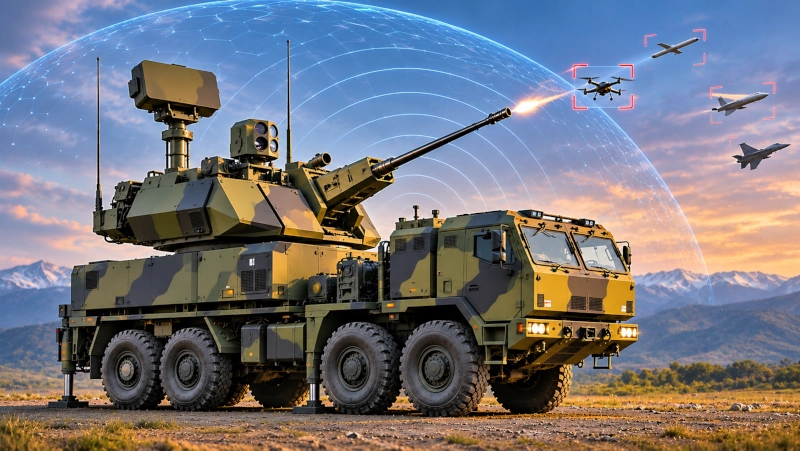
British defence manufacturer BAE Systems is exploring a partnership with Indian industry for the potential domestic production of its Swedish-developed Bofors TRIDON Mk2 mobile air defence system. The proposed collaboration is aimed at positioning the advanced 40 mm gun-based platform for possible Indian Army requirements, particularly in countering unmanned aerial vehicles, loitering munitions, cruise missiles and other emerging airborne threats.
Tony Walton, Managing Director of BAE Systems India, has indicated that the company intends to offer the TRIDON Mk2 to the Indian Army while examining opportunities for manufacturing cooperation with domestic defence companies. The proposal reflects BAE Systems’ broader strategy of strengthening its industrial presence in India through local production, technology partnerships and collaboration with established Indian manufacturers. Although discussions on potential localisation are underway, no Indian production partner has been formally announced, and the Indian Army has not placed a confirmed procurement order for the system.
BAE Systems Targets India’s Emerging Air Defence Requirements
The TRIDON Mk2 is being promoted as a potential solution for India’s evolving ground-based air defence requirements, particularly the need to protect military formations and critical installations against increasingly diverse aerial threats. The growing operational use of small drones, loitering munitions and precision-guided weapons has increased interest in systems capable of providing rapid, sustained and relatively economical protection at shorter engagement ranges.
During discussions reported in October 2026, Walton explained that BAE Systems had highlighted the TRIDON Mk2 in connection with the Indian Army’s interest in 30–40 mm gun-based air defence capabilities. The company considers the system suitable for addressing threats that may not always justify the expenditure associated with launching conventional surface-to-air missiles. Its proposed role would be to complement existing air defence systems rather than replace missile-based protection.
The company is examining a manufacturing arrangement that would involve Indian industry if the system is selected through the country’s defence procurement process. Such an approach would align with India’s emphasis on domestic defence production while potentially creating opportunities for local manufacturing, integration, maintenance and ammunition support. However, the selection of an Indian industrial partner and the establishment of a production facility would depend on future procurement decisions and commercial agreements.
TRIDON Mk2 Combines Bofors 40 mm Gun with Advanced Fire-Control Technology
Developed by BAE Systems Bofors in Sweden, the TRIDON Mk2 is a mobile, remotely operated air defence system built around the established Bofors 40 mm automatic cannon. The platform combines rapid-firing artillery with modern fire-control systems, target-acquisition sensors and programmable ammunition to engage multiple categories of aerial and surface threats.
According to BAE Systems, the system can engage drones, loitering munitions, aircraft, cruise missiles and certain ground targets, including armoured vehicles. Its modular architecture allows the weapon system to be integrated with different vehicle platforms or deployed in stationary configurations, providing flexibility for both mobile military formations and the protection of strategically important installations.
The TRIDON Mk2 has a stated effective engagement range of up to 12 kilometres, depending on the target, ammunition, sensor configuration and surrounding terrain. The system is capable of firing approximately 300 rounds per minute and incorporates its own day-and-night target-acquisition equipment and fire-control capabilities. These characteristics are intended to provide rapid engagement against threats approaching defended positions, although actual effectiveness depends on the operating environment and the nature of the incoming target.
The platform was publicly introduced at the Eurosatory defence exhibition in France in June 2024. BAE Systems presented it as a modern evolution of the Bofors 40 mm gun family, combining established artillery technology with updated sensors, ammunition and vehicle integration capabilities designed for contemporary battlefield requirements.
Programmable 3P Ammunition Strengthens Counter-Drone Capabilities
One of the principal technological features of the TRIDON Mk2 is its compatibility with Bofors 3P programmable ammunition. The designation refers to pre-fragmented, programmable and proximity-fuzed ammunition, which is designed to provide different engagement effects against a variety of targets.
Unlike conventional ammunition that relies primarily on direct impact, programmable rounds can be configured for different operating conditions and target characteristics. This flexibility is particularly relevant when engaging small or manoeuvring aerial targets, where the ability to generate a controlled fragmentation effect near the target can improve the effectiveness of gun-based air defence.
The combination of programmable ammunition and modern fire-control technology enables the TRIDON Mk2 to address different threat categories without requiring an entirely separate weapon system for each type of engagement. Its ability to use a common 40 mm gun platform for multiple defensive roles could make it suitable for layered air defence arrangements in which guns, missiles, sensors and electronic warfare systems operate together.
BAE Systems has also expressed interest in exploring local ammunition manufacturing if the TRIDON Mk2 progresses into an Indian acquisition programme. Walton indicated that domestic ammunition production could logically accompany local gun manufacturing, potentially creating additional opportunities for Indian defence manufacturers. Nevertheless, discussions concerning ammunition partnerships remain preliminary, and no Indian manufacturing arrangement for TRIDON Mk2 ammunition has been confirmed.
Swedish Procurement Demonstrates International Interest in TRIDON Mk2
The TRIDON Mk2 has already attracted confirmed procurement interest outside India. On April 2, 2026, BAE Systems announced that it had secured a contract worth approximately USD 180 million from Sweden’s Defence Materiel Administration for the air defence system.
The Swedish procurement represents a significant development for the programme, demonstrating that the system has progressed beyond its initial public presentation into contracted production. BAE Systems also confirmed that Sweden’s Defence Materiel Administration had procured TRIDON Mk2 systems on behalf of Sweden and Denmark in February 2026 for transfer to Ukraine as part of efforts to strengthen Ukrainian air defence capabilities.
The manufacturer describes the TRIDON Mk2 as a modular system intended to provide effective protection against evolving aerial threats while remaining relatively straightforward to deploy and maintain. Its ability to engage different target categories has become particularly relevant as armed forces seek additional defensive capabilities against unmanned aircraft and other airborne threats.
While these international contracts establish the programme’s commercial development, they do not constitute an Indian procurement commitment. Any acquisition by the Indian Army would require a separate evaluation and procurement process based on operational requirements, technical performance, commercial considerations and domestic manufacturing arrangements.
BAE Systems Builds on Existing Indian Defence Manufacturing Partnerships
BAE Systems’ interest in localising TRIDON Mk2 production follows its continuing efforts to expand cooperation with Indian defence manufacturers. The company has established industrial relationships across several defence segments, including partnerships involving military vehicles, weapons and aerospace technologies.
One of its recent initiatives involves cooperation with Larsen & Toubro on the BvS10 Sindhu articulated all-terrain vehicle programme. Manufacturing activities associated with the programme have commenced at L&T’s Armoured Systems Complex in Gujarat, providing an example of BAE Systems’ approach to working with Indian industry on advanced military platforms.
During discussions with journalists in October, BAE Systems executives identified ground-based air defence as another potential area for cooperation. Walton indicated that the company would seek an Indian industrial arrangement for TRIDON Mk2 broadly consistent with its localisation approach in other defence programmes.
The existence of the BvS10 Sindhu partnership does not establish that Larsen & Toubro has been selected for TRIDON Mk2 manufacturing. BAE Systems has not publicly identified a confirmed Indian partner for the air defence system, and the proposed localisation arrangement remains subject to future developments.
If a domestic production programme proceeds, potential industrial activities could include vehicle integration, precision component manufacturing, mechanical assemblies, fire-control integration, ammunition production and maintenance support. The actual scope of Indian participation would depend on the commercial structure of any future agreement and the technologies made available for local manufacturing.
Potential Contribution to India’s Layered Air Defence Network
The proposed introduction of TRIDON Mk2 comes at a time when modern armed forces are placing greater emphasis on protecting military assets against low-altitude and relatively inexpensive airborne threats. Small unmanned aircraft can perform reconnaissance, identify targets and deliver explosive payloads, while larger loitering munitions can threaten vehicles, logistics infrastructure and command facilities.
Countering these threats requires a combination of detection, identification, tracking and engagement capabilities. Missile-based air defence systems remain important for intercepting aircraft and other higher-value threats, but their use against comparatively inexpensive drones can create operational and economic challenges. Gun-based systems equipped with modern sensors and programmable ammunition can provide an additional defensive layer where engagement conditions permit.
The TRIDON Mk2 is designed to operate within this broader defensive architecture. Its mobility could allow it to accompany ground formations or provide protection for selected military installations, while its remotely operated weapon system and fire-control capabilities are intended to support rapid engagement against approaching threats.
For India, any assessment of the platform would need to consider its compatibility with existing surveillance and air defence networks, performance against relevant threat profiles, ammunition availability, maintenance requirements and overall acquisition costs. Domestic manufacturing could also influence the long-term viability of the system by supporting local supply chains and reducing dependence on imported components and maintenance services.
The platform’s possible role would therefore be determined not merely by its individual weapon performance but by how effectively it could be integrated into the Indian Army’s wider air defence structure.
Indian Manufacturing Proposal Awaits Procurement Decisions
BAE Systems’ proposed localisation of the TRIDON Mk2 represents another potential opportunity for India’s defence manufacturing industry to participate in the production of advanced military systems. A future partnership could provide opportunities for Indian companies specialising in vehicle manufacturing, precision engineering, weapon integration, ammunition and electronic systems, depending on the eventual procurement and industrial arrangements.
However, the initiative remains at the exploratory stage. There has been no official announcement identifying an Indian manufacturing partner, approving a domestic production facility or confirming an Indian Army order for the system. The discussions therefore represent a prospective industrial opportunity rather than an established manufacturing programme.
The proposal also predates the latest reports published on November 3, 2026. BAE Systems’ interest in manufacturing TRIDON Mk2 in India was reported in July, with further executive comments on the system and potential industrial cooperation emerging in October. The recent coverage reinforces the company’s continuing interest but does not establish a new manufacturing agreement.
The possible introduction of the Bofors TRIDON Mk2 into India’s defence manufacturing ecosystem reflects the growing importance of mobile gun-based air defence systems in addressing contemporary aerial threats. With BAE Systems seeking to combine its established weapons technology with Indian manufacturing capabilities, the proposal could develop into a significant industrial collaboration if future procurement decisions support it. Until then, the programme remains an example of prospective international defence cooperation rather than a confirmed Indian acquisition.
Sources: BAE Systems official TRIDON Mk2 product documentation and announcements dated June 13, 2024, and April 2, 2026; BAE Systems executive statements reported by Janes in July 2026; Indian Aerospace and Defence Bulletin and Aviation Defence Universe, October 2026; IDRW, November 3, 2026.
You may also like
-
Chennai Space Startup Inbound Aerospace Seeks $10 Million to Develop Reusable Spacecraft
-
ISRO’s Space Supply Chain Opens New Opportunities for Indian Companies as Gayatri Rubbers Enters Aerospace Sector
-
Maestros Electronics Wins ₹1.67 Crore Order to Equip Four Indian Navy Ships with Telemedicine Systems
-
MIDHANI, BARC and Heavy Water Board Join Forces to Recover Strategic Cobalt and Nickel for Defence and Aerospace Industries
-
GE Aerospace Delegation Visits LMW’s Coimbatore Facility to Explore Aerospace Manufacturing Collaboration
