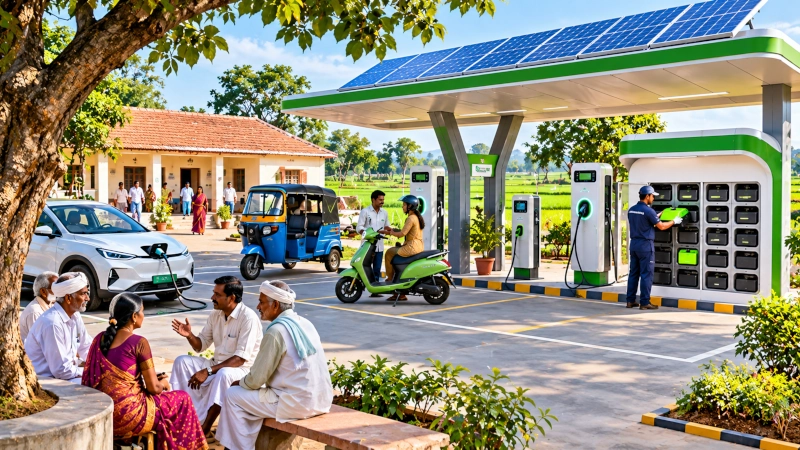
India is taking a significant step towards expanding electric vehicle infrastructure into rural and semi-urban areas through a new partnership between the Ministry of Panchayati Raj and Convergence Energy Services Limited (CESL). The two organisations have signed a Memorandum of Understanding to facilitate the development of electric vehicle charging and battery-swapping stations on suitable Panchayat land across the country. The initiative seeks to improve the availability of charging infrastructure beyond major cities while creating opportunities for rural local bodies to generate additional revenue from public assets.
The agreement was signed on October 30, 2026, during the National Workshop on the People’s Plan Campaign 2026–27 in New Delhi and was officially announced by the Ministry of Panchayati Raj the following day. It provides an institutional framework for identifying suitable land, assessing infrastructure requirements and establishing charging and battery-swapping facilities in coordination with state governments and Panchayati Raj institutions.
According to the Ministry, potential locations include Panchayat premises and suitable land situated along national and state highways. The proposed infrastructure is intended to support different categories of electric vehicles, including two-wheelers, three-wheelers, passenger cars and medium and heavy-duty vehicles. The initiative also aims to strengthen the financial sustainability of Gram, Block and District Panchayats by enabling productive use of land under their administration.
The agreement reflects a wider effort to connect India’s transition towards electric mobility with rural infrastructure development and local financial self-reliance. Instead of concentrating charging facilities exclusively in metropolitan centres and established commercial locations, the partnership seeks to create a mechanism through which rural local bodies can participate in developing the country’s emerging electric mobility network.
Ministry of Panchayati Raj and CESL Establish Framework for Cooperation
The Memorandum of Understanding was exchanged in the presence of Union Minister of Panchayati Raj Rajiv Ranjan Singh and Ministry Secretary Dr. Vineet Joshi. The agreement was signed by Mukta Shekhar, Joint Secretary in the Ministry of Panchayati Raj, and Akhilesh Kumar Dixit, Director of Convergence Energy Services Limited.
CESL is a wholly owned subsidiary of Energy Efficiency Services Limited, an organisation operating within the institutional framework of the Ministry of Power. The company is involved in developing and implementing initiatives associated with energy efficiency, clean energy and electric mobility.
Under the agreement, the Ministry of Panchayati Raj will facilitate coordination with State Panchayati Raj Departments to identify appropriate sites for the proposed charging infrastructure. The Ministry will also support monitoring and administrative coordination associated with implementation.
CESL will undertake the technical and operational responsibilities involved in establishing the facilities. These responsibilities include evaluating potential locations, assessing charging demand, supplying equipment, installing infrastructure, conducting technical tests, commissioning stations and managing their operation and maintenance.
The division of responsibilities is intended to combine locally available land with the specialised technical capabilities required to establish electric vehicle infrastructure. Panchayats may administer land suitable for charging stations, but many local bodies may not independently possess the engineering expertise, financial resources or operational systems required to develop and maintain such facilities.
Through the partnership, the government seeks to create a structured arrangement in which rural local bodies can provide access to suitable assets while a specialised organisation undertakes the technical development of the infrastructure.
Expanding Electric Vehicle Charging Beyond Urban Centres
The availability of convenient and reliable charging infrastructure remains an important factor influencing the adoption of electric vehicles. Although public charging networks have expanded in several major cities and along selected highways, the distribution of facilities across rural and semi-urban India remains uneven.
Many journeys involve travel between villages, nearby towns, agricultural markets, industrial centres, schools and healthcare facilities. Electric vehicle users travelling along these routes require dependable charging options, particularly when the available driving range or operating schedule makes home charging insufficient.
The proposed use of Panchayat land could help address this infrastructure requirement by creating additional locations for charging services in areas that may otherwise receive limited private investment.
Sites near national and state highways are particularly relevant because they can potentially serve both local users and vehicles undertaking longer journeys. Charging facilities at such locations could support passenger vehicles, commercial fleets, delivery services and other forms of electric transportation.
However, the technical requirements of these facilities will vary considerably according to the categories of vehicles expected to use them. Electric two-wheelers and three-wheelers generally require different charging arrangements from passenger cars or heavy commercial vehicles.
Larger vehicles may require higher-capacity electrical connections and more specialised equipment, while smaller mobility applications may be served through comparatively modest installations.
The agreement therefore provides for technical assessments and demand evaluation before individual charging facilities are established. This approach is intended to ensure that the infrastructure developed at each location reflects actual requirements rather than following a uniform model regardless of local conditions.
Battery-Swapping Facilities Could Support Commercial Electric Mobility
The partnership also includes provisions for establishing battery-swapping facilities at suitable locations. Battery swapping allows a compatible electric vehicle to exchange a depleted battery for a charged unit instead of remaining stationary while the original battery is recharged.
This arrangement can reduce the time required for vehicles to resume operations and may be particularly useful for commercial mobility applications involving frequent journeys.
Electric three-wheelers, local delivery vehicles and certain categories of electric two-wheelers are among the applications where battery-swapping technology may offer practical advantages.
In rural and semi-urban areas, three-wheelers play an important role in passenger transportation and the movement of goods between settlements and commercial centres. Electric versions of these vehicles could benefit from access to charging and swapping infrastructure where sufficient demand exists.
For commercial operators, the time required to recharge a vehicle can influence daily utilisation and operating costs. Battery swapping may provide an alternative where compatible vehicle platforms and suitable commercial arrangements are available.
Nevertheless, the technology also requires reliable battery management, equipment compatibility, electrical infrastructure and appropriate safety procedures. Battery ownership arrangements, maintenance responsibilities and the cost of maintaining charged battery inventories are important considerations for operators.
The agreement between the Ministry and CESL provides a mechanism for exploring such facilities, but it does not establish that every location will include battery-swapping services. The eventual configuration of each station will depend on demand, technical feasibility and the operational requirements of local users.
Panchayat Land to Become a Source of Infrastructure and Revenue
One of the most significant aspects of the initiative is its emphasis on the productive use of Panchayat-owned land. Rural local bodies administer public assets and undertake responsibilities relating to civic infrastructure, community services and local development, but their ability to finance these activities can be constrained by limited locally generated revenue.
The Ministry of Panchayati Raj has identified the strengthening of Own Sources of Revenue as an important component of improving the financial sustainability of rural local governments.
The proposed charging and battery-swapping initiative seeks to create opportunities for Gram, Block and District Panchayats to generate recurring income from suitable public land.
Depending on the commercial arrangements developed for individual projects, revenue could arise through the permitted use of land and associated infrastructure agreements. Such income may provide additional financial resources for maintaining public assets, improving civic amenities and supporting local development activities.
The initiative therefore links electric mobility infrastructure with the wider objective of strengthening Panchayat finances. Rather than treating land solely as an administrative resource, the government is exploring ways in which suitable public assets can support new infrastructure while generating economic value for rural communities.
However, the amount of revenue that a Panchayat may receive will depend on several factors, including location, demand, infrastructure utilisation, operating expenses and the terms of the agreement governing the facility.
The government has not announced a uniform revenue-sharing formula or guaranteed income for participating Panchayats. The financial benefits will therefore need to be evaluated as individual projects move towards implementation.
Strengthening Financial Self-Reliance of Rural Local Governments
The agreement was announced during a national workshop focused on developing stronger and more financially independent Panchayati Raj institutions.
Addressing the gathering, Union Minister Rajiv Ranjan Singh emphasised the need to strengthen Panchayats as effective institutions of local development and democratic governance. He highlighted the importance of participatory planning, better coordination among government departments and stronger financial resources for rural local bodies.
The Minister also underscored the role of Gram Sabhas in identifying community priorities and preparing development plans that reflect local requirements.
The Ministry has introduced Model Panchayat Tax, Rates and Fees Rules to encourage transparent and accountable mobilisation of local revenue.
These measures are intended to provide a broader framework through which rural local bodies can improve their financial capabilities and reduce excessive dependence on external grants.
The electric vehicle infrastructure initiative complements this approach by identifying a potential revenue-generating activity connected to a growing national infrastructure requirement.
For Panchayats located near major transportation corridors or commercial centres, charging facilities could provide opportunities for using public assets in ways that support both infrastructure development and local finances.
At the same time, the commercial viability of such arrangements will depend on appropriate site selection and effective implementation.
CESL to Assess Technical Feasibility and Charging Demand
Developing electric vehicle charging infrastructure requires careful examination of the technical and commercial characteristics of individual locations.
Under the agreement, CESL will undertake site assessments and demand aggregation before proceeding with installation.
Site assessments will need to consider the availability and suitability of land, road access, electricity supply, connection requirements and other conditions necessary for operating charging facilities.
The expected number and categories of electric vehicles using a particular location will also influence the design of the infrastructure.
A charging station situated near a busy highway may require different equipment and electrical capacity from a facility serving a village market or local transportation centre.
Demand aggregation is intended to help identify areas where charging requirements are sufficient to support the establishment and sustained operation of facilities.
Following the identification of suitable locations, CESL will be responsible for supplying and installing equipment, undertaking technical testing and commissioning the facilities.
The company will also manage operation and maintenance under the agreed framework.
These responsibilities are important because charging infrastructure requires ongoing maintenance, reliable electrical connections and effective management to remain useful to vehicle operators.
The agreement is intended to provide a coordinated implementation mechanism rather than requiring individual Panchayats to independently develop the necessary technical capabilities.
Highway Locations Could Strengthen Regional Electric Mobility
The inclusion of suitable Panchayat land along national and state highways gives the initiative a wider transportation dimension.
India’s highway network connects major cities with smaller towns, villages, industrial areas and agricultural markets. Many of these routes pass through locations administered by rural local bodies.
The availability of suitable land near such routes could create opportunities to establish charging facilities that serve both local communities and vehicles travelling between regions.
For electric passenger vehicles, highway charging infrastructure can improve the practicality of longer journeys by providing access to electricity outside urban areas.
For commercial operators, strategically located charging facilities can support more predictable travel schedules and reduce concerns regarding access to charging services.
The potential benefits may be particularly relevant to electric vehicles used in goods transportation and regional passenger services.
However, the infrastructure requirements of medium and heavy-duty electric vehicles can be substantial. Appropriate electrical capacity, charging equipment and operational arrangements will be necessary to support such vehicles.
The partnership provides a framework for assessing these requirements at potential locations.
Its long-term contribution to regional electric mobility will depend on the number of operational facilities eventually established, their geographical distribution and their reliability.
Connecting Panchayat Infrastructure With India’s Clean Mobility Policies
The initiative forms part of a wider policy environment supporting the adoption of electric vehicles and the development of associated infrastructure.
The Government of India has introduced several measures intended to strengthen charging networks and encourage investment in electric mobility.
In September 2024, the Ministry of Power issued guidelines for the installation and operation of electric vehicle charging infrastructure. These guidelines establish a framework for developing charging facilities and addressing relevant technical and operational requirements.
Further guidelines relating to battery-swapping and charging stations were issued in 2025.
The Ministry of Heavy Industries has also allocated ₹2,000 crore for public electric vehicle charging infrastructure under the PM Electric Drive Revolution in Innovative Vehicle Enhancement scheme, commonly known as PM E-DRIVE.
These initiatives reflect the importance of developing supporting infrastructure alongside measures intended to encourage electric vehicle adoption.
The agreement between the Ministry of Panchayati Raj and CESL adds a distinct rural governance component to these efforts by addressing the availability of land and coordination with local institutions.
However, the agreement does not establish that every proposed Panchayat charging station will automatically receive financial assistance under PM E-DRIVE. The funding and implementation arrangements applicable to individual projects will depend on the relevant schemes and subsequent decisions.
Rural Electric Mobility Could Benefit Local Transportation
The development of charging infrastructure outside urban centres could support several transportation requirements in rural India.
Residents of villages and smaller towns depend on transport services for accessing employment, educational institutions, healthcare facilities, agricultural markets and other essential services.
Electric two-wheelers and three-wheelers may offer suitable mobility options for certain travel requirements, while larger electric vehicles could support commercial transportation where infrastructure and operating conditions permit.
Access to convenient charging facilities could improve the practical usability of these vehicles and reduce dependence on charging arrangements located far from their normal operating areas.
For local commercial operators, reliable charging or battery-swapping facilities may help improve vehicle availability and support more consistent operations.
However, charging infrastructure alone does not determine the pace of electric vehicle adoption.
Vehicle affordability, electricity reliability, maintenance services, battery performance and the availability of appropriate vehicle models are also important factors.
The proposed infrastructure could address one part of this wider challenge by expanding access to charging services where sufficient demand exists.
The benefits will vary across regions and will depend on the eventual distribution of facilities and the development of local electric vehicle markets.
People’s Plan Campaign Emphasises Community Participation
The agreement was signed during the National Workshop on the People’s Plan Campaign 2026–27, organised by the Ministry of Panchayati Raj in New Delhi on October 30.
The workshop brought together more than 400 participants, including representatives from state governments, Panchayati Raj institutions and organisations associated with rural development.
The People’s Plan Campaign operates under the theme Sabki Yojana, Sabka Vikas and seeks to strengthen participatory planning at the Gram, Block and District Panchayat levels.
The campaign encourages local communities to identify development priorities through Gram Sabha meetings and incorporate them into structured Panchayat Development Plans.
The 2026–27 campaign commenced on October 2, 2026, with special Gram Sabha meetings organised across the country.
During the national workshop, the Ministry released the People’s Plan Campaign booklet in English and Hindi and discussed measures to improve coordination among government programmes.
The discussions emphasised the importance of ensuring that local development plans reflect community requirements and make effective use of available resources.
The proposed electric vehicle infrastructure initiative is relevant to this approach because decisions concerning the use of Panchayat land and the development of new facilities can be considered within wider local planning processes.
Community participation may also help identify locations where charging infrastructure would be most useful to residents and transport operators.
Pradhan Mantri Viksit Gram Swaraj Yojana to Support Local Governance
The workshop also highlighted the Pradhan Mantri Viksit Gram Swaraj Yojana, a government initiative intended to strengthen the institutional capabilities of Panchayati Raj bodies.
Union Minister Rajiv Ranjan Singh described the programme as an important component of efforts to develop self-reliant Panchayats capable of preparing and implementing effective local development plans.
The initiative focuses on improving institutional capacity, strengthening governance and promoting better coordination between government programmes.
An important objective is to ensure that Panchayat Development Plans are responsive to local requirements and supported by appropriate administrative and financial arrangements.
The programme also emphasises the use of digital governance systems and improved mechanisms for planning and monitoring development activities.
The development of sustainable local revenue sources is closely connected to these objectives because financial resources influence the ability of Panchayats to maintain public assets and provide community services.
The agreement with CESL offers one potential mechanism through which rural local bodies may generate revenue while participating in the expansion of clean transportation infrastructure.
Digital Platforms to Improve Rural Development Planning
The Ministry of Panchayati Raj has also highlighted the role of digital systems in improving local development planning and administrative coordination.
During the workshop, Secretary Dr. Vineet Joshi emphasised the importance of strengthening coordination between digital platforms, including eGramSwaraj and the Samarth Panchayat Portal.
These platforms support different functions associated with Panchayat administration, planning and financial management.
Improved coordination between such systems can help local authorities use available information more effectively when preparing development plans and monitoring infrastructure projects.
Evidence-based planning is particularly relevant to initiatives involving public assets and commercial infrastructure because their success depends on understanding local conditions.
For electric vehicle charging stations, decisions concerning location and capacity should reflect vehicle movement, electricity availability, land suitability and expected demand.
The technical assessments proposed under the CESL agreement could therefore complement the wider emphasis on data-informed local planning.
Together, these arrangements may help improve the relationship between infrastructure investment and actual community requirements.
Implementation Will Depend on Local Conditions and Financial Viability
Although the signing of the agreement represents a confirmed government initiative, the proposed charging network remains at the planning and implementation stage.
The Ministry of Panchayati Raj has not announced a specific nationwide target for the number of charging or battery-swapping facilities to be established.
The official release also does not provide a consolidated project investment figure, state-wise allocation or fixed deadline for completing the proposed infrastructure.
These details will depend on subsequent site selection, technical assessments and implementation arrangements.
The availability of suitable Panchayat land will be an important consideration, but other factors will also influence whether individual projects proceed.
Reliable electricity supply, connection capacity, equipment costs, expected vehicle utilisation and maintenance requirements will affect technical and commercial feasibility.
State government coordination will be necessary to address applicable land administration and infrastructure requirements.
Where charging stations are developed, their long-term viability will depend on operational reliability and sufficient demand from users.
The memorandum therefore establishes an institutional framework for developing infrastructure rather than confirming that a nationwide network has already been constructed.
The distinction is important because the agreement represents the beginning of a coordinated development process, with individual projects expected to follow further assessments and approvals.
Towards Greener Mobility and Financially Stronger Panchayats
The agreement between the Ministry of Panchayati Raj and Convergence Energy Services Limited represents an effort to combine India’s clean mobility objectives with the developmental priorities of rural local governments.
By identifying suitable Panchayat land for electric vehicle charging and battery-swapping facilities, the initiative aims to improve access to essential infrastructure beyond major cities while creating opportunities for recurring local revenue.
The programme could support regional electric mobility by providing charging services along important transportation corridors and in rural locations where sufficient demand exists.
For Panchayats, the productive use of suitable public assets could generate additional financial resources for local infrastructure and community services.
For electric vehicle users, the eventual establishment of reliable charging and swapping facilities could improve the practicality of electric mobility in areas where infrastructure remains limited.
The success of the initiative will depend on careful site selection, appropriate technology, financial viability and sustained coordination among government institutions and implementing agencies.
As the partnership progresses towards implementation, it offers a framework through which rural local bodies can participate more directly in India’s expanding electric mobility ecosystem.
The development reflects a broader approach to infrastructure planning in which clean transportation, local economic opportunities and the financial sustainability of Panchayati Raj institutions are addressed together.
References
Ministry of Panchayati Raj, Press Information Bureau, Government of India, 31 October 2026. Official announcement concerning the National Workshop on the People’s Plan Campaign 2026–27 and the Memorandum of Understanding between the Ministry of Panchayati Raj and Convergence Energy Services Limited for establishing electric vehicle charging and battery-swapping infrastructure on Panchayat land.
https://www.pib.gov.in/PressReleseDetailm.aspx?PRID=2330751
Ministry of Panchayati Raj, Press Information Bureau, Government of India, 29 October 2026. Official announcement concerning preparations for the National Workshop on the People’s Plan Campaign 2026–27 and the proposed agreement for electric vehicle charging and battery-swapping facilities.
https://www.pib.gov.in/PressReleaseIframePage.aspx?PRID=2330147
Ministry of Power, Press Information Bureau, Government of India, 6 August 2026. Official information concerning electric vehicle charging infrastructure guidelines, battery-swapping arrangements and government initiatives supporting the electrification of transportation.
https://www.pib.gov.in/PressReleasePage.aspx?PRID=2295696
Ministry of Heavy Industries, Press Information Bureau, Government of India, 9 December 2025. Official parliamentary response concerning electric vehicle charging infrastructure and the allocation of ₹2,000 crore for public charging facilities under the PM E-DRIVE scheme.
https://www.pib.gov.in/PressReleaseIframePage.aspx?PRID=2200851
You may also like
-
Centre Approves ₹710 Crore for 509 Km of Rural Roads in Mizoram, Connecting 48 Habitations for First Time
-
India Expands Electric Vehicle Research Infrastructure as ARAI Inaugurates Advanced Testing Facilities
-
India Launches DEPA Framework to Enable Secure AI Training While Protecting Data Sovereignty
-
Sun Pharma Reportedly Secures Indian Regulatory Approval for Generic Oral Semaglutide Tablets
-
India’s Startup Ecosystem Expands as Technology Companies Gain Greater Access to Public Capital Markets
