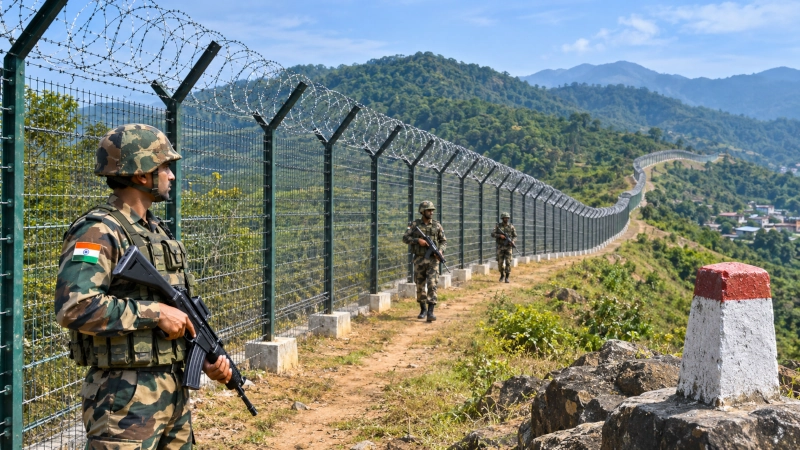
India is strengthening security infrastructure along its international boundary with Myanmar, with approximately 55 kilometres of border fencing completed in Manipur and preparatory construction advancing across another 80 kilometres. The ongoing project is part of the government’s efforts to improve border surveillance, regulate cross-border movement and address security challenges along India’s strategically important northeastern frontier.
The development comes amid renewed attention to border infrastructure following an inspection by Assam Rifles Director General Lieutenant General Vikas Lakhera on October 28, 2026. During his visit to Moreh and Chongjang in Manipur’s Tengnoupal district, the senior military officer reviewed the progress of fencing construction, existing security arrangements and the operational preparedness of personnel deployed along the India–Myanmar boundary.
Manipur shares approximately 398 kilometres of international border with Myanmar. Much of this boundary passes through mountainous terrain, dense forests and remote settlements, creating significant challenges for conventional surveillance, patrolling and infrastructure development. The fencing project is intended to strengthen the security framework along these difficult stretches while supporting more effective monitoring of movement across the international boundary.
Manipur Government Confirms Completion of 55 Kilometres of Fencing
Manipur Home Minister Govindas Konthoujam informed the State Legislative Assembly on September 2, 2026, that approximately 55 kilometres of fencing had been completed along the state’s international boundary with Myanmar. He explained that the work was progressing as part of a broader initiative to strengthen border management and improve security arrangements in areas vulnerable to unauthorised movement and cross-border criminal activities.
The minister also indicated that the government was working towards completing the border fencing project by 2028. However, he acknowledged that difficult terrain and logistical constraints, particularly the transportation of construction materials to remote locations, continued to affect the pace of implementation.
Further details were provided by Chief Minister Yumnam Khemchand Singh in October 2026. According to the Chief Minister, the ongoing project covers approximately 240 kilometres of the India–Myanmar border in Manipur and involves an estimated expenditure of ₹3,223 crore. While fencing had been completed along 55 kilometres, supporting piers had already been erected along an additional 80 kilometres, indicating that preparatory construction was progressing beyond the finished sections.
The distinction between these figures is important because the erection of supporting piers does not constitute completion of the actual border fence. Based on the government’s reported figures, approximately 23% of the identified 240-kilometre project had been fenced, while the remaining sections were at different stages of preparation or construction. The completed 55 kilometres represent approximately 14% of Manipur’s entire 398-kilometre international boundary.
Assam Rifles Chief Reviews Border Infrastructure and Security Preparedness
The progress of the fencing project received renewed attention following the October 28 inspection by Lieutenant General Vikas Lakhera, Director General of the Assam Rifles. The senior officer visited Moreh and Chongjang in Tengnoupal district, where he examined the prevailing security situation, ongoing infrastructure development and operational arrangements along the international boundary.
At Moreh, Lieutenant General Lakhera interacted with local residents and reviewed the conditions affecting communities living near the border. He also examined the progress of infrastructure development and assessed the readiness of security personnel responsible for monitoring sensitive stretches of the frontier.
During his subsequent visit to Chongjang, the Assam Rifles chief inspected ongoing border fencing work and reviewed the technical and physical progress of construction. According to information released by Headquarters Inspector General Assam Rifles (South), he emphasised the importance of continuous surveillance, operational preparedness and effective coordination among security agencies.
The inspection highlighted the relationship between physical border infrastructure and broader security operations. While fencing can help regulate movement and establish clearer physical barriers, its effectiveness depends on regular patrolling, intelligence gathering, communications infrastructure and the ability of security forces to respond quickly to emerging threats.
Strategic Importance of the India–Myanmar International Border
India shares an international boundary of approximately 1,643 kilometres with Myanmar, extending across Arunachal Pradesh, Nagaland, Manipur and Mizoram. Manipur accounts for approximately 398 kilometres of this boundary, making border management an important component of the state’s security environment.
The international frontier passes through geographically difficult areas characterised by steep hills, extensive forest cover and limited road connectivity. These conditions complicate the movement of personnel, transportation of equipment and maintenance of surveillance infrastructure. In several locations, the terrain also makes the construction of conventional fencing considerably more challenging than along comparatively accessible international boundaries.
The border has longstanding historical, cultural and economic connections, with communities on both sides maintaining traditional relationships. These connections make the management of cross-border movement a complex responsibility requiring coordination between security agencies, civilian authorities and local communities.
India’s northeastern region also occupies an important position in the country’s wider connectivity with Southeast Asia. Consequently, maintaining security along the Myanmar frontier is relevant not only to internal security but also to the development of reliable transport corridors, regulated trade and long-term regional connectivity.
Border Fencing to Address Smuggling and Unauthorised Movement
One of the principal objectives of the fencing initiative is to improve the ability of security agencies to monitor and regulate cross-border movement. Concerns relating to arms smuggling, narcotics trafficking, unauthorised crossings and the activities of criminal networks have contributed to the emphasis on stronger physical security infrastructure along the India–Myanmar boundary.
The mountainous terrain and extensive forest cover provide significant challenges for conventional monitoring. In areas where physical barriers are absent, security forces must depend heavily on patrols, observation posts, intelligence inputs and local information to identify potentially unauthorised activity.
Border fencing is intended to complement these arrangements by establishing more clearly defined barriers and directing legitimate cross-border movement towards designated points where appropriate verification and security procedures can be undertaken. Such infrastructure can also support surveillance operations by helping security personnel identify vulnerable locations and monitor activities along sensitive stretches.
However, physical fencing cannot independently resolve every security challenge associated with an international boundary. Effective border management requires the integration of surveillance technology, intelligence coordination, reliable communications, adequate personnel deployment and sustained engagement with communities living near the frontier.
The Assam Rifles’ recent review underscores the importance of combining infrastructure development with operational readiness rather than treating fencing as a standalone security solution.
Moreh Remains a Strategically Important Border Town
Moreh, located in Manipur’s Tengnoupal district opposite the Myanmar town of Tamu, remains one of the most important locations along the India–Myanmar international boundary. The town has historically functioned as a centre for cross-border commerce and movement, giving it significance in both economic connectivity and security management.
Its geographical position also places Moreh near sensitive stretches of the international frontier where boundary alignment and demarcation have required attention. During proceedings in the Manipur Legislative Assembly in September, Home Minister Govindas Konthoujam identified the area between Border Pillars 75 and 79 in the Moreh sector as particularly sensitive.
Other locations, including stretches around Molchom and Choro Khunou, have also been identified in discussions concerning boundary management and fencing. These areas demonstrate the practical difficulties involved in implementing physical security infrastructure where geographical conditions and historical boundary arrangements require careful examination.
Questions have also been raised about reports suggesting possible territorial adjustments between India and Myanmar. Responding to these concerns in the Assembly, the Home Minister stated that the Manipur government had not received official communication from the Ministry of External Affairs regarding any proposed exchange of territory.
The government has maintained that boundary-related concerns require appropriate administrative and diplomatic consideration. Accurate demarcation remains important because fencing must be constructed with due regard to the recognised international boundary and the circumstances of communities living nearby.
Difficult Terrain Presents Major Engineering Challenges
The construction of border fencing across Manipur involves substantial logistical and engineering requirements because of the difficult landscape. Unlike relatively level border regions, many stretches of the India–Myanmar boundary pass through steep hills, forested areas and remote locations where access roads and transport infrastructure are limited.
Moving construction materials, machinery and supporting equipment to these locations can be complicated and expensive. The installation of fencing also requires foundations and supporting structures capable of remaining stable under the geographical and environmental conditions of the region.
The state government has acknowledged that logistical constraints have contributed to delays in project implementation. Transporting materials across difficult terrain and ensuring their availability at remote construction sites remain important factors affecting the pace of work.
The reported installation of supporting piers along another 80 kilometres indicates that preparatory engineering activities have progressed beyond the sections where fencing has already been completed. Nevertheless, these stretches will require additional construction before they can be counted as operational fencing.
The government’s stated target of completing the project by 2028 provides a planning objective, although the actual schedule will depend on construction progress, accessibility, engineering conditions and the resolution of relevant administrative issues.
Assam Rifles Plays a Critical Role in Border Security
The Assam Rifles is responsible for important security functions along the India–Myanmar border, including surveillance, patrolling and supporting efforts to prevent unauthorised cross-border movement. Its deployments in Manipur place the force at the forefront of managing security challenges in several sensitive border areas.
The force’s responsibilities extend beyond maintaining a physical presence along the international boundary. Effective operations require intelligence gathering, coordination with other agencies, monitoring of vulnerable routes and continuous assessment of developments affecting the security environment.
The October inspection by Lieutenant General Lakhera reflected these operational priorities. His emphasis on surveillance and readiness highlighted the need to ensure that infrastructure development is accompanied by effective field-level security arrangements.
The construction of border fencing can improve the ability of deployed personnel to monitor selected stretches, but its effectiveness will depend on integration with observation posts, communications networks, patrolling arrangements and other security measures.
Coordination between the Assam Rifles, state authorities and other relevant agencies will therefore remain important as the fencing project advances.
Border Infrastructure and Stability in Northeast India
Strengthening the India–Myanmar border is connected to India’s broader efforts to improve security and infrastructure across the northeastern region. The geographical proximity of Manipur to Myanmar makes developments across the international boundary relevant to local security conditions, cross-border movement and regional connectivity.
The continuing instability in parts of Myanmar has added to the complexity of managing the frontier. Security agencies must address possible threats while ensuring that legitimate humanitarian, administrative and community-related concerns receive appropriate consideration.
Infrastructure development can assist security forces by improving access to remote locations, supporting the deployment of surveillance equipment and enabling more effective responses to incidents. However, maintaining stability also requires cooperation with local communities and attention to the social and economic circumstances of border settlements.
The construction of fencing may affect traditional movement patterns and access arrangements in some locations. Consequently, consultation with affected communities and coordination between civilian and security authorities remain important elements of implementation.
A sustainable border management framework must balance the need to prevent illegal activities with the practical requirements of lawful movement, local livelihoods and regional stability.
India Advances Towards Stronger Border Management
The completion of approximately 55 kilometres of fencing along Manipur’s international boundary with Myanmar represents measurable progress in India’s efforts to strengthen security infrastructure along its northeastern frontier. The additional 80 kilometres where supporting piers have been erected indicate that construction preparations are continuing across further sections of the planned project.
The ₹3,223-crore initiative covering approximately 240 kilometres reflects the scale of the government’s infrastructure undertaking in a geographically challenging region. Its successful implementation will require sustained construction activity, coordination among government agencies and careful attention to boundary-related and community concerns.
The recent inspection by the Assam Rifles Director General has reinforced the importance of maintaining surveillance, operational preparedness and effective coordination while physical infrastructure development continues.
As India works towards the government’s stated 2028 completion target, the central objective remains the establishment of a more effective and integrated border management system. By combining fencing with surveillance capabilities, reliable infrastructure and sustained security operations, the country aims to improve the protection of its international boundary while supporting stability and regulated connectivity along the India–Myanmar frontier.
You may also like
-
Indian Navy Achieves Major Milestone as Rafale Marine Fighter Successfully Lands on INS Vikrant
-
Munish Forge Secures ₹19.18-Crore Defence Order from Armoured Vehicles Nigam Limited
-
Quad Announces Over $85 Million Initiative to Expand Trusted Artificial Intelligence Across Indo-Pacific
-
India Hosts First BIMSTEC Maritime Security Exercise in Andaman and Nicobar Islands to Strengthen Bay of Bengal Security
-
Air Chief Marshal Ashutosh Dixit Takes Charge as India’s 29th Chief of Air Staff
