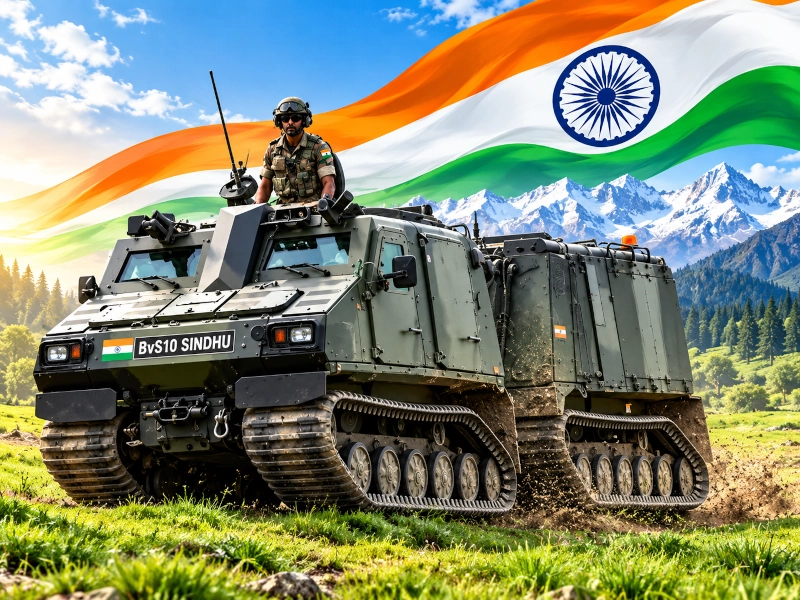
Indian engineering and defence manufacturing major Larsen & Toubro (L&T), in collaboration with British defence company BAE Systems, has commenced production of the BvS10 Sindhu articulated all-terrain vehicles for the Indian Army at its Armoured Systems Complex in Hazira, Gujarat. The manufacturing programme represents an important development in India’s efforts to expand domestic production of specialised military vehicles capable of operating in extreme geographical and climatic conditions.
The commencement of production was formally marked at the Hazira facility on October 28, 2026, following the award of a manufacturing contract by the Indian Army in November 2025. The initial order comprises 18 vehicles, with the first deliveries expected to begin in March 2027.
The BvS10 Sindhu is an upgraded Indian variant of the BvS10 articulated all-terrain vehicle developed by BAE Systems Hägglunds of Sweden. The platform has been adapted to meet the Indian Army’s operational requirements across high-altitude mountains, deserts, marshlands and amphibious environments.
Under the agreement, L&T is responsible for manufacturing the vehicles in India with technical and design assistance from BAE Systems Hägglunds. The contract also includes comprehensive integrated logistics support covering initial deployment, maintenance and life-cycle sustainment.
Manufacturing Begins at L&T’s Armoured Systems Complex in Hazira
The production programme is being undertaken at L&T’s Armoured Systems Complex in Hazira, which serves as an important facility for the company’s defence manufacturing operations.
The commencement ceremony marked the transition of the BvS10 Sindhu programme from procurement and development activities to the manufacturing stage.
According to defence industry reporting, L&T has upgraded the facility with automated manufacturing processes to support production of the specialised articulated vehicles.
Arun Ramchandani, Senior Vice President and Head of Precision Engineering at L&T, highlighted the significance of the programme for the company’s expanding defence manufacturing capabilities.
The collaboration combines L&T’s engineering and industrial production infrastructure with BAE Systems Hägglunds’ expertise in articulated military vehicles designed for difficult operational environments.
The production programme follows a partnership established between the two companies in September 2023, when they announced plans to introduce the BvS10 platform to the Indian market under the Make in India initiative.
The companies subsequently developed the BvS10 Sindhu configuration to meet the Indian Army’s requirements.
The manufacturing contract was formally announced on November 19, 2025, after the vehicle successfully completed a series of demanding military trials.
BvS10 Sindhu Designed for Extreme Indian Terrain
The BvS10 Sindhu is designed to provide military mobility in geographical environments where conventional wheeled vehicles and many tracked platforms face significant limitations.
Its articulated configuration consists of two connected vehicle sections that can move relative to each other, improving manoeuvrability across uneven ground, steep slopes and difficult terrain.
Both sections are supported by tracked running systems that distribute the vehicle’s weight over a relatively large surface area.
This design helps the platform negotiate snow, ice, loose sand, mud, marshland and rocky terrain while maintaining traction and stability.
The articulated arrangement also allows the vehicle to negotiate difficult obstacles and changes in terrain more effectively than many conventional rigid-body vehicles.
BAE Systems describes the BvS10 family as capable of operating across snow, ice, rock, sand, mud, swamps and steep mountain environments.
The platform also possesses amphibious capabilities, enabling it to cross certain waterways and operate in flooded or coastal environments.
These characteristics make the BvS10 Sindhu particularly relevant to the Indian Army’s operational requirements along the country’s northern and western borders.
Indian Army Plans Deployment in Ladakh and Kutch
The initial BvS10 Sindhu vehicles are intended to support Indian Army operations in Ladakh and the Kutch region of Gujarat.
In Ladakh, military personnel must operate across high-altitude terrain characterised by steep gradients, snow-covered routes, rocky surfaces and severe winter conditions.
Operations at elevations approaching 18,000 feet create substantial challenges for vehicles because of reduced atmospheric oxygen, extreme temperatures and difficult ground conditions.
The BvS10 Sindhu has been developed to address such mobility requirements, allowing personnel and essential supplies to be transported across terrain that may be inaccessible to conventional military vehicles.
The platform is also expected to support operations in the Kutch region, where marshland, desert terrain and seasonal flooding create different but equally demanding mobility challenges.
The Great Rann of Kutch contains extensive salt flats and marshy areas where the availability of stable ground can vary significantly with weather and seasonal conditions.
Tracked articulated vehicles can provide operational advantages in these environments because of their ground-pressure characteristics and ability to traverse difficult surfaces.
The deployment of the BvS10 Sindhu could therefore improve the Army’s ability to transport troops, equipment and supplies during patrols and other operations in challenging border regions.
Extensive Trials Conducted Before Indian Army Selection
Before the procurement contract was awarded, the BvS10 Sindhu underwent a series of trials designed to assess its suitability for Indian military conditions.
According to the official announcements issued by L&T and BAE Systems in November 2025, the vehicle successfully completed demanding evaluations in both sea-level and high-altitude environments.
The trials were intended to demonstrate its mobility, operational performance and suitability for different terrains and climatic conditions.
Testing in varied environments is particularly important for specialised military vehicles expected to operate across India’s diverse geographical regions.
High-altitude performance presents challenges for propulsion systems, cooling arrangements and vehicle mobility, while desert and marshland operations impose different requirements concerning traction, stability and mechanical reliability.
The BvS10 Sindhu’s successful completion of the trials contributed to its selection for the Indian Army’s articulated all-terrain vehicle requirement.
The Indian version incorporates adaptations intended to address local operational conditions, although the companies have not publicly disclosed every technical modification included in the final production configuration.
Articulated Tracked Design Provides Enhanced Mobility
The BvS10 platform differs from conventional military transport vehicles through its two-section articulated architecture.
Instead of relying on a single rigid vehicle body, the BvS10 uses interconnected front and rear sections, each supported by tracked running gear.
The articulation mechanism allows the vehicle to maintain improved contact with uneven surfaces while negotiating obstacles and steep terrain.
This configuration is especially useful when operating on snow, soft ground and marshland where conventional wheeled vehicles may experience difficulties maintaining traction.
The tracked arrangement spreads the vehicle’s weight across a greater surface area, helping reduce the pressure exerted on soft terrain.
Another important characteristic is its ability to operate in amphibious environments.
According to BAE Systems, the broader BvS10 platform can traverse flooded areas and coastal waters, providing additional flexibility for military operations.
These capabilities could prove useful for Indian Army formations operating in regions where road infrastructure is limited or environmental conditions restrict conventional vehicle movement.
BvS10 Platform Supports Multiple Military Roles
The broader BvS10 family has been designed to support a range of military missions beyond conventional troop transportation.
According to BAE Systems, the platform’s modular architecture allows it to be configured for personnel transport, command and control, medical evacuation, logistics support, vehicle repair and recovery, situational awareness and weapon-support functions.
This flexibility allows military operators to adapt the basic vehicle platform to different operational requirements.
Personnel transport variants can support troop movement in difficult terrain, while logistics configurations can carry supplies and equipment to forward locations.
Medical evacuation variants may provide mobility for casualty transportation in regions where conventional ambulances cannot operate effectively.
Command and control configurations can accommodate specialised communications and operational equipment, supporting military coordination in remote environments.
The wider BvS10 family can also accommodate weapon systems and other mission-specific equipment.
However, the exact configurations included in the Indian Army’s initial order have not been comprehensively detailed in the official corporate announcements.
The availability of different variants should therefore not be interpreted as confirmation that the Indian Army has ordered every configuration offered within the BvS10 family.
Make in India Programme Strengthens Defence Manufacturing
The BvS10 Sindhu programme supports India’s efforts to expand domestic defence production through licensed manufacturing and international industrial collaboration.
Under the agreement, L&T will manufacture the vehicles at Hazira with technical and design support from BAE Systems Hägglunds.
The arrangement allows manufacturing activities to be undertaken within India rather than relying exclusively on the import of fully assembled military vehicles.
It also creates opportunities for Indian industry to develop capabilities associated with specialised tracked mobility platforms, mechanical systems, vehicle integration and military equipment sustainment.
The programme is particularly relevant because articulated all-terrain vehicles require engineering capabilities that differ from those used in conventional military trucks and armoured vehicles.
Manufacturing such platforms involves specialised chassis designs, tracked propulsion systems, articulation mechanisms, power transmission arrangements and integrated vehicle control systems.
Developing domestic expertise in these technologies can contribute to India’s wider defence manufacturing ecosystem.
The collaboration also provides opportunities for Indian suppliers involved in precision engineering, mechanical assemblies, vehicle components and industrial manufacturing.
Technology Transfer Supports Long-Term Industrial Capabilities
A central component of the L&T–BAE Systems partnership is the provision of technical and design support by BAE Systems Hägglunds.
The Swedish company is the original manufacturer of the BvS10 platform and has developed substantial experience in producing articulated tracked vehicles for military applications.
The licensing arrangement provides a framework for manufacturing the India-specific variant at L&T’s domestic facility.
Such partnerships can help Indian manufacturers acquire experience in producing specialised defence equipment while establishing industrial infrastructure capable of supporting future production requirements.
The programme also includes integrated logistics support for deployment, maintenance and life-cycle sustainment.
This is significant because military vehicle programmes require long-term support beyond the initial manufacturing and delivery stages.
Maintenance facilities, spare parts availability, technical documentation, training and repair capabilities are essential for ensuring that military vehicles remain operational throughout their service lives.
Developing domestic support capabilities can help reduce logistical dependence on overseas facilities and improve the availability of equipment during extended military operations.
BvS10 Family Already Operates with Several International Armed Forces
The BvS10 platform has an established international operating history.
According to BAE Systems, vehicles belonging to the BvS10 family are used by the armed forces of Austria, France, the Netherlands, Sweden, Ukraine and the United Kingdom.
The platform has also been ordered by Germany.
Its adoption by multiple armed forces reflects the demand for specialised vehicles capable of operating in difficult terrain and extreme climatic conditions.
The Indian Army’s procurement represents the platform’s expansion into the Asian defence market.
For BAE Systems Hägglunds, the partnership with L&T creates a manufacturing presence in India and supports the company’s wider international industrial cooperation.
For L&T, the programme provides an opportunity to strengthen its role in the specialised military vehicle manufacturing segment.
The international experience of the BvS10 family provides a foundation for the Indian variant, although the BvS10 Sindhu must still meet the Indian Army’s specific operational and maintenance requirements.
Initial Order Could Lead to Further Manufacturing Opportunities
The Indian Army’s initial procurement covers 18 BvS10 Sindhu vehicles, with deliveries scheduled to commence in March 2027.
At the October 28 production ceremony, L&T’s Arun Ramchandani indicated that the platform could eventually be inducted in larger numbers.
He stated that the Indian Army had identified potential applications for the vehicle in different operational roles.
The remarks suggest that the manufacturer sees opportunities for additional orders as the Army evaluates the platform’s performance and operational utility.
However, no further confirmed procurement contract beyond the initial 18 vehicles has been established through the available official announcements.
Any future expansion of the programme would depend on the Army’s operational requirements, procurement decisions and available funding.
The ability to manufacture the platform domestically could provide advantages if additional orders are placed, particularly by allowing production capacity and maintenance infrastructure to be expanded within India.
Production Marks New Milestone in India’s Military Mobility Capabilities
The commencement of BvS10 Sindhu production at Hazira represents a significant step in the development of India’s specialised military vehicle manufacturing capabilities.
The programme combines a proven international vehicle design with Indian engineering and industrial production infrastructure.
Its successful implementation could strengthen the Indian Army’s ability to operate in high-altitude mountains, marshlands, deserts and other challenging environments.
The platform’s articulated tracked configuration, amphibious capabilities and adaptability to different military roles provide options for improving mobility in regions where conventional vehicles face operational limitations.
The partnership also contributes to India’s efforts to expand domestic defence manufacturing, develop specialised engineering capabilities and establish sustainable support infrastructure for critical military equipment.
With the first deliveries expected to begin in March 2027, the next phase of the programme will involve completing production, meeting quality and acceptance requirements, and preparing the vehicles for operational induction.
The BvS10 Sindhu programme illustrates how international technology partnerships and domestic manufacturing can contribute to the development of specialised military capabilities tailored to India’s geographical and operational requirements.
References
1. Larsen & Toubro Limited — Official Corporate Press Release
“Larsen & Toubro and BAE Systems Secure Indian Army Licensed Manufacturing Contract for BvS10.” November 19, 2025.
Official Source: https://www.larsentoubro.com/pressreleases/2025-11-19-larsen-toubro-and-bae-systems-secure-indian-army-licensed-manufacturing-contract-for-bvs10-3
2. BAE Systems — Official Corporate Announcement
“BAE Systems and Larsen & Toubro Secure Indian Army Licensed Manufacturing Contract for BvS10.” November 19, 2025.
Official Source: https://www.baesystems.com/en-us/article/bae-systems-and-larsen-and-toubro-secure-indian-army-licensed-manufacturing-contract-for-bvs10
3. Larsen & Toubro and BAE Systems — Original Partnership Announcement
“BAE Systems and Larsen & Toubro Team Up to Bring BvS10 All-Terrain Vehicle to India Under the Make in India Programme.” September 14, 2023.
Official Source: https://www.larsentoubro.com/media/48747/2023-09-14-bae-systems-and-larsen-toubro-team-up-to-bring-bvs10-all-terrain-vehicle-to-india.pdf
4. Janes — Defence Industry Reporting
“L&T, BAE Systems Begin BvS10 Sindhu Production for Indian Army.” October 29, 2026. Reporting on the commencement of production at Hazira, the initial 18-vehicle order and the planned March 2027 delivery schedule.
Source: https://www.janes.com/defence-intelligence-insights/defence-news/defence/lt-bae-systems-begin-bvs10-sindhu-production-for-indian-army
You may also like
-
Indian Defence Firm Tonbo Imaging Secures European EO/IR Seeker Export Order with €13 Million Potential
-
Japan Explores Indian Missile Testing Facilities for Long-Range Anti-Ship Weapons and Attack Drones
-
HAL Expands Aerospace Component Procurement, Strengthening Make in India Manufacturing Ecosystem
-
Indian Navy Explores Laser and Microwave Weapons as Future Warships Face Growing Power and Energy Demands
-
India and South Korea Explore Joint Military Technology Development and Defence Industrial Cooperation
