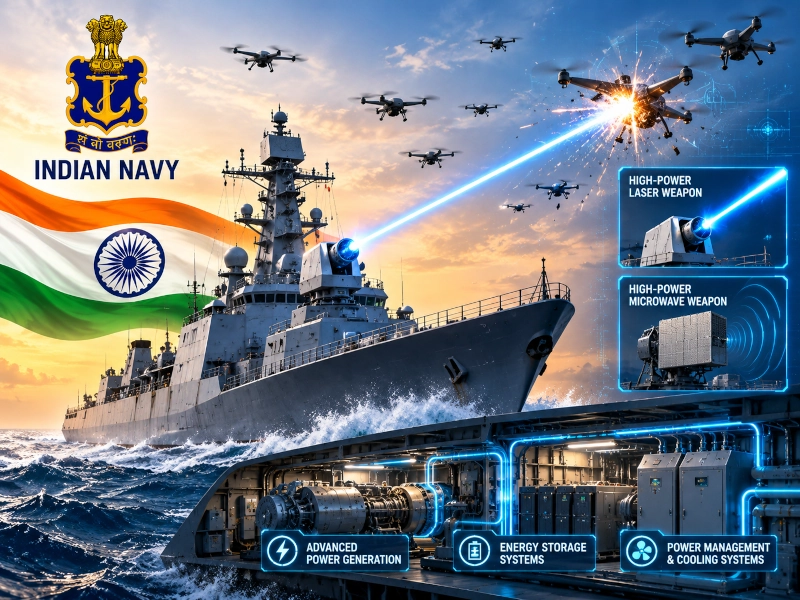
The Indian Navy is exploring advanced directed-energy weapon technologies as part of its efforts to strengthen maritime defence capabilities against emerging threats, particularly unmanned aerial vehicles and coordinated drone attacks. The technologies under consideration include high-power laser systems and high-power microwave weapons, which could provide alternative methods of intercepting aerial threats without relying exclusively on conventional missiles and ammunition.
Vice Admiral Ajay Kochhar, Vice Chief of the Naval Staff, highlighted the importance of emerging defence technologies during a press conference in New Delhi on October 19, 2026, ahead of the fifth edition of the Navy’s Swavlamban 2026 innovation and indigenisation seminar.
The Navy’s interest in directed-energy weapons reflects changing requirements in modern maritime warfare, where increasingly affordable unmanned systems can be deployed in large numbers against expensive naval platforms. Traditional interception methods, particularly surface-to-air missiles, may impose substantial financial and logistical costs when used against comparatively inexpensive drones.
The adoption of laser and microwave weapons could introduce new options for naval air defence. However, integrating these technologies aboard warships presents important engineering challenges, particularly concerning the generation, storage and distribution of large quantities of electrical energy.
Indian Navy Focuses on Directed-Energy Weapons for Counter-Drone Defence
Directed-energy weapons use concentrated electromagnetic energy to disrupt, damage or destroy targets. Unlike conventional guns and missiles, these systems deliver energy directly towards a target rather than launching a physical projectile.
High-energy laser weapons concentrate optical energy onto a target, potentially damaging its structure, sensors or other vulnerable components through intense heating. Their effectiveness depends on several factors, including beam power, target characteristics, atmospheric conditions, tracking accuracy and the duration for which energy can be maintained on the target.
High-power microwave weapons operate differently. They generate concentrated electromagnetic pulses or bursts capable of interfering with or damaging susceptible electronic systems.
Such weapons are being investigated internationally for counter-drone applications because they may provide options for addressing threats involving multiple unmanned platforms.
During the October 19 press conference, Vice Admiral Kochhar drew attention to the economic imbalance created when expensive defensive missiles are used against relatively inexpensive drones.
The growing availability of small unmanned aircraft has increased the importance of developing interception systems capable of responding to repeated attacks without exhausting a warship’s limited inventory of defensive missiles.
Directed-energy systems could complement existing naval air defence arrangements by providing an additional layer of protection against suitable targets.
Advanced Electrical Power Systems Become Critical for Future Warships
The integration of high-power lasers and microwave weapons introduces significant electrical engineering requirements.
Conventional naval weapons depend primarily on stored ammunition and mechanical launching systems. Directed-energy weapons, by contrast, require substantial electrical power to generate and deliver the energy used during an engagement.
High-energy lasers may require continuous electrical input while operating, along with additional power for targeting systems, beam control equipment and cooling mechanisms.
High-power microwave weapons may place different demands on a ship’s electrical infrastructure because some designs require the rapid accumulation and release of large amounts of electrical energy.
These requirements could make energy storage systems, high-capacity electrical distribution networks and advanced power management increasingly important in future naval vessel designs.
Modern warships already operate power-intensive systems, including surveillance radars, communication networks, electronic warfare equipment, sonar systems and automated combat management platforms.
Introducing directed-energy weapons would add another potential demand to these existing electrical requirements.
Naval engineers must therefore consider how a vessel can allocate electrical energy between propulsion, navigation, sensors, communications and weapon systems without compromising operational reliability.
The Indian Navy’s confirmed pursuit of laser and microwave technologies makes these engineering considerations increasingly relevant. However, the government has not announced a separate, specifically identified naval power-generation programme exclusively dedicated to these weapons.
High-Power Laser Development Included in Indian Navy Innovation Challenges
The Ministry of Defence’s Department of Defence Production has formally identified high-power laser technology as an area for indigenous defence innovation.
Under the ADITI 2 initiative, launched on October 7, 2024, the Indian Navy issued a challenge for the design and development of a high-power laser source exceeding 10 kilowatts.
The challenge forms part of the Innovations for Defence Excellence framework, which seeks to involve Indian startups, private companies, research institutions and technology developers in addressing advanced defence requirements.
Developing a high-power laser source involves more than generating an intense beam of light. A practical weapon system also requires accurate target identification, tracking equipment, beam-directing mechanisms, thermal management and electrical power control.
For maritime applications, these systems must operate under demanding environmental conditions involving saltwater exposure, humidity, temperature variations and continuous movement of the host vessel.
Ship motion creates additional difficulties because a laser must remain accurately directed towards a moving target despite changes in the warship’s position and orientation.
Successful integration would therefore require coordination between optical engineering, control systems, electrical engineering and naval platform design.
The official ADITI challenge confirms the Navy’s interest in developing this technology. It does not establish that the resulting system has completed operational qualification or entered service aboard Indian warships.
Indian Navy Pursues Indigenous High-Power Microwave Weapons
The Indian Navy has also identified high-power microwave weapon systems as a priority area for indigenous technological development.
On October 29, 2024, the Department of Defence Production launched an ADITI 3 challenge covering the design and development of a high-power microwave weapon system.
High-power microwave weapons are designed to deliver electromagnetic energy towards a target, potentially disrupting electronic circuits, communication equipment or other sensitive components.
Unlike laser weapons, which generally concentrate energy on a relatively narrow target area, certain microwave weapon designs can produce electromagnetic effects across a broader region.
This characteristic makes microwave technology particularly relevant to research into countering multiple drones or groups of unmanned systems.
However, the effectiveness of such weapons depends on target electronics, electromagnetic shielding, distance, antenna characteristics and the energy delivered to the target.
Microwave weapon systems also require careful electromagnetic compatibility engineering to prevent unintended interference with the host warship’s own electronic equipment.
A modern naval vessel contains numerous sensitive electronic systems, making the safe integration of powerful electromagnetic emitters an important technical consideration.
The ADITI 3 challenge demonstrates that the Indian Navy is pursuing domestic development of microwave-based defence capabilities as part of its wider technological modernisation programme.
Energy Storage and Cooling Present Major Engineering Challenges
One of the most significant challenges associated with directed-energy weapons is the management of electrical and thermal energy.
A high-energy laser does not convert all incoming electrical power into useful optical energy. Some of the input energy is released as heat, which must be removed to maintain equipment performance and prevent damage.
This creates a requirement for effective cooling infrastructure, potentially including liquid cooling systems, heat exchangers and specialised thermal management equipment.
Naval platforms must accommodate these systems within limited internal space while maintaining operational reliability during prolonged deployments.
High-power microwave systems may also require energy storage arrangements capable of supporting short-duration power demands.
Depending on the weapon architecture, these arrangements could involve capacitors, power-conditioning equipment and other electrical components designed to manage rapid energy delivery.
The ability to recharge energy storage systems between engagements can influence how frequently a weapon can be employed.
For warships facing repeated drone attacks, this relationship between power availability, energy storage and engagement frequency becomes particularly important.
Future naval designs may consequently need to consider directed-energy weapon requirements at an early stage of platform development rather than treating them solely as equipment that can be added later.
These are engineering implications of directed-energy weapon integration and should not be interpreted as confirmation that the Indian Navy has selected a particular battery technology, electrical architecture or cooling system for future ships.
Directed-Energy Weapons Could Reduce the Cost of Countering Drones
The economics of naval air defence have become increasingly important as unmanned systems grow more accessible and numerous.
Traditional naval air defence systems frequently depend on sophisticated interceptor missiles designed to engage aircraft, incoming missiles and other high-value threats.
Although these weapons remain essential for dealing with demanding aerial threats, using them against inexpensive drones can create a considerable cost imbalance.
Directed-energy weapons could potentially reduce the expenditure associated with certain defensive engagements because they use electrical energy rather than expendable missile interceptors.
Once a laser or microwave system is installed, the marginal cost of an individual engagement may be relatively low, particularly when compared with the procurement cost of advanced missiles.
However, this does not mean directed-energy weapons are inexpensive to develop or operate.
Their overall costs include research and development, installation, electrical generation, maintenance, cooling, system integration and eventual replacement of critical components.
Operational effectiveness may also be constrained by environmental conditions, target characteristics, available power and the need to engage several threats in quick succession.
Consequently, directed-energy weapons are more appropriately viewed as potential additions to layered naval defence systems rather than complete replacements for conventional missiles and guns.
Swavlamban 2026 Highlights India’s Naval Technology Priorities
The Indian Navy’s interest in emerging weapon technologies formed part of the broader discussions surrounding Swavlamban 2026, held at the Manekshaw Centre in New Delhi on October 26 and 27.
The fifth edition of the Naval Innovation and Indigenisation Seminar was organised by the Indian Navy in collaboration with the Defence Innovation Organisation and the Society of Indian Defence Manufacturers.
The event brought together representatives from the armed forces, defence manufacturers, startups, micro, small and medium enterprises, research organisations, academic institutions and investors.
The seminar focused on accelerating indigenous technological development and converting promising innovations into deployable capabilities for maritime operations.
According to the Ministry of Defence, the exhibition covered technologies associated with maritime surveillance, counter-unmanned aircraft systems, artificial intelligence, quantum technologies, safety and operational efficiency.
The event also included the release of the Swavlamban 5.0 document and the Compendium of Technology Imperatives, Problem Statements and Future Concepts.
These publications were intended to provide industry and research organisations with greater visibility into the Navy’s technological requirements and future development priorities.
The emphasis on counter-drone systems and advanced technologies reflects the increasing importance of innovation in preparing naval forces for complex maritime security environments.
Defence Minister Calls for Advanced Indigenous Technologies
Addressing Swavlamban 2026 on October 26, Defence Minister Rajnath Singh called for the next stage of India’s defence self-reliance efforts, describing the requirement as Aatmanirbharta 2.0.
He emphasised the importance of developing sophisticated indigenous technologies, strengthening research and development capabilities and establishing resilient domestic supply chains.
The Defence Minister also highlighted the need for closer cooperation between the armed forces, Indian manufacturers, research institutions and startups.
He identified ideation, prototyping, testing, contracting, induction and life-cycle support as important stages in converting technological concepts into operational defence capabilities.
These priorities are particularly relevant to directed-energy weapons because their successful development requires expertise across several scientific and engineering disciplines.
Laser and microwave technologies involve optics, electromagnetic engineering, electronics, advanced materials, thermal management, software and power systems.
Developing such capabilities domestically could create opportunities for Indian defence companies and research institutions to participate in sophisticated naval technology programmes.
The broader objective is to strengthen India’s ability to develop, manufacture, maintain and upgrade critical defence systems without excessive dependence on external suppliers.
Future Warships May Require More Integrated Electrical Architectures
The increasing importance of electrically powered weapon systems could influence how future naval vessels are designed.
Traditionally, many warships have employed separate arrangements for propulsion and onboard electrical power generation.
Advances in integrated electrical propulsion and power distribution technologies have created opportunities to manage energy requirements across multiple shipboard functions.
An integrated power architecture can potentially distribute available electrical energy between propulsion equipment, sensors, communication systems and other onboard requirements.
Such arrangements could become relevant for platforms expected to carry high-energy defensive systems.
However, the suitability of any particular electrical architecture depends on the vessel’s size, mission requirements, propulsion configuration, available space and expected operational demands.
Integrating powerful electrical weapons may also require improvements in electromagnetic compatibility, power conditioning, energy storage and system redundancy.
The objective would be to ensure that weapon operations do not interfere with essential navigation, propulsion or combat management functions.
For future Indian warships, these considerations could become increasingly important as the Navy evaluates directed-energy weapons and other power-intensive technologies.
No officially confirmed decision has been identified specifying that a particular class of future Indian warships will receive a dedicated laser or microwave weapon power architecture.
Indigenous Development Could Strengthen India’s Naval Industrial Ecosystem
The development of laser and microwave technologies could create opportunities for Indian companies specialising in advanced electronics, electrical systems, precision engineering and defence manufacturing.
A complete directed-energy weapon system involves numerous components beyond the primary energy emitter.
These include power supplies, electronic control systems, sensors, precision mechanical assemblies, specialised materials, cooling equipment and software.
Developing such technologies through indigenous programmes could encourage collaboration between Indian research institutions, private companies and established defence manufacturers.
The iDEX and ADITI frameworks provide mechanisms for connecting emerging technology developers with operational requirements identified by the armed forces.
Successful projects may contribute to domestic expertise in areas that also have applications beyond directed-energy weapons.
Advanced power electronics, thermal management, optical systems and electromagnetic technologies are relevant to aerospace, communications, industrial manufacturing and other high-technology sectors.
The ability to develop and integrate these technologies domestically could therefore contribute to India’s broader defence industrial capabilities.
However, the transition from experimental systems to operational naval equipment requires extensive testing, qualification, integration and long-term maintenance planning.
Indian Navy Prepares for Emerging Maritime Security Challenges
The Indian Navy’s pursuit of laser and high-power microwave technologies reflects the changing nature of maritime warfare.
The growing use of unmanned aircraft and other relatively inexpensive systems has increased the need for defensive technologies capable of responding to large numbers of threats without imposing unsustainable ammunition costs.
Directed-energy weapons offer potential advantages in this environment, particularly when incorporated into layered defence arrangements alongside conventional naval weapons.
Their eventual deployment will depend on advances in electrical power availability, energy storage, cooling, target tracking, system reliability and operational testing.
The official high-power laser and microwave development challenges demonstrate that India is actively pursuing relevant technologies through indigenous defence innovation programmes.
At the same time, the requirements associated with these weapons illustrate why electrical engineering and energy management may become increasingly important considerations in future warship design.
As the Indian Navy continues its technological modernisation, the development of directed-energy weapons could help strengthen its ability to counter emerging aerial threats while supporting domestic expertise in advanced defence systems.
The transition from technological exploration to operational capability will ultimately depend on the successful integration of weapon performance, electrical infrastructure, maritime reliability and cost-effective deployment.
References
1. Ministry of Defence, Government of India — Swavlamban 2026 Curtain Raiser Press Conference
Press Information Bureau, October 19, 2026. Official announcement covering Vice Admiral Ajay Kochhar’s address on emerging technologies, naval innovation and indigenous capability development.
Official Source: https://www.pib.gov.in/PressReleseDetailm.aspx?PRID=2325173&lang=1®=3
2. Department of Defence Production, Ministry of Defence — ADITI Innovation Challenges
Official government records documenting the Indian Navy’s October 7, 2024, challenge for developing a high-power laser source exceeding 10 kilowatts and its October 29, 2024, challenge for a high-power microwave weapon system.
Official Source: https://www.ddpmod.gov.in/hi/offerings/innovations
3. Ministry of Defence — Indian Navy’s Swavlamban 2026 to Focus on Emerging Technologies and Indigenous Defence Capabilities
Press Information Bureau, October 24, 2026. Official announcement detailing the seminar’s objectives, participating organisations and technological priorities.
Official Source: https://www.pib.gov.in/PressReleaseIframePage.aspx?PRID=2328089&lang=2®=48
4. Ministry of Defence — Raksha Mantri Calls for Aatmanirbharta 2.0 at Swavlamban 2026
Press Information Bureau, October 26, 2026. Official government announcement covering advanced defence technologies, research and development, indigenous supply chains and the release of naval technology publications.
Official Source: https://www.pib.gov.in/PressReleseDetailm.aspx?PRID=2328590&lang=1®=3
You may also like
-
Japan Explores Indian Missile Testing Facilities for Long-Range Anti-Ship Weapons and Attack Drones
-
L&T and BAE Systems Begin Production of BvS10 Sindhu All-Terrain Vehicles for Indian Army at Hazira
-
HAL Expands Aerospace Component Procurement, Strengthening Make in India Manufacturing Ecosystem
-
India and South Korea Explore Joint Military Technology Development and Defence Industrial Cooperation
-
Pratt & Whitney Signs Over $40 Million in Aerospace Supply Agreements with Indian Manufacturers
