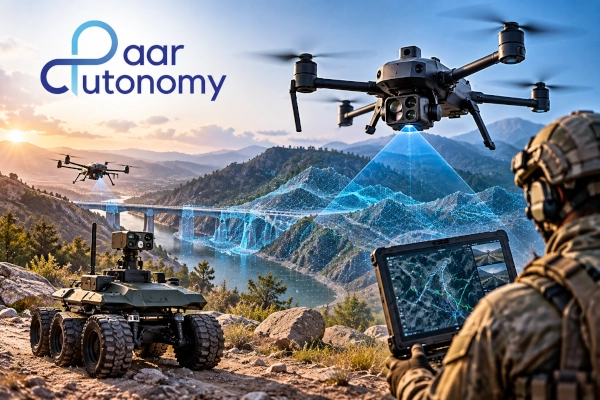
Bengaluru-based defence technology startup Paar Autonomy is developing indigenous artificial intelligence-powered perception and navigation systems designed to help unmanned vehicles operate in environments where satellite navigation signals are unavailable or unreliable. The company is focusing on advanced visual-inertial navigation, onboard artificial intelligence and multisensor technologies intended to improve the operational independence of unmanned defence platforms.
Paar Autonomy’s technological approach centres on enabling autonomous systems to interpret their surroundings through onboard sensors and computing equipment. Its development programme includes camera-based perception systems, artificial intelligence software and navigation technologies designed to function without continuous dependence on Global Navigation Satellite Systems (GNSS).
The company is developing these capabilities through its Sentinel product family, which includes systems designed for aerial and ground vehicles. The initiative reflects growing Indian private-sector involvement in technologies associated with autonomous defence platforms, particularly in perception, navigation and onboard intelligence.
Developing Navigation Systems That Do Not Depend on GPS
Satellite-based navigation plays an important role in the operation of unmanned aerial vehicles and autonomous ground platforms. Conventional navigation systems use signals from satellite constellations to determine position, velocity and timing. However, satellite signals can become unavailable because of interference, environmental limitations or deliberate electronic disruption.
These limitations create particular challenges for unmanned vehicles operating in demanding environments. A vehicle that depends entirely on satellite navigation may experience difficulties maintaining accurate positioning when signals become unreliable.
Paar Autonomy is addressing this technological challenge through GNSS-independent visual-inertial navigation. According to the company’s official website, the technology combines visual information with inertial measurements to support autonomous navigation without relying exclusively on satellite positioning.
Visual-inertial navigation uses information from cameras alongside measurements of motion and orientation. By processing these inputs, a navigation system can estimate how a vehicle moves relative to its surroundings.
Such systems can help unmanned platforms maintain awareness of their movement when satellite navigation is disrupted. Their effectiveness depends on sensor quality, environmental conditions, computing performance and the accuracy of the underlying navigation algorithms.
Edge-Based Artificial Intelligence Supports Autonomous Operations
A central element of Paar Autonomy’s development strategy is the use of edge-based artificial intelligence, which enables computing and information processing to take place directly aboard an autonomous platform.
Traditional remotely operated systems may depend heavily on communication links to transmit sensor information to external processing facilities. However, communications can become unreliable because of geographical conditions, limited bandwidth or electronic interference.
Edge-based computing reduces the need to transmit every observation to a remote system for processing. Instead, onboard processors analyse information collected by cameras and other sensors, allowing the platform to interpret aspects of its surroundings locally.
Paar Autonomy identifies embodied artificial intelligence as one of its principal technology areas. This approach involves integrating perception, computing and autonomous decision-support capabilities into physical systems.
For unmanned vehicles, such technologies can support navigation, environmental awareness and autonomous movement. They can also reduce dependence on uninterrupted communication with remote processing infrastructure.
The company is developing these systems for defence applications where reliable onboard perception and navigation are important operational requirements.
Sentinel Product Family Targets Aerial and Ground Vehicles
Paar Autonomy’s official product portfolio includes four named systems: Sentinel 1, Sentinel 2, Sentinel Nano and Sentinel Nano Dual.
The company describes Sentinel 1 as its flagship model designed for aerial vehicles. The system forms part of its development programme for integrating perception and autonomous capabilities into unmanned aerial platforms.
Sentinel 2 is intended for ground vehicles. This reflects the company’s interest in extending its perception technologies beyond drones to other autonomous platforms that operate in complex environments.
The Sentinel Nano series focuses on aerial applications requiring more compact equipment. The company identifies Sentinel Nano as a system designed for aerial vehicles, while Sentinel Nano Dual targets lightweight unmanned aerial vehicles intended for long-endurance operations.
These product categories demonstrate the company’s strategy of developing adaptable perception systems for different vehicle types rather than concentrating exclusively on one drone platform.
However, Paar Autonomy’s official product pages currently identify the systems as Coming Soon. The company has not published detailed technical specifications, independently verified performance figures or confirmed production quantities for these models on those pages.
Multisensor Perception Forms the Foundation of the Technology
Paar Autonomy identifies advanced multisensor perception as another central component of its technology development.
Multisensor perception involves collecting and processing information from different sensing technologies to create a more comprehensive understanding of the surrounding environment.
Camera systems provide visual information, while inertial sensors supply measurements related to movement and orientation. Combining these inputs can help autonomous systems estimate their position and interpret environmental conditions.
The company describes its perception systems as platform-agnostic and designed for integration with different types of equipment. This approach is intended to make the underlying technology adaptable to multiple unmanned platforms.
Such integration capabilities are relevant to the broader autonomous systems industry because aerial and ground vehicles differ substantially in their operating conditions, mobility requirements and sensor configurations.
Developing adaptable perception technologies can allow manufacturers to integrate common elements of sensing and computing equipment across different platforms while modifying individual systems to meet specific requirements.
GPS-Denied Navigation Gains Importance in Modern Defence
The increasing use of unmanned systems has created demand for navigation technologies capable of operating under difficult conditions.
Satellite navigation signals are comparatively weak when they reach receivers on Earth. They can therefore be affected by interference or intentionally disrupted through electronic warfare.
Autonomous platforms operating in such environments require alternative methods of estimating their position and maintaining awareness of their surroundings.
Visual-inertial navigation is one approach to reducing dependence on satellite positioning. By combining camera observations with inertial measurements, these systems can estimate movement even when GNSS information is unavailable.
However, visual-inertial navigation also faces limitations. Poor visibility, inadequate lighting, changing environmental features and accumulated positioning errors can affect performance.
Consequently, the development of reliable GNSS-independent navigation requires careful sensor integration, robust computing algorithms and extensive testing under different operating conditions.
Paar Autonomy’s stated focus on resilient autonomy reflects the importance of addressing these technical challenges as unmanned platforms become more widely used.
Indigenous Development Strengthens India’s Defence Technology Ecosystem
Paar Autonomy positions its technology development within India’s expanding indigenous defence manufacturing ecosystem.
The company states that its mission is to build physical AI-enabled hardware for perception, autonomy and intelligence in India. Its emphasis on domestic technological development reflects the growing role of Indian startups in specialised defence electronics and autonomous systems.
Modern unmanned platforms depend on numerous interconnected technologies, including propulsion, communications, sensors, navigation equipment, computing hardware and control software.
While the aircraft or ground vehicle provides the physical platform, perception and navigation systems contribute to its ability to interpret the environment and operate autonomously.
Developing expertise in these technologies can strengthen India’s capabilities in advanced robotics, embedded computing and intelligent sensing systems.
The domestic development of such equipment may also create opportunities for specialised component manufacturers, electronics suppliers and engineering firms.
However, indigenous development claims must be distinguished from complete domestic sourcing. Paar Autonomy has not publicly established the domestic content of every component used in its proposed systems.
Investment Supports the Company’s Technology Development
Paar Autonomy has also attracted investment from AdvantEdge Founders as it works to expand its defence technology activities.
Company founder Vignesh Jayaraman publicly acknowledged the investor’s support in connection with the funding announcement reported in October 2026.
The investment comes as the company pursues the development of advanced perception equipment and navigation technologies for unmanned platforms.
Expanding such technologies from initial development into wider industrial production requires investment in electronics engineering, software development, testing facilities and manufacturing capabilities.
Companies developing autonomous systems must also demonstrate reliability under practical operating conditions before their equipment can be adopted for demanding applications.
For Paar Autonomy, continued development of its Sentinel product family and GNSS-independent navigation capabilities will be important elements of its growth strategy.
The company has not provided detailed production targets or independently verified operational deployment figures through the official product information reviewed for this article.
Wider Applications for AI-Powered Autonomous Systems
Although Paar Autonomy identifies defence as its principal area of focus, technologies associated with autonomous perception and satellite-independent navigation can also have applications beyond military operations.
Industrial inspection systems, for example, may need to navigate areas where satellite reception is obstructed by large structures or surrounding terrain. Autonomous ground vehicles operating inside industrial facilities may similarly require navigation systems that do not depend entirely on GNSS signals.
Robotic platforms used in infrastructure monitoring can benefit from onboard perception systems capable of interpreting local surroundings and estimating movement.
Disaster-response technologies may also require alternative navigation capabilities when communications infrastructure is damaged or satellite signals become unreliable.
These applications demonstrate the wider technological relevance of camera-based perception, edge computing and visual-inertial navigation.
However, applications in individual civilian sectors should be regarded as potential uses of the underlying technologies rather than confirmed deployments by Paar Autonomy unless the company identifies specific operational projects.
Towards More Resilient Indigenous Autonomous Platforms
Paar Autonomy’s work on artificial intelligence-powered perception and GNSS-independent navigation represents an emerging area of India’s defence technology development.
Its Sentinel product family demonstrates an effort to create specialised systems for aerial and ground vehicles, while its research into visual-inertial navigation addresses the challenge of operating without reliable satellite positioning.
The company’s emphasis on edge-based artificial intelligence also highlights the growing importance of onboard computing in autonomous technologies.
Further progress will depend on testing, product qualification, manufacturing development and successful integration with unmanned platforms.
As India expands its capabilities in robotics, defence electronics and autonomous systems, specialised startups such as Paar Autonomy can contribute to the development of technologies that improve navigation resilience and reduce dependence on external systems.
The continued development of indigenous perception and navigation technologies will strengthen the technological foundation required for India’s next generation of autonomous aerial and ground platforms.
References
1. Paar Autonomy — Official Corporate Website
Company information covering physical artificial intelligence, GNSS-independent visual-inertial navigation, edge-based computing and multisensor perception.
https://www.paar-autonomy.com
2. Paar Autonomy — Sentinel 1
Official product information identifying Sentinel 1 as the company’s flagship system designed for aerial vehicles.
https://www.paar-autonomy.com/products/sentinel-1
3. Paar Autonomy — Sentinel 2
Official product information identifying Sentinel 2 as a perception system designed for ground vehicles.
https://www.paar-autonomy.com/products/sentinel-2
4. Paar Autonomy — Sentinel Nano
Official product information covering the Sentinel Nano system intended for aerial vehicles.
https://www.paar-autonomy.com/products/sentinel-nano
5. Paar Autonomy — Sentinel Nano Dual
Official product information identifying the system’s intended application in lightweight, long-endurance unmanned aerial vehicles.
https://www.paar-autonomy.com/products/sentinel-nano-dual
6. Paar Autonomy — Official LinkedIn Presence
Company updates and statements concerning its technology development and investment activities.
https://www.linkedin.com/company/paar-autonomy
You may also like
-
Sigma Advanced Systems Secures Fresh ₹973 Crore NATO Artillery Ammunition Order
-
India Advances Indigenous Defence and Space Technologies Through Naval Innovation, Drones and Advanced Electronics
-
Thales Seeks Indian Partnerships for Next-Generation Missiles, Radars and Electronic Warfare Systems
-
Indian and Australian Armies Conduct Jungle and Coastal Warfare Drills in AUSTRAHIND 2026
-
Sagar Defence Unveils Autonomous Vessel at SWAVLAMBAN 2026, Expands Manufacturing
