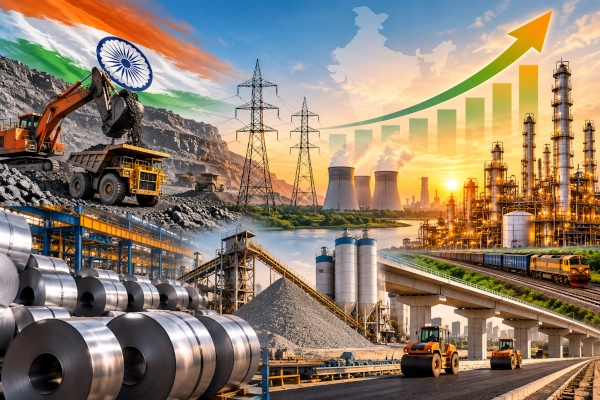
India’s core industrial sector recorded robust growth in September 2026, with the Index of Core Industries (ICI) expanding by 7.9% year-on-year, compared with 5.9% in August. Strong performance in iron ore, electricity, coal, petroleum refinery products, cement and steel contributed to the acceleration, reflecting increased production across several important segments of the country’s industrial economy.
According to provisional figures released by the Ministry of Commerce and Industry on October 21, 2026, the September performance was substantially higher than the 3.1% growth recorded in the corresponding month of 2025. The latest figures form part of the revised core industries index, which uses 2022–23 as its base year and includes nine major industrial sectors.
The cumulative growth rate for April–September 2026 reached 5.1%, compared with 2.5% during the corresponding period of the previous financial year. The improvement indicates stronger overall production during the first half of FY 2026–27, despite continued contractions in fertilisers, natural gas and crude oil.
Iron Ore Production Leads Core Sector Expansion
Iron ore recorded the highest growth among India’s nine core industries, with production increasing by 18.4% in September 2026 compared with the same month of the previous year. The expansion followed 5.5% growth in August, representing a substantial acceleration in the sector’s year-on-year performance.
Iron ore is an essential raw material for steel production and supports several manufacturing and infrastructure industries. Its inclusion in the revised Index of Core Industries recognises the mineral’s importance to India’s industrial production system.
During April–September 2026, iron ore production increased by 21.2% compared with the corresponding period of 2025. This made it one of the strongest-performing sectors during the first half of the financial year.
The sustained expansion in iron ore production reflects the growing contribution of mineral extraction to India’s industrial output. The sector’s performance also provides an important indicator of activity within the domestic raw materials supply chain.
Coal Production Rebounds with 10.7% Growth
India’s coal sector recorded a notable recovery in September, with production increasing by 10.7% year-on-year. The expansion followed a 3.8% contraction in August, marking a significant improvement in monthly performance.
Coal remains an important component of India’s energy system, particularly for electricity generation and energy-intensive industries. Increased domestic production supports the availability of fuel for thermal power stations and several industrial operations.
Despite September’s strong recovery, cumulative coal production during April–September 2026 remained 1% below the corresponding period of the previous year. This indicates that the latest monthly improvement followed a period of uneven production performance.
The September figures nevertheless demonstrate a recovery in coal output and its contribution to the acceleration of the overall core industries index.
Electricity Generation Records 11.4% Increase
Electricity generation increased by 11.4% in September 2026 compared with the corresponding month of 2025. Although growth moderated from 13.1% in August, the sector remained among the strongest contributors to the core industries index.
Electricity carries the highest weight in the revised index, accounting for approximately 30.93% of the total. Its performance therefore has a substantial influence on overall core sector growth.
During the first six months of FY 2026–27, electricity generation increased by 10.2% year-on-year. The sustained expansion indicates higher power production over the period, an important development for an economy with growing industrial, commercial and household electricity requirements.
The electricity sector’s strong performance, alongside the recovery in coal production, contributed to the broader improvement in India’s industrial activity during September.
Petroleum Refinery Products Register 10.3% Growth
Production of petroleum refinery products expanded by 10.3% in September 2026, compared with 5.6% in August. The improvement made refinery products one of the leading contributors to the month’s overall core sector expansion.
Petroleum refinery products include fuels and other processed petroleum materials used in transportation, manufacturing and industrial operations. The sector occupies an important position within India’s energy and industrial supply chains.
Refinery products account for approximately 22.57% of the revised core industries index, making them the second-largest component after electricity.
For April–September 2026, refinery product output increased by 1% compared with the same period of the previous year. Although cumulative growth remained modest, the September performance represented a substantial improvement in the sector’s monthly year-on-year growth.
Cement and Steel Production Maintain Positive Growth
Cement production increased by 9.8% in September 2026, continuing its positive performance after recording 11.7% growth in August. The sector maintained relatively strong year-on-year expansion despite the moderation in its monthly growth rate.
Cement is a major input for roads, housing, industrial facilities and other construction activities. Its production performance is therefore closely connected with activity across India’s construction and infrastructure sectors.
Steel output increased by 4.9% in September, compared with 3.5% in August. The acceleration indicates improved year-on-year production growth in a sector that supplies essential materials to engineering, manufacturing, transportation and infrastructure industries.
During April–September 2026, cement production expanded by 10.1%, while steel production increased by 4.3%. These figures indicate that both sectors maintained positive growth during the first half of the financial year, with cement recording the stronger cumulative expansion.
Fertilisers, Natural Gas and Crude Oil Record Contractions
While six core industries registered positive growth, three sectors experienced declining production during September 2026.
Fertiliser production contracted by 11.7% year-on-year, continuing the negative trend recorded in previous months. During August, fertiliser output had declined by 12.4%, indicating persistent weakness in the sector’s production performance.
Natural gas production fell by 4.6% in September, compared with a contraction of 4.9% in August. Crude oil production also remained negative, declining by 1.4% after a 3.6% reduction in the preceding month.
The cumulative figures for April–September 2026 show fertiliser production declining by 7.6%, natural gas output falling by 4.4% and crude oil production decreasing by 3.7%.
These contractions demonstrate that the overall improvement in core industries output was not uniform across all sectors. While mineral production, power generation and industrial materials recorded stronger growth, selected energy and fertiliser segments continued to face production challenges.
Revised Core Industries Index Now Covers Nine Sectors
The September 2026 figures represent the fourth monthly release under India’s revised Index of Core Industries, which adopted 2022–23 as its base year in July 2026.
The revision replaced the earlier 2011–12 base year and expanded the index from eight industries to nine through the inclusion of iron ore.
The Office of the Economic Adviser, under the Department for Promotion of Industry and Internal Trade, introduced the revised series to improve the representation of industrial activity and align the index more closely with the updated Index of Industrial Production.
The revision also introduced methodological changes to the steel and coal components. Gross production data replaced net production data for steel, while the coal index now includes only raw coal to prevent double counting of processed coal products.
The revised index assigns the highest weights to electricity at 30.93%, petroleum refinery products at 22.57% and steel at 17.58%. These three sectors together account for more than 71% of the index, making their performance particularly important to overall industrial growth.
Core Sector Growth Reaches 5.1% in First Half of FY 2026–27
India’s nine core industries recorded cumulative growth of 5.1% during April–September 2026, compared with 2.5% in the corresponding period of FY 2025–26.
Iron ore emerged as the strongest performer over the six-month period, recording 21.2% growth. Electricity and cement followed with increases of 10.2% and 10.1%, respectively.
Steel production expanded by 4.3%, while petroleum refinery products recorded 1% growth. Coal output remained marginally negative over the period despite its strong recovery in September.
The cumulative figures demonstrate that industrial growth during the first half of the financial year was supported principally by mineral extraction, electricity generation and construction-related materials.
The September acceleration provides additional evidence of stronger activity across several industrial segments, although the continuing weakness in crude oil, natural gas and fertilisers highlights differences in sectoral performance.
Stronger Core Industries Output Supports India’s Industrial Momentum
The September 2026 core industries data reflects an improvement in India’s industrial production across several sectors essential to manufacturing, energy supply and infrastructure development.
The strong performance of iron ore, coal and refinery products contributed to the month’s acceleration, while electricity, cement and steel maintained positive growth. Together, these developments supported the overall expansion of the nine-industry index.
The increase in cumulative growth from 2.5% to 5.1% during the first half of the financial year also indicates stronger production momentum compared with the corresponding period of 2025.
The revised index provides a broader measure of industrial activity by incorporating iron ore and updating the methodology used to assess core industries. Its September reading highlights the expanding contribution of mineral resources, power generation and industrial materials to India’s economy.
With six of the nine core industries recording positive growth, India’s industrial production base demonstrated renewed momentum in September 2026. The official figures provide an encouraging indication of activity across the country’s major infrastructure-linked and manufacturing-supporting sectors.
References
- Ministry of Commerce and Industry, Government of India — Provisional Index of Core Industries for the Month of September 2026, and Final Index for the Month of August 2026 with Base Year 2022–23. Press Information Bureau, October 21, 2026. Release ID: 2326038.
https://www.pib.gov.in/PressReleseDetailm.aspx?PRID=2326038 - Ministry of Commerce and Industry, Government of India — First Press Release of Index of Core Industries of New Series with Base Year 2022–23. Press Information Bureau, July 20, 2026.
https://www.pib.gov.in/PressReleasePage.aspx?PRID=2286615 - Office of the Economic Adviser, Department for Promotion of Industry and Internal Trade — Official Index of Core Industries database and revised series.
https://eaindustry.nic.in/ici_download_data.asp
You may also like
-
Balkrishna Industries Partners with Pirelli to Manufacture 8 Lakh Premium Car Tyres in India by 2030
-
Apollo Group Commissions 9,000 MT Explosives Facility in West Bengal, Expanding Indigenous Manufacturing Capacity
-
India Proposes Mandatory Advanced Emergency Braking Systems for New Cars from October 2030
-
India Post Creates History-Records ₹8,213 Crore Revenue in First Half of FY 2026–27, Parcel Business Grows 71%
-
Jeeraphool Rice of Chhattisgarh: The Fragrant Heritage Grain of Surguja with GI Recognition
