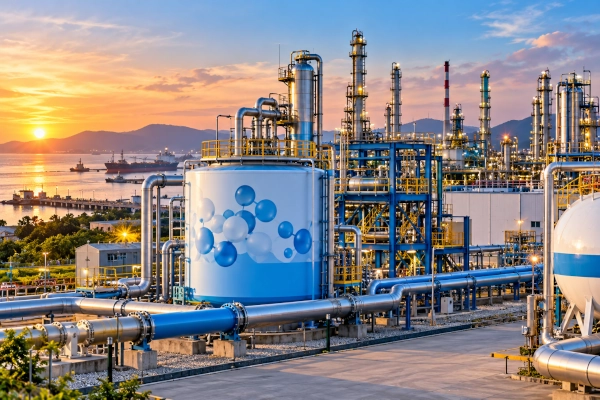
Hindustan Petroleum Corporation Limited (HPCL) has commissioned what it describes as India’s first refinery blue hydrogen unit at its Visakhapatnam refinery in Andhra Pradesh. The public sector oil company disclosed the development on October 22, 2026, while announcing its financial and operational performance for the second quarter of FY2026–27. The facility incorporates HPCL’s patented HiGAS technology and HP Novel Amine technology, representing an important milestone in the application of indigenous hydrogen and carbon-capture technologies within India’s petroleum refining industry.
The unit was commissioned during the July–September 2026 quarter as part of HPCL’s continuing efforts to modernise refinery operations and develop cleaner industrial technologies. The project builds on the company’s research and development capabilities, particularly in gas separation, carbon capture and hydrogen processing. Its commissioning also strengthens the role of Indian-developed technologies in addressing the energy industry’s evolving operational and environmental requirements.
Indigenous HiGAS Technology at the Heart of the Project
The blue hydrogen unit incorporates HPCL’s proprietary HiGAS technology, developed by the company’s research and development division. The technology uses a high-gravity gas absorption system to improve contact between gases and liquids, enabling more efficient gas separation within a compact processing arrangement.
Unlike conventional absorption systems that depend primarily on gravity-driven contact between gas and liquid streams, HiGAS uses a rotating packed bed to generate high centrifugal forces. This process intensifies mass transfer and can reduce the equipment size required for certain industrial separation applications. The technology demonstrates HPCL’s efforts to develop alternatives to conventional imported process systems.
The refinery blue hydrogen installation also uses HP Novel Amine technology for carbon dioxide absorption. Combining these technologies allows the facility to integrate carbon dioxide capture with refinery hydrogen processing. The project therefore provides an industrial application for technologies developed through HPCL’s indigenous research programmes.
Understanding Blue Hydrogen and Its Role in Petroleum Refining
Hydrogen plays an essential role in modern petroleum refineries, particularly in processes that remove sulphur from fuels and convert heavier petroleum fractions into more valuable products. Refineries traditionally produce much of their hydrogen from fossil-based feedstocks, which generate carbon dioxide during processing.
Blue hydrogen refers to hydrogen produced from fossil-based sources where associated carbon dioxide emissions are captured for storage or utilisation. The technology seeks to reduce emissions associated with conventional hydrogen production while retaining established industrial hydrogen-generation processes.
Carbon capture is central to this approach. However, the overall environmental performance of blue hydrogen depends on the proportion of carbon dioxide captured, the emissions associated with the production process and the eventual treatment of the captured gas. HPCL’s commissioning announcement establishes the deployment of the technology but does not, by itself, quantify the facility’s achieved emissions reductions.
For petroleum refineries, carbon-capture technologies can provide an additional pathway for managing industrial emissions while existing hydrogen production systems continue operating. The experience gained from such installations can also support the development of more efficient gas-processing and carbon-management technologies.
HPCL’s Research Capabilities Support Indian Refinery Technology
The blue hydrogen project reflects the growing contribution of HPCL’s Green Research and Development Centre to India’s petroleum refining industry. The centre undertakes research in process engineering, catalysts, alternative fuels, hydrogen technologies, carbon capture and other industrial applications.
HPCL has developed several proprietary technologies intended to improve refinery efficiency and reduce dependence on external technology providers. Its research activities include hydrogen purification through pressure swing adsorption, high-gravity gas separation and emerging carbon-capture systems.
The Visakhapatnam refinery has served as an important location for demonstrating these technologies under actual industrial operating conditions. Earlier research programmes included the development of hydrogen purification systems and pilot-scale applications designed to improve refinery processing capabilities.
Commercial application of indigenous technologies can strengthen domestic engineering expertise while generating operational experience for future projects. It also creates opportunities for Indian equipment manufacturers and specialised engineering companies involved in process equipment, instrumentation and industrial automation.
Visakhapatnam Refinery Expands Its Hydrogen Technology Capabilities
The commissioning of the blue hydrogen unit adds to HPCL’s existing hydrogen-related initiatives at the Visakhapatnam refinery. The company previously commissioned a 370-tonne-per-annum green hydrogen facility, becoming the first Indian public sector refinery operator to implement such a plant.
Green hydrogen and blue hydrogen use different production pathways. Green hydrogen is produced using renewable electricity, generally through water electrolysis, while blue hydrogen combines conventional hydrogen production with carbon capture. Both technologies form part of the broader effort to reduce emissions associated with industrial hydrogen consumption.
HPCL is also pursuing additional green hydrogen capacity at Visakhapatnam under India’s National Green Hydrogen Mission. The government has identified a 5,000-tonne-per-annum green hydrogen project associated with the refinery under the mission’s incentive framework.
The coexistence of different hydrogen technologies at Visakhapatnam provides opportunities to evaluate their operational characteristics and suitability for refinery applications. These developments strengthen the refinery’s position as an important centre for advanced petroleum processing and hydrogen-related technology deployment.
HPCL Advances 201-Kilometre LPG Pipeline in West Bengal
Alongside the blue hydrogen commissioning, HPCL disclosed that it had mechanically completed the 201-kilometre Haldia–Panagarh LPG pipeline in West Bengal during the September 2026 quarter. The pipeline was undergoing pre-commissioning activities when the company announced its quarterly results on October 22.
The pipeline originates at the LPG import and storage facilities at Haldia and connects to HPCL’s LPG bottling plant at Panagarh. It is designed to transport liquefied petroleum gas more efficiently while supporting distribution requirements in West Bengal and neighbouring markets, including Bihar and Jharkhand.
Pipeline transportation offers an alternative to moving large quantities of LPG over long distances by road. Dedicated infrastructure can improve supply-chain efficiency, reduce dependence on tanker movements and strengthen the reliability of fuel distribution networks.
Mechanical completion represents an important construction milestone, although the pipeline must complete the necessary testing, safety checks and commissioning procedures before beginning regular commercial operations. Once operational, the Haldia–Panagarh connection will strengthen HPCL’s eastern India LPG logistics infrastructure.
Refinery Modernisation and Capital Investment Continue
HPCL’s quarterly operational results also highlighted continued investment in refining and marketing infrastructure. The company reported capital expenditure of ₹2,085 crore during the July–September 2026 quarter, bringing its total investment during the first half of FY2026–27 to ₹3,819 crore.
The company’s refineries processed approximately 6.20 million metric tonnes of crude oil during the quarter. HPCL also reported consolidated revenue from operations of approximately ₹1.39 lakh crore and a net profit of ₹3,625.22 crore for the reporting period.
These investments support refinery modernisation, product transportation, operational efficiency and the development of new energy technologies. The blue hydrogen facility and Haldia–Panagarh pipeline represent two distinct components of HPCL’s wider infrastructure and technology development programme.
Strengthening India’s Indigenous Energy Technology Ecosystem
The commissioning of the refinery blue hydrogen unit marks progress in the industrial application of technologies developed within India’s public sector energy industry. By deploying its patented HiGAS and HP Novel Amine technologies, HPCL has demonstrated the potential of domestic research to address complex gas-processing and carbon-capture requirements.
The project also contributes to the development of specialised engineering capabilities in hydrogen processing, carbon dioxide separation and industrial process integration. Experience gained from operating the facility can inform future technology improvements and create opportunities for wider applications across energy-intensive industries.
Together with investments in green hydrogen, refinery modernisation and petroleum transportation infrastructure, the development reflects HPCL’s expanding technological capabilities. The Visakhapatnam project adds another indigenous industrial application to India’s energy sector and strengthens the country’s long-term efforts towards greater technological self-reliance.
References
- Hindustan Petroleum Corporation Limited: Financial and operational disclosures for the second quarter of FY2026–27, announced on October 22, 2026.
- ETEnergyWorld, October 22, 2026: HPCL Q2 Net Profit Falls 6% to ₹3,625 Crore.
https://energy.economictimes.indiatimes.com/news/oil-and-gas/hpcl-q2-net-profit-falls-6-to-3625-crore/135121029 - HPCL Green Research and Development Centre: Official information on HP-HiGAS technology and indigenous gas separation processes.
https://www.hindustanpetroleum.com/pages/HPGRDC-NEW-TECHNOLOGIES - Ministry of New and Renewable Energy, Press Information Bureau, August 11, 2026: National Green Hydrogen Mission Advances Green Hydrogen Adoption in Petroleum and Refining Sector.
https://www.pib.gov.in/PressReleasePage.aspx?PRID=2297571 - Hindustan Petroleum Corporation Limited: Official information on the Haldia–Panagarh LPG Pipeline Project.
https://www.hindustanpetroleum.com/pages/pipeline-ongoing-projects - Department of Public Enterprises, Government of India: Public Enterprises Survey 2024–25, including HPCL’s indigenous blue hydrogen technology development programme.
You may also like
-
Bihar’s GI-Tagged Mithila Makhana Expands Global Reach as India Exports 7,265 Tonnes in FY26
-
Sigma Advanced Systems Secures ₹174 Crore Export Order for 155mm Artillery Ammunition Subsystems
-
Bharat Electronics Secures ₹1,011 Crore in New Defence Orders for Radar, Communication and Sonar Systems
-
NHPC Announces Commercial Operation of Fifth 250 MW Unit at Subansiri Lower Hydroelectric Project
-
India’s 300 kW Laser Weapon Ambitions Could Strengthen Future Defence Against Cruise Missiles
