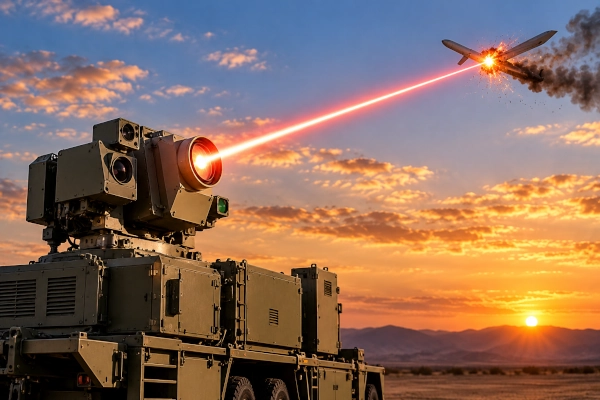
India’s pursuit of high-power laser weapons represents an important step towards developing a new generation of indigenous air defence technologies. The Ministry of Defence has formally identified Directed Energy Weapons (DEWs) with power ratings of 300 kilowatts and above as a priority area for industry-led development. Alongside this long-term objective, the Defence Research and Development Organisation (DRDO) has demonstrated laser-based weapon systems capable of engaging aerial threats and has successfully integrated directed-energy technology into a multilayered air defence architecture.
The growing importance of cruise missiles, unmanned aerial vehicles and coordinated aerial attacks has increased the need for defensive systems that can respond rapidly to multiple threats. Conventional surface-to-air missiles remain essential for intercepting hostile aircraft and missiles, while high-power lasers offer the possibility of adding another layer of protection. By using concentrated electromagnetic energy rather than conventional ammunition, these weapons could eventually provide a complementary means of engaging selected airborne targets.
India’s progress is supported by several officially documented developments, including the government’s identification of 300 kW-class directed-energy systems in March 2022 and DRDO’s successful trials of its Integrated Air Defence Weapon System in August 2025. These achievements establish a technological foundation for more advanced laser weapons, including systems that could contribute to future cruise-missile defence.
India Identifies 300 kW Directed Energy Weapons as a Development Priority
On 11 March 2022, the Ministry of Defence announced the identification of 18 major defence platforms for industry-led design and development under different provisions of the Defence Acquisition Procedure 2020. Among the technologies selected for development under the Make-I category were Directed Energy Weapons rated at 300 kW and above, covering both high-powered electromagnetic devices and high-powered laser systems.
This announcement formally placed high-energy directed weapons within India’s indigenous defence technology development priorities. The inclusion of systems rated at 300 kW and above reflects the government’s intention to encourage domestic industry to acquire the scientific, engineering and manufacturing capabilities required for such advanced technologies.
The Make-I category supports projects involving the design and development of defence equipment, systems and major platforms by Indian industry. Under this framework, the Ministry of Defence can provide financial assistance covering up to 70% of the total cost of prototype development. The arrangement is intended to reduce development risks for participating companies while encouraging domestic technological innovation.
In a written reply to the Lok Sabha on 22 July 2022, the Ministry of Defence reiterated that the 18 platforms had been identified following consultations with the Armed Forces, DRDO and industry. The government explained that these selections reflected future warfare requirements, operational challenges, technological developments and the need to reduce dependence on imported defence systems.
DRDO Establishes an Indigenous Foundation for Laser Weapons
India’s development of directed-energy weapons predates the announcement of its 300 kW ambitions. DRDO has conducted research on high-energy lasers, electro-optical technologies, target acquisition and specialised systems for countering aerial threats.
The Ministry of Defence’s Year End Review for 2020 recorded the deployment of a DRDO-developed anti-drone system at the Red Fort during Independence Day security arrangements. The system combined electronic countermeasures with a laser-based Directed Energy Weapon capable of damaging hostile micro-drones.
The official announcement established that DRDO had progressed beyond laboratory research to developing laser-based equipment for practical security applications. Such systems represented an early stage in India’s efforts to employ concentrated energy against airborne threats.
Counter-drone applications are particularly important because small unmanned aircraft present challenges for conventional air defence systems. Many are inexpensive, difficult to detect at long distances and capable of operating at low altitudes. Using relatively costly interceptor missiles against every small drone can place considerable pressure on available defensive resources.
Laser-based directed-energy weapons offer a different approach. Their effectiveness depends on maintaining sufficient energy on a vulnerable part of the target, enabling the beam to damage critical components. Their ability to engage threats without launching conventional projectiles makes them attractive for certain short-range air defence applications.
India’s early counter-drone work helped establish capabilities that are relevant to more powerful directed-energy systems, including precision tracking, beam control, power management and the integration of laser weapons with surveillance equipment.
Integrated Air Defence Weapon System Demonstrates Major Progress
A significant development occurred on 23 August 2025, when DRDO successfully conducted the maiden flight trials of its indigenous Integrated Air Defence Weapon System (IADWS) off the Odisha coast.
According to the Ministry of Defence announcement issued the following day, IADWS combines three distinct defensive technologies: the Quick Reaction Surface-to-Air Missile (QRSAM), the Advanced Very Short Range Air Defence System (VSHORADS) and a high-power laser-based Directed Energy Weapon.
During the trials, the integrated system simultaneously engaged and destroyed three aerial targets comprising two high-speed fixed-wing unmanned aerial vehicles and one multicopter drone. The targets operated at different ranges and altitudes, demonstrating the ability of the integrated defensive architecture to coordinate different weapon systems during a common engagement.
The successful trials marked an important advance in India’s efforts to develop multilayered air defence systems. Rather than operating laser weapons independently, DRDO demonstrated their integration with missile-based interceptors, sensors, communications equipment and centralised command-and-control systems.
The Ministry of Defence confirmed that the Defence Research and Development Laboratory (DRDL) developed the centralised command-and-control centre and served as the programme’s nodal laboratory. Research Centre Imarat (RCI) developed the VSHORADS component, while the Centre for High Energy Systems and Sciences (CHESS) developed the directed-energy weapon.
Range instrumentation deployed by the Integrated Test Range at Chandipur recorded the system’s performance. DRDO reported that its missile systems, laser weapon, detection equipment, communications infrastructure and command-and-control elements performed successfully during the trials.
Defence Minister Rajnath Singh congratulated DRDO, the Armed Forces and participating industries on the achievement. He described the trials as an important demonstration of India’s multilayered air defence capabilities and their potential to strengthen the protection of critical facilities against aerial threats.
The August 2025 trials also demonstrated an important operational concept: different types of defensive weapons can work together against aerial threats that vary in speed, altitude and configuration.
Although the official trials involved unmanned aerial targets rather than cruise missiles, the development established a valuable foundation for future integrated air defence capabilities.
How High-Power Laser Weapons Could Counter Cruise Missiles
Cruise missiles present a complex challenge for modern air defence networks because they can fly at high speeds, follow low-altitude trajectories and approach targets from different directions. Their ability to exploit terrain and operate close to the Earth’s surface can reduce the time available for detection, identification and interception.
Conventional air defence systems address these threats through networks of surveillance radars, command centres and interceptor missiles. However, large numbers of incoming weapons can place considerable demands on missile inventories and engagement systems, particularly when several threats approach within a short period.
High-power laser weapons could eventually provide an additional defensive option against certain classes of cruise missiles. Such systems operate by directing a concentrated beam of electromagnetic energy onto a target. When sufficient energy reaches a vulnerable component, the resulting heating can damage its structure, electronics or other critical systems.
Unlike conventional missiles, laser weapons do not require a separate physical interceptor for every engagement. Their ammunition supply effectively depends on the availability of electrical energy, cooling capacity and the operating limits of their components. This characteristic could make them useful for defending selected locations against repeated aerial attacks.
However, cruise missiles present substantially more demanding targets than small drones. Their speed, construction, flight characteristics and limited exposure time require greater precision, power and sustained tracking performance.
Consequently, the development of 300 kW-class laser technology is relevant to future cruise-missile defence, but achieving the required power rating is only one part of the challenge. A complete operational system must also demonstrate reliable target detection, accurate tracking, sufficient energy delivery and effective performance under realistic environmental conditions.
Why the 300 kW Power Category Is Important
The government’s identification of directed-energy weapons rated at 300 kW and above signals an ambition to develop systems that operate beyond the power levels generally associated with smaller counter-drone applications.
Laser power is an important factor in determining the amount of energy that a weapon can deliver to a target within a given period. A more powerful laser can potentially deposit the required energy more quickly or maintain effectiveness over greater distances, provided its optical systems, beam quality and atmospheric operating conditions support such performance.
For perspective, a laser delivering 300 kW of continuous optical power produces 300 kilojoules of energy every second. This relationship illustrates the considerable energy involved in high-power laser operations. However, the actual energy absorbed by a target depends on several additional factors, including atmospheric transmission, beam spreading, target reflectivity and the accuracy of the tracking system.
Developing weapons in this category therefore requires more than increasing laser output. Engineers must address the efficiency of the laser source, its power supply, heat dissipation, optical components and the mechanical systems used to direct the beam.
High-power laser systems also require stable electrical power and effective cooling arrangements. These requirements influence their dimensions, weight, mobility and suitability for different operational environments.
India’s 300 kW development objective is significant because it encourages domestic expertise across several advanced engineering fields simultaneously. Progress in these technologies can support the development of increasingly capable directed-energy systems for military applications.
Overcoming the Technical Challenges of Laser-Based Defence
One of the principal challenges facing high-energy laser weapons is the atmosphere through which their beams must travel. Dust, smoke, fog, rain and atmospheric turbulence can reduce the energy reaching a target or interfere with the concentration of the beam.
Laser weapons also require an unobstructed line of sight to their targets. This creates particular difficulties when engaging low-flying cruise missiles that may remain hidden behind terrain or other obstacles until they approach the defended area.
A successful interception requires the system to detect the target, determine its trajectory, identify an appropriate engagement opportunity and maintain an accurately directed beam for the necessary duration.
The duration of this engagement, often described as dwell time, depends on the energy required to damage the target and the rate at which the beam delivers usable energy. A fast-moving cruise missile can reduce the available engagement window, particularly when it approaches at low altitude.
Thermal management presents another engineering challenge. High-power laser sources and their supporting electronics produce heat during operation. Efficient cooling is essential for maintaining performance and supporting repeated engagements.
These requirements explain why future laser weapons must operate as components of wider air defence networks rather than as independent replacements for missile-based systems. Surveillance sensors, command centres, tracking equipment and conventional interceptors will remain important parts of the overall defensive architecture.
Countering Saturation Attacks Through Multilayered Air Defence
A saturation attack attempts to overwhelm an air defence network by presenting more threats than its available systems can efficiently engage within a limited period.
Such attacks may combine cruise missiles, unmanned aircraft and other airborne weapons. Their effectiveness depends not only on the number of incoming threats but also on their timing, direction, speed and ability to complicate defensive decision-making.
High-energy laser weapons offer the prospect of strengthening defences against this challenge by adding another engagement method to existing interceptor systems. For suitable targets within their effective operating envelopes, laser weapons could reduce the need to expend conventional missiles.
Nevertheless, a single laser weapon cannot necessarily engage several separate targets simultaneously. Most conventional high-energy laser architectures must direct their beams onto individual targets for a sufficient period before proceeding to another engagement.
The effectiveness of a laser-equipped defence network would therefore depend on the number of available laser systems, their positioning, target-tracking capabilities and coordination with other weapons.
DRDO’s August 2025 IADWS trials are particularly relevant in this context. The successful simultaneous engagement of three aerial targets demonstrated how different defensive systems can operate under centralised command and control.
The combination of QRSAM, VSHORADS and laser-based directed-energy technology provides a foundation for assigning different threats to suitable defensive weapons. Future improvements in sensor integration, engagement management and laser power could further strengthen this approach.
For cruise-missile defence, the objective would be to develop an architecture capable of detecting approaching threats early, coordinating multiple defensive systems and allocating engagements according to target characteristics and available resources.
CHESS and the Development of Directed Energy Technologies
The Centre for High Energy Systems and Sciences, a DRDO laboratory based in Hyderabad, has an important role in India’s directed-energy research and development activities.
CHESS developed the high-power laser component incorporated into the Integrated Air Defence Weapon System tested in August 2025. Its participation demonstrates the importance of specialised research laboratories in advancing technologies that require expertise in laser physics, high-energy systems and associated engineering disciplines.
Directed-energy weapon development involves several interconnected technologies. High-power laser generation must work alongside beam-directing equipment, thermal management systems, electro-optical sensors and electronic control mechanisms.
Successful integration of these components is essential for converting a laboratory technology into a weapon system capable of operating in demanding field conditions.
The IADWS programme also demonstrates how DRDO laboratories contribute complementary capabilities to a common defence architecture. While CHESS supplied the directed-energy component, DRDL developed the centralised command-and-control system, and RCI contributed the VSHORADS technology.
This collaborative approach allows India to combine expertise in laser technologies, missile engineering, surveillance systems and integrated air defence.
As research progresses towards higher-power directed-energy weapons, such institutional capabilities will remain important for designing, testing and integrating advanced systems.
Role of Indian Industry in Developing Advanced Laser Weapons
India’s decision to include 300 kW and higher directed-energy weapons under the Make-I framework creates opportunities for domestic companies to participate in technologically demanding defence programmes.
The development of advanced laser systems requires specialised capabilities in precision manufacturing, high-performance electrical equipment, cooling systems, optical engineering, electronics and systems integration.
Indian manufacturers working in these fields can contribute to building the industrial infrastructure needed for indigenous directed-energy weapons. Their participation can also strengthen domestic supply chains for components that have applications across aerospace, defence and other advanced technology sectors.
The government’s March 2022 announcement specifically encouraged industry-led development of major defence platforms. By providing a mechanism for government support during prototype development, the Make-I framework seeks to encourage companies to undertake complex technological projects.
This approach is consistent with India’s broader effort to increase private-sector participation in defence research and manufacturing.
Developing advanced directed-energy weapons domestically can strengthen the country’s ability to design, manufacture, maintain and improve these systems over successive generations. It can also support the creation of engineering expertise in technologies that will become increasingly important in modern military operations.
Connection with India’s Sudarshan Chakra Mission
India’s work on advanced air defence technologies also aligns with the broader objectives of the Sudarshan Chakra Mission.
During an address at a defence conclave in New Delhi on 30 August 2025, Defence Minister Rajnath Singh discussed the mission’s objective of providing comprehensive aerial protection to important locations across the country over the following decade.
He explained that the initiative envisages employing both defensive and offensive technologies to strengthen national security. The Defence Minister also referred to DRDO’s successful IADWS trials on 23 August 2025, describing the simultaneous engagement of three targets as an important initial step towards the mission’s objectives.
The connection is significant because comprehensive aerial protection requires multiple technologies working together. Surveillance systems must identify incoming threats, command networks must coordinate defensive responses, and appropriate weapons must engage targets across different ranges and altitudes.
Laser-based directed-energy weapons could become one element of this wider architecture as their capabilities mature. Their potential contribution would complement India’s indigenous surface-to-air missiles and other established air defence technologies.
The successful integration demonstrated during the IADWS trials provides a foundation for continued development of such networked defensive systems.
India’s Future High-Power Laser Defence Capabilities
India’s officially documented achievements demonstrate progress in the development and integration of laser-based directed-energy weapons. The deployment of an indigenous laser-equipped counter-drone system in 2020, the identification of 300 kW-class weapons for industry-led development in 2022 and the successful IADWS trials in 2025 establish a clear progression in the country’s directed-energy technology efforts.
The next technological challenge involves developing more powerful, reliable and operationally adaptable systems capable of addressing increasingly demanding aerial threats.
Future improvements in laser efficiency, beam control, power generation and thermal management could expand the range of targets against which these weapons can operate effectively. Integration with advanced radars and command-and-control networks would further enhance their potential contribution to air defence.
Cruise-missile interception represents a demanding application for this technology. The speed, construction and flight profiles of such weapons require sophisticated tracking and sufficient energy delivery within restricted engagement windows.
While the Ministry of Defence has identified 300 kW and higher directed-energy weapons as a development priority, the official announcements examined do not establish that an Indian laser system of this power has entered operational service or successfully intercepted a cruise missile.
India’s demonstrated achievements currently centre on counter-drone capabilities and the successful integration of high-power laser technology into multilayered air defence systems. These developments provide the technological foundation for pursuing more demanding applications.
Building the Next Generation of Indigenous Air Defence
India’s ambitions in high-power laser weapons reflect a broader transformation in its approach to advanced military technologies. The emphasis is increasingly on combining indigenous research, industrial participation and integrated weapon systems to address emerging security challenges.
The development of 300 kW-class directed-energy technology could eventually strengthen India’s ability to defend strategic installations, military bases and other critical infrastructure against selected aerial threats, including cruise missiles.
DRDO’s successful Integrated Air Defence Weapon System trials have already demonstrated the value of combining conventional missiles with laser-based weapons under a coordinated command architecture.
As India advances its high-energy laser research and manufacturing capabilities, directed-energy weapons are positioned to become an increasingly important component of the country’s future defensive technology portfolio.
The continued development of indigenous laser systems, together with advanced sensors, surface-to-air missiles and integrated command networks, will support India’s objective of building a more capable, technologically advanced and self-reliant national air defence architecture.
References
1. Ministry of Defence – Identification of 18 Major Platforms for Industry-Led Design and Development
Press Information Bureau, 11 March 2022.
Official confirmation that Directed Energy Weapons rated at 300 kW and above, including high-powered electromagnetic and laser devices, were identified under the Make-I development framework.
https://www.pib.gov.in/PressReleasePage.aspx?PRID=1805135
2. Ministry of Defence – Development Work by Defence Industries
Press Information Bureau, 22 July 2022.
Lok Sabha reply explaining the selection of advanced defence platforms for industry-led development under the Defence Acquisition Procedure 2020.
https://www.pib.gov.in/PressReleasePage.aspx?PRID=1843761
3. Ministry of Defence – Year End Review 2020
Press Information Bureau, 1 January 2021.
Official documentation of DRDO’s indigenous anti-drone system incorporating a laser-based Directed Energy Weapon.
https://www.pib.gov.in/PressReleasePage.aspx?PRID=1685437
4. Ministry of Defence – DRDO Successfully Conducts Maiden Flight Tests of Integrated Air Defence Weapon System
Press Information Bureau, 24 August 2025.
Official confirmation of the successful trials involving QRSAM, VSHORADS and a high-power laser-based Directed Energy Weapon.
https://www.pib.gov.in/PressReleasePage.aspx?PRID=2160257
5. Ministry of Defence – Defence Minister Rajnath Singh Addresses Defence Conclave on Warfare in the 21st Century
Press Information Bureau, 30 August 2025.
Official statement discussing the Sudarshan Chakra Mission and the importance of integrated air defence technologies.
https://www.pib.gov.in/PressReleasePage.aspx?PRID=2162174
6. Ministry of Defence – Year End Review 2025
Press Information Bureau, 31 December 2025.
Government assessment of major defence technology achievements, including the successful testing of DRDO’s Integrated Air Defence Weapon System.
https://www.pib.gov.in/PressReleasePage.aspx?PRID=2210154
You may also like
-
Indian Army Seeks 360-Degree Laser Warning System with Automatic Smoke Protection for Tanks
-
DRDO Seeks Indian Industry Partners for Development and Production of R-59 Air-Launched Weapon System
-
Ministry of Defence Signs ₹770 Crore Contract with BEL for Advanced Low-Level Radars to Strengthen Indian Army Air Defence
-
Indian Air Force Unveils Unmanned and Autonomous Systems Roadmap to Industry, Focuses on Indigenous Drone Technologies
-
India’s Indigenous Firefighting Robot Moves from INS Vikrant to Army and Air Force
