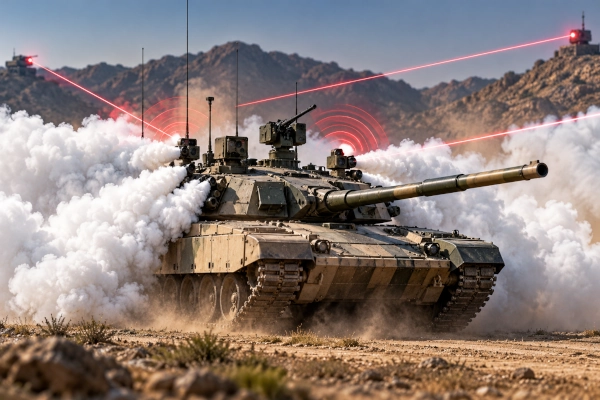
The Indian Army has initiated a procurement process for an advanced 360-degree Laser Warning Receiver (LWR) integrated with an automatic smoke countermeasure system to strengthen the survivability of its armoured vehicles. The requirement reflects the growing importance of automated defensive technologies capable of detecting laser-based targeting threats and initiating protective measures before an armoured vehicle comes under attack.
The procurement was published through the Government e-Marketplace (GeM) in October 2026 under the Ministry of Defence’s Department of Military Affairs. The tender, seeks one unit of a 360-degree Laser Warning Receiver with Automatic Smoke Countermeasure for Tank.
The initiative represents an opportunity to evaluate technologies that combine early threat detection, automated warning and defensive smoke deployment. Such systems can improve the protection of tanks operating in environments where laser rangefinders, target designators and precision-guided anti-armour weapons present significant threats.
Indian Army Initiates Procurement of Automated Tank Protection System
The procurement requirement was issued on October 5, 2026, through the Government e-Marketplace. The listed quantity is one unit, with the procurement associated with an Indian Army establishment in Kachchh, Gujarat.
The requirement identifies an integrated system combining 360-degree laser warning capability with automatic smoke countermeasures. This combination is intended to improve the ability of an armoured vehicle to recognise potential targeting threats and respond through protective measures.
A further procurement record, identified as GEM/2026/R/754408, appeared in October for one set of equipment under the same description. The records indicate a focused procurement requirement rather than a confirmed large-scale acquisition of systems for the Army’s tank fleet.
The procurement is particularly relevant as modern armoured warfare increasingly involves precision targeting, laser-guided weapons and rapidly developing battlefield surveillance technologies.
How a 360-Degree Laser Warning Receiver Protects Tanks
A Laser Warning Receiver is a defensive electronic system designed to detect laser radiation directed towards a military vehicle. Such radiation may originate from laser rangefinders, laser target designators or other systems used to support the targeting of armoured vehicles.
Laser warning technology enables a tank crew to recognise that their vehicle may be under observation or targeted by an opposing weapon system. Depending on the receiver’s design, it can also provide information about the direction from which laser illumination originates.
A 360-degree configuration is intended to provide coverage around the vehicle rather than limiting detection to the forward-facing sector. This is important because threats may originate from different directions, particularly during manoeuvres in complex terrain.
The effectiveness of such systems depends on their sensor architecture, detection capability, processing algorithms and integration with the vehicle’s defensive equipment.
By incorporating laser warning technology into an armoured platform, military forces can improve situational awareness and reduce the time required to recognise certain targeting threats.
Automatic Smoke Countermeasures to Improve Tank Survivability
The integration of automatic smoke countermeasures represents an important feature of the Indian Army’s procurement requirement.
Conventional smoke protection systems often depend on the crew identifying a threat and manually initiating defensive action. Automated systems can reduce this response interval by linking suitable threat detection equipment with smoke deployment controls.
When a laser warning receiver identifies a qualifying threat, an integrated defensive system can initiate a smoke countermeasure according to its programmed operating parameters.
Smoke screens are used in armoured warfare to obstruct observation and interfere with certain optical and laser-based targeting methods. Specialised multispectral smoke systems can also provide protection against selected infrared observation and guidance technologies.
The degree of protection depends on the smoke composition, deployment geometry, environmental conditions and characteristics of the opposing targeting system.
Automatic deployment can be particularly valuable during fast-moving combat situations, when tank crews must simultaneously manage navigation, surveillance, communication and weapon operations.
The combination of warning and defensive countermeasures therefore represents an important approach to improving the survivability of armoured vehicles.
Countering Laser-Guided Anti-Tank Threats
Modern armoured vehicles face a range of threats from anti-tank guided missiles, precision weapons and advanced battlefield targeting systems.
Many military targeting arrangements use lasers to measure distance or designate targets for weapons. Laser Warning Receivers can identify compatible laser emissions and alert vehicle crews to the possibility of hostile targeting.
The integration of smoke countermeasures provides an additional defensive option against certain laser-dependent weapon systems by attempting to interrupt the targeting process.
However, laser warning and smoke protection are not universal countermeasures against all anti-tank weapons. Their effectiveness varies according to the guidance technology employed by the weapon and the characteristics of the protective system.
For this reason, modern tank survivability relies on several complementary defensive measures, including armour, mobility, situational awareness, electronic systems and other active or passive protection technologies.
The Indian Army’s interest in laser warning receivers reflects the increasing importance of integrating electronic threat detection with protective measures on armoured vehicles.
Improving Protection for Indian Army Armoured Formations
India operates armoured formations equipped with several classes of main battle tanks, including the T-72, T-90 and indigenous Arjun platforms.
As battlefield threats evolve, modernisation of armoured vehicles increasingly includes improvements to surveillance equipment, electronic protection and defensive systems in addition to conventional armour and firepower.
Laser warning receivers can form part of this modernisation approach by giving crews additional information about potential targeting activity.
Automatic smoke countermeasures can further improve defensive responsiveness by reducing dependence on manual intervention during critical situations.
The procurement of an integrated warning and smoke protection system provides an opportunity to assess equipment that could complement the Army’s existing armoured vehicle protection arrangements.
The current tender establishes a limited equipment requirement and does not identify a confirmed fleet-wide installation programme or specify which tank model will ultimately receive the system.
Opportunities for Indian Defence Electronics Manufacturers
The procurement also presents opportunities for companies involved in defence electronics, electro-optical technologies, embedded systems and armoured vehicle equipment.
Developing laser warning systems requires specialised capabilities in optical sensing, electronic signal processing, ruggedised hardware and integration with vehicle control systems.
Automatic smoke countermeasure equipment adds further requirements involving defensive control electronics, communication interfaces and dependable operation under demanding military conditions.
Indian defence manufacturers and specialised MSMEs possess growing capabilities across several of these technology areas. Participation in such procurement opportunities can support further industrial development and strengthen domestic expertise in advanced vehicle protection systems.
The GeM procurement framework also provides provisions for eligible Micro and Small Enterprises and startups to participate under applicable procurement conditions.
The October tender records provide for MSME-related preferences and certain relaxations. However, the listed procurement does not establish a specific Make in India purchase preference.
Integrated Electronic Protection Becomes Increasingly Important in Armoured Warfare
The Indian Army’s requirement reflects a broader technological shift in armoured vehicle protection, where electronic surveillance and automated defensive systems increasingly complement conventional armour.
Modern tank protection involves identifying threats at the earliest possible stage and providing crews with sufficient information to respond effectively.
Laser warning systems contribute to this process by detecting certain forms of targeting activity. When linked to compatible smoke countermeasures, they can also support faster defensive action.
The integration of these capabilities into armoured vehicles requires reliable sensors, dependable processing equipment and effective coordination between warning and protection systems.
Such technologies can improve the defensive awareness of armoured formations while contributing to the development of more sophisticated vehicle protection architectures.
Indian Army Advances Armoured Vehicle Protection Technologies
The Indian Army’s October 2026 procurement requirement for a 360-degree Laser Warning Receiver with Automatic Smoke Countermeasure highlights its continuing interest in technologies that strengthen tank survivability.
The system combines laser threat awareness with the ability to initiate protective smoke countermeasures, addressing an important aspect of modern armoured warfare.
Although the current procurement concerns one unit, the requirement provides a defined opportunity to assess integrated defensive equipment intended for military vehicles.
The initiative also highlights the importance of advanced electronics, automated protection and specialised engineering in future armoured vehicle modernisation.
As India continues developing its indigenous defence technology ecosystem, greater integration of electronic warning systems and automated countermeasures will contribute to the evolution of more capable and resilient armoured platforms.
References
1. Government e-Marketplace (GeM), Government of India
360° Laser Warning Receiver with Automatic Smoke Countermeasure for Tank.
Procuring Organisation: Indian Army, Department of Military Affairs, Ministry of Defence.
Tender Reference: GEM/2026/B/8119925
Published: October 5, 2026.
Official procurement portal: https://bidplus.gem.gov.in/all-bids
2. Government e-Marketplace (GeM), Government of India
360° Laser Warning Receiver with Automatic Smoke Countermeasure for Tank.
Procuring Organisation: Indian Army, Department of Military Affairs.
Procurement Reference: GEM/2026/R/754408
October 2026 procurement record concerning one set of equipment.
Official procurement portal: https://bidplus.gem.gov.in/all-bids
3. Publicly Indexed Government Procurement Records
Procurement listings corresponding to the Indian Army’s GeM tender references, including quantity, buyer identification and tender description.
Procurement record GEM/2026/B/8119925
Procurement record GEM/2026/R/754408
You may also like
-
India’s 300 kW Laser Weapon Ambitions Could Strengthen Future Defence Against Cruise Missiles
-
DRDO Seeks Indian Industry Partners for Development and Production of R-59 Air-Launched Weapon System
-
Ministry of Defence Signs ₹770 Crore Contract with BEL for Advanced Low-Level Radars to Strengthen Indian Army Air Defence
-
Indian Air Force Unveils Unmanned and Autonomous Systems Roadmap to Industry, Focuses on Indigenous Drone Technologies
-
India’s Indigenous Firefighting Robot Moves from INS Vikrant to Army and Air Force
