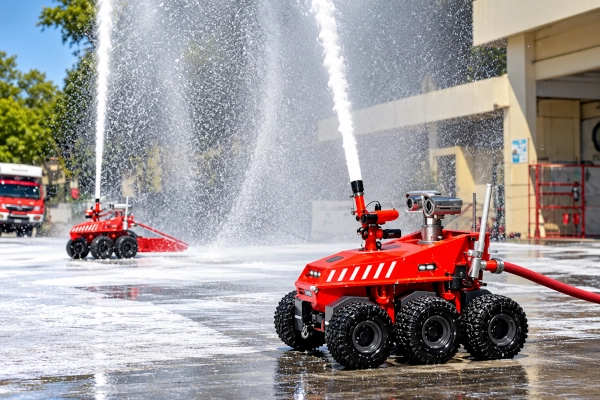
India’s indigenous defence robotics ecosystem has achieved an important milestone with the growing adoption of the FF Bot, an unmanned firefighting robot developed by Ahmedabad-based Swadeshi Empresa Private Limited. Originally developed through the Ministry of Defence’s Innovations for Defence Excellence (iDEX) initiative, the robotic firefighting system has progressed from naval demonstrations aboard India’s indigenous aircraft carrier INS Vikrant to wider adoption by the Indian armed forces.
The Indian Navy has inducted 50 firefighting robots, while the Indian Air Force has placed an order for 80 units, according to the Foundation for Innovation and Technology Transfer (FITT) at IIT Delhi. The Indian Army has also demonstrated the technology and pursued its adoption for hazardous firefighting operations. These developments highlight the increasing importance of indigenous robotic systems in protecting military personnel, aircraft, ammunition facilities and other critical defence infrastructure.
Recent reports published in October 2026 have brought renewed attention to the technology, particularly its deployment within the Indian Air Force and its reported certification by the Directorate General of Quality Assurance (DGQA). The FF Bot demonstrates how an Indian defence startup can develop a specialised solution for one service and expand its applications across the armed forces.
Swadeshi Empresa Develops Indigenous Firefighting Robot Under iDEX
Swadeshi Empresa Private Limited developed the FF Bot as a remotely operated unmanned ground vehicle designed to assist firefighters in dangerous environments. The system forms part of the company’s growing portfolio of robotic firefighting and emergency response technologies.
The Ministry of Defence’s iDEX programme supports innovation by connecting startups, MSMEs and individual innovators with technological requirements identified by the armed forces. Through this initiative, Indian companies can develop specialised solutions that address operational challenges while strengthening domestic defence manufacturing.
Swadeshi Empresa emerged from this innovation ecosystem with a robotic platform capable of undertaking firefighting operations in areas where direct human intervention could expose personnel to extreme temperatures, smoke, toxic gases or explosions.
The company describes its FF Bot as a multipurpose firefighting unmanned ground vehicle designed to support firefighting personnel in high-risk environments. Its development reflects the growing role of robotics, remote operation and indigenous engineering in modern emergency response systems.
Indian Navy Demonstrates Firefighting Robot Aboard INS Vikrant
The Indian Navy was among the earliest adopters of the indigenous firefighting robot, recognising its potential to improve emergency response capabilities aboard naval platforms.
On March 6, 2023, Defence Minister Rajnath Singh witnessed demonstrations of indigenous technologies during the Naval Commanders’ Conference aboard INS Vikrant. According to the Ministry of Defence’s official announcement, the demonstrations included a firefighting bot and a spotter drone, alongside presentations on emerging technologies.
The inclusion of the firefighting robot during the naval conference highlighted the Navy’s interest in unmanned systems capable of supporting critical safety functions.
Aircraft carriers present demanding firefighting environments because they operate aircraft, aviation fuel, electrical equipment and complex machinery within a confined maritime setting. Fires aboard such vessels can threaten personnel, operational equipment and ship safety, making rapid emergency response essential.
A remotely operated firefighting robot can help emergency teams approach hazardous areas while limiting the exposure of personnel to dangerous conditions.
Swadeshi Empresa subsequently identified its FF Bot as operational aboard INS Vikrant, marking the progression of the indigenous technology from demonstration to practical naval application.
Indian Navy Inducts 50 Indigenous Firefighting Robots
The wider adoption of the FF Bot by the Indian Navy represents an important achievement for India’s domestic defence robotics industry.
The Foundation for Innovation and Technology Transfer at IIT Delhi, which has supported Swadeshi Empresa through the iDEX ecosystem, reported that the company had successfully inducted 50 firefighting robots into the Indian Navy.
This development demonstrates the increasing acceptance of unmanned emergency response technologies within India’s naval infrastructure.
Naval firefighting presents specialised operational challenges because ships and shore establishments may contain fuel storage facilities, machinery compartments, electrical installations and other equipment requiring immediate protection during emergencies.
Remotely operated robots can supplement conventional firefighting arrangements by entering hazardous locations, providing visual information and assisting with water or foam delivery.
The induction of 50 units also reflects the ability of an Indian startup to move beyond prototype development and supply equipment for operational military requirements. Such progress is particularly significant for the iDEX programme, which aims to translate indigenous innovation into practical defence capabilities.
Indian Air Force Orders 80 FF Bots for Emergency Response
The Indian Air Force has emerged as another major customer for Swadeshi Empresa’s firefighting robots, expanding the technology’s applications beyond naval facilities.
According to FITT-IIT Delhi, the Indian Air Force placed an order for 80 FF Bots. Reports published on October 19 and 20, 2026, also described the procurement and the delivery of indigenous firefighting robots for military emergency response applications.
The systems are intended to strengthen the Air Force’s ability to respond to fires involving aircraft, aviation fuel, ammunition and critical airbase infrastructure. These environments can expose conventional firefighting teams to considerable danger, particularly when burning fuel, damaged equipment or explosive materials complicate emergency operations.
The robotic platforms allow operators to approach hazardous locations from a safer distance while directing firefighting operations towards affected areas.
Recent reports also indicate that the equipment underwent operational evaluation in demanding conditions, including demonstrations associated with Exercise Vayu Shakti 2026 at Pokhran.
The Air Force’s adoption of the technology reflects the growing importance of unmanned ground systems in supporting the protection, safety and operational readiness of military installations.
Indian Army Adopts Robotic Firefighting Technology for Ammunition Depots
The Indian Army has also moved towards deploying indigenous firefighting robots to improve safety at sensitive military installations, particularly ammunition depots and fuel storage facilities.
According to an October 19, 2026, report by News9, the Army signed a ₹62 crore contract for 18 firefighting robots with Swadeshi Empresa on January 13, 2026. The procurement followed military evaluation of the system, including a Single Stage Composite Trial intended to assess its suitability for operational requirements.
Ammunition depots present particularly demanding firefighting conditions because fires can spread rapidly and may trigger secondary explosions. The presence of ammunition, explosives and combustible materials makes conventional firefighting operations extremely hazardous.
Remote-controlled firefighting robots can help emergency personnel approach dangerous locations without immediately exposing human teams to these risks. By supporting fire suppression and cooling operations, the equipment can strengthen emergency response capabilities at critical military facilities.
The Ministry of Defence had officially showcased an indigenous firefighting robot during the Indian Army’s Vijay Diwas celebrations in December 2025. The government described the system as a remotely controlled platform using cameras and sensors to assist firefighters in dangerous environments. Its potential applications also extend to industrial installations and civilian disaster response.
How India’s Indigenous FF Bot Works
The FF Bot is designed as a remotely operated ground vehicle capable of entering areas where intense heat, smoke, debris or the risk of explosions may prevent firefighters from approaching safely.
According to technical descriptions published in October 2026, the system uses a six-wheel-drive configuration to move across difficult surfaces. Operators control the robot remotely using a joystick and touchscreen interface, allowing them to guide the vehicle towards affected areas while remaining at a safer location.
The robot incorporates optical and thermal imaging cameras to provide operators with visual information from the surrounding environment. Thermal imaging is particularly useful when smoke limits normal visibility because it can help identify areas of elevated temperature and locate potential fire hotspots.
The firefighting equipment includes systems capable of directing water, water fog or foam towards affected areas. These capabilities allow the robot to assist in suppressing fires and cooling equipment exposed to high temperatures.
Reports also describe an onboard cooling arrangement that helps protect the robot when operating near intense heat. Its mobility and remote-control capabilities allow firefighting teams to position the equipment more effectively without requiring personnel to enter hazardous areas during the initial response.
The robot is intended to supplement trained firefighting teams rather than replace them. Human operators remain responsible for assessing the situation, controlling the equipment and coordinating broader emergency response activities.
Indigenous Firefighting Robot Receives DGQA Certification
Another development reported in October 2026 concerns the certification of Swadeshi Empresa’s firefighting robot by the Directorate General of Quality Assurance.
According to News9’s October 19 report, the FF Bot received certification declaring it suitable for Indian military use following evaluations of reliability, durability and performance under demanding environmental conditions.
The reported assessment included tests based on the JSS 55555 defence standard, which covers environmental conditions such as extreme temperatures, humidity, salt exposure, dust and mechanical shocks.
Such testing is particularly relevant to equipment intended for deployment across India’s diverse military environments. Firefighting robots may need to operate at coastal naval installations, desert airbases, ammunition facilities and other locations exposed to challenging conditions.
The certification represents an important development for indigenous defence technology because military equipment must demonstrate dependable performance under operational conditions.
It also strengthens the company’s prospects for supplying robotic firefighting systems to additional defence and security organisations.
Exercise Vayu Shakti 2026 Demonstrates Operational Applications
The Indian Air Force’s Exercise Vayu Shakti 2026 at Pokhran provided another opportunity to demonstrate indigenous firefighting robotics under demanding conditions.
According to reports published in October 2026, the FF Bot participated in demonstrations involving simulated emergencies and hazardous operating environments. The activities highlighted its ability to negotiate difficult terrain and support firefighting operations while personnel controlled the equipment remotely.
Military airbases require specialised emergency response capabilities because aircraft operations involve aviation fuel, electrical systems, maintenance facilities and other infrastructure where fires can have serious operational consequences.
A robotic firefighting platform offers an additional means of responding to such emergencies. It can help emergency teams assess hazardous conditions and direct firefighting equipment towards affected areas while limiting personnel exposure.
These capabilities are particularly valuable in situations involving burning aircraft, damaged infrastructure, fuel storage facilities or ammunition-related emergencies.
The Air Force’s interest in indigenous robotic firefighting systems therefore reflects a broader effort to incorporate advanced technology into the protection of critical military infrastructure.
India’s iDEX Programme Supports Defence Robotics Innovation
The development of the FF Bot highlights the contribution of the Ministry of Defence’s Innovations for Defence Excellence programme to India’s expanding indigenous defence technology ecosystem.
The initiative encourages startups and MSMEs to develop solutions for challenges identified by the armed forces. It provides opportunities for smaller technology companies to participate in defence research, prototyping, testing and eventual procurement.
Swadeshi Empresa’s progress illustrates this approach. The company developed a specialised robotic firefighting platform, demonstrated its capabilities to the Indian Navy and subsequently expanded its engagement with other military services.
The progression from prototype development to military procurement is particularly important for India’s defence startup ecosystem. It demonstrates how domestic companies can translate engineering expertise into equipment that addresses practical operational requirements.
The FF Bot also reflects the growing importance of unmanned ground vehicles beyond conventional military applications. Robotics can contribute to emergency response, logistics, hazardous material handling, infrastructure inspection and other tasks where reducing human exposure to danger is an important objective.
Indigenous Military Robotics Creates Opportunities Beyond Defence
Although the FF Bot was developed to address military firefighting requirements, its underlying technology has applications across several civilian sectors.
Industrial facilities such as petroleum refineries, chemical plants, power stations, manufacturing complexes and large warehouses face firefighting challenges involving hazardous materials, high temperatures and restricted access.
Remotely operated firefighting equipment can provide additional protection in such environments by allowing emergency teams to assess conditions and begin suppression operations from safer positions.
The technology also has potential applications in ports, airports, tunnels and disaster response operations where conventional firefighting vehicles may face access limitations.
The development of domestic robotic systems can support India’s industrial safety sector while creating opportunities for specialised manufacturing, electronics, sensors, automation and engineering services.
As indigenous robotic technologies mature, their wider adoption can contribute to improved workplace safety and strengthen India’s capabilities in industrial automation.
From INS Vikrant to Three Armed Services: A Make in India Achievement
The journey of Swadeshi Empresa’s FF Bot demonstrates how indigenous innovation can address specialised defence requirements and develop into a technology with wider military applications.
The Indian Navy’s early interest in robotic firefighting, including demonstrations aboard INS Vikrant, provided an important foundation for the system’s development. The subsequent induction of 50 units established its growing role within naval emergency response capabilities.
The Indian Air Force’s order for 80 robots and the Indian Army’s reported procurement of 18 units further demonstrate the expanding adoption of the technology across India’s defence services.
The reported DGQA certification adds another dimension to this progress by recognising the system’s suitability for demanding military environments.
For India’s defence manufacturing sector, the development represents an encouraging example of a domestic startup creating specialised equipment through indigenous research, engineering and collaboration with the armed forces.
As India expands its investment in unmanned systems and defence robotics, technologies such as the FF Bot will play an increasingly important role in protecting military personnel, safeguarding critical infrastructure and strengthening emergency response capabilities.
The transition from a naval innovation to a multi-service firefighting solution illustrates the practical potential of Aatmanirbhar Bharat, where Indian engineering addresses national defence requirements while creating opportunities for technological and industrial growth.
References
1. Ministry of Defence, Government of India — Press Information Bureau
Raksha Mantri Reviews Operational Capabilities of Indian Navy During Naval Commanders’ Conference Aboard INS Vikrant.
Published: March 6, 2023.
Official confirmation of the indigenous firefighting bot demonstration aboard INS Vikrant.
https://www.pib.gov.in/Pressreleaseshare.aspx?PRID=1904622
2. Ministry of Defence, Government of India — Press Information Bureau
Indian Army Showcases Atmanirbharta and Innovations at Vijay Diwas ‘At Home’.
Published: December 15, 2025.
Official information on the Indian Army’s demonstration of indigenous robotic firefighting technology.
https://www.pib.gov.in/newsite/erelcontent.aspx?lang=2®=48&relid=280800
3. Foundation for Innovation and Technology Transfer, IIT Delhi
Swadeshi Empresa Private Limited — Indigenous Fire-Fighting Bot.
Institutional announcement confirming the Indian Navy’s induction of 50 FF Bots and the Indian Air Force’s order for 80 units.
Official FITT-IIT Delhi announcement
4. Swadeshi Empresa Private Limited
Official company information on FF Bot, indigenous firefighting robotics and operational deployment aboard INS Vikrant.
Home
5. News9 — October 19, 2026
Tested to Military Standard: What It Took for a Firefighting Robot to Earn DGQA’s Nod.
Reports DGQA certification, the Indian Army’s ₹62 crore procurement and military testing requirements.
https://www.news9live.com/featured/tested-to-military-standard-what-it-took-for-a-firefighting-robot-to-earn-dgqas-nod-3017457
6. Research, News & Analysis — October 19, 2026
From iDEX SPRINT to the Indian Air Force: Swadeshi Empresa’s Firefighting Robots Delivered in 11 Months.
Reports on the company’s defence innovation programme, technical capabilities, military testing and Indian Air Force procurement.
From iDEX SPRINT to the Indian Air Force: Swadeshi Empresa’s Firefighting Robots Delivered in 11 Months
You may also like
-
India and Singapore Begin SIMBEX 2026 Naval Exercise in Bay of Bengal, Focus on Anti-Submarine Warfare
-
IBSAMAR IX 2026 Concludes in South Africa, Strengthening Maritime Cooperation Between India, Brazil and South Africa
-
Ammunic Systems Develops Indigenous Loitering Munition Warheads and Drone-Integrated Weapon Technologies
-
Indian Air Force Signs Contract with Cyronics for Indigenous Wideband HF Modem Developed Under iDEX
-
Vijayan Trishul Defence Partners with Czech Firm DEUS Automation to Manufacture Small-Calibre Ammunition in India
