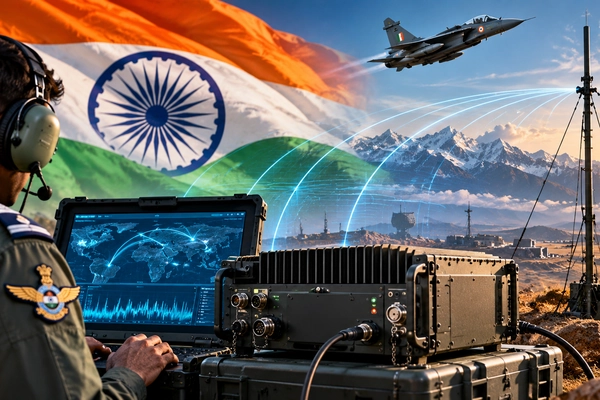
The Indian Air Force (IAF) has signed a contract with Pune-based Cyronics Innovation Labs Limited for an indigenously developed Wideband High Frequency (HF) Modem, strengthening India’s domestic capabilities in advanced military communication technologies.
The Indian Air Force confirmed the development through its VayuSaksham innovation initiative in October 2026. The system was designed and developed under Innovations for Defence Excellence (iDEX), a Ministry of Defence programme that encourages Indian startups, MSMEs and technology companies to develop indigenous solutions for the Armed Forces.
The contract represents an important development in India’s efforts to strengthen military communication infrastructure using domestically developed technologies. Wideband HF communication systems are particularly relevant to long-distance connectivity, where conventional radio networks may face geographical and infrastructure limitations.
Indian Air Force Contracts Cyronics for Indigenous Communication Technology
The Indian Air Force’s VayuSaksham initiative announced that it had signed a contract with Cyronics Innovation Labs Limited for an indigenous Wideband HF Modem intended to enhance the service’s operational capabilities.
The announcement was also shared by the Defence Innovation Organisation, which administers the iDEX programme under the Department of Defence Production.
The development marks progress in the IAF’s efforts to encourage domestic companies to address specialised defence technology requirements. Through iDEX, the Armed Forces identify technological challenges and collaborate with Indian innovators to develop solutions suited to operational needs.
Cyronics’ Wideband HF Modem emerged from this innovation framework, demonstrating the potential for specialised Indian technology companies to contribute to military communication modernisation.
Wideband HF Modem Developed Under Defence India Startup Challenge 5
The Indian Air Force had identified the requirement for a Wideband HF Modem under Defence India Startup Challenge 5 (DISC 5).
The development requirement appeared as Challenge No. 7, titled Development of Wide Band HF Modem for Networked Secure Voice, Data and Video Communication.
The objective was to develop an advanced digital modem capable of supporting networked communications over high-frequency radio channels.
Traditional HF communication systems have long provided voice and limited data connectivity over considerable distances. The Air Force’s requirement sought to extend these capabilities through improved digital modulation, signal processing and wider bandwidth utilisation.
The original development challenge envisaged data transmission rates exceeding 48 kilobits per second, with an eventual target of 512 kilobits per second.
It also specified compatibility with relevant NATO Standardisation Agreements (STANAG) and the MIL-STD-188-110D standard for HF data communication.
These specifications established the technical objectives for the indigenous development programme and provided a framework for evaluating prospective solutions.
How Wideband HF Communication Works
High Frequency radio communication generally operates within the 3–30 MHz frequency range. One of its most important characteristics is the ability to support communication over distances extending beyond the direct line of sight.
HF signals can propagate over long distances by interacting with the Earth’s ionosphere, allowing communication between widely separated locations without requiring a continuous chain of terrestrial relay stations.
This characteristic has made HF radio an important communication technology for military organisations, maritime operations and other applications requiring long-distance connectivity.
Unlike satellite communication, HF systems can provide beyond-line-of-sight communication without depending on an orbiting satellite. This offers an additional communication pathway when other infrastructure is unavailable or unsuitable.
However, HF propagation depends on atmospheric and ionospheric conditions, including variations associated with solar activity. These conditions influence signal quality, usable frequencies and available transmission capacity.
Modern digital signal-processing techniques help address these limitations by improving modulation efficiency, error correction and frequency selection.
Wideband HF technology seeks to increase the quantity of information transmitted through available HF channels, enabling more advanced digital communication applications.
IAF Requirement Covers Secure Voice, Data and Video Communication
The Indian Air Force’s original iDEX challenge focused on developing an HF modem capable of handling voice, data and video communication through digital transmission techniques.
The technical requirements envisaged multiband and multicarrier modulation and demodulation, using digital signal processing to improve communication efficiency.
The challenge also identified direct digital conversion as an approach for achieving wideband transmission and reception capabilities.
These technologies can help improve the utilisation of available HF spectrum and support higher information-transfer rates.
The programme also considered advanced modulation techniques to reduce transmission errors and improve the relationship between signal strength and background noise.
For military users, the ability to exchange digital information over extended distances can support communication between geographically dispersed installations and operational units.
Secure communication remains a central requirement in defence applications, particularly when transmitting operational information across large areas.
Artificial Intelligence and Machine Learning Included in Development Objectives
An interesting feature of the original iDEX challenge was its emphasis on exploring Artificial Intelligence and Machine Learning for HF communication management.
The Indian Air Force identified the potential use of AI and ML techniques for automatic communication frequency selection based on signal quality.
HF radio conditions change with ionospheric activity, geographical location and time of day. These variations can influence the reliability of a communication link.
Automated frequency selection can help identify more suitable communication channels as conditions change, reducing the need for continuous manual intervention.
The challenge also envisaged research into frequency-hopping algorithms and ionospheric modelling.
Such capabilities could contribute to the development of adaptive communication systems capable of responding more effectively to changing propagation conditions.
The original requirements further identified the potential for developing advanced HF radio architectures supporting multiple users and wider digital communication applications.
Cyronics Brings Indigenous RF and Software-Defined Radio Expertise
Cyronics Innovation Labs specialises in radio-frequency engineering, microwave systems and software-defined radio technologies.
The company develops electronic subsystems and communication-related technologies, including RF front-end modules and associated radio equipment.
Its technical portfolio includes HF software-defined radio front-end modules designed for applications requiring radio-frequency transmission and reception.
Software-defined radio technology allows many communication functions traditionally performed through dedicated hardware to be implemented or controlled through software-based signal processing.
This approach offers flexibility in implementing communication waveforms, modulation methods and other digital radio functions.
The development of indigenous RF components and digital communication systems strengthens India’s domestic expertise in an area important to defence, aerospace and other strategic industries.
Cyronics’ participation in the IAF programme demonstrates the growing role of specialised private enterprises in the development of advanced military electronics.
iDEX Creates Opportunities for Indian Defence Technology Companies
The Innovations for Defence Excellence programme was established to encourage indigenous innovation across India’s defence and aerospace sectors.
Implemented through the Defence Innovation Organisation, the initiative connects the Armed Forces and defence public sector enterprises with startups, MSMEs, research organisations and individual innovators.
Participating defence organisations identify technological requirements through structured challenges. Indian innovators can then propose and develop solutions aligned with these operational needs.
The programme provides a pathway for domestic companies to undertake research and development in areas that have traditionally depended on specialised international technologies.
It also encourages collaboration between military users and industry during the technology development process.
The Cyronics Wideband HF Modem contract illustrates how a defined Air Force requirement can progress through an indigenous innovation programme towards a formal procurement arrangement.
Beyond the immediate communication application, programmes of this nature help strengthen domestic capabilities in electronics design, embedded systems, software engineering and advanced signal processing.
Indigenous HF Technology Strengthens India’s Military Communication Ecosystem
Modern military operations require communication systems capable of functioning across different geographical environments and operational conditions.
Satellite communications, terrestrial radio networks, optical-fibre infrastructure and HF systems each perform different functions within a broader military communication architecture.
HF radio remains valuable because it provides an additional long-distance communication option without requiring continuous terrestrial infrastructure.
Advances in digital signal processing and wideband modulation can extend its usefulness for exchanging information beyond traditional voice communication.
For India, developing these technologies domestically supports greater technological self-reliance and creates opportunities for strengthening the national military electronics industry.
Indigenous development also builds expertise in designing, manufacturing and maintaining specialised communication equipment.
The Indian Air Force’s contract with Cyronics represents progress towards these objectives and reinforces the role of Indian technology companies in developing equipment for national defence requirements.
India Advances Indigenous Defence Communication Capabilities
The contract between the Indian Air Force and Cyronics Innovation Labs marks another step in the development of India’s indigenous military communication technologies.
The Wideband HF Modem programme combines the Air Force’s operational requirements with domestic expertise in radio-frequency engineering and digital communication systems.
Its development under iDEX demonstrates how collaboration between the Armed Forces and specialised Indian companies can help address complex technological requirements.
As India continues to expand its defence electronics and communication capabilities, projects such as the Wideband HF Modem will contribute to a stronger indigenous research, development and manufacturing ecosystem.
The growing participation of Indian innovators in advanced military technologies also supports the wider objectives of Atmanirbhar Bharat and Make in India in defence manufacturing.
References
- Indian Air Force — VayuSaksham, October 2026. Official announcement confirming the contract with Cyronics Innovation Labs Limited for an indigenous Wideband HF Modem developed under iDEX.
https://x.com/IAF_InnovAce - Defence Innovation Organisation, Department of Defence Production, Ministry of Defence. Official iDEX account sharing the Indian Air Force contract announcement.
https://x.com/India_iDEX - Innovations for Defence Excellence — Defence India Startup Challenge 5. Challenge No. 7: Development of Wide Band HF Modem for Networked Secure Voice, Data and Video Communication.
https://idex.gov.in/uploads/challenges/1677049878_fae77a4dfb9378682b04.pdf - Cyronics Innovation Labs — Official Website. Information on the company’s RF engineering, software-defined radio and communication technology capabilities.
https://www.cyronics.com/ - Cyronics Innovation Labs — HF Software-Defined Radio Front-End Module. Technical overview of the company’s HF radio-frequency development capabilities.
https://www.cyronics.com/products/fem/hf
You may also like
-
Ammunic Systems Develops Indigenous Loitering Munition Warheads and Drone-Integrated Weapon Technologies
-
Vijayan Trishul Defence Partners with Czech Firm DEUS Automation to Manufacture Small-Calibre Ammunition in India
-
Ashok Leyland Developing Hydrogen-Powered Stallion Military Truck, Exploring Autonomous Vehicles and Drones
-
SSS Defence Wins UP Police Order for 90 Indigenous P-72 Assault Rifles
-
India Calls for Unified Action Against Terrorism at SCO Meeting, Pushes for Sovereignty-Based Connectivity and Trade
