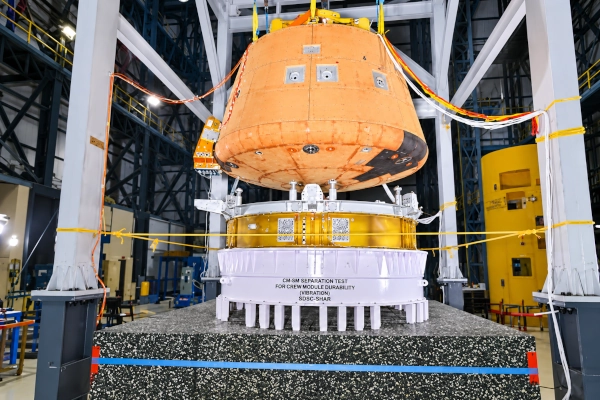
The Indian Space Research Organisation (ISRO) has successfully completed a series of Crew Module–Service Module separation tests for the Gaganyaan human spaceflight programme, marking another important milestone in India’s preparations for independent human space missions.
The tests were conducted at the Vikram Sarabhai Space Centre (VSSC), Thiruvananthapuram, using a specially developed test facility designed to simulate the separation of the two major components of the Gaganyaan spacecraft.
Announcing the achievement on October 16, 2026, ISRO confirmed that the tests successfully validated the spacecraft’s separation mechanisms and demonstrated the ability of several critical onboard systems to withstand the mechanical shocks generated during separation.
The successful trials strengthen confidence in the spacecraft’s design and its readiness for the first uncrewed Gaganyaan mission, designated G1, which ISRO is targeting for launch in 2026.
Understanding the Gaganyaan Crew Module and Service Module
The Gaganyaan spacecraft consists of two principal components: the Crew Module (CM) and the Service Module (SM). Together, they form the Orbital Module, which remains integrated during launch and orbital operations.
The Crew Module is designed to accommodate astronauts and provide the protected environment necessary for their journey into space and subsequent return to Earth. It incorporates critical systems for navigation, thermal protection, environmental management and spacecraft recovery.
The Service Module supports the spacecraft during orbital operations by providing essential functions, including propulsion, power and associated support systems.
Both modules remain connected through a specialised separation system and a series of electrical and fluid connections known as umbilicals. These connections enable the transfer of electrical signals and fluids between the modules while they operate as a single spacecraft.
Before the Crew Module begins its descent into Earth’s atmosphere, it must separate safely from the Service Module. This transition allows the Crew Module to undertake atmospheric re-entry independently, using its dedicated guidance, propulsion and thermal protection systems.
ISRO Validates Critical Crew Module Separation Mechanisms
According to ISRO, the separation of the Crew Module from the Service Module requires several precisely coordinated mechanical events.
The process involves pyrotechnic devices, separation mechanisms and systems designed to disconnect the electrical and fluid connections between the two modules.
Pyrotechnic devices use controlled explosive energy to activate specific mechanical functions within the spacecraft. Such devices are commonly employed in space systems because they can initiate rapid and reliable separation events when commanded.
The Gaganyaan separation system must operate in the correct sequence to ensure that the modules disconnect cleanly without damaging essential spacecraft equipment.
ISRO’s latest tests simulated these separation events, including the severing of multiple umbilical connections linking the Crew Module and Service Module.
The successful demonstration confirmed that the integrated separation mechanisms performed according to the required design parameters.
Advanced Test Facility Developed at Vikram Sarabhai Space Centre
ISRO developed a dedicated test setup at VSSC to validate the overall design and operation of the Crew Module–Service Module separation system.
The facility incorporated a simulated assembly of the two spacecraft modules along with extensive instrumentation to record their behaviour during testing.
This arrangement allowed engineers to reproduce important aspects of the separation sequence under controlled ground conditions and evaluate the resulting mechanical loads and shocks.
During the tests, the separation mechanisms were activated to simulate the disconnection of the Crew Module from the Service Module. The instrumentation captured the response of the assembly and its associated subsystems.
The testing programme allowed ISRO engineers to assess the structural and functional behaviour of critical spacecraft equipment during the separation event.
Such ground qualification activities are essential for human spaceflight programmes because separation mechanisms must function reliably during a mission, when direct physical intervention is impossible.
Avionics and Navigation Systems Demonstrate Shock Survivability
One of the important achievements of the latest trials was the successful validation of the shock survivability of critical Crew Module subsystems.
ISRO confirmed that the tests demonstrated the robustness of various avionics systems and the Inertial Navigation System against mechanical shocks produced during module separation.
Avionics systems support spacecraft guidance, control, monitoring and communication functions. They must continue operating reliably throughout launch, orbital flight, separation and atmospheric re-entry.
The Inertial Navigation System uses motion-sensing instruments to determine the spacecraft’s movement and orientation. This information is essential for maintaining the correct attitude and supporting controlled re-entry.
During separation, the rapid activation of pyrotechnic mechanisms can generate significant transient mechanical loads. Sensitive electronic components and navigation instruments must withstand these loads without losing functionality.
The successful tests provide important validation of the Crew Module’s ability to maintain the integrity of its critical electronic systems during this demanding transition.
Thermal Protection Systems Successfully Withstand Separation Shocks
ISRO also evaluated the shock survivability of the Crew Module’s thermal protection systems, including those associated with the aft and conical heat shields.
Thermal protection is essential during atmospheric re-entry because a spacecraft travelling at orbital velocities encounters intense aerodynamic heating as it descends through Earth’s atmosphere.
The Crew Module’s heat shield protects its structure and internal systems from these extreme thermal conditions.
However, the thermal protection system must also withstand mechanical forces encountered during launch, orbital operations and separation from the Service Module.
The latest tests demonstrated that the aft and conical heat shield systems could tolerate the mechanical shocks associated with the separation process.
This validation contributes to the overall qualification of the Crew Module for atmospheric re-entry and recovery.
Crew Module Umbilical Shield and Recovery Systems Evaluated
The Gaganyaan tests also examined the Crew Module Deployable Umbilical Shield and the pyrotechnic devices associated with the Crew Module Uprighting System.
The deployable umbilical shield forms part of the spacecraft’s protective arrangements associated with its module connections and separation sequence.
The Crew Module Uprighting System is designed to help maintain or restore the correct orientation of the spacecraft after it lands in the sea.
Following atmospheric re-entry, the Crew Module is expected to descend using a parachute-based system before splashdown. The uprighting mechanism forms part of the recovery architecture intended to support the module’s stability in water.
ISRO had previously completed qualification tests of the uprighting system, including inflation tests involving its flotation equipment.
The latest separation tests extended the evaluation of this equipment by demonstrating the shock survivability of its associated pyrotechnic devices.
These results strengthen confidence in the durability of systems required during the final stages of the spacecraft’s return to Earth.
Thermal and Humidity Control Equipment Passes Separation Tests
Another important component evaluated during the testing programme was the Crew Module’s Thermal and Humidity Control System.
Maintaining suitable environmental conditions inside a crewed spacecraft is essential for astronaut comfort, equipment reliability and mission safety.
Thermal management systems regulate internal temperatures, while humidity control helps maintain appropriate atmospheric conditions within the spacecraft.
Such systems must remain structurally and functionally reliable despite the vibration, acceleration and mechanical shocks encountered during different mission phases.
ISRO confirmed that the tests demonstrated the shock survivability of components associated with the Thermal and Humidity Control System.
The successful evaluation adds to the qualification progress of the spacecraft’s environmental management equipment.
Gaganyaan Separation Tests Build on Earlier Qualification Milestones
The latest achievement follows several important qualification activities completed by ISRO during the development of Gaganyaan’s Crew Module systems.
On July 12, 2026, ISRO announced the successful completion of three major qualification tests covering the Crew Module Uprighting System, the Crew Module–Service Module Connect Disconnect System and the structural response of the Crew Module to apex cover separation loads.
During the uprighting system tests, engineers validated the inflation of flotation equipment using stored high-pressure gas. The demonstration confirmed that the system met its prescribed functional and performance requirements.
ISRO also tested the separation of the Crew Module–Service Module umbilical assembly, confirming clean disconnection and the structural stability of the associated Crew Module interfaces.
Another qualification test examined the spacecraft’s ability to withstand loads generated when its apex cover separates before parachute deployment.
Engineers applied approximately 1.75 times the estimated reaction loads to a simulated Crew Module assembly, validating the structural margins required for the separation event.
These earlier tests established a technical foundation for the subsequent integrated Crew Module–Service Module separation demonstrations.
Crew Module Propulsion System Supports Controlled Re-Entry
Following separation from the Service Module, the Gaganyaan Crew Module must maintain its orientation during the descent and re-entry phases.
ISRO has developed a dedicated Crew Module Propulsion System using a bipropellant-based Reaction Control System to provide three-axis attitude control.
The system incorporates 12 thrusters, each producing 100 newtons of thrust, together with high-pressure gas bottles, propellant feed systems and associated control components.
These thrusters enable the Crew Module to control its pitch, yaw and roll during the descent sequence before parachute deployment.
ISRO previously completed important propulsion system qualification tests, including a successful hot-firing demonstration conducted at the ISRO Propulsion Complex, Mahendragiri, in April 2023.
The propulsion system was subsequently integrated into the Crew Module for the first uncrewed Gaganyaan mission.
The successful separation trials complement these propulsion developments by validating the transition from integrated orbital operations to independent Crew Module flight.
Gaganyaan G1 Prepares for India’s Human Spaceflight Programme
The first uncrewed Gaganyaan mission, designated G1, is intended to demonstrate the performance of major spacecraft systems before India undertakes crewed missions.
The programme involves extensive qualification of the launch vehicle, spacecraft structure, propulsion, navigation, environmental control, thermal protection, parachute systems and recovery equipment.
ISRO is preparing to use a human-rated version of its LVM3 launch vehicle, known as HLVM3, for the Gaganyaan programme.
The launch vehicle incorporates enhanced reliability measures and a Crew Escape System designed to protect astronauts during specified emergency conditions in the launch phase.
The uncrewed mission will provide an opportunity to evaluate the integrated spacecraft and its supporting systems under actual flight conditions.
According to ISRO’s October 16 announcement, the successful Crew Module–Service Module separation tests provide additional confidence for the G1 mission, which remains targeted for 2026.
Indigenous Human Spaceflight Technologies Strengthen India’s Space Programme
Gaganyaan represents one of India’s most technologically demanding space programmes because human spaceflight requires exceptionally high standards of reliability, safety and systems integration.
The development involves multiple ISRO centres, research institutions and Indian industrial partners contributing specialised technologies and manufacturing capabilities.
VSSC plays an important role in spacecraft systems, structural engineering and qualification testing, while the Liquid Propulsion Systems Centre contributes propulsion technologies and associated equipment.
The programme also draws upon India’s experience in launch vehicle development, orbital operations, re-entry technologies and spacecraft recovery.
The successful development of indigenous separation systems, pyrotechnic mechanisms, navigation equipment and thermal protection technologies strengthens the domestic technological foundation required for future human space missions.
These capabilities will also contribute valuable engineering expertise to India’s long-term plans for advanced spacecraft and human exploration beyond low Earth orbit.
ISRO Advances Towards India’s First Independent Human Spaceflight
The successful completion of the Crew Module–Service Module separation tests marks another important step in ISRO’s preparations for the Gaganyaan programme.
By validating the separation mechanisms and demonstrating the shock survivability of critical spacecraft subsystems, ISRO has strengthened confidence in a complex sequence that must operate reliably before atmospheric re-entry.
The achievement builds upon earlier qualification tests involving spacecraft propulsion, structural systems, flotation equipment and separation mechanisms.
As preparations continue for the first uncrewed Gaganyaan mission, these technological milestones are bringing India closer to demonstrating an integrated, indigenously developed human spaceflight system.
The progress reinforces India’s growing capabilities in advanced spacecraft engineering, mission safety and human spaceflight technologies while supporting the country’s long-term ambitions in space exploration.
References
- Indian Space Research Organisation (ISRO), October 16, 2026: ISRO Successfully Completes Crew Module–Service Module Separation Tests for Gaganyaan Programme
- Indian Space Research Organisation (ISRO), July 12, 2026: Successful Accomplishment of Major Qualification Tests for Crew Module Systems of Gaganyaan Mission
- Indian Space Research Organisation (ISRO), January 22, 2025: Liquid Propulsion Systems Integrated on Crew Module for First Uncrewed Gaganyaan Mission
- Indian Space Research Organisation (ISRO), April 6, 2023: Successful Completion of Crew Module Propulsion System Demonstration Tests
- Indian Space Research Organisation (ISRO): Gaganyaan G1 Launch Campaign and Human-Rated LVM3 Assembly
You may also like
-
ISRO’s Aditya-L1 Expands Global Solar Research as Joint Observations with Europe’s Proba-3 Reveal New Insights
-
ISRO Advances Indigenous 1,100 kN Methane Rocket Engine for Next-Generation Launch Vehicle
-
Indian Scientists Identify A Few Martian Analogue Sites
-
Climate History Finds Monsoon Fluctuation Footprints From Sediment Transport to Farming Adaptations
-
IIT Guwahati and IIT Kharagpur Develop Brain-Inspired Vision Device That Uses 500 Times Less Energy
