India’s space economy, currently valued at approximately USD 9 billion, is projected to expand to USD 40–45 billion over the next seven to eight years, driven by increasing private investment, policy reforms and growing commercial opportunities.
Union Minister of State (Independent Charge) for Science and Technology, Earth Sciences and Space, Dr Jitendra Singh, highlighted this growth potential during a media roundtable on Space, Sovereignty and New Economy, organised by the Bloomberg New Economy Forum in New Delhi on October 17, 2026.
The Minister emphasised that India is entering a new phase of space-sector development, shifting its focus from demonstrating technological capabilities to establishing globally competitive commercial space enterprises.
He identified predictable market demand, faster regulatory approvals, greater investment and sustainable business models as essential requirements for expanding India’s presence in the international space economy.
Private Sector Reforms Transform India’s Space Industry
The opening of India’s space sector to private participation in 2019–2020 under Prime Minister Narendra Modi marked a major transformation in the country’s space ecosystem.
The reforms created opportunities for private companies to participate in satellite development, launch systems, propulsion technologies, manufacturing, space-based applications and associated services.
Dr Jitendra Singh observed that the progress achieved over the past five to six years demonstrates the potential of collaboration between government institutions and private enterprises in a technologically demanding sector.
India’s next priority is to translate these technological capabilities into commercially successful businesses capable of competing in international markets.
The Minister emphasised that private investment, industrial expansion and access to global customers would play an important role in achieving this objective.
Predictable Demand and Faster Approvals to Support Space Startups
Dr Jitendra Singh identified the creation of sustained market demand as a critical requirement for developing financially viable space enterprises.
He highlighted the government’s use-case-based approach, under which public institutions can serve as anchor customers for emerging technologies and support proof-of-concept projects.
Such arrangements can help private companies demonstrate their capabilities, establish commercial applications and secure the customer base required for long-term investment.
The Minister also called for faster regulatory approvals, reduced business costs and stronger integration of domestic supply chains.
Companies seeking installation or export licences should receive approvals within clearly defined timelines, enabling them to plan investments and commercial operations with greater certainty.
Referring to GST-related measures for space products, he stressed that regulatory and taxation reforms should deliver practical benefits to industry.
Together, these measures can encourage Indian space startups to expand manufacturing, develop market-ready technologies and establish sustainable revenue streams.
International Investment to Strengthen Indigenous Space Capabilities
India is seeking greater domestic and international investment to accelerate technology development, manufacturing and commercial expansion across the space sector.
Dr Jitendra Singh emphasised that international cooperation and indigenous technological capabilities are complementary priorities.
While foreign investment and partnerships can provide access to capital, advanced technologies and international markets, domestic capabilities remain essential for national security and strategic autonomy.
The Minister advocated stronger collaboration between Indian government institutions, private enterprises and international partners to develop resilient supply chains and expand commercial opportunities.
Such partnerships can help Indian companies participate more actively in global space programmes while strengthening the country’s technological and industrial capabilities.
Space Technology Driving Agriculture, Infrastructure and Disaster Management
Beyond satellite launches and exploration missions, India’s space programme is increasingly contributing to economic development and public administration.
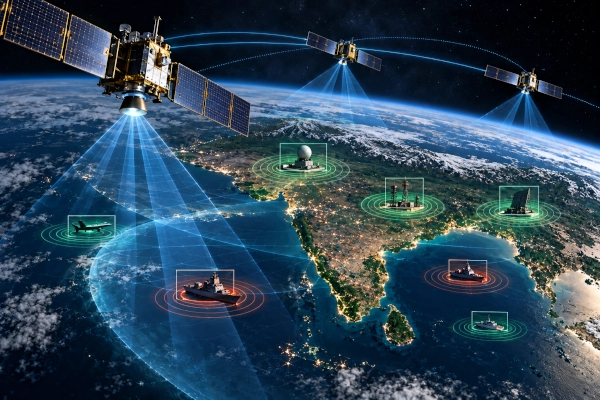
Dr Jitendra Singh highlighted the growing application of satellite communications, geospatial technologies and Earth observation systems in infrastructure development, agriculture, disaster management and defence.
Space-based technologies are supporting project clearances, monitoring infrastructure implementation, tracking development timelines and geotagging public works.
Satellite imagery and geospatial information also enable more effective agricultural planning, resource management and disaster preparedness.
The Minister referred to India’s provision of space-based information and disaster management support to neighbouring countries, including Myanmar, Bangladesh and Sri Lanka.
These applications demonstrate the growing economic and developmental value of space technologies beyond conventional launch and satellite manufacturing activities.
Satellite Data and Downstream Services Open New Commercial Opportunities
The expanding use of satellite-generated information is creating new opportunities for Indian companies developing applications for industries, government agencies and individual consumers.
Earth observation, satellite communications, geospatial analytics and data-driven services represent important areas for commercial expansion.
Dr Jitendra Singh emphasised that the space economy must be viewed beyond the development of rockets and satellites.
The integration of space technologies with infrastructure monitoring, agriculture, industrial operations and public services can create additional markets for private enterprises.
Commercial applications developed around satellite data and communications infrastructure are expected to become important contributors to the expansion of India’s space industry.
Public-Private Partnerships to Drive the Next Phase of Growth
The Bloomberg New Economy Forum roundtable brought together representatives from government, industry, entrepreneurship, academia and the international space community.
Participants included Vinod Kumar, Director (Promotion) at the Indian National Space Promotion and Authorisation Centre (IN-SPACe), and Aisha Bowe, former NASA engineer, Blue Origin astronaut and Founder and CEO of STEMBoard and LINGO.
Discussions focused on transforming sovereign space capabilities into commercially competitive industries, attracting private capital and strengthening supply chains while protecting national interests.
Dr Jitendra Singh emphasised the importance of adapting policies to technological developments and emerging industry requirements.
He also highlighted the need for stronger public-private partnerships that combine the technological expertise of established government institutions with the innovation, investment and commercial capabilities of private enterprises.
India Preparing for a Larger Role in the Global Space Economy
India’s projected expansion from a USD 9 billion space economy to USD 40–45 billion reflects the growing commercial potential of the country’s space capabilities.
The transformation is expected to generate opportunities across satellite manufacturing, launch services, propulsion technologies, Earth observation, communications, geospatial applications and downstream services.
With continued policy support, expanding private participation, stronger indigenous capabilities and international partnerships, India is positioning its space industry for sustained commercial growth.
The emphasis on building globally competitive enterprises marks an important step in transforming India’s achievements in space science and technology into a larger, innovation-driven industrial economy.
References
- Press Information Bureau, Department of Space — October 17, 2026: India’s Space Economy to Reach USD 40–45 Billion in 7–8 Years; Dr Jitendra Singh Underlines Increasing Private Investments
- Press Information Bureau, Ministry of Science and Technology — June 14, 2026: India’s Space Economy Poised to Reach USD 45 Billion in Next Decade; Over 400 Space Startups Driving Growth
You may also like
-
NewSpace Successfully Tests Indigenous RATO Booster for Sheshnag-150 Long-Range Loitering Munition
-
Picraft Technology Successfully Tests Indigenous Swarm Drones at 16,500 Feet in Ladakh
-
Ajara Ghansal Rice: Maharashtra’s Aromatic Heritage Grain from the Western Ghats
-
Mankind Pharma to Acquire 70% Stake in Belgian CAR-T Cancer Therapy Developer for €48 Million
-
Solar Industries to Acquire Sivasakthi Industrial Explosives for ₹115 Crore, Expands Manufacturing Business
