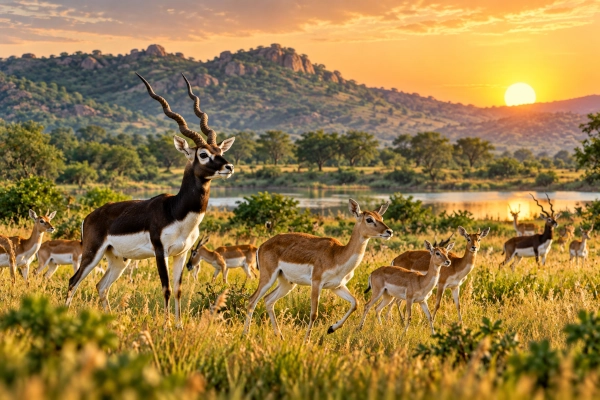
Chhattisgarh is preparing to reintroduce 50 blackbucks (Antilope cervicapra) into Gomarda Wildlife Sanctuary in Sarangarh-Bilaigarh district, marking an important step towards restoring a species that disappeared from the region more than five decades ago. The Chhattisgarh Forest Department has approved the translocation of the animals from Barnawapara Wildlife Sanctuary, where an earlier conservation programme successfully established a growing blackbuck population.
The initiative, reported on October 14, 2026, forms part of the state’s broader efforts to restore native wildlife, strengthen grassland ecosystems and expand suitable habitats for threatened and locally extinct species. Forest officials plan to undertake the translocation in stages, allowing the animals to adapt to their new surroundings while conservation teams monitor their movement, health and behaviour.
The proposed reintroduction represents a significant milestone for Gomarda Wildlife Sanctuary, where blackbucks once formed part of the natural landscape before disappearing during the 1970s. Their return will help restore an important component of the region’s grassland biodiversity and strengthen long-term wildlife conservation efforts.
Blackbucks Set to Return to Gomarda After More Than 50 Years
Gomarda Wildlife Sanctuary, located in Chhattisgarh’s Sarangarh-Bilaigarh district, contains a mixture of forests, grasslands, scrub vegetation and natural water sources. These habitats support a variety of wildlife and provide suitable ecological conditions for herbivorous species such as blackbucks.
Historical accounts indicate that blackbucks once inhabited the region that now forms Chhattisgarh. However, hunting, poaching, habitat encroachment and developmental activities contributed to a steady decline in their numbers. By the 1970s, the species had disappeared from the landscape, leaving a gap in the region’s native grassland fauna.
The Chhattisgarh Forest Department is now working to reverse this local extinction through a planned reintroduction programme. The initiative involves transferring 50 blackbucks from Barnawapara Wildlife Sanctuary, where conservation efforts have established a successful breeding population.
The animals will be introduced gradually, providing opportunities for forest officials to assess their adaptation and monitor their interactions with the surrounding habitat. The programme will also contribute to the restoration of Gomarda’s ecological diversity by re-establishing a native antelope species within its historical range.
Barnawapara Wildlife Sanctuary’s Conservation Success Makes Reintroduction Possible
The proposed translocation builds upon a successful blackbuck restoration programme undertaken at Barnawapara Wildlife Sanctuary in Chhattisgarh’s Baloda Bazar district.
During 2017–18, the Chhattisgarh State Wildlife Board initiated a conservation programme that involved introducing 77 blackbucks into Barnawapara Wildlife Sanctuary. Of these, 50 animals came from the National Zoological Park in New Delhi, while 27 were brought from Kanan Pendari Zoological Garden in Bilaspur.
The animals initially remained within managed enclosures to help them adjust to their new environment. Forest officials subsequently released them into suitable habitats in stages, allowing the population to establish itself under natural conditions.
The programme produced encouraging results. According to the latest information shared by forest officials, Barnawapara’s blackbuck population has increased to more than 150 animals, demonstrating successful reproduction and adaptation within the sanctuary.
Krishanu Chandrakar, Superintendent of Barnawapara Wildlife Sanctuary, explained that the animals required time to adapt before their gradual release into the open habitat. Some blackbucks continue to remain within managed enclosures as part of the conservation programme.
The increasing population has created an opportunity to establish another blackbuck population within the state. Transferring animals to Gomarda will extend the benefits of Barnawapara’s conservation programme to an additional protected landscape.
Gomarda’s Grasslands and Water Resources Offer Suitable Habitat
The selection of Gomarda Wildlife Sanctuary is based on its favourable environmental conditions and geographical relationship with Barnawapara.
According to O. P. Yadav, Principal Chief Conservator of Forests for Wildlife Management and Biodiversity Conservation in Chhattisgarh, the two sanctuaries are separated by approximately 70 kilometres and form part of the same broader landscape.
Gomarda contains grasslands and dependable water resources, making it suitable for a species that depends on open vegetation and access to natural grazing areas.
Blackbucks are primarily grassland antelopes that prefer open plains, grassy areas and sparsely wooded landscapes. Their physical adaptations, including slender bodies and powerful legs, allow them to move rapidly across open terrain.
Unlike many forest-dwelling deer species, blackbucks depend heavily on open habitats where they can detect approaching predators and escape through high-speed running. Maintaining grasslands with appropriate vegetation is therefore essential for supporting healthy populations.
The Chhattisgarh Forest Department expects Gomarda’s habitat conditions to provide the resources required for the animals to establish a breeding population.
The availability of grasslands, water and suitable refuge areas will play an important role in determining the long-term success of the reintroduction programme.
Blackbuck Conservation Highlights Importance of India’s Grassland Ecosystems
The blackbuck, also known as the Indian antelope, is one of India’s most recognisable native grassland mammals. Adult males develop distinctive spiral-shaped horns and typically display dark brown to black upper bodies with contrasting white underparts. Females and young animals generally have lighter brown coats and lack the prominent horns seen in males.
The species is known for its agility and remarkable running ability. Blackbucks live in herds and feed primarily on grasses, although they may also consume leaves, shoots and other vegetation depending on seasonal availability.
Blackbucks occur naturally in suitable grassland and open scrub habitats across several parts of the Indian subcontinent. Their survival depends on maintaining landscapes that provide adequate grazing, water and protection from disturbance.
Although the species is classified as Least Concern on the IUCN Red List, it receives the highest level of legal protection under Schedule I of India’s Wildlife (Protection) Act, 1972, as amended.
The species has experienced significant local population declines because of habitat conversion, hunting, fragmentation and competition for grazing resources.
The disappearance of blackbucks from parts of central India illustrates the vulnerability of grassland-dependent wildlife when natural habitats undergo extensive changes.
Restoring blackbuck populations can therefore serve as an important component of broader efforts to conserve grassland ecosystems and protect the ecological diversity associated with these habitats.
Wildlife Translocation Requires Careful Planning and Scientific Monitoring
Reintroducing animals into a habitat where they have been absent for decades requires careful preparation and long-term management.
Wildlife translocation involves capturing animals from an established population, transporting them to another suitable location and releasing them under conditions designed to support their survival.
For blackbucks, the process must account for the animals’ sensitivity to stress, their social behaviour and their need for open habitats. Capture and transportation procedures require specialised handling to minimise the risk of injury and physiological stress.
Gradual releases can help conservation teams observe how the animals respond to their new surroundings before additional individuals are introduced.
Following release, monitoring provides information about survival, movement patterns, habitat utilisation and reproductive success. These observations help wildlife managers determine whether the introduced animals are adapting successfully and whether further habitat management is required.
The experience gained through Barnawapara’s restoration programme provides valuable knowledge for the Gomarda initiative. The establishment of a growing population at Barnawapara demonstrates the importance of habitat suitability, managed acclimatisation and continued protection.
For Gomarda, successful restoration will depend on sustaining appropriate grassland habitats, protecting the animals from illegal hunting and maintaining conditions that support natural breeding.
Reintroduction Could Strengthen Wildlife Tourism and Local Livelihoods
The return of blackbucks is also expected to create opportunities for nature tourism and local economic development in the Gomarda landscape.
Blackbucks are visually distinctive animals and are often among the most attractive wildlife species for visitors interested in grassland ecology, nature photography and wildlife observation.
A successfully established population could add to Gomarda Wildlife Sanctuary’s appeal as a destination for responsible wildlife tourism.
According to Principal Chief Conservator O. P. Yadav, the translocation initiative is expected to encourage tourism activities and create employment opportunities for communities living near the sanctuary.
Wildlife tourism can support local guides, accommodation providers, transport operators and other small enterprises associated with visitor services. Carefully managed tourism also provides opportunities to promote environmental education and increase public awareness of grassland conservation.
The development of tourism facilities must remain compatible with habitat protection and the ecological requirements of the introduced animals. Maintaining appropriate visitor management practices will help ensure that conservation remains the primary objective of the programme.
The Forest Department has indicated that similar restoration initiatives may eventually be considered for other suitable sanctuaries, drawing upon the experience gained at Barnawapara and Gomarda.
Chhattisgarh’s Blackbuck Revival Programme Receives National Recognition
Chhattisgarh’s efforts to restore blackbuck populations have attracted national attention as an example of species recovery through planned conservation measures.
Prime Minister Narendra Modi referred to the state’s blackbuck conservation initiative during his Mann Ki Baat programme on April 26, 2026, acknowledging the progress achieved through the reintroduction programme.
The recovery at Barnawapara demonstrates how coordinated conservation action can help re-establish species that have disappeared from parts of their historical range.
The programme also illustrates the importance of maintaining suitable habitats after reintroduction. Translocating animals represents the beginning of the restoration process, while successful reproduction and the establishment of a self-sustaining population provide stronger indications of long-term conservation success.
With Barnawapara now supporting more than 150 blackbucks, the planned introduction of 50 animals into Gomarda marks the next stage in expanding the species’ presence across Chhattisgarh.
The initiative strengthens the role of protected areas in restoring native wildlife while supporting broader efforts to conserve the state’s forests, grasslands and biodiversity.
Gomarda Reintroduction Marks a New Chapter in Chhattisgarh’s Wildlife Conservation
The planned return of 50 blackbucks to Gomarda Wildlife Sanctuary after more than five decades represents an important step in restoring Chhattisgarh’s native wildlife heritage.
The project builds upon the successful conservation programme at Barnawapara, where a founding population of 77 animals introduced during 2017–18 has grown to more than 150 individuals.
By extending this restoration effort to Gomarda, the Forest Department is working to establish another population of a legally protected native antelope within its historical habitat.
The initiative also highlights the ecological importance of grasslands, which support specialised wildlife and contribute to the diversity of India’s natural landscapes.
Through habitat protection, scientific monitoring and community participation, Chhattisgarh is strengthening its approach to species recovery and biodiversity conservation.
The return of blackbucks to Gomarda will restore a missing element of the sanctuary’s wildlife and create new opportunities for conservation research, environmental awareness and responsible nature tourism. The programme represents an encouraging example of how sustained conservation efforts can help native species reclaim landscapes from which they disappeared generations ago.
References
- The Indian Express. How Chhattisgarh Is Bringing Blackbucks Back After Five Decades. Jayprakash S. Naidu, October 14, 2026. Includes statements from Chhattisgarh Forest Department officials on the translocation programme, Barnawapara’s blackbuck population and Gomarda’s habitat suitability.https://indianexpress.com/article/india/chhattisgarh-gomarda-sanctuary-to-welcome-50-blackbucks-after-50-years-10920625/
- Indian Masterminds. Chhattisgarh to Bring Back 50 Blackbucks to Gomarda Sanctuary After Five Decades. October 14, 2026.https://indianmasterminds.com/news/chhattisgarh-blackbuck-reintroduction-gomarda-sanctuary-242212/
- The Times of India. From Extinction to Open Plains, Blackbuck Makes a Wild Return. April 3, 2026. Details of blackbuck restoration and releases at Barnawapara Wildlife Sanctuary.https://timesofindia.indiatimes.com/city/bhopal/from-extinction-to-open-plains-blackbuck-makes-a-wild-return/articleshow/130004602.cms
- Ministry of Environment, Forest and Climate Change, Government of India. Wildlife (Protection) Act, 1972, as Amended. Legal provisions governing the protection of wildlife species in India.https://moef.gov.in/
- International Union for Conservation of Nature (IUCN). The IUCN Red List of Threatened Species — Antilope cervicapra. Conservation status and ecological information on the blackbuck.https://www.iucnredlist.org/
You may also like
-
Asiatic Lions Return to Barda Wildlife Sanctuary After 144 Years as Scientific Study Confirms Habitat’s Conservation Potential
-
India’s Ramsar Sites Reach 103 as Sukhna Wetland and Sauj Jheel Receive International Recognition
-
India Expands Global Big Cat Conservation as International Big Cat Alliance Opens New Headquarters
-
Satpura Tiger Reserve’s Barasingha Population Crosses 300 as Madhya Pradesh Plans New Wildlife Corridors
-
Karnataka’s Tiger Population Could Cross 700 as New Census Builds on Official Count of 563
