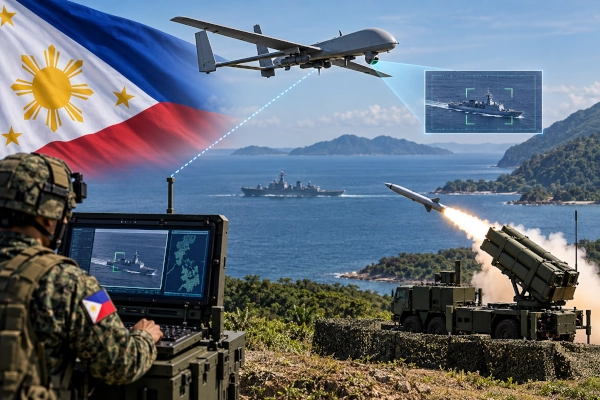
The Indian-made BrahMos supersonic cruise missile has reportedly demonstrated the ability to penetrate Chinese guided-missile destroyer air defences in simulated military engagements conducted by the Philippine Marine Corps. The findings, reported by Naval News on October 5, 2026, highlight the growing importance of the BrahMos coastal defence system in the Philippines’ maritime security strategy.
The report indicates that internal military wargames produced favourable outcomes for BrahMos, with the missile reportedly emerging in some scenarios as the only available weapon capable of overcoming the simulated air defence systems of Chinese guided-missile destroyers.
However, the Philippine military has not publicly released the detailed simulation results or independently confirmed the reported penetration performance. The findings concern computer-assisted military simulations, not actual missile interceptions or live engagements against Chinese warships.
Official Philippine and United States military records separately confirm that Philippine Marines have been developing their BrahMos targeting and maritime strike capabilities through joint military exercises conducted during 2026.
Philippine Marines Report Favourable BrahMos Wargame Outcomes
According to the October 5 report by Naval News, the Philippine Marine Corps Coastal Defense Regiment has been gaining operational experience with its newly acquired BrahMos anti-ship missile batteries.
The publication reported that internal military simulations had produced favourable results when BrahMos was employed against notional Chinese surface combatants. In certain scenarios, the missile reportedly demonstrated an ability to penetrate air defences that other available weapon systems could not overcome.
Such results are relevant to the Philippine military’s efforts to develop credible coastal defence capabilities against sophisticated naval formations.
The publication did not disclose the number of simulated engagements, missile launch conditions, defensive weapons employed or detailed assumptions used in the wargames.
Consequently, the reported outcomes cannot establish a definitive assessment of BrahMos performance against operational Chinese destroyers. They nevertheless indicate the significance Philippine military planners attach to the missile’s supersonic speed and maritime strike capabilities.
US and Philippine Marines Conduct Maritime Strike Training in August 2026
Official United States Marine Corps records confirm that American and Philippine military personnel conducted maritime fires and targeting exercises at Camp Bojeador in the Philippines on August 25–26, 2026.
The training formed part of Archipelagic Coastal Defense Continuum 26.4, a bilateral programme designed to strengthen the Philippine Marine Corps’ coastal defence capabilities and improve operational coordination with American forces.
Photographs and accompanying descriptions published by the US Department of Defense’s Defense Visual Information Distribution Service (DVIDS) on September 1, 2026, document the participation of Philippine Marines from the Coastal Defense Regiment alongside American personnel from Marine Rotational Force–Southeast Asia.
The training focused on maritime targeting procedures, fire support coordination and the development of operational familiarity between the participating forces.
These official records confirm the training activities but do not disclose any BrahMos missile penetration results or simulated interception outcomes against Chinese naval air defence systems.
Chinese Type 052D Destroyers Featured in Maritime Targeting Scenarios
A September 8, 2026, report by USNI News provided additional details about the maritime strike training conducted in Northern Luzon.
According to the publication, American and Philippine Marines developed simulated maritime strike plans involving Chinese naval platforms represented within the exercise environment.
The notional naval formation comprised two Type 052D guided-missile destroyers, one Type 054A guided-missile frigate and a Type 901 fast combat support ship.
The exercise reportedly involved planning the use of Philippine Air Force Hermes unmanned aerial vehicles to identify and track maritime targets before developing simulated strike solutions involving BrahMos missiles.
This training addressed an essential aspect of modern anti-ship missile operations: integrating surveillance information with targeting procedures and missile employment.
The August exercise should be distinguished from the separate internal wargames described in the October Naval News report. No official statement establishes that the two activities produced identical results or used the same simulation conditions.
Philippine Military Officially Confirms BrahMos Simulation Firing
The Philippine military had previously confirmed that BrahMos would participate in simulated maritime strike operations during Exercise Balikatan 2026.
On April 20, 2026, Philippine exercise director Major General Francisco Lorenzo announced that the Coastal Defense Regiment’s BrahMos system would participate in the joint maritime strike component of Balikatan.
Speaking at Camp Aguinaldo in Quezon City, Lorenzo explained that the missile system would participate in a simulated operational environment rather than conduct an actual launch.
The Philippine News Agency, the government’s official news service, reported that simulation firing involves activating the relevant sensors and fire-control procedures to replicate an operational engagement without releasing a missile.
This approach enables military personnel to practise the coordination required for missile operations while evaluating command procedures, communication arrangements and target engagement processes.
The exercise formed part of the Philippines’ broader effort to strengthen its coastal defence capabilities through cooperation with the United States and other military partners.
BrahMos Provides Philippines with Supersonic Coastal Strike Capability
BrahMos is a supersonic cruise missile developed through cooperation between India and Russia. The missile combines high-speed flight with precision guidance and can be configured for land-based, shipborne and airborne applications.
The Philippine military acquired the shore-based anti-ship version to strengthen its ability to engage hostile surface vessels operating within the effective range of its coastal defence systems.
The missile travels at approximately Mach 2.8, making it substantially faster than conventional subsonic anti-ship cruise missiles.
Its high speed reduces the time available for defending warships to detect, track and engage the incoming weapon after it enters their defensive engagement envelope.
The missile’s low-altitude maritime flight capability also presents challenges for shipborne surveillance and air defence systems because radar detection can be constrained by the curvature of the Earth and the operating environment.
However, these characteristics do not make BrahMos immune to interception. Its effectiveness depends on several operational factors, including targeting accuracy, missile flight profile, electronic warfare conditions and the defending warship’s detection and interception capabilities.
India Supplied BrahMos Missiles Under $375 Million Defence Agreement
The Philippines became the first international customer for BrahMos when it signed a contract with India in January 2022 for three shore-based anti-ship missile batteries.
The agreement, valued at approximately $375 million, represented an important milestone in India’s defence export programme and the expansion of bilateral military cooperation.
The first BrahMos missile equipment arrived in the Philippines in April 2024, allowing the Philippine Marine Corps to begin establishing its operational infrastructure and training personnel.
The acquisition supports the country’s efforts to strengthen its maritime defence capabilities across an extensive archipelago comprising thousands of islands.
Shore-based anti-ship missile batteries provide a means of defending important coastal approaches and maritime areas without requiring every engagement to depend on naval surface combatants.
The Philippine Marine Corps Coastal Defense Regiment has been developing the infrastructure, technical proficiency and operational procedures needed to employ these systems effectively.
BrahMos Adds a New Dimension to Philippine Maritime Defence
The Philippines faces distinctive maritime security requirements because of its geography and the importance of surrounding sea routes.
Its coastal defence strategy increasingly emphasises mobile missile systems, maritime surveillance and the ability to coordinate defensive operations across geographically separated locations.
BrahMos contributes to this approach by providing a land-based capability to engage surface vessels at considerable distances from the coastline.
Missile units can be positioned to protect strategically important maritime approaches, while mobile launchers can support dispersed operations.
However, effective employment requires accurate and timely targeting information. Surveillance aircraft, unmanned systems, coastal radars and communication networks must provide reliable information about potential maritime targets.
The August 2026 exercises with American Marines demonstrate the Philippine military’s efforts to develop this integration between surveillance assets, operational planning and coastal missile systems.
Why Modern Destroyer Air Defences Present a Complex Challenge
Chinese guided-missile destroyers such as the Type 052D employ integrated naval air defence systems designed to detect and engage different categories of aerial threats.
These warships combine surveillance radars, missile launch systems and close-range defensive weapons to create multiple opportunities for interception.
A successful anti-ship missile engagement must account for the defending vessel’s ability to detect the incoming threat, classify its trajectory and deploy appropriate countermeasures.
Supersonic missiles compress the available reaction time, while low-altitude approaches can complicate early detection.
Nevertheless, the outcome depends on the specific operational conditions. Electronic countermeasures, radar performance, missile engagement geometry and defensive ammunition availability can substantially influence the effectiveness of a naval air defence system.
A simulated penetration therefore represents an outcome under defined modelling assumptions rather than proof that a particular weapon can consistently defeat a modern warship.
The reported Philippine wargame findings should be understood as an assessment of BrahMos within simulated conditions, not as evidence of a demonstrated ability to overcome every Chinese naval air defence configuration.
Indian Defence Technology Gains Operational Experience Overseas
The growing integration of BrahMos into Philippine coastal defence planning represents an important development for India’s defence manufacturing and export capabilities.
Unlike equipment demonstrations conducted primarily for prospective buyers, operational deployment allows an export customer to evaluate a weapon system within its own military organisation, terrain and defence requirements.
The Philippine Marine Corps is developing personnel proficiency, targeting procedures and supporting infrastructure around the Indian-supplied system.
This operational experience can strengthen cooperation between the two countries in training, maintenance, technical support and long-term missile system sustainment.
The BrahMos programme also illustrates India’s growing participation in the international defence market, particularly in precision-guided weapons and advanced missile technologies.
Its export to the Philippines established a foundation for deeper defence cooperation while demonstrating India’s capability to supply sophisticated military systems to international partners.
BrahMos Strengthens India-Philippines Defence Cooperation
The latest reports of favourable simulation results add to the growing attention surrounding the Philippine Marine Corps’ BrahMos programme.
Official military documentation confirms that Philippine forces are conducting increasingly sophisticated maritime strike training, including joint exercises with American Marines and simulated missile employment during Balikatan 2026.
Although the specific claims concerning penetration of Chinese destroyer air defences remain unverified by an official military disclosure, they reflect the importance attached to advanced anti-ship missile capabilities in contemporary maritime defence planning.
For India, the Philippine BrahMos programme represents a significant example of indigenous defence technology entering operational service with an international partner.
The continuing development of Philippine BrahMos capabilities strengthens India-Philippines defence cooperation while reinforcing India’s expanding role as a supplier of advanced military technology. As the Philippine Marine Corps develops greater operational proficiency, the programme will contribute to maritime security cooperation and the evolution of coastal defence capabilities in the Indo-Pacific.
References
- Philippine News Agency, Government of the Philippines — April 20, 2026. BrahMos Missile System to Undergo ‘Simulation Firing’ in ‘Balikatan’. Official confirmation of planned BrahMos participation in simulated maritime strike operations.
https://www.pna.gov.ph/articles/1273289 - US Department of Defense — Defense Visual Information Distribution Service (DVIDS), September 1, 2026. US Marines Conduct Maritime Fires and Effects Training with Philippine Marines. Official US Marine Corps photographic documentation of the August 2026 exercises.
https://www.dvidshub.net/image/9897960/us-marines-conduct-maritime-fires-and-effects-training-with-philippine-marines - US Department of Defense — DVIDS, September 1, 2026. US Marines Conduct Maritime Fires and Effects Training with Philippine Marines. Additional documentation of maritime targeting activities at Camp Bojeador.
https://www.dvidshub.net/image/9897961/us-marines-conduct-maritime-fires-and-effects-training-with-philippine-marines - Philippine News Agency — April 20, 2026. AFP Chief Says ‘Balikatan’ to Build More Efficient Defense Systems. Official remarks concerning Philippine military readiness and the development of integrated defence capabilities.
https://www.pna.gov.ph/articles/1273279 - USNI News — September 8, 2026. Marines Help Philippine Armed Forces Develop Strike Plans for BrahMos Anti-Ship Missile. Reporting on simulated maritime targeting scenarios involving Chinese naval platforms.
https://news.usni.org/2026/09/08/marines-help-philippine-armed-forces-develop-strike-plans-for-brahmos-anti-ship-missile - Naval News — October 5, 2026. Philippines: The Coastal Defense Regiment 2026 BrahMos Update. Original reporting on the Philippine Marine Corps’ internal BrahMos wargames and reported simulated penetration results.
https://www.navalnews.com/naval-news/2026/10/philippines-the-coastal-defense-regiment-2026-brahmos-update
You may also like
-
Goodluck Defence Secures ₹58.20-Crore Domestic Order for 155mm Artillery Shells
-
Envirotech Systems Secures Indian Navy Contract for Acoustic Silencer Prototype
-
Indian Navy Achieves Major Milestone as Rafale Marine Fighter Successfully Lands on INS Vikrant
-
Munish Forge Secures ₹19.18-Crore Defence Order from Armoured Vehicles Nigam Limited
-
India Strengthens Myanmar Border Security as Manipur Completes 55 Km of Fencing
