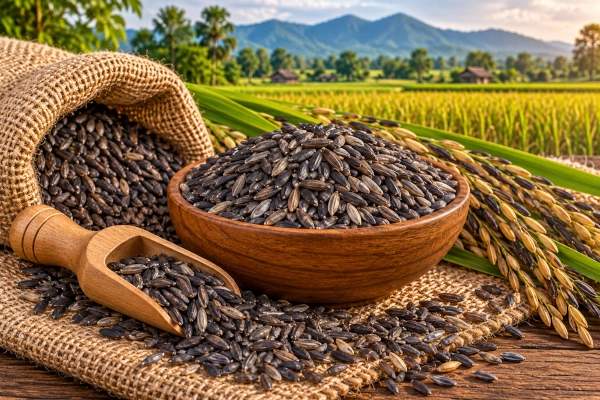
In the fertile plains and Himalayan foothills of North Bengal grows Kalonunia, an indigenous aromatic rice celebrated for its distinctive black husk, delicate fragrance and fine white grains. Traditionally cultivated in Jalpaiguri, Cooch Behar and Alipurduar, this heritage variety represents an important part of West Bengal’s agricultural biodiversity and regional culinary traditions.
Unlike black rice varieties whose edible kernels contain dark purple pigments, Kalonunia has a black outer husk enclosing a white, medium-slender grain. Its unusual appearance distinguishes it from many other traditional rice varieties, while its natural aroma and cooking qualities have earned it a place among Bengal’s valued non-Basmati aromatic grains.
Generations of farmers have maintained Kalonunia through traditional cultivation and seed selection. Its association with North Bengal’s agricultural landscape reflects the close relationship between indigenous crops, regional environmental conditions and farming knowledge developed over centuries.
Kalonunia Rice received Geographical Indication (GI) registration on January 2, 2024, formally recognising its geographical association with West Bengal. The registration followed sustained efforts by agricultural institutions to document and protect the region’s traditional aromatic rice varieties.
GI Details at a Glance
- Geographical Indication: Kalonunia Rice
- State: West Bengal
- Product: Agricultural – Rice
- Class: 30
- Application Number: 743
- Date of Filing: 12 March 2021
- GI Journal: 178
- Journal Availability Date: 31 August 2023
- Certificate Number: 538
- GI Certificate Date: 2 January 2024
- Registered Proprietor: State Agricultural Management & Extension Training Institute (SAMETI), Government of West Bengal
- Registered Proprietor’s Address: Ramakrishna Mission Ashrama, Narendrapur, South 24 Parganas, West Bengal – 700103
- Geographical Area: West Bengal
- Traditional Cultivation Region: Jalpaiguri, Cooch Behar, Alipurduar and adjoining parts of Darjeeling and Uttar Dinajpur
- Registration Valid Until: 11 March 2024, as currently displayed in the GI Registry; updated renewal validity is not shown.
The official Geographical Indications Registry identifies Kalonunia under Application Number 743 and records its status as registered. Although the certificate was issued in January 2024, the public entry still displays March 11, 2024, as the validity date. The current renewal position therefore requires clarification from the Registry.
Origins and History of Kalonunia Rice in North Bengal
Kalonunia belongs to Bengal’s longstanding tradition of cultivating indigenous aromatic rice varieties. Its agricultural history is closely associated with the northern districts of West Bengal, where farming communities have preserved distinctive rice landraces through generations of cultivation.
The exact period when Kalonunia first entered cultivation remains uncertain. However, agricultural documentation identifies it as a traditional variety maintained within North Bengal’s established rice-growing systems.
The broader history of aromatic rice cultivation in Bengal extends back several centuries. Bidhan Chandra Krishi Viswavidyalaya notes that historical manuscripts, district gazetteers and traditional literature document the cultivation and use of scented rice varieties in Bengal over approximately 500 years.
These records establish the longstanding regional tradition of aromatic rice cultivation, although they do not independently establish an exact historical age for Kalonunia.
Farmers preserved the variety because of its distinctive appearance, pleasant aroma and suitability for regional food preparations. Over time, Kalonunia became associated with the agricultural identity of the Himalayan foothill districts.
Its survival demonstrates how farming communities maintained crop diversity through traditional seed selection long before modern commercial seed-production systems became widespread.
The Geography and Climate Behind Kalonunia Rice
Kalonunia’s traditional cultivation is concentrated in the northern agricultural districts of West Bengal, particularly Jalpaiguri, Cooch Behar and Alipurduar.
The rice is also associated with parts of Darjeeling and Uttar Dinajpur, according to documentation prepared by Bidhan Chandra Krishi Viswavidyalaya and Uttar Banga Krishi Viswavidyalaya.
These districts lie within the Terai and adjoining northern Bengal plains, where the foothills of the Eastern Himalayas influence regional weather, rainfall and agricultural conditions.
The landscape includes fertile plains, river systems, seasonal wetlands and agricultural fields that receive substantial rainfall during the southwest monsoon.
The Teesta, Jaldhaka, Torsa and other regional river systems contribute to the wider agricultural environment of North Bengal. Their associated plains support extensive cultivation of rice and other crops.
Kalonunia has traditionally been maintained in medium and lowland agricultural fields. Its adaptation to local growing conditions reflects generations of cultivation within the region’s monsoon-dependent farming systems.
The combination of inherited seed material, seasonal climate and established agricultural practices has helped preserve the distinctive characteristics associated with this variety.
What Makes Kalonunia Rice Unique?
Kalonunia is distinguished by its black husk, fine white kernel, natural fragrance and characteristic plant structure.
According to Bidhan Chandra Krishi Viswavidyalaya, the mature paddy grains possess a dark or black outer husk, occasionally accompanied by an awn. After removing the husk, the edible rice grain is white and belongs to the medium-slender category.
This distinction is important because Kalonunia is sometimes confused with black rice. Unlike pigmented varieties such as Chak-Hao, Kalonunia is not characterised by a naturally dark-purple edible kernel.
Scientific characterisation of Kalonunia has recorded an average kernel length of approximately 5.12 millimetres and a breadth of around 1.94 millimetres.
The rice also possesses a medium-to-strong natural aroma, making it suitable for preparations in which fragrance is an important quality.
Its grain composition contributes to its cooking characteristics. Research has reported amylose content of approximately 18.1%, although measured values can vary between samples and growing conditions.
These characteristics distinguish Kalonunia from both long-grained Basmati and the short, bold aromatic rice varieties traditionally cultivated in other parts of West Bengal.
Traditional Cultivation and Indigenous Farming Knowledge
Kalonunia is traditionally cultivated during the kharif season, when monsoon rainfall supports paddy cultivation throughout North Bengal.
Farmers prepare their fields according to local soil conditions and water availability. Traditional cultivation practices include seed selection, nursery preparation, transplanting and crop management suited to the regional growing season.
Research examining Kalonunia identifies it as a photoperiod-sensitive rice landrace. This means that changes in day length influence flowering and crop development.
Traditional Kalonunia plants are comparatively tall and require a relatively long growing period. Research has recorded plant heights of approximately 145 centimetres and maturity around 151 days under the conditions examined.
Tall plants can present management challenges, particularly when exposed to strong winds, heavy rainfall or conditions that encourage lodging.
The preservation of suitable seed material remains essential for maintaining the variety’s grain characteristics and fragrance.
Farmers who continue cultivating Kalonunia contribute to the conservation of an agricultural resource that might otherwise decline as more commercially productive varieties become widespread.
Kalonunia Rice in Traditional Bengali Cuisine
Kalonunia belongs to Bengal’s broader culinary tradition of using fragrant rice in festive meals, ceremonial preparations and household cooking.
Its natural aroma makes it suitable for pulao, where rice is cooked with selected spices, vegetables or other ingredients while retaining its distinctive fragrance.
Traditional aromatic rice varieties are also used in payesh, the Bengali rice pudding prepared with milk and sweetening ingredients. Kalonunia can contribute its characteristic aroma to such preparations.
The grain may also be used in bhog, the food traditionally offered during religious ceremonies, and in rice-based preparations associated with regional festivals.
Bengal’s aromatic rice traditions include pithe, homemade rice cakes prepared in different forms during seasonal celebrations. Rice flour from suitable fragrant varieties contributes to these culinary practices.
Bidhan Chandra Krishi Viswavidyalaya identifies Kalonunia among the traditional aromatic varieties used across Bengal’s food culture, alongside Gobindobhog, Tulaipanji and Radhunipagal.
These culinary associations help preserve the relevance of traditional rice varieties beyond their agricultural importance.
Geographical Indication Recognition in 2024
Kalonunia received Geographical Indication registration under India’s Geographical Indications of Goods (Registration and Protection) Act, 1999.
The State Agricultural Management & Extension Training Institute, Government of West Bengal, filed the application on March 12, 2021.
The Geographical Indications Registry published the application in Journal Number 178 on August 31, 2023. Following the registration process, the rice received Certificate Number 538 on January 2, 2024.
The registration formally recognises Kalonunia’s association with West Bengal and its established reputation as an indigenous agricultural product.
GI protection is intended to distinguish authentic geographical products from unrelated goods marketed under the same designation. It also provides a framework for maintaining the reputation and characteristics associated with a registered product.
The Registry identifies several authorised users associated with Kalonunia, including Jalpaiguri Krishi Vigyan Kendra, Cooch Behar Krishi Vigyan Kendra and Paschimbanga Agri Marketing Corporation Limited.
Their inclusion reflects the participation of agricultural and marketing institutions in the registered product’s development.
Agricultural Universities Helped Secure GI Recognition
Bidhan Chandra Krishi Viswavidyalaya and Uttar Banga Krishi Viswavidyalaya played important roles in documenting Kalonunia’s agricultural characteristics and supporting its recognition.
The universities undertook this work through the Rashtriya Krishi Vikas Yojana-supported Bengal Aromatic Rice Project, launched in February 2009.
The project brought together researchers, government agencies, farmer organisations and agricultural marketing institutions to support traditional aromatic rice cultivation in West Bengal.
As part of the initiative, researchers prepared technical documentation describing the history, cultivation practices, grain characteristics and commercial potential of several indigenous varieties.
A status paper on Kalonunia was submitted to the Patent Information Centre of the West Bengal State Council of Science and Technology in February 2016.
The university project team also developed GI-related documentation and product-identification material to support geographical recognition.
These efforts established a scientific and institutional foundation for Kalonunia’s subsequent registration.
Scientific Research into Kalonunia’s Grain Characteristics
Agricultural researchers have examined Kalonunia to better understand its genetic identity, plant structure and grain-quality characteristics.
A scientific characterisation study involving Bidhan Chandra Krishi Viswavidyalaya and Bose Institute, Kolkata, examined Kalonunia through field evaluations and molecular techniques.
The field research covered the kharif seasons of 2013, 2014 and 2018. Researchers recorded important characteristics, including plant height, flowering behaviour, grain dimensions, kernel colour and aroma.
The study identified Kalonunia as a black-husked, medium-slender aromatic rice with white edible kernels.
The researchers also examined molecular markers to better understand the variety’s genetic characteristics and support its identification.
Such scientific work is important because traditional rice varieties can be difficult to distinguish when they share similar grain appearances or regional names.
Genetic characterisation helps establish varietal identity and supports efforts to preserve authentic seed populations.
Agricultural Research Examines Kalonunia’s Nutritional Properties
Kalonunia has also been included in research examining the nutritional characteristics and disease resistance of indigenous aromatic rice cultivars from the Himalayan foothills.
A study published in 2021 evaluated traditional aromatic rice varieties from the sub-Himalayan Terai region, including Kalonunia.
Researchers examined grain characteristics, nutritional attributes and resistance to rice blast, an important fungal disease affecting rice cultivation.
The study identified Kalonunia as a traditional, photoperiod-sensitive variety with relatively tall plants and comparatively low yield potential.
Under the general conditions described for traditional Kalonunia landraces, expected yields were approximately 1.5–2.0 tonnes per hectare.
These figures illustrate the productivity challenges associated with maintaining certain indigenous rice varieties.
However, lower yield potential does not necessarily indicate lower agricultural value. Aromatic quality, regional reputation and consumer preferences may support speciality markets that differ from conventional rice markets.
The scientific evaluation of traditional varieties contributes to the understanding of agricultural biodiversity and provides information useful for future crop-improvement programmes.
Research into Organic Nutrient Management
Agricultural scientists have investigated methods of improving Kalonunia production through different nutrient-management practices.
A study published in the Indian Journal of Agronomy evaluated aromatic rice cultivation under organic nutrient-management systems in West Bengal’s hill region.
The research compared Kalonunia with another aromatic rice variety and examined the effects of nutrient sources such as vermicompost and mustard cake.
Under the experimental conditions, Kalonunia recorded a grain yield of approximately 3.32 tonnes per hectare, demonstrating that suitable cultivation management can improve performance beyond the yields commonly associated with traditional landrace production.
The study also reported protein content of approximately 7.25% and net income of ₹57,043 per hectare for Kalonunia under the conditions evaluated.
These results demonstrate the importance of crop management, nutrient availability and local growing conditions in determining agricultural productivity.
The findings should not be interpreted as guaranteed yields or returns for all Kalonunia farmers, since actual performance depends on soil fertility, rainfall, agricultural inputs and market prices.
Nevertheless, research into improved cultivation practices offers opportunities to strengthen the economic viability of traditional aromatic rice.
Comparative Research on Black-Husked Aromatic Rice
Kalonunia has also been examined alongside other black-husked aromatic rice varieties cultivated in eastern and northeastern India.
Researchers at Bidhan Chandra Krishi Viswavidyalaya conducted field experiments during the 2018 and 2019 kharif seasons to compare Kalonunia, Kola Joha and Chakhao Poireiton.
The study evaluated inorganic, integrated and organic nutrient-management practices to assess differences in grain yield, quality and economic performance.
Researchers found that integrated nutrient management could improve productivity and selected grain-quality characteristics in traditional black-husked rice cultivars.
The study also examined head rice recovery, aroma and the economic returns associated with different nutrient treatments.
This research illustrates the value of studying indigenous rice varieties through comparative agricultural experiments. Such work helps identify suitable management practices while documenting the distinctive characteristics of individual landraces.
Quality Testing and AGMARK Development
Maintaining consistent grain quality is important for establishing Kalonunia as a recognised speciality rice product.
The Bengal Aromatic Rice Project has supported scientific grain-quality testing and the development of grading standards for traditional aromatic rice varieties.
According to Bidhan Chandra Krishi Viswavidyalaya, 80 Kalonunia rice samples collected from farmer groups were submitted for testing through the Directorate of Marketing and Inspection system between February 2018 and February 2021.
These samples formed part of a wider quality-assessment programme covering traditional varieties such as Gobindobhog, Tulaipanji, Kataribhog and Radhunipagal.
Following technical discussions, draft Non-Basmati Aromatic Rice Grading and Marking Rules were published on October 16, 2023.
Kalonunia was among the five aromatic rice varieties included in the proposed grading framework.
GI registration and AGMARK perform different functions. Geographical Indication protection concerns geographical origin and associated product characteristics, while AGMARK grading addresses agricultural quality standards.
Developing reliable quality parameters can help farmers, processors and consumers distinguish authentic speciality rice from ordinary commercial products.
Farmer Organisations and Collective Cultivation
Farmer organisations play an important role in maintaining traditional rice varieties and strengthening their commercial development.
The Bengal Aromatic Rice Project has supported technology-assisted group cultivation through cooperation between agricultural universities, farmers and government marketing institutions.
According to university documentation, the broader initiative has involved more than 6,000 farmers associated with approximately 70 farmer organisations across 15 districts of West Bengal.
These figures cover several aromatic rice varieties, including Kalonunia, rather than Kalonunia cultivation alone.
The programme provides technical guidance on seed selection, crop management, production practices and marketing.
Collective cultivation can help maintain varietal purity by encouraging participating farmers to use appropriate seed material and follow consistent production methods.
Farmer organisations also help aggregate harvested rice, making cleaning, processing, packaging and marketing more practical for small producers.
Such arrangements strengthen the connection between traditional agricultural knowledge and organised commercial markets.
Kalonunia Rice and North Bengal’s Agricultural Economy
Kalonunia’s distinctive characteristics provide opportunities within India’s market for premium non-Basmati aromatic rice.
Its natural fragrance, medium-slender grains and regional identity distinguish it from conventional rice varieties marketed primarily on production volume.
Consumers interested in traditional Bengali cuisine and regional agricultural products may value these characteristics.
Organised processing and packaging can help Kalonunia reach markets beyond its traditional growing districts.
However, commercial expansion requires more than geographical recognition. Farmers and producer organisations must maintain seed purity, consistent grain quality and reliable access to buyers.
Appropriate grading and transparent product identification are also essential for protecting the reputation of the variety.
The involvement of agricultural universities and government marketing institutions provides an institutional foundation for developing these opportunities.
Preserving Kalonunia’s Genetic Heritage
Kalonunia represents an important component of the agricultural biodiversity maintained in North Bengal.
Traditional rice landraces contain genetic characteristics developed through long-term cultivation under particular environmental conditions.
These characteristics can provide valuable resources for scientific research and future crop-improvement programmes.
The expansion of commercially productive rice varieties has created challenges for the preservation of indigenous landraces across India.
When farmers discontinue cultivating a traditional variety, locally maintained seed populations may gradually disappear. Agricultural knowledge associated with its cultivation can also be lost.
Preserving Kalonunia therefore requires continued cultivation, community seed conservation and scientific documentation.
Agricultural institutions can support these efforts through seed multiplication, varietal characterisation and the development of suitable cultivation practices.
Maintaining authentic Kalonunia seed material protects both its agricultural identity and its potential contribution to future rice research.
The Future of Kalonunia Rice in West Bengal
Kalonunia has opportunities for further development within India’s expanding market for traditional agricultural products.
Its distinctive black husk, white edible grain and natural fragrance provide a recognisable identity that can support speciality marketing.
Research into cultivation practices has demonstrated opportunities to improve productivity, while scientific grain characterisation provides information useful for maintaining quality.
Farmer organisations and agricultural universities can help translate these findings into practical field recommendations.
Improved processing, packaging and traceability can also strengthen consumer confidence and market access.
Continued conservation of traditional seed populations will remain essential as agricultural production systems evolve.
By combining traditional cultivation knowledge with modern agricultural research, West Bengal can support the commercial development of Kalonunia while preserving its distinctive heritage.
Kalonunia Rice: A Living Symbol of North Bengal’s Agricultural Heritage
Kalonunia rice represents the enduring relationship between North Bengal’s agricultural landscape, farming communities and traditional food culture.
Its black-husked paddy grains, fragrant white kernels and distinctive cooking characteristics have helped preserve its identity through generations of cultivation.
The GI certificate issued in January 2024 formally acknowledges its geographical association with West Bengal, while agricultural research has strengthened understanding of its genetic characteristics, productivity and nutritional qualities.
The work of agricultural universities, farmer organisations and government institutions has created opportunities for better cultivation practices, quality assurance and organised marketing.
Beyond its commercial value, Kalonunia remains a living agricultural resource that contributes to India’s indigenous rice diversity.
With continued farmer participation, scientific conservation and growing awareness of regional food traditions, Kalonunia can strengthen rural livelihoods while preserving the fragrant agricultural heritage of North Bengal for future generations.
References
- Geographical Indications Registry, Intellectual Property India — Kalonunia Rice, Application Number 743. Official registration details, applicant, journal publication, certificate and recorded validity.
https://search.ipindia.gov.in/GIRPublicSearch/Application/Details/743 - Agricultural and Processed Food Products Export Development Authority (APEDA) — Geographical Indications of West Bengal. Official listing of Kalonunia Rice and its registration details.
https://apeda.gov.in/West_Bengal - Bidhan Chandra Krishi Viswavidyalaya — Diversity in Aromatic Rice. Official agricultural information on Kalonunia’s grain characteristics, cultivation region and traditional aromatic rice diversity.
https://www.bckv.edu.in/index.php/en/bengal-auromatic-introduction-en - Bidhan Chandra Krishi Viswavidyalaya — GI and AGMARK. Documentation covering GI recognition, status papers, quality testing and proposed grading standards.
https://www.bckv.edu.in/index.php/en/bengal-aromatic-gi-agmark-en - Bidhan Chandra Krishi Viswavidyalaya — Technology-Supported Group Cultivation. Farmer participation and agricultural development programmes involving indigenous aromatic rice.
https://www.bckv.edu.in/index.php/en/bengal-aromatic-group-cultivation-en - Bidhan Chandra Krishi Viswavidyalaya — Registration of Farmers’ Varieties. Conservation and legal protection of indigenous aromatic rice varieties.
https://www.bckv.edu.in/index.php/en/bengal-aromatic-varieties-en - Evaluation of Indigenous Aromatic Rice Cultivars from the Sub-Himalayan Terai Region of India for Nutritional Attributes and Blast Resistance. Scientific evaluation of traditional aromatic rice, including Kalonunia.
https://pmc.ncbi.nlm.nih.gov/articles/PMC7910543/ - Indian Journal of Agronomy — Effect of Organic Nutrient Management on Yield, Quality, Nutrient Uptake and Economics of Aromatic Rice in the Hill Zone of West Bengal. Research on Kalonunia productivity and nutrient management.
https://pub.isa-india.in/index.php/ija/article/view/170 - ORYZA – An International Journal of Rice — Yield, Quality and Economic Response of Black-Husked Scented Rice to Different Nutrient Management Options. Comparative research involving Kalonunia and other aromatic rice cultivars.
https://epubs.icar.org.in/index.php/OIJR/article/view/179363
You may also like
-
India Advances Geothermal Energy Development with First Wells in Ladakh and National Policy Framework
-
Sikkim’s Soreng Becomes India’s First Organic Fisheries Cluster as Centre Launches New Certification Framework
-
India’s Affle Announces $420 Million Acquisition of Israeli AI Advertising Company Perion
-
CISF Introduces Specialised Security Commands to Protect India’s Critical PSU and Industrial Infrastructure
-
Coal India Sets All-Time Monthly Production Record of 67.2 Million Tonnes in October 2026
