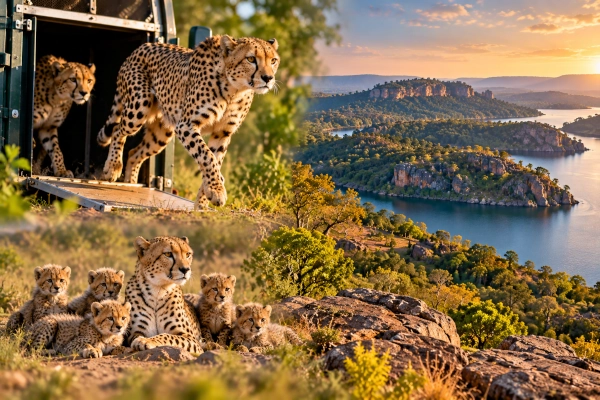
India’s cheetah reintroduction programme is set to expand to a third habitat in Madhya Pradesh, with Veerangana Durgavati Tiger Reserve in the Bundelkhand region being prepared to receive cheetahs from Kuno National Park.
The move marks the next stage of Project Cheetah after Kuno National Park and Gandhi Sagar Wildlife Sanctuary. Official National Tiger Conservation Authority material has identified the Nauradehi landscape, now part of Veerangana Durgavati Tiger Reserve, as one of the sites being prepared for future cheetah introduction.
Veerangana Durgavati Joins the Cheetah Landscape
Veerangana Durgavati Tiger Reserve was created by bringing together the Nauradehi Wildlife Sanctuary landscape and the Veerangana Durgavati Wildlife Sanctuary area.
The reserve extends across Sagar, Damoh and Narsinghpur districts and contains a mix of dry forests, open woodland and grassland habitats. This combination is important for cheetahs, which require large open landscapes with adequate prey and sufficient room to disperse.
Project Cheetah Moves Beyond Kuno
Kuno National Park was developed as India’s first cheetah reintroduction site under Project Cheetah, which began in September 2022.
The programme later expanded to Gandhi Sagar Wildlife Sanctuary, where the National Tiger Conservation Authority and Madhya Pradesh Forest Department prepared a second habitat as part of a wider metapopulation strategy.
Official NTCA planning documents have also identified Nauradehi, now within Veerangana Durgavati Tiger Reserve, as another landscape being prepared for cheetah introduction.
The objective is to gradually reduce dependence on a single population centre and establish multiple managed cheetah populations across suitable habitats.
India’s Cheetah Population Reaches 60
The expansion comes at a time when India’s cheetah population has reached a new milestone.
On October 5, 2026, the Ministry of Environment, Forest and Climate Change announced that Indian-born female cheetah KJP21 had given birth to five healthy cubs at Kuno National Park.
The births increased India’s total cheetah population to 60, including 41 cheetahs born in India.
The growing number of Indian-born animals is important because the long-term success of the programme depends on establishing a self-sustaining population rather than relying mainly on imported cheetahs.
A Metapopulation Strategy Is Taking Shape
Project Cheetah is increasingly moving towards a landscape-based conservation model.
The NTCA has described the wider Kuno–Gandhi Sagar landscape as part of a metapopulation approach in which cheetahs can be managed across several suitable habitats.
This reduces the risks associated with concentrating all animals at a single site and gives wildlife managers greater flexibility to move animals between habitats when necessary.
Adding Veerangana Durgavati Tiger Reserve would strengthen that model by creating another managed cheetah population centre in Madhya Pradesh.
Habitat Preparation Is Central to the Expansion
Introducing cheetahs into a new landscape requires more than simply moving animals from one reserve to another.
Potential sites need secure acclimatisation enclosures, adequate prey populations, veterinary facilities, trained monitoring teams and suitable open habitat.
Official Project Cheetah documents have shown that Nauradehi has been under consideration for several years as part of the programme’s expansion strategy.
The preparation of additional sites also reflects lessons learned during the first years of cheetah management at Kuno.
Tigers and Cheetahs in the Same Larger Landscape
Veerangana Durgavati is also a tiger reserve, which gives its role in Project Cheetah additional ecological significance.
The reserve supports tigers and other large carnivores while also containing open habitats that can support cheetahs.
Managing both species within the same broader landscape will require careful monitoring of prey availability, habitat use and interactions between predators.
For conservation managers, this makes the reserve an important test of how cheetahs can be integrated into a more complex Indian carnivore landscape.
Expanding Beyond a Single-Site Experiment
The broader importance of Veerangana Durgavati lies in what it represents for the future of Project Cheetah.
Kuno was the starting point. Gandhi Sagar showed that the programme could expand into another habitat. Veerangana Durgavati now takes that process further towards a distributed population model.
India’s official cheetah strategy has always envisaged multiple habitats rather than a permanent concentration at one site.
As breeding success increases and additional landscapes are prepared, the programme is moving closer to that original objective.
Project Cheetah Enters Its Next Phase
The establishment of a third cheetah habitat in Madhya Pradesh marks another important step in restoring a species that disappeared from India in the 20th century.
The immediate priority will be to ensure that transferred animals adapt successfully and that prey, habitat and veterinary monitoring remain strong.
Over the longer term, the success of Project Cheetah will depend on maintaining healthy populations across several suitable landscapes while protecting open ecosystems and supporting local communities.
Veerangana Durgavati Tiger Reserve now becomes part of that larger conservation effort, taking Project Cheetah further from a single reintroduction site towards a broader network of habitats across central India.
References
- National Tiger Conservation Authority — Project Cheetah official portal and programme documents.
- National Tiger Conservation Authority — Stripes, Project Cheetah expansion and metapopulation planning.
- Madhya Pradesh Forest Department — Official notification establishing Veerangana Durgavati Tiger Reserve.
- Ministry of Environment, Forest and Climate Change / Press Information Bureau — Official update on the birth of five cheetah cubs at Kuno National Park, October 5, 2026.
- Press Information Bureau — Official background material on the expansion of Project Cheetah beyond Kuno.
You may also like
-
Kashmir Markhor Population Rises to 227 as Kazinag Conservation Efforts Show Results
-
ICAR-CIFRI Pushes Conservation of Indigenous Himalayan Fish for Biodiversity and Livelihood Security
-
Indian-Born Cheetah KJP21 Gives Birth to Five Cubs at Kuno, India’s Cheetah Population Reaches 60
-
ZSI and Mahatma Gandhi University Discover New Earthworm Species in Western Ghats
-
ZSI Scientists Identify New Fish Species Bathymyrus perplexus From the Bay of Bengal
