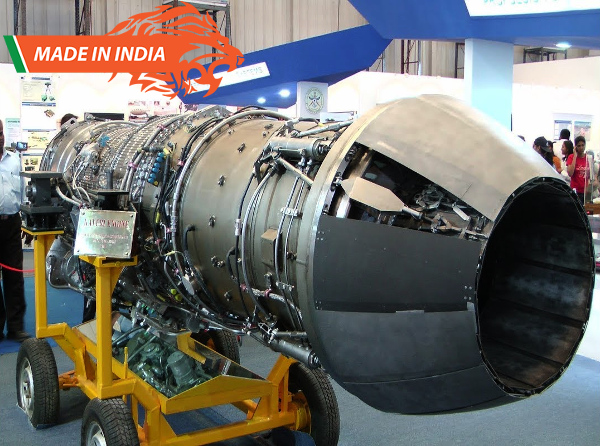
India’s long-running Kaveri aero-engine programme may ultimately prove more valuable as a technology foundation than as a single engine tied to one aircraft. Although the original Kaveri did not achieve the thrust required for the operational Tejas fighter, official government records show that the programme created a substantial domestic base in compressors, turbines, combustors, digital engine control, materials and high-temperature technologies.
That technological foundation is now relevant to a larger question facing Indian aerospace: whether the country can build a family of indigenous military gas-turbine engines rather than pursue each future aircraft powerplant as an isolated project.
Recent discussion around a possible Kaveri 2.0 has revived that possibility. A more powerful fighter-class engine could build upon the technologies accumulated through Kaveri, while the same underlying expertise in engine cores, materials, controls and manufacturing could eventually support a separate high-bypass turbofan for transport aircraft. Such an approach would not mean fitting the same engine to both aircraft categories. It would mean developing a common technological base from which different engines could emerge.
Kaveri Created More Than a Single Engine
The Kaveri project was sanctioned in 1989 to develop an indigenous powerplant for the Light Combat Aircraft. Its original objective was not fully achieved because the engine could not deliver the thrust required by the operational Tejas configuration.
However, the Ministry of Defence has repeatedly emphasised that Kaveri generated capabilities extending beyond the original programme. By November 2021, nine complete prototype engines and four core engines had been built, while cumulative testing had reached 3,217 hours.
The programme also completed altitude testing and flying-test-bed trials. An Indian-developed military gas turbine was mounted on an IL-76 flying test bed in Russia, providing the country with experience in taking an indigenous jet engine beyond laboratory testing and into the flight environment.
The government has consequently described Kaveri technologies as building blocks for other Indian engine-development programmes rather than treating the project simply as an unsuccessful attempt to power Tejas.
The Kabini Core Is an Important Part of the Story
At the centre of Kaveri lies the Kabini core engine. DRDO describes Kabini as comprising the high-pressure compressor, combustor and high-pressure turbine used to demonstrate hot-section technologies and study the behaviour of the Kaveri high-pressure spool.
These components represent some of the most demanding parts of any modern gas turbine. The compressor must raise air pressure efficiently across a wide operating envelope, while the combustor must maintain stable combustion under extreme conditions. The turbine must then extract energy from gases operating at very high temperatures while remaining mechanically reliable.
Mastery of these areas has value far beyond a particular Kaveri configuration. Engine cores can form the technological starting point for more than one propulsion architecture, provided they are substantially redesigned and optimised for the intended aircraft.
This is where the broader significance of a future Kaveri-derived programme becomes apparent.
Kaveri 2.0 Would Need a Major Increase in Fighter-Class Performance
The present Tejas Mk1 and Mk1A use the American GE Aerospace F404-GE-IN20 afterburning turbofan. GE Aerospace identifies the IN20 as the highest-thrust variant of the F404 family and places it in the 19,000-pound, or roughly 85-kN, thrust class.
HAL ordered another 99 F404-IN20 engines for Tejas Mk1A, and GE delivered the first engine from that order in March 2025. The existing Tejas fleet therefore already has an established powerplant and support architecture.
Any future indigenous engine intended for Tejas-class aircraft would consequently have to do much more than simply run successfully. It would need to satisfy demanding requirements for thrust, weight, fuel consumption, acceleration, reliability, thermal management, service life and compatibility with the aircraft.
The Ministry of Defence acknowledged as early as 2021 that the original Kaveri architecture could not be integrated into the operational Tejas because the aircraft required higher thrust. It specifically stated that a modified engine version would be necessary for any future Tejas application.
That official position remains an important benchmark when discussing Kaveri 2.0. A new fighter engine would effectively represent another generation of development rather than the straightforward revival of the original Kaveri.
DRDO Continues to Build on the Kaveri Technology Base
Kaveri development did not end when the engine ceased to be the planned Tejas powerplant. DRDO shifted part of its work towards a dry, non-afterburning derivative suitable for an unmanned combat aircraft.
DRDO’s current propulsion technology roadmap includes development of a flight-worthy dry aero-engine for an Unmanned Combat Air Vehicle through the Gas Turbine Research Establishment. This programme allows technologies originating in Kaveri to continue progressing through engineering, testing and eventual airborne applications.
The importance of the programme was underlined in February 2026 when Defence Minister Rajnath Singh visited GTRE in Bengaluru and reviewed indigenous military gas-turbine engine projects. During the visit, he also witnessed a full-afterburner test of the Kaveri engine.
The Ministry of Defence used the occasion to reiterate the government’s commitment to achieving self-reliance in aero-engine development. That commitment gives the accumulated Kaveri knowledge strategic relevance even though India’s current fighter programmes continue to use imported powerplants.
A Transport Aircraft Engine Would Be a Different Machine
The possibility of applying Kaveri-derived technology to a future transport aircraft needs careful explanation.
A fighter turbofan and a transport-aircraft turbofan are designed around substantially different requirements. Fighters generally require compact dimensions, high thrust-to-weight ratios, rapid throttle response and, in many cases, afterburning capability. Transport aircraft place far greater emphasis on fuel efficiency, endurance, reliability, lower noise and high bypass ratios.
A future Indian transport-aircraft engine would therefore not simply be a Kaveri 2.0 with a larger fan fitted to the front.
Instead, technologies developed through Kaveri could contribute to a new engine programme. Compressor aerodynamics, high-pressure turbine technology, combustor design, single-crystal or advanced turbine materials, coatings, bearings, controls, manufacturing techniques and engine-health monitoring are among the capabilities that can transfer between engine families.
The configuration surrounding that core knowledge would have to be designed specifically for transport-aircraft requirements.
This Is How Major Engine Families Evolve
The larger strategic opportunity lies in developing reusable engine technologies rather than repeating an entirely new learning cycle for every platform.
An indigenous fighter engine programme could strengthen India’s capabilities in compact high-performance compressors, high-temperature turbines and afterburning systems. A transport-engine programme could build on parts of that knowledge while developing larger fans, low-pressure turbines, high-bypass architectures and efficiency-focused systems.
Both programmes would also draw on common national infrastructure for testing, materials, precision manufacturing, instrumentation, digital controls and certification.
That is potentially more important than whether an engine actually carries the Kaveri name.
A mature aero-engine industry is built around engineering families, manufacturing processes and accumulated design knowledge. Once those capabilities become sufficiently deep, individual engines increasingly become applications of a national technological ecosystem rather than standalone projects.
India Already Has Critical Building Blocks
Several Kaveri achievements demonstrate the depth of technology accumulated during the programme. DRDO has developed and flight-proven a Full Authority Digital Engine Control system associated with Kaveri. Earlier Ministry of Defence disclosures also recorded indigenous development and certification of multiple specialised materials.
The programme additionally created expertise in altitude testing, endurance trials, flying-test-bed operations and the integration of a complete indigenous gas turbine with an aircraft.
These capabilities do not by themselves produce a globally competitive engine. They do, however, reduce the number of technologies that have to be developed from the beginning.
That distinction is important. Aero-engine development is exceptionally difficult because advances in individual components must eventually operate reliably as an integrated system. Improving turbine temperature without controlling blade life, or raising compressor pressure without maintaining stability, does not produce a viable aircraft engine.
The value of Kaveri lies partly in the fact that Indian engineers have already worked through many of those interactions in a complete engine programme.
Tejas Could Eventually Become a Technology Demonstrator
Any future Kaveri 2.0 integration with Tejas would require formal development, testing and certification before it could be considered an operational replacement for the F404. No official announcement currently establishes such an engine as the approved powerplant for Tejas Mk1 or Mk1A.
Nevertheless, Tejas represents an obvious aircraft class against which an Indian fighter engine could eventually be evaluated.
India has previously considered the possibility of developing Kaveri derivatives with minimal changes to the LCA airframe. Historical government statements concerning earlier Kaveri development repeatedly stressed the value of maintaining compatibility with India’s fighter-aircraft requirements.
A future programme could therefore use the Tejas class as an engineering benchmark even if operational fleet replacement remains a much later decision.
Transport Propulsion Could Become the Next Frontier
India’s dependence on imported aircraft engines extends well beyond combat aviation. Large transport aircraft require sophisticated turbofan engines produced by an even smaller group of global manufacturers.
Developing a domestic transport-aircraft powerplant would therefore represent an industrial challenge comparable in importance to mastering fighter propulsion.
A common technology strategy could make such an ambition more realistic. Rather than beginning with an entirely separate national capability for every engine class, India could build expertise around increasingly mature compressor, turbine, combustor, materials and control technologies and adapt those capabilities to different aircraft.
That approach would also give Indian private industry a larger and more predictable role. Precision castings, turbine components, electronics, sensors, control systems, additive manufacturing and specialised materials could serve multiple engine programmes rather than depending on one platform.
Kaveri 2.0 Is Still a Concept, Not an Approved Dual-Role Engine Programme
The distinction between technological possibility and official programme status remains essential.
DRDO and the Ministry of Defence have confirmed continued work on indigenous military aero-engines and the reuse of technologies generated by Kaveri. DRDO publications have also referred to further Kaveri development and the possibility of a Kaveri 2.0.
However, the government has not officially announced a sanctioned programme under which one Kaveri 2.0 engine will power both Tejas Mk1A and a future Medium Transport Aircraft.
Nor would such a literal common engine arrangement be technically likely because fighter and transport propulsion requirements are fundamentally different.
The more credible interpretation is that Kaveri 2.0 could become part of a common Indian aero-engine technology base from which specialised engines for fighters, unmanned aircraft and eventually transports could be developed.
From One Engine Project to an Indian Engine Ecosystem
Kaveri’s greatest contribution may therefore lie beyond the aircraft it was originally intended to power.
More than three decades of work have given India indigenous experience in gas-turbine design, engine cores, hot-section technologies, controls, materials, integration and testing. The programme also demonstrated where India’s technological gaps remained and where further investment would be required.
The next step is to convert that accumulated knowledge into successive generations of usable engines.
A successful Kaveri 2.0-class fighter engine would represent one branch of that evolution. A future high-bypass transport engine could become another. Dry engines for unmanned combat aircraft provide a third pathway.
Together, these programmes could gradually transform Kaveri from the story of a single delayed fighter engine into the technological foundation of a wider Indian propulsion industry.
That would give India something more strategically valuable than one indigenous powerplant: the ability to design different aircraft engines for different missions from an increasingly common national base of knowledge, industry and infrastructure.
References
- Press Information Bureau, Ministry of Defence — Development of Kaveri Engine, November 29, 2021. Press Information Bureau
- Press Information Bureau, Ministry of Defence — Raksha Mantri Reviews Projects of Indigenous Military Gas Turbine Engine Development During Visit to DRDO’s GTRE, February 16, 2026. Press Information Bureau
- Defence Research and Development Organisation — Kaveri Core Engine – Kabini, Gas Turbine Research Establishment. DRDO
- Defence Research and Development Organisation — Propulsion Technologies: Flight-Worthy Aero Engine for Unmanned Combat Air Vehicle, GTRE. DRDO
- Press Information Bureau, Ministry of Defence — Developments of Kaveri Fighter Engine, July 30, 2015. Press Information Bureau
- Press Information Bureau, Ministry of Defence — Development of Indigenous Aero-Engine by DRDO, December 21, 2011. Press Information Bureau
- GE Aerospace — Delivering for India Today and Into the Future, March 26, 2025. GE Aerospace
- GE Aerospace — F404 Engine Specifications and Tejas Mk1 Application. GE Aerospace
- DRDO, DESIDOC News Clippings — material discussing continued refinement and proposed Kaveri 2.0 development. DRDO
You may also like
-
IZI Enterprise Wins DRDO Order for VANA Surveillance Drones
-
ideaForge Enters Long-Range ISR and UCAV Segment with ZOLT Hybrid and ZOLT Combat Drone
-
HAL to Raise AL-31FP Engine Production from 30 to 50 Annually for Su-30MKI Fleet
-
Astra Microwave Developing Seeker for BrahMos-NG, Testing and Qualification Expected Within Months
-
India and Austria Move to Deepen Security and Strategic Cooperation
