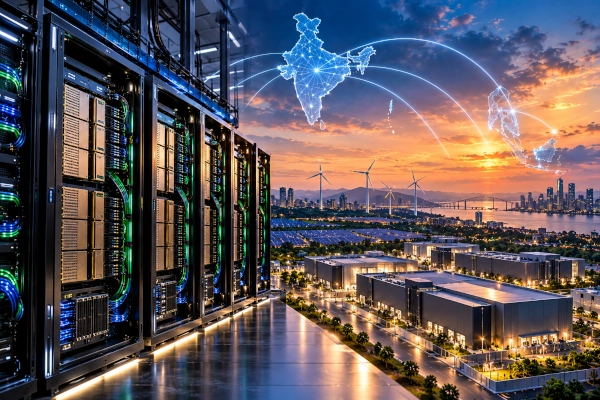
AM Intelligence, the AI infrastructure platform promoted by the founders of Greenko, has placed two additional firm and binding orders for around 20,000 NVIDIA Rubin GPUs, significantly expanding its planned artificial intelligence computing footprint across India and Malaysia. The new systems are expected to be deployed as NVIDIA Vera Rubin NVL72 rack-scale platforms and add roughly 70 MW of compute capacity, with deliveries scheduled for the second quarter of 2027.
Combined with an earlier commitment for around 9,000 Rubin GPUs for its Hyderabad AI factory, the company now has approximately 29,000 Rubin GPUs and close to 100 MW of committed frontier AI computing capacity. The scale of the programme places AM Intelligence among the more ambitious emerging AI infrastructure developers in the region.
20,000 New GPUs Add Around 70 MW of Compute Capacity
The latest order represents the next stage of AM Intelligence’s plan to build large-scale AI factories capable of supporting model training, inference and enterprise workloads. The company is targeting customers including cloud providers, AI laboratories, enterprises, sovereign AI programmes and developers that need access to high-performance computing without building their own hyperscale infrastructure.
The additional 20,000 Rubin GPUs are expected to contribute about 70 MW of compute capacity. When added to the earlier Hyderabad deployment, AM Intelligence’s committed capacity approaches 100 MW, creating a sizeable base for the company’s wider expansion plans across India and Southeast Asia.
Hyderabad Became the Starting Point for the AI Factory Model
AM Intelligence announced its first major Rubin commitment in August 2026, when it ordered around 9,000 GPUs for an AI factory in Hyderabad. That project established the technical model the company now intends to replicate across multiple locations.
The Hyderabad facility is being designed around high-density GPU deployment, liquid cooling, fast networking and large-scale storage. These systems are necessary because frontier AI models require thousands of accelerators to work together continuously while moving enormous volumes of data between processors and storage infrastructure.
The expansion into Malaysia therefore marks a transition from a single-site deployment towards a distributed regional AI compute platform.
What NVIDIA Vera Rubin NVL72 Brings
NVIDIA’s Vera Rubin platform is the generation that follows Blackwell and has been designed specifically for large-scale AI factory environments. A Rubin NVL72 rack integrates 72 Rubin GPUs through NVIDIA’s high-speed NVLink architecture, allowing the rack to operate as a tightly connected computing system rather than as a collection of independent accelerators.
The platform combines Rubin GPUs with Vera CPUs, high-bandwidth memory, advanced networking and infrastructure processors. It is intended to support demanding workloads including foundation-model training, post-training, agentic AI, multimodal reasoning and high-volume inference.
For AI infrastructure operators, this architecture is important because the cost of generating each AI token increasingly depends on how efficiently computing, memory, networking and power systems work together.
AI Infrastructure Is Becoming a Power and Cooling Challenge
Building an AI factory of this scale involves much more than purchasing GPUs. Modern AI accelerators consume large amounts of electricity and generate substantial heat, forcing operators to design power distribution, cooling and networking as part of the computing system itself.
AM Intelligence plans to use liquid cooling and high rack-density infrastructure across its AI factories. Liquid cooling is becoming increasingly important as conventional air cooling struggles with the heat generated by densely packed accelerators.
The company also plans to use high-speed RDMA over Converged Ethernet networking to move data quickly between servers and storage systems. This reduces communication bottlenecks when thousands of processors are working on a common AI workload.
Greenko Connection Gives AM Intelligence a Strong Energy Base
AM Intelligence’s connection with Greenko gives its AI infrastructure strategy an important energy dimension. Greenko has built a substantial renewable-energy and energy-storage portfolio, and AM Intelligence intends to integrate computing infrastructure with reliable power systems.
This is especially relevant because AI data centres cannot depend on intermittent electricity. They require stable round-the-clock power, high-quality grid connections and substantial backup and storage capacity.
The combination of renewable generation and energy storage could therefore allow AM Intelligence to design AI factories around predictable power availability while also reducing dependence on conventional grid electricity during peak demand.
Another 300 MW Planned Over the Next 15 Months
The first 100 MW of committed compute capacity is only the beginning of AM Intelligence’s stated expansion programme. The company has indicated that it plans to bring another 300 MW of AI compute capacity to market over the next 15 months, potentially taking its near-term pipeline towards around 400 MW.
AM Intelligence has also indicated that the wider expansion programme could involve capital expenditure exceeding $20 billion. This should be understood as a planned investment trajectory rather than money already fully deployed.
The scale of the proposed expansion reflects the company’s expectation that regional demand for advanced AI compute will grow rapidly over the next several years.
Long-Term Target Extends to 1 GW of Compute
AM Intelligence’s broader strategy extends beyond the current India-Malaysia programme. The company has outlined a long-term target of developing around 1 GW of Compute-as-a-Service capacity, supported by a much larger portfolio of powered AI data-centre infrastructure across India, the United States and Europe.
The current 29,000 committed Rubin GPUs represent an initial tranche within that wider roadmap. Additional capacity is expected to be added progressively through 2027 and 2028 as new sites, power infrastructure and hardware become available.
This approach gives AM Intelligence the potential to evolve from an individual data-centre operator into a global AI infrastructure platform.
Compute-as-a-Service Could Broaden Access to Advanced AI
AM Intelligence is positioning its infrastructure around a Compute-as-a-Service model rather than dedicating the hardware to a single internal application. Under this model, customers can rent access to GPU clusters without having to construct their own data centres or purchase large quantities of expensive accelerator hardware.
Potential users include startups, enterprises, universities, AI laboratories and government-backed programmes. This could be particularly important in India, where access to frontier compute remains expensive and limited compared with markets that already have large hyperscale AI clusters.
Shared AI infrastructure can therefore reduce entry barriers for organisations that need advanced computing capacity but cannot justify billion-dollar investments in their own facilities.
India Is Rapidly Expanding National AI Compute Capacity
AM Intelligence’s expansion comes at a time when India is also increasing public access to advanced computing resources. Under the IndiaAI Mission, the government has been aggregating GPU capacity so that startups, researchers and public institutions can access high-performance AI infrastructure domestically.
The Ministry of Electronics and Information Technology announced in February 2026 that another 20,000 GPUs would be added beyond an existing pool of more than 38,000 GPUs supporting India’s AI ecosystem. Government-backed capacity and private projects such as AM Intelligence operate through different models, but together they are increasing the amount of advanced computing physically available within India.
This expansion is important because domestic AI capability increasingly depends on access to compute at scale, not simply on software talent.
India Needs More Than GPUs to Build a Sovereign AI Ecosystem
High-end GPUs are only one part of a competitive AI ecosystem. Large models also require dependable electricity, high-speed networking, data storage, trained engineers, software frameworks and access to large datasets.
The significance of AM Intelligence’s approach lies in its attempt to build complete AI factories rather than merely importing accelerator cards. By combining chips, power systems, cooling, networking and storage, the company is moving towards the vertically coordinated infrastructure model used by global hyperscalers.
This integration is essential because bottlenecks in any one layer can reduce the effectiveness of the entire system.
Rubin Systems Can Support Both Training and Inference
The planned AI factories are expected to support both model training and inference. Training involves processing enormous datasets to build or refine AI models, often requiring thousands of GPUs to operate continuously for weeks or months.
Inference takes place after a model has been trained and involves generating responses, analysing inputs or performing reasoning tasks. As AI systems become more sophisticated, inference itself is becoming increasingly demanding, particularly for agentic AI, long-context models and multimodal applications.
Vera Rubin has been designed to support both stages, allowing the same infrastructure to be used for a wide range of AI workloads.
Malaysia Adds a Regional Dimension
The decision to expand into Malaysia gives AM Intelligence a presence beyond India and positions the company within the wider Asian data-centre market.
Malaysia has become an increasingly important regional data-centre location because of its connectivity, power availability and proximity to major Southeast Asian markets. Combining Indian and Malaysian capacity could allow AM Intelligence to serve customers across South and Southeast Asia while balancing energy availability, regulatory requirements and regional demand.
The precise allocation of the 20,000 new GPUs between India and Malaysia has not been publicly disclosed.
A Major Bet on AI Infrastructure Economics
Ordering 20,000 next-generation GPUs represents a large financial commitment because AI data-centre economics depend heavily on utilisation. Expensive accelerators generate returns only when customers use them consistently at high load factors.
AM Intelligence is therefore betting that demand for regional AI compute will grow fast enough to justify building capacity ahead of full customer adoption. This strategy carries commercial risk, but it also allows the company to secure scarce hardware early and position itself for customers that require immediate access to large clusters.
The success of the programme will depend not only on procurement but also on how effectively AM Intelligence attracts long-term users and maintains high infrastructure utilisation.
India Is Emerging as a Major AI Infrastructure Market
India’s technology sector is gradually moving beyond its traditional strength in software and services towards the physical infrastructure that supports frontier artificial intelligence.
Domestic AI growth now increasingly depends on data centres, accelerator hardware, advanced networking, energy systems and cooling technologies. Projects involving AM Intelligence, hyperscale cloud providers, domestic data-centre companies and the IndiaAI Mission are collectively expanding this physical layer.
Greater domestic computing capacity can improve data locality, reduce dependence on overseas infrastructure and give Indian companies and researchers more direct access to advanced AI resources.
AM Intelligence Links Renewable Energy With AI Factories
The most distinctive feature of AM Intelligence’s strategy is the connection between large-scale computing and energy infrastructure. AI factories require enormous amounts of dependable electricity, while renewable-energy developers increasingly need large and predictable consumers capable of using power continuously.
AM Intelligence’s expansion creates an opportunity to design computing capacity around energy availability rather than treating electricity as an external constraint. That approach could become increasingly important as AI systems place greater pressure on national grids and data-centre power consumption rises.
With around 29,000 Rubin GPUs now committed and additional capacity under development, AM Intelligence is positioning itself as a significant emerging AI compute provider connected to India’s wider technology ecosystem. The programme also illustrates how the next phase of India’s artificial-intelligence growth is moving beyond software into the underlying physical systems — chips, power, cooling, storage and networks — that make large-scale AI possible.
References
AM Intelligence — Company announcement on expansion of NVIDIA Vera Rubin AI factory capacity in India and Malaysia, October 5, 2026.
NVIDIA — NVIDIA Vera Rubin Opens Agentic AI Frontier, March 16, 2026.
https://nvidianews.nvidia.com/news/nvidia-vera-rubin-platform
NVIDIA Developer Blog — Inside the NVIDIA Rubin Platform: Six New Chips, One AI Supercomputer, January 5, 2026.
https://developer.nvidia.com/blog/inside-the-nvidia-rubin-platform-six-new-chips-one-ai-supercomputer/
NVIDIA — Vera Rubin Driving Performance Per Watt and Lower Token Costs, July 21, 2026.
https://blogs.nvidia.com/blog/vera-rubin/
Press Information Bureau, Ministry of Electronics and Information Technology — IndiaAI compute infrastructure expansion, February 17, 2026.
https://www.pib.gov.in/PressReleseDetailm.aspx?PRID=2229171
You may also like
-
Japan’s Semiconductor Companies Deepen India Footprint as Chip Ecosystem Advances
-
India and UAE Explore New Avenues to Expand Trade, Investment and Business Cooperation
-
GalaxEye Advances 30-Satellite OptoSAR Constellation After Securing US Patent
-
TDB Backs BigEndian Semiconductors with ₹130 Crore for Indigenous VeerAI Vision Chip
-
Wayanad Jeerakasala Rice — Kerala’s Aromatic Grain from the High Valleys of the Western Ghats
