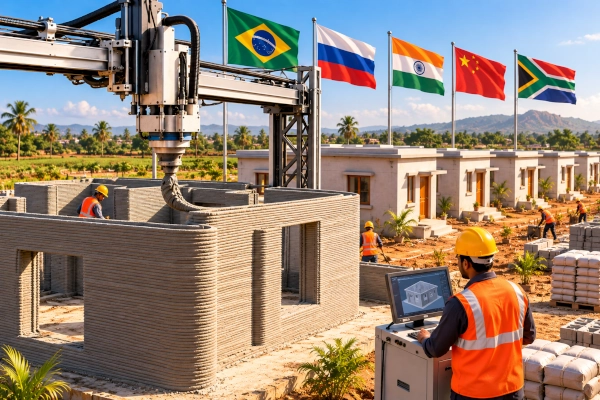
India has taken a significant step towards using automated construction technology in public housing, with the launch of a 177-home 3D concrete-printing pilot project in Andhra Pradesh’s Guntur district.
The project was formally launched on October 4, 2026, at Burripalem village in Guntur district by Union Minister for Agriculture and Farmers’ Welfare and Rural Development Shivraj Singh Chouhan, in the presence of Andhra Pradesh Chief Minister N. Chandrababu Naidu. According to the Ministry of Rural Development, the pilot will be implemented in Burripalem and Obulnayudupalem at an estimated cost of ₹14 crore.
The official figure is 177 houses, not 117. The project is being presented by the government as the country’s first pilot housing programme using 3D concrete-printing technology at this scale.
177 Houses to Be Completed Within Six Months
The Ministry of Rural Development has said that the 177 houses will be constructed using advanced machinery and 3D concrete-printing systems, with the entire pilot expected to be completed within six months.
The technology is intended to reduce construction time, labour requirements and overall building costs while producing houses with greater durability and longer service life than conventional structures.
Rather than relying on traditional brick-by-brick construction, 3D concrete printing deposits specially formulated concrete in programmed layers to form walls and structural elements. Digital building models guide the printing system, allowing much of the shell of a house to be created with relatively little formwork.
For rural housing programmes, this approach could become significant if it proves capable of delivering consistent quality at scale.
Project Forms Part of a Much Larger Rural Housing Expansion
The 3D-printed housing pilot was launched alongside a much larger expansion of rural housing in Andhra Pradesh.
At the Burripalem programme, the Centre handed over the first instalment for three lakh permanent houses worth ₹3,600 crore under the Pradhan Mantri Awas Yojana-Gramin 2.0.
The initial housing allocation had been substantially smaller. According to the Ministry of Rural Development, Andhra Pradesh had originally been considered for around 76,000 houses before the allocation was increased to three lakh.
The state government has also sought additional housing support, with Chief Minister Chandrababu Naidu indicating a requirement for another six lakh homes. Chouhan said that further batches could be sanctioned after completion of the current three-lakh-house programme.
The 177-home 3D-printing project therefore functions as a technology demonstration within a far larger housing programme rather than as a standalone construction scheme.
Why 3D Concrete Printing Is Attracting Attention
Three-dimensional concrete printing has emerged as an experimental alternative to conventional construction in several countries because it can automate one of the most labour-intensive stages of building.
A large robotic printing system follows a digital design and extrudes concrete or a cementitious mixture layer by layer. Walls can be printed with openings for doors, windows and utilities already incorporated into the design.
Automation can reduce dependence on extensive temporary formwork, limit material wastage and allow repetitive housing designs to be produced quickly. Digital control can also improve dimensional consistency between units.
These advantages make the technology particularly interesting for large housing programmes where hundreds or thousands of similar structures need to be delivered within tight schedules.
Construction Speed Could Be the Biggest Advantage
The Andhra Pradesh pilot will provide an opportunity to test whether the theoretical speed advantages of 3D printing translate into real gains under Indian field conditions.
Government statements surrounding the project have emphasised substantial time savings. The entire group of houses is expected to be ready within six months, substantially accelerating construction compared with many conventional rural-housing projects.
However, printing the walls is only one stage of completing a house. Foundations, roofing, electrical systems, plumbing, doors, windows, flooring and finishing work still require conventional construction processes.
The real measure of the technology will therefore be the time required to deliver a fully habitable home rather than simply the speed at which a printer can create its walls.
Lower Labour Requirements Could Change Housing Construction
Another major attraction is the possibility of reducing labour intensity.
Conventional masonry requires large teams for brick laying, mixing, plastering and repeated formwork operations. Automated printing replaces some of this manual work with digitally controlled machinery.
That does not remove labour from the construction process entirely. Instead, the workforce changes. Operators, engineers, machine technicians, material specialists and finishing crews become increasingly important.
If adopted at scale, 3D printing could therefore create demand for a new category of digitally trained construction workers while reducing dependence on repetitive manual masonry.
Material Efficiency Could Reduce Construction Waste
Construction generates large quantities of waste through excess concrete, broken masonry, discarded formwork and cutting losses.
Because 3D printing deposits material according to a digital model, it has the potential to place concrete only where it is structurally required. Complex wall geometries can also be produced without elaborate moulds.
This can improve material efficiency, although the overall environmental benefit depends heavily on the formulation of the printable concrete.
Cement production remains carbon-intensive. The long-term sustainability of printed housing will therefore depend not only on automation but also on whether lower-carbon cementitious mixtures, supplementary materials and efficient structural designs can be incorporated.
Durability Will Be Closely Watched
The Ministry of Rural Development has said the printed houses are expected to offer enhanced durability and longevity.
That claim will need to be demonstrated over time because 3D-printed concrete behaves differently from conventionally cast concrete. Each printed layer must bond effectively with the layer beneath it, and quality control is essential to prevent weak interfaces.
Indian conditions also create demanding durability requirements. Buildings must withstand intense heat, monsoon rainfall, humidity and, depending on location, cyclonic winds or seismic stresses.
The Guntur pilot could therefore provide valuable practical information on how printed structures perform outside controlled demonstrations.
Digital Designs Could Make Housing More Adaptable
One of the less visible advantages of 3D printing is the flexibility offered by digital design.
Once a building model has been prepared, modifications can often be made through software rather than by redesigning physical moulds and formwork. This could allow housing units to be adapted for different plot sizes, climatic zones or household requirements.
Standardised designs can also be repeated consistently across large housing developments.
For government housing programmes, that combination of standardisation and digital adaptability could prove useful if the technology eventually expands beyond pilot projects.
Rural Deployment Is an Important Test
Most high-profile 3D-printed construction projects globally have been demonstration homes, institutional buildings or urban developments. Andhra Pradesh’s project is notable because it is being linked directly with rural housing.
Deploying the technology in villages tests challenges that may not arise in urban construction sites. Heavy printing equipment must reach the site, concrete mixtures must be prepared consistently, electricity and water supplies must be dependable, and trained operators must be available.
The economics of transporting and operating large printers across dispersed rural settlements will also need to be assessed.
These practical factors will determine whether 3D printing is best suited to concentrated housing clusters or can eventually be deployed more widely across rural India.
Andhra Pradesh Is Positioning Technology as Part of Its Housing Strategy
The state government has increasingly promoted advanced technologies across infrastructure, urban development and manufacturing, and the Guntur housing project extends that approach into rural construction.
Launching the pilot alongside the allocation of three lakh PMAY-Gramin houses gives the state an opportunity to compare new construction methods with conventional housing delivery on a significant scale.
If the printed houses can meet cost, durability and completion targets, the model could potentially be replicated in future housing clusters elsewhere in Andhra Pradesh.
The state’s interest in a much larger housing programme also means that successful technologies could move quickly from pilot stage to broader deployment.
Public Housing Could Become a Major Market for Construction Automation
India’s housing needs create a potentially large market for technologies that reduce construction time while maintaining affordability and structural quality.
3D printing is unlikely to replace conventional construction across the country in the near term. Brick masonry, precast systems, cast concrete and other established methods remain deeply embedded in India’s construction ecosystem.
Its strongest initial role may instead be in repetitive projects where many similar housing units need to be built in the same location.
Government housing colonies, disaster-relief accommodation, institutional buildings and planned residential developments could offer suitable environments for such automated systems.
Pilot Will Determine Whether the Technology Can Scale
The significance of the Guntur project lies less in the number of homes being built than in what those homes can demonstrate.
The government now has an opportunity to measure construction speed, actual costs, labour requirements, structural performance, maintenance needs and resident experience under real operating conditions.
If the technology demonstrates clear advantages, the 177 houses at Burripalem and Obulnayudupalem could provide a template for broader adoption. Equally, the pilot can reveal where conventional construction remains more practical or economical.
By testing 3D concrete printing within a major rural-housing programme, Andhra Pradesh is moving the technology from isolated demonstration projects towards practical public infrastructure. The project marks an important step in India’s effort to combine affordable housing with advanced construction methods and could help define how far automated building technology can contribute to the country’s future housing needs.
References
Press Information Bureau, Ministry of Rural Development — Shivraj Singh Chouhan Hands Over 3 Lakh Houses Worth ₹3,600 Crore to Andhra Pradesh, Lays Foundation for India’s First 3D Concrete-Printed Housing Project, October 4, 2026.
https://www.pib.gov.in/PressReleseDetailm.aspx?PRID=2318899
Press Information Bureau, Ministry of Rural Development — Modi Government’s Historic Move to Provide 3 Lakh Permanent Houses to Andhra Pradesh; 3D Concrete-Printing Housing Project Launched in Guntur, October 4, 2026.
https://www.pib.gov.in/PressReleseDetailm.aspx?PRID=2318911
You may also like
-
Sanchar Saathi Crosses 30 Crore Visits as Citizens Help India Fight Telecom Fraud
-
PRAHAAR: India’s First National Counter-Terrorism Policy and Strategy
-
Defence Accounts Department Launches SAKSHAM Integration, PRISM and Revamped National Compilation System
-
India Simplifies Foreign Guest Reporting for Hotels Under New Immigration Framework
-
India Signs UN Convention Against Cybercrime as Global Digital Security Cooperation Expands
