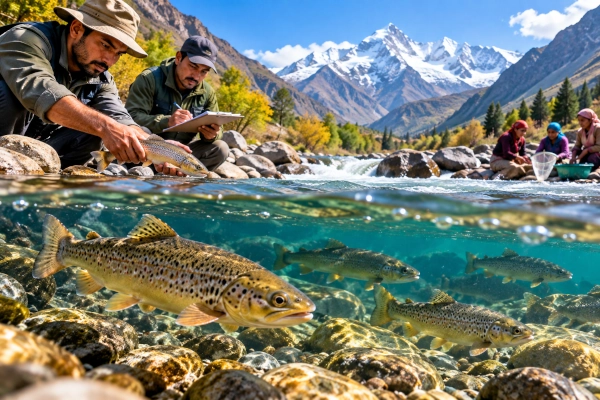
The ICAR-Central Inland Fisheries Research Institute has intensified efforts to conserve indigenous Himalayan fish resources while linking biodiversity protection with sustainable livelihoods in Himachal Pradesh.
The initiative was carried out on October 2, 2026, at Udaipur in Lahaul and Spiti district, where ICAR-CIFRI organised an awareness programme on indigenous fish culture along the River Chandrabhaga. The programme focused on protecting native fish diversity, promoting scientifically managed fisheries and creating livelihood opportunities for communities dependent on fragile Himalayan river ecosystems.
River Chandrabhaga Becomes Focus of Conservation Effort
Udaipur lies along the River Chandrabhaga in one of Himachal Pradesh’s ecologically sensitive high-altitude landscapes. The region combines cold-water river systems, native fish diversity and rural communities whose livelihoods are closely connected with local natural resources.
ICAR-CIFRI used the programme to highlight the ecological importance of indigenous fish species and the need to prevent their decline through better habitat protection, responsible fishing and science-based fisheries management. The institute emphasised that conservation measures must be designed in a way that also supports local income and food security.
Native Fish Conservation Linked With Rural Livelihoods
ICAR-CIFRI Director Dr Pradip Dey stressed that Himalayan rivers are valuable repositories of indigenous aquatic biodiversity and also hold considerable potential for sustainable rural livelihoods.
The institute’s approach seeks to combine native fish conservation with habitat restoration, community participation, scientific fish culture and river ranching. This model treats biodiversity protection and livelihood development as complementary objectives rather than competing priorities.
For remote Himalayan communities, carefully managed fisheries can provide supplementary income without placing unsustainable pressure on river ecosystems.
Indigenous Trout Identified as an Important Opportunity
The programme highlighted the potential of indigenous trout breeding, hatchery development and scientific culture technologies in the Himalayan region.
Developing reliable breeding and hatchery systems for native fish can help reduce pressure on wild populations while creating a controlled source of seed for aquaculture and conservation programmes.
ICAR-CIFRI also identified river ranching as a possible intervention in stretches where fish populations have declined. Ranching involves releasing scientifically produced fish seed into suitable natural habitats to strengthen depleted stocks, provided habitat conditions and ecological carrying capacity are properly assessed.
Climate Change Adds Pressure to Himalayan Fish Habitats
The Himalayan aquatic environment is highly sensitive to changes in temperature, river flow and precipitation. Climate change can alter water temperature, seasonal discharge patterns and the availability of suitable spawning and feeding habitats for cold-water fish.
ICAR-CIFRI therefore placed conservation of indigenous species within the broader challenge of climate-resilient fisheries management.
Protecting native fish populations can help maintain ecological stability because indigenous species are adapted to local river conditions and form part of long-established food webs. Their decline can affect not only fisheries but also the wider functioning of river ecosystems.
Hydropower Development Brings Additional Ecological Challenges
The institute also drew attention to pressures associated with hydropower development in Himalayan river systems.
Dams, barrages and altered flow regimes can modify habitats, affect fish migration and change sediment and nutrient movement. These impacts can become particularly important for species that depend on specific spawning grounds or seasonal river connectivity.
ICAR-CIFRI’s emphasis on habitat identification and conservation reflects the need to understand these ecological changes before expanding fisheries production.
Scientific management therefore requires more than stocking rivers with fish. It also involves maintaining suitable habitats, protecting breeding areas and ensuring that river flow conditions continue to support native species.
Essential Fish Habitats Need Better Protection
Participants were sensitised to the importance of identifying and conserving essential fish habitats, including spawning grounds, nursery areas and feeding zones.
Protecting such areas can be more effective than attempting to restore fish populations after severe depletion has already occurred.
The programme also addressed the ecological consequences of destructive fishing practices. Unsustainable harvesting methods can reduce breeding populations, damage habitats and remove fish faster than river systems can replenish them.
Responsible fishing practices, seasonal restrictions where required and community participation are therefore important components of long-term conservation.
River Ranching Could Help Restore Depleted Populations
River ranching formed an important part of the conservation strategy discussed by ICAR-CIFRI.
When scientifically planned, ranching can supplement depleted populations by releasing healthy juveniles of appropriate indigenous species into suitable river stretches. The approach is most effective when accompanied by habitat protection, monitoring and regulation of fishing pressure.
ICAR-CIFRI has already used similar interventions in other Indian river systems, including the Ganga, where indigenous fish fingerlings have been released under biodiversity-restoration programmes.
Applying comparable methods in Himalayan rivers could support stock restoration while generating additional livelihood opportunities for local communities.
Government Fisheries Schemes Could Support Local Communities
ICAR-CIFRI also briefed participants on opportunities available under major Government of India fisheries programmes.
These include the Pradhan Mantri Matsya Sampada Yojana, the Fisheries and Aquaculture Infrastructure Development Fund and the Pradhan Mantri Matsya Kisan Samridhi Sah-Yojana.
Such schemes can support infrastructure, aquaculture development, capacity building and livelihood diversification. Connecting remote Himalayan communities with these programmes can help convert conservation-oriented fisheries into viable local enterprises.
The institute’s approach therefore combines ecological restoration with access to government support, technology and training.
Wider ICAR-CIFRI Strategy in Himachal Pradesh
The Chandrabhaga initiative is part of a broader expansion of ICAR-CIFRI’s work in Himachal Pradesh.
In September 2026, the institute and the Himachal Pradesh Department of Fisheries discussed a renewed roadmap for reservoir fisheries covering Gobind Sagar, Pong, Kol Dam and the Chamera reservoir system.
The programme includes scientific stock enhancement, quality seed production, cage and pen culture, habitat conservation and improved monitoring.
ICAR-CIFRI has also identified opportunities for golden mahseer conservation, trout culture and technology-enabled fisheries management using water-quality sensors, GIS, remote sensing, drones and underwater remotely operated vehicles.
Technology Could Strengthen Himalayan Fisheries Management
Modern monitoring tools could become increasingly important in fragile Himalayan aquatic systems.
Real-time sensors can track dissolved oxygen, temperature and other water-quality parameters, while drones and remote-sensing systems can support habitat mapping and surveillance of difficult-to-access river stretches.
Underwater remotely operated vehicles can assist in inspecting submerged structures and studying aquatic habitats without requiring extensive physical intervention.
Combining these tools with conventional fisheries science can provide authorities with better data for deciding where to stock fish, where to restrict fishing and which habitats require protection.
Indigenous Fish Conservation Supports the Wider Blue Economy
India’s Blue Economy strategy increasingly includes inland rivers, reservoirs and wetlands alongside marine fisheries.
Himalayan rivers form an important part of this framework because they support biodiversity, local food systems and livelihoods across remote regions.
However, increasing fish production cannot come at the cost of native biodiversity. The long-term productivity of fisheries depends on healthy ecosystems capable of sustaining breeding populations and maintaining water quality.
ICAR-CIFRI’s programme reflects a model in which fisheries development is built around ecological sustainability rather than short-term extraction.
Community Participation Will Remain Central
Scientific programmes can provide technology and technical guidance, but local communities remain essential to the success of river conservation.
Fishers and residents are often the first to observe changes in fish abundance, water levels, spawning behaviour and habitat conditions. Their participation can therefore strengthen monitoring while also improving compliance with conservation measures.
Community-based management can also make conservation economically meaningful by ensuring that local people benefit from healthier fish populations and sustainable fisheries.
Himalayan Fish Conservation Moves Towards Science-Led Management
The Chandrabhaga programme demonstrates a broader shift towards integrating biodiversity conservation, scientific fisheries management and rural development in India’s Himalayan regions.
By focusing on indigenous fish, breeding technology, hatcheries, habitat protection and river ranching, ICAR-CIFRI is building a framework that can help restore depleted populations while strengthening livelihood opportunities.
Protecting Himalayan aquatic biodiversity will require long-term monitoring and careful management, but programmes that combine science with community participation provide a strong foundation for maintaining healthy rivers and sustainable fisheries across India’s mountain landscapes.
References
Indian Council of Agricultural Research — ICAR-CIFRI, Barrackpore Safeguards Indigenous Himalayan Fish, Promotes Sustainable Livelihoods and Biodiversity Conservation in Himachal Pradesh, October 2, 2026.
https://www.icar.org.in/en/icar-cifri-barrackpore-safeguards-indigenous-himalayan-fish-promotes-sustainable-livelihoods-and
Indian Council of Agricultural Research — ICAR-CIFRI, Barrackpore and Himachal Pradesh Partner to Unlock Reservoir Fisheries Potential and Transform Fisher Livelihoods, September 9, 2026.
https://www.icar.gov.in/en/icar-cifri-barrackpore-and-himachal-pradesh-partner-unlock-reservoir-fisheries-potential-and
You may also like
-
Indian-Born Cheetah KJP21 Gives Birth to Five Cubs at Kuno, India’s Cheetah Population Reaches 60
-
ZSI and Mahatma Gandhi University Discover New Earthworm Species in Western Ghats
-
ZSI Scientists Identify New Fish Species Bathymyrus perplexus From the Bay of Bengal
-
Rare Afro-Asian Sand Snake Rediscovered in Kutch After More Than 150 Years
-
Indravati Tiger Reserve to Reopen for Wildlife Safaris After Four Decades
