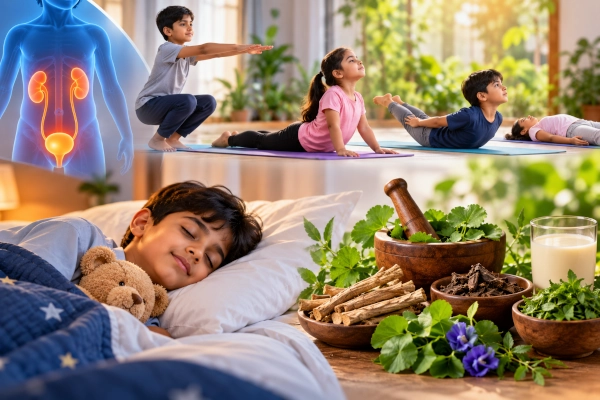
A clinical study conducted at the Institute of Teaching and Research in Ayurveda in Jamnagar has reported encouraging results from combining Ayurvedic medicine with selected yoga asanas for managing nocturnal enuresis, commonly known as bedwetting, among children.
The eight-week study involved around 38 children aged 6 to 14 years and compared Ayurvedic treatment alone with an integrated Ayurveda-Yoga approach. According to the Ministry of Ayush, the combined intervention produced greater improvement across several clinical and behavioural parameters than Ayurvedic medicine alone.
The findings have been published in the AYU Journal.
Study Conducted at ITRA Jamnagar
The research was carried out by the Department of Kaumarbhritya, or Ayurveda paediatrics, at ITRA Jamnagar, an Institution of National Importance under the Ministry of Ayush.
Children participating in the study were divided into two groups.
The first group received Medhya Rasayana Churna twice daily with milk. The formulation contained Brahmi, Shankhpushpi, Yashtimadhu and Guduchi.
The second group received the same Ayurvedic formulation along with regular practice of four yoga asanas: Utkatasana, Ardha-Shalabhasana, Bhujangasana and Shavasana.
The yoga practices were performed in the morning and evening during the eight-week intervention period.
Combined Approach Reported Greater Reduction in Bedwetting
The most notable difference between the two groups was seen in the frequency of bedwetting.
Children receiving Ayurvedic medicine alone showed an improvement of around 38 per cent, while those receiving Ayurveda together with yoga showed approximately 70 per cent improvement.
The results suggest that the addition of regular yoga practice may have contributed to better outcomes when used alongside the Ayurvedic formulation.
The study does not establish that either intervention should replace standard paediatric evaluation, but it does provide evidence supporting further research into integrated approaches for nocturnal enuresis.
Memory and Behavioural Parameters Also Improved
The researchers also assessed changes in memory, irritability, hyperactivity, concentration and morale.
Children receiving the combined Ayurveda-Yoga intervention showed approximately 61 per cent improvement in memory, compared with about 31 per cent among those receiving Ayurvedic medicine alone.
The combined group also recorded around 66 per cent reduction in irritability and approximately 71 per cent reduction in hyperactivity.
Improvements were additionally observed in concentration and morale.
These findings are important because bedwetting in older children can sometimes occur alongside stress, behavioural difficulties or sleep-related concerns, although the condition can have several different causes.
Why Yoga May Have Helped
According to ITRA Director Prof. Dr. Tanuja Nesari, nocturnal enuresis may in some cases involve difficulties with bladder control as well as psychological and behavioural factors.
The study suggests that selected postures such as Utkatasana and Bhujangasana may support the pelvic region and contribute to better bladder control.
The relaxation component of Shavasana may also help reduce physical and mental tension, while regular structured practice can support concentration and behavioural regulation.
These possible mechanisms remain areas for further clinical investigation.
Role of the Ayurvedic Formulation
The Ayurvedic preparation used in both groups contained Brahmi, Shankhpushpi, Yashtimadhu and Guduchi.
Within Ayurveda, Brahmi and Shankhpushpi are traditionally used in formulations associated with mental calmness, memory and cognitive support.
Yashtimadhu and Guduchi also have established traditional uses within Ayurvedic practice.
The ITRA study examined these ingredients as part of a combined formulation rather than evaluating each herb separately.
Bedwetting Is Common and Should Be Managed Sensitively
Nocturnal enuresis is common during childhood and often improves with age.
In some children, however, persistent bedwetting can affect confidence, sleep, family routines and emotional well-being. It may also be associated with urinary problems, constipation, sleep disorders, developmental factors or other medical conditions.
For this reason, persistent or new-onset bedwetting should be assessed appropriately rather than treated solely as a behavioural issue.
The Ministry of Ayush also emphasised that the condition should be addressed with sensitivity and proper medical guidance.
Study Adds to Evidence on Integrated Traditional Care
The research is notable because it evaluates an integrated treatment model rather than Ayurveda or yoga in isolation.
Combining medicine with lifestyle and physical practices reflects a broader approach often used within traditional Indian systems of healthcare.
The greater improvement recorded in the combined group suggests that future studies with larger participant numbers, longer follow-up and stronger control designs could help determine how reproducible the findings are.
Encouraging Results, but Larger Studies Are Needed
The study involved only around 38 children, so its findings should be interpreted as encouraging rather than definitive.
Small clinical studies can identify useful signals, but larger randomised trials are needed to establish treatment effectiveness, determine which children benefit most and assess whether improvements continue after treatment ends.
Further research could also compare integrated Ayurveda-Yoga treatment with standard behavioural therapy, alarm therapy and other established approaches to nocturnal enuresis.
A Promising Direction for Integrative Paediatric Care
The ITRA study provides early evidence that combining Ayurvedic medicine with structured yoga practice may offer additional benefit in managing childhood bedwetting and related behavioural symptoms.
The reported improvement of around 70 per cent in bedwetting frequency in the combined group is particularly noteworthy, though larger studies will be necessary before broader clinical conclusions can be drawn.
For now, the findings strengthen the case for carefully designed research into integrative paediatric care that combines traditional knowledge, lifestyle practices and modern clinical evaluation.
References
Press Information Bureau, Ministry of Ayush — Integrated Ayurveda-Yoga Approach Shows Encouraging Results in Management of Bedwetting Among Children: ITRA Study, October 5, 2026.
Institute of Teaching and Research in Ayurveda, Jamnagar — Department of Kaumarbhritya research on nocturnal enuresis.
AYU Journal — Published clinical study on integrated Ayurveda and yoga in childhood nocturnal enuresis.
You may also like
-
India’s Cervavac HPV Vaccine Receives WHO Prequalification, Opening Path for Wider Global Use
-
Russia’s Irkutsk Pneumonia Scare: No Confirmed Plague Epidemic, No Immediate Threat to India
-
Ayurveda on Dinner: Why Lighter and Earlier May Be Better
-
NIT Rourkela–IISER Berhampur Team Patents Cotarnine-Derived Formulation for Oral Cancer Research
-
Ayurveda and the Main Meal: Why Midday Matters
