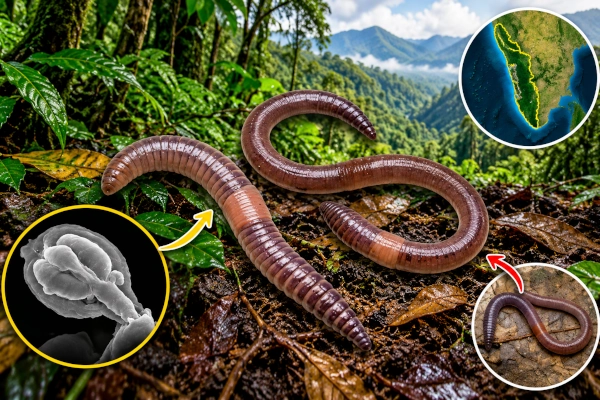
Researchers from the Zoological Survey of India and Mahatma Gandhi University, Kerala, have described a new earthworm species from the Western Ghats while also rediscovering another species that had remained absent from the scientific record for more than eight decades.
The newly identified species has been named Drawida incomparabilis. During the same research effort, scientists also recorded Drawida loricata, a species originally described in 1945 and not scientifically documented again for 81 years.
New Earthworm Species Found in the Southern Western Ghats
The specimens were collected from forest landscapes in the southern Western Ghats across Kerala and Tamil Nadu.
Field surveys covered protected areas including the Anamalai Tiger Reserve and Parambikulam Tiger Reserve, where researchers examined soil habitats for earthworms using direct collection methods.
The discovery adds to the growing record of specialised soil fauna from the Western Ghats, one of India’s most biologically diverse regions.
Why the Species Was Named Drawida incomparabilis
The new earthworm has been named Drawida incomparabilis, with the species name derived from Latin and conveying the sense of something exceptional or beyond comparison.
Researchers selected the name because the species possesses a combination of anatomical characteristics that clearly distinguishes it from other known members of the genus Drawida.
The earthworm is also relatively large. Reported specimens measured approximately 217 to 392 millimetres in length, making it a conspicuous member of the local soil ecosystem despite its subterranean lifestyle.
Distinctive Anatomy Separates It From Related Species
Taxonomists identified Drawida incomparabilis through detailed examination of its external and internal anatomical features.
One of its most distinctive characteristics is the position and number of its gizzards. The species possesses between six and eight gizzards extending across segments 24 to 33, an unusually posterior arrangement within the genus.
Researchers also noted distinctive glandular prostate structures that help separate the species from closely related earthworms.
Only a small number of known Drawida species show comparable internal arrangements. Drawida nilamburensis, another species from southern India, shares some similarities but differs in several important anatomical characteristics, including the structure of its prostate and overall body form.
Drawida loricata Rediscovered After 81 Years
The same research effort produced another significant finding with the rediscovery of Drawida loricata.
The species was originally described in 1945 but had not appeared in subsequent scientific records for more than eight decades. Fresh specimens now allow researchers to re-examine the species using modern taxonomic methods and improve knowledge of its present distribution.
Rediscoveries of this kind are valuable because many older species descriptions were based on very limited collections. New specimens can help clarify anatomy, habitat preference and relationships with closely related species.
Drawida Is a Major Asian Earthworm Genus
Drawida incomparabilis belongs to the family Moniligastridae, an ancient group of terrestrial earthworms distributed mainly across Asia.
The family contains nearly 200 recognised species across several genera, with Drawida representing one of its most species-rich groups.
Many species in the genus have restricted geographical distributions and can be closely associated with particular forest types, elevations or soil conditions. This makes detailed regional surveys especially important for documenting their true diversity.
Earthworms Are Important Engineers of Forest Soil
Earthworms play a major ecological role despite spending most of their lives beneath the surface.
Their burrowing helps improve soil aeration and water movement, while their feeding contributes to decomposition and nutrient cycling. They also influence soil structure by mixing organic material with deeper mineral layers.
Different earthworm species can occupy highly specialised ecological niches. Their presence and diversity can therefore provide useful information about soil conditions and the ecological history of a forest landscape.
The discovery of a large new species shows that significant portions of India’s below-ground biodiversity remain poorly documented.
Field Taxonomy Remains Essential for Biodiversity Science
The discovery demonstrates the continuing importance of direct field surveys and classical taxonomic research.
Modern biodiversity science increasingly uses genetic tools, remote sensing and large ecological datasets, but new species still have to be located, collected and carefully compared with known organisms before they can be formally described.
This is particularly important for subterranean animals such as earthworms, which are far less visible than birds, mammals or flowering plants and can remain undetected even inside well-known protected areas.
The rediscovery of Drawida loricata also shows why repeated surveys are necessary. A species that disappears from scientific records for decades may still survive in isolated habitats that have simply not been examined closely enough.
Western Ghats Continue to Reveal Hidden Biodiversity
The Western Ghats are internationally recognised for their exceptional biological richness and high levels of endemism.
Research in the region frequently reveals new species of amphibians, reptiles, fishes, plants and invertebrates. The discovery of Drawida incomparabilis adds soil fauna to that continuing record of biodiversity.
The collaboration between the Zoological Survey of India and Mahatma Gandhi University also strengthens knowledge of an ecological layer that often receives far less attention than larger and more visible wildlife.
By documenting a completely new species while bringing an 81-year-old species back into the scientific record, the study reinforces the importance of sustained taxonomic exploration in the Western Ghats. Every such discovery adds to the scientific foundation needed to understand and conserve one of India’s most remarkable natural landscapes.
References
Research Matters — Beyond comparison: meet Drawida incomparabilis, a new earthworm species discovered in the Western Ghats
https://researchmatters.in/news/beyond-comparison-meet-drawida-incomparabilis-a-new-earthworm-species-discovered-in-the-western-ghats
Zootaxa — A new species of Drawida Michaelsen, 1900 (Clitellata: Moniligastridae) from the Western Ghats, and the rediscovery of D. loricata Gates, 1945 from Southern India
You may also like
-
ZSI Scientists Identify New Fish Species Bathymyrus perplexus From the Bay of Bengal
-
Rare Afro-Asian Sand Snake Rediscovered in Kutch After More Than 150 Years
-
Indravati Tiger Reserve to Reopen for Wildlife Safaris After Four Decades
-
Tiny 3.3-mm Parasitic Wasp Discovered in Assam Marks First Record of Its Genus in India
-
How India Brought the Greater One-Horned Rhinoceros Back From the Brink
