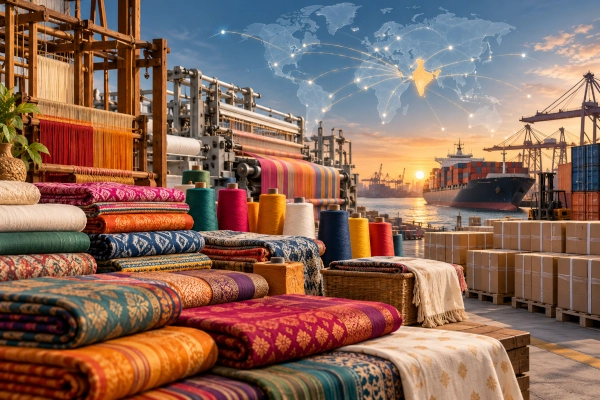
The Ministry of Textiles is working to significantly expand India’s textile export base by identifying thousands of new exporters from districts across the country and strengthening local production centres as globally competitive export hubs. The initiative builds on the government’s District-Led Textiles Transformation strategy, which seeks to move export growth beyond a limited number of established industrial centres and create a wider pipeline of export-ready businesses.
The ministry’s broader district-based approach now covers more than 500 textile-exporting districts and is being aligned with the government’s Districts as Export Hubs framework. The objective is to improve export preparedness, market access, infrastructure, sustainability and institutional support at the district level while helping more MSMEs participate consistently in international trade.
District-Led Textiles Transformation Targets Priority Districts
The Ministry of Textiles formally launched the District-Led Textiles Transformation initiative in January 2026 with a two-part strategy covering 100 Champion Districts and 100 Aspirational Districts. Champion Districts are those with stronger export performance, established MSME ecosystems and substantial textile-sector employment, while Aspirational Districts have lower export bases but significant untapped potential.
The ministry developed this classification through a data-driven assessment of export performance, MSME presence and workforce participation. The long-term objective is to transform high-potential districts into global export champions while helping aspirational districts become stronger and more self-reliant textile production centres.
More Than 500 Districts Already Export Textiles
India already has a wide geographic base for textile exports. Official Ministry of Textiles data shows that textile and apparel products, including handicrafts, were exported from 548 districts in 2025–26. Major exporting districts included Tiruppur, Gautam Buddha Nagar, Bengaluru Urban, Gurugram, Mumbai, Panipat, Surat, Ahmedabad, Ludhiana and Thane.
This existing network provides a strong foundation for expanding the number of exporters. Rather than concentrating solely on established hubs, the ministry is increasingly focusing on smaller districts with specialised capabilities in handloom, handicrafts, cotton textiles, apparel, man-made fibres, home textiles and traditional products.
Government Wants More Districts to Become Export Hubs
The textiles initiative is closely aligned with the wider Districts as Export Hubs programme. That framework treats every district as a potential centre of export planning by identifying products with international demand, connecting local producers with overseas markets and coordinating central and state-level support.
Since June 2026, the Districts as Export Hubs programme has adopted a more focused and outcome-based implementation model across 27 States and Union Territories. Its priorities include increasing new exporter registrations, improving export value and helping districts use MSME clusters, Geographical Indication products and local industrial strengths more effectively.
Capacity Building Will Be Central to Creating New Exporters
A major part of the textile export strategy is expected to focus on businesses that currently sell only within India or export irregularly. Such firms often have viable products but lack experience in international documentation, quality standards, packaging, logistics, payment systems and buyer identification.
Capacity-building programmes can help these businesses understand international market requirements, product positioning, export finance and compliance. For smaller textile and handicraft enterprises, this support can determine whether they remain domestic suppliers or develop into regular exporters.
The wider Districts as Export Hubs programme is already using institutions such as the Export Credit Guarantee Corporation of India, Export Promotion Council for Handicrafts, Federation of Indian Export Organisations, Exim Bank and the Ministry of MSME to strengthen district-level export knowledge and solve practical barriers faced by new exporters.
Textile Export Facilitation Centres Will Support Local Businesses
The Ministry of Textiles has established Textile Export Facilitation Centres to provide businesses with market information, export guidance and support in understanding global opportunities. Six such centres had been established by July 2026 as part of the government’s effort to improve textile export preparedness.
These centres can play an important role in helping local manufacturers understand consumer preferences, international standards and product-market opportunities. They can also support districts in identifying exportable product portfolios rather than relying only on existing traditional markets.
Sustainability and Machinery Upgrades Form Part of the Strategy
Global textile markets are increasingly demanding stronger environmental compliance, traceability and resource efficiency. The Ministry of Textiles has therefore placed sustainability among the priorities of its district-level export strategy.
At the Textiles Summit 2026, the ministry emphasised value addition, compliance with sustainability and environmental standards, better product-market matching and greater use of India’s Free Trade Agreements. District-level road maps are expected to incorporate measures such as machinery modernisation, cleaner production and improved export-support infrastructure.
This is particularly important for smaller manufacturers because competitiveness increasingly depends not only on price but also on quality consistency, environmental standards, delivery reliability and the ability to meet buyer-specific requirements.
India’s Textile Exports Reached ₹3.25 Lakh Crore in 2025–26
India’s textile and apparel exports, including handicrafts, stood at ₹3,25,339 crore in 2025–26, according to official Ministry of Textiles data. This represented growth over the previous year and reflected export expansion across more than 100 international destinations.
Ready-made garments remained the largest export category, followed by cotton textiles and man-made textiles. Carpets, handicrafts, jute, silk, wool and handloom products also contributed to the export basket, giving India a highly diversified textile base.
Free Trade Agreements Are Opening New Market Opportunities
The government is linking district-level textile development with a broader market-diversification strategy covering 40 priority countries. India already has multiple Free Trade Agreements in force, while additional agreements with major markets are expected to create new opportunities for textile and apparel exporters.
For district-based firms, improved tariff access alone will not guarantee export growth. Businesses must also be able to meet product specifications, scale production, comply with sustainability norms and build reliable international buyer relationships.
The ministry’s district-focused strategy is intended to create this supporting ecosystem so that smaller producers can make practical use of the market opportunities created by trade agreements.
Tiruppur Shows the Potential of Strong District-Level Export Ecosystems
Tiruppur offers one of the clearest examples of how a district can develop into a globally recognised textile export hub. Government data noted that Tiruppur achieved record exports of about ₹46,000 crore in 2025–26, with local industry targeting ₹1 lakh crore in exports by 2030.
The district’s success has been built around specialised manufacturing clusters, supplier networks, skilled labour, export institutions and long-standing relationships with international buyers. The government’s wider district strategy seeks to replicate aspects of this ecosystem in regions that possess strong production capabilities but have not yet developed comparable export networks.
Aspirational Districts Could Broaden India’s Export Geography
The inclusion of 100 Aspirational Textile Districts is particularly significant because many of these regions possess traditional textile skills but remain weakly connected to international markets.
Handloom weaving, handicrafts, embroidery, cotton production and region-specific textile traditions are often concentrated in districts where enterprises operate at relatively small scale. Better market access, design support, quality certification, logistics and export facilitation could allow these producers to reach higher-value overseas markets.
A stronger district-level export base could also help spread employment and manufacturing growth more evenly rather than concentrating textile exports in a small number of metropolitan and industrial centres.
MSMEs Will Be Central to the Next Phase of Textile Export Growth
India’s textile industry is highly decentralised and includes a large number of micro, small and medium enterprises. Any significant increase in the number of exporters will therefore depend heavily on bringing more MSMEs into formal international trade.
For many such companies, the initial barrier is not manufacturing capability but the complexity associated with finding buyers, arranging export finance, understanding customs procedures and complying with foreign regulations.
District-level facilitation can reduce these barriers by bringing export institutions closer to manufacturing clusters and creating a more structured path from domestic production to international sales.
India Is Building a Wider Textile Export Base
The Ministry of Textiles’ district-led strategy represents a shift from simply increasing export volumes to expanding the number and geographic spread of companies participating in global trade.
With textile exports already originating from more than 500 districts, the foundation for wider participation exists. The next phase will depend on converting promising manufacturers into regular exporters, improving district-level infrastructure and creating stronger connections between local production clusters and international markets.
By combining exporter development, sustainability, technology upgrades, trade agreements and district-level planning, India is seeking to build a more diversified and resilient textile export ecosystem. Expanding the pool of exporters by thousands of businesses over the coming years would strengthen that transformation and give more districts a direct role in India’s global textile growth.
References
Press Information Bureau, Ministry of Textiles — Ministry of Textiles Announces District-Led Textiles Transformation Plan to Create Global Export Champions, 8 January 2026
https://www.pib.gov.in/PressReleasePage.aspx?PRID=2212663
Press Information Bureau, Ministry of Textiles — Trade Preparedness and Export Competitiveness of Textile Sector, 24 July 2026
https://www.pib.gov.in/PressReleasePage.aspx?PRID=2288808
Press Information Bureau, Ministry of Textiles — Garment Exports, 11 August 2026
https://www.pib.gov.in/PressReleasePage.aspx?PRID=2297513
Press Information Bureau — Districts as Export Hubs: Taking India’s Exports to Every District, 2 September 2026
https://www.pib.gov.in/PressReleasePage.aspx?PRID=2305826
Press Information Bureau, Ministry of Textiles — Textiles Summit 2026 Concludes With Focus on Sustainability, Exports and Global Market Expansion, 24 June 2026
https://www.pib.gov.in/PressReleasePage.aspx?PRID=2277529
You may also like
-
ULOOK Develops Space-Based RF Intelligence Platform as It Joins Peak XV Surge 12
-
TDB Backs Multi Nano Sense With ₹37.51 Crore to Build Indigenous Multi-Gas Sensor Platform
-
India and Jordan Target US$5 Billion Bilateral Trade by 2030 as Economic Cooperation Expands
-
BHEL Awards ₹480.73 Crore Cryogenic Air Separation Unit Contract for Odisha Coal-to-Ammonium Nitrate Project
-
Kuttiattoor Mango — Kannur’s Orange-Gold Heirloom and the Mango Heritage of North Malabar
