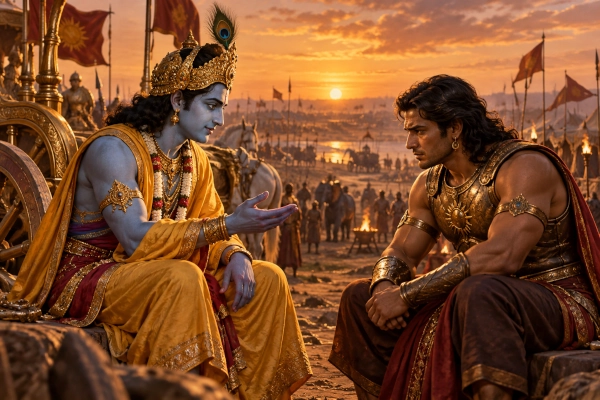
After the formal peace mission to Hastinapura failed, Krishna turned to a private diplomatic approach with Karna, one of Duryodhana’s strongest allies and the warrior most closely identified with Arjuna’s great battlefield rivalry. The meeting took place at a moment when the political space for compromise had almost disappeared and the Kuru conflict was moving rapidly towards war.
Krishna’s approach was extraordinary because it did not simply offer Karna wealth, command or prestige. He revealed that Karna was Kunti’s eldest son, which made him the senior-born brother of Yudhishthira, Bhima, Arjuna, Nakula and Sahadeva. Krishna then offered a political settlement built around that revelation: Karna could join the Pandavas, be recognised publicly as their eldest brother and receive the kingship that followed from that seniority.
The proposal was designed to achieve something that formal diplomacy had failed to do. Rather than persuade Duryodhana to compromise, Krishna attempted to alter the balance of power around him by removing the ally whose loyalty and military strength mattered most. The episode stands out in the Mahabharata’s Udyoga Parva as one of its clearest examples of confidential diplomacy, strategic realignment and the limits of political incentives.
Formal Peace Negotiations Had Reached Their Limit
Krishna’s private meeting with Karna came only after the public diplomatic process at Hastinapura had broken down. Krishna had already spoken before the Kuru court and urged Dhritarashtra, Duryodhana and the senior elders to avoid a war that would destroy much of the Kuru world.
The negotiations had brought the central dispute into the open, but they had not changed Duryodhana’s position. His refusal to grant the Pandavas a settlement meant that the conflict was no longer waiting on a formal proposal. The question had become whether anything could still change the military and political alignment before the armies met.
This is the point at which Krishna’s diplomacy shifted from public negotiation to private intervention. The target was no longer the Kuru court as a whole. It was one man whose defection could reshape the coming war.
Why Karna Was Central to Duryodhana’s Position
Karna was far more than a powerful warrior in Duryodhana’s camp. His relationship with Duryodhana had been built over many years and carried emotional, political and military weight.
When Karna’s social standing was questioned during the martial exhibition at Hastinapura, Duryodhana publicly elevated him and made him king of Anga. For Karna, that act was not merely political patronage. It was recognition at a moment when others had humiliated him.
That memory shaped the alliance between the two men. Duryodhana gained a formidable champion, while Karna gained status, friendship and a place within the political order. By the time war approached, their relationship had become one of the strongest personal bonds sustaining the Kaurava coalition.
Krishna therefore understood that removing Karna from Duryodhana’s side would do more than weaken the Kaurava army. It could shake Duryodhana’s confidence and damage the cohesion of the alliance around him.
Krishna Used a Private Channel Deliberately
The meeting with Karna was conducted privately rather than before the court. That choice was essential to the diplomatic method.
A public proposal would have forced Karna to respond under the pressure of reputation, pride and immediate political scrutiny. A private conversation allowed Krishna to introduce sensitive information and test a dramatic settlement without turning the exchange into a spectacle.
This is one of the defining features of back-channel diplomacy. Private channels are useful when public positions have hardened, when leaders cannot easily retreat in front of their supporters, or when proposals are too politically sensitive to introduce openly.
Krishna created exactly that kind of space with Karna.
The Revelation of Karna’s Birth Changed the Political Equation
Krishna began by revealing that Karna was not born into the charioteer family that had raised him. His biological mother was Kunti, who had given birth to him before her marriage to Pandu.
This meant that Karna was not simply connected to the Pandavas by blood. He was older than all five of them and therefore stood before Yudhishthira in birth order.
The revelation carried enormous political implications. Karna’s lifelong rivalry with the Pandavas was suddenly transformed by the knowledge that he belonged to the same family. The man who had prepared to fight Arjuna was, by birth, Arjuna’s elder brother.
Krishna was therefore doing more than revealing a family secret. He was introducing an entirely new basis for legitimacy, succession and political alignment.
Krishna Offered Karna Recognition and Kingship
The settlement Krishna placed before Karna was sweeping. Karna could cross over to the Pandava side, reveal his true birth and be accepted as the eldest son of Kunti.
That would make him the senior Pandava brother and place him in a position of exceptional dynastic authority. Krishna indicated that the Pandavas would honour this seniority and that Karna could become king.
The offer addressed nearly every grievance that had shaped Karna’s life. It offered public recognition of his birth, an end to the stigma associated with his supposed social status, acceptance by the Pandavas and access to sovereign power.
Few diplomatic proposals in the Mahabharata offer so much to a single individual.
The Strategic Purpose Was to Change the War Before It Began
Krishna’s offer also had an obvious strategic purpose. Karna was one of the most dangerous warriors supporting Duryodhana, and his rivalry with Arjuna gave the coming war a powerful personal dimension.
Had Karna joined the Pandavas, Duryodhana would have lost a crucial ally while the Pandava coalition gained another elite warrior. The psychological effect might have been even greater than the military effect, because Karna’s defection could have encouraged doubts among others already uneasy about the war.
Krishna was therefore attempting to change the battlefield through diplomacy before the armies entered it.
The meeting demonstrates that strategic diplomacy is not always about reaching compromise between two sides. Sometimes it seeks to change the composition of those sides.
Karna Understood the Offer and Still Refused It
Karna’s refusal is what gives the episode its lasting importance.
He did not reject Krishna because he misunderstood the proposal. He accepted the truth about his birth and understood what recognition as Kunti’s eldest son could mean.
He also understood the political power being offered to him.
Yet Karna refused to abandon Duryodhana.
His decision rested on the belief that deserting Duryodhana at the moment of greatest danger would be dishonourable. Duryodhana had stood by him when others had rejected or insulted him, and Karna believed that gratitude for that loyalty could not simply be erased by a newly revealed biological relationship.
Birth Could Not Erase a Lifetime of Loyalty
Krishna’s revelation changed the truth of Karna’s ancestry, but it did not change the history of his life.
Adhiratha and Radha had raised him. Duryodhana had recognised him. His friendships, ambitions, humiliations and loyalties had developed within relationships that were real to him regardless of biological birth.
That distinction is central to understanding Karna’s response. Krishna offered him identity through blood. Karna answered from an identity built through lived experience.
The episode therefore becomes a powerful study of the limits of lineage in politics. Biological legitimacy can matter greatly, but it does not automatically replace bonds formed through loyalty, gratitude and shared history.
Karna Chose Honour Over Advantage
From a purely material perspective, Krishna’s offer was difficult to surpass. Karna could receive royal recognition, political supremacy, reconciliation with his brothers and a place at the head of the Pandava order.
Yet Karna judged the proposal through a different standard. He believed that accepting those advantages by abandoning Duryodhana would stain his honour.
This reveals one of the deeper diplomatic lessons of the episode. Negotiators often assume that political actors will respond primarily to incentives such as office, territory, wealth or security. Karna demonstrates that some decisions are governed by values that cannot be reduced to material gain.
For him, loyalty had become part of identity itself.
Reputation Was Part of Karna’s Calculation
Karna also had to consider how his decision would be understood by others.
A move to the Pandava side immediately before war could appear opportunistic, especially after years of public loyalty to Duryodhana. Karna knew that such a decision might make it seem that he had remained loyal only until a better offer appeared.
For a man whose life had been shaped by questions of dignity and recognition, that possibility mattered deeply.
Diplomatic offers can therefore fail even when they are materially generous if acceptance imposes a reputational cost that the recipient considers unbearable.
Krishna’s Proposal Shows How Coalitions Can Be Targeted
The Kaurava side was not a single-minded political bloc. Bhishma, Drona, Karna, Shalya and others had different reasons for standing with Duryodhana.
Krishna’s private approach recognised this complexity.
Rather than continuing to negotiate only with Duryodhana, he tested whether one of the coalition’s strongest internal relationships could be broken. Had Karna crossed over, the effects could have spread well beyond a single change of allegiance.
This is a familiar principle in statecraft. A coalition can sometimes be weakened more effectively by changing the loyalties within it than by confronting it directly.
The Negotiation Revealed the Limits of Material Diplomacy
Krishna’s proposal addressed status, legitimacy and power with extraordinary precision. What it did not overcome was the moral meaning Karna attached to loyalty.
That is why the episode remains valuable as a study of diplomacy. It shows that the strongest offer is not always the one with the greatest material value.
A successful negotiation depends on understanding what the other party considers essential to self-respect, identity and honour. Without that understanding, even an apparently irresistible offer can fail.
Karna’s refusal was therefore not irrational within his own moral framework. He considered the loss of honour more serious than the loss of kingship.
Confidential Diplomacy Still Produced Strategic Knowledge
Krishna did not persuade Karna to defect, but the meeting was not useless.
The conversation established clearly that Karna would remain with Duryodhana even after learning the truth of his birth. The Pandavas could therefore prepare for war without depending on the possibility of a late change of allegiance.
Private diplomacy often produces this kind of value. Even when it fails to create agreement, it can reveal motivations, clarify loyalties and eliminate uncertainty.
Krishna left the meeting with a clearer understanding of Karna’s position and of the emotional foundation holding one of Duryodhana’s most important alliances together.
Karna’s Refusal Was Made With Full Awareness of the Risk
Karna did not remain with Duryodhana because he was unaware of the danger ahead.
He understood the strength of the Pandavas and the significance of Krishna’s presence on their side. His decision therefore cannot be reduced to confidence in victory.
Karna accepted that loyalty might lead him towards defeat.
This makes the episode particularly striking. Diplomacy becomes much harder when the person being approached is willing to accept serious personal loss rather than violate a principle he considers fundamental.
The Modern Diplomatic Meaning
Krishna’s private meeting with Karna is an exceptional example of back-channel diplomacy before the Kurukshetra War. Formal negotiations had failed, so Krishna attempted a confidential political realignment that could weaken Duryodhana’s coalition without fighting.
The proposal was designed with enormous strategic intelligence. It offered Karna legitimacy, family recognition, political power and the possibility of kingship. Yet the negotiation failed because Karna placed loyalty to Duryodhana above those incentives.
The episode carries a clear modern lesson. Diplomacy cannot be built only around what negotiators believe the other side should value. It must take seriously the values the other side actually considers decisive.
Political actors may reject wealth, office, territory or security when accepting them would conflict with identity, loyalty, honour or historical memory. Negotiations become far more effective when these non-material interests are understood before the offer is designed.
Krishna’s meeting with Karna therefore shows both the sophistication and the limits of back-channel diplomacy. It was a carefully targeted attempt to change the balance of power before war, but it encountered something political calculation alone could not overcome: Karna’s conviction that loyalty to Duryodhana was worth more than a throne.
References
Mahabharata, Udyoga Parva — Krishna’s private conversation with Karna following the peace mission to Hastinapura.
Mahabharata, Critical Edition — Bhandarkar Oriental Research Institute, Pune; Udyoga Parva.
Kisari Mohan Ganguli, The Mahabharata — Udyoga Parva sections dealing with Krishna and Karna.
Bibek Debroy, The Mahabharata — Udyoga Parva translation based on the Critical Edition.
You may also like
-
India Emerges in Black Sea Shipping Diplomacy as Ukraine Seeks Maritime Truce With Russia
-
One Voice – One Resolve – One India: Namami Bharatam Marks 150 Years of Vande Mataram Across the Nation
-
Drupada’s Priest at Hastinapura: The Mahabharata’s First Formal Diplomatic Attempt to Prevent the Kurukshetra War
-
India and Finland Expand Technology Dialogue as New Delhi Deepens European Partnerships
-
India and Slovenia Explore Manufacturing, Energy and Digital Opportunities Around India-EU Trade Expansion
