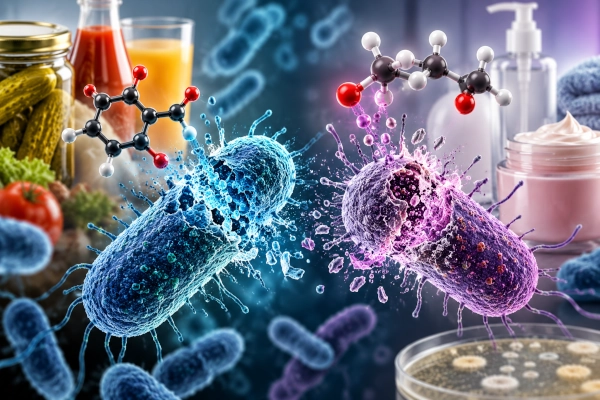
Two preservatives routinely used in food and personal-care products have protected products against microbial contamination for decades. Yet the precise sequence of events through which these chemicals destroy bacteria has remained incompletely understood. An Indian academia-industry research collaboration has now provided a detailed picture of what happens inside bacterial cells when these preservatives attack.
Researchers at the Institute of Nano Science and Technology (INST), Mohali, working with Unilever R&D Bengaluru, investigated sodium benzoate and phenoxyethanol using advanced microscopy and biochemical techniques. Their experiments revealed that these preservatives do considerably more than damage the outer boundary of bacterial cells. They compromise the cell envelope while simultaneously triggering destructive chemical reactions inside the microorganism.
The findings provide a clearer scientific basis for understanding how widely used preservatives work and could eventually help industries design preservation systems more precisely for different formulations.
Two Familiar Preservatives Under the Microscope
Sodium benzoate is one of the most familiar preservatives used by the food industry. It is particularly associated with acidic foods and beverages, including sauces, pickles and certain drinks.
Phenoxyethanol has a different range of applications and is commonly used in personal-care and cosmetic formulations such as shampoos, moisturisers and sunscreens. It also has applications in pharmaceutical and other formulations requiring microbial protection.
Despite their widespread use, the exact antibacterial mechanisms of these compounds have not always been fully understood at the cellular level. The Indian research team therefore examined how bacteria physically and chemically respond when exposed to them.
The researchers selected two substantially different bacterial species for the experiments: Staphylococcus aureus, which is Gram-positive, and Pseudomonas aeruginosa, which is Gram-negative. Their different cell-envelope structures allowed scientists to investigate whether the preservatives could act effectively against fundamentally different types of bacteria.
Watching Bacterial Cells Collapse
Transmission electron microscopy provided researchers with a close view of the structural changes occurring after exposure to the preservatives.
Sodium benzoate caused bacterial cells to shrink and collapse. Phenoxyethanol produced a noticeably different response, with cells expanding or bulging before membrane disruption and rupture occurred.
Researchers also observed leakage of intracellular material from damaged bacterial cells. Once the membrane loses its integrity, the bacterium can no longer maintain the carefully controlled internal environment necessary for survival.
The observations demonstrated that sodium benzoate and phenoxyethanol do not simply produce identical antibacterial effects through interchangeable chemical pathways. Each creates characteristic structural changes while ultimately compromising the bacterial cell.
A Second Attack Begins Inside the Cell
Damage to the bacterial membrane represented only one part of the mechanism uncovered by the researchers.
The team found increased accumulation of reactive aldehydes and oxygen-derived reactive species inside bacterial cells following preservative treatment. This produces oxidative stress, creating a hostile internal environment capable of damaging essential biological machinery.
Proteins can be affected, membranes can lose structural integrity and other cellular components can undergo chemical damage. The preservatives therefore appear to attack bacteria on more than one front.
The bacterial cell first experiences damage to its protective envelope while internal biochemical stress simultaneously increases. The combined effect eventually overwhelms the microorganism’s ability to maintain normal cellular functions.
Sodium Benzoate Becomes Much More Powerful in Acidic Conditions
One of the study’s most practically important findings concerned acidity.
Researchers found that sodium benzoate became dramatically more effective against bacteria under acidic conditions. According to the Department of Science and Technology, its antibacterial activity increased approximately 16-fold in an acidic environment.
This behaviour helps explain why sodium benzoate has proved particularly useful for preserving acidic foods and beverages.
Phenoxyethanol behaved differently. Its antibacterial effectiveness remained comparatively stable across a considerably wider pH range. That characteristic can make it valuable in formulations where acidity cannot be maintained within the narrow range most favourable to sodium benzoate.
The distinction provides manufacturers with a clearer scientific basis for selecting preservatives according to the chemical environment of individual products rather than treating different preservatives as equivalent antimicrobial ingredients.
Combining Microscopy With Biochemical Investigation
The researchers did not rely on microscopy alone to determine what was happening.
They used inhibition-zone and minimum inhibitory concentration experiments to establish how effectively different concentrations suppressed bacterial growth. Transmission electron microscopy then allowed the physical deterioration of bacterial cells to be observed at very small scales.
Additional experiments examined membrane permeability and the leakage of cellular contents. Biochemical analysis was used to investigate the chemical disturbances developing inside the microorganisms.
Combining these methods enabled researchers to connect visible structural destruction with the biochemical changes occurring inside bacterial cells. The result was a more complete picture of preservative action than could be obtained from conventional bacterial growth tests alone.
Indian Academia and Industry Work Together
The research also demonstrates the potential of collaboration between India’s publicly supported scientific institutions and industrial research organisations.
The Institute of Nano Science and Technology in Mohali is an autonomous institute under the Department of Science and Technology. Its researchers worked with scientists from Unilever R&D Bengaluru, combining advanced scientific investigation with industrial expertise in formulation and preservation technologies.
The research involved Ishani Sharma, S. M. Rose, Madhu Lata, Somnath Das, Nagaraja I. S. Acharya, Maheshwara Naik, Samiran Mahapatra and Sharmistha Sinha.
Their work was published in Letters in Applied Microbiology under the title Insights into membrane disruption and oxidative stress in Gram-positive and Gram-negative bacteria: role of sodium benzoate and phenoxyethanol.
The scientific paper was published on February 9, 2026, while the Department of Science and Technology highlighted the research on September 23, 2026. The distinction is important because the September development represents official recognition and dissemination of the research rather than the original publication date of the scientific paper.
Towards Smarter Preservation Systems
Preservation is ultimately a balancing exercise. Manufacturers must prevent microbial growth while considering product chemistry, stability, regulatory requirements and the concentration of preservatives being used.
Understanding precisely how a preservative attacks microorganisms can make that process more scientific.
The new research shows that sodium benzoate is particularly powerful under acidic conditions, while phenoxyethanol maintains useful antibacterial activity across a broader pH range. Both ultimately damage bacterial membranes while contributing to destructive biochemical stress inside the cells.
Such information could help researchers develop preservation systems tailored to particular products instead of relying primarily on conventional concentration-based approaches.
It may also support future research into combinations of preservatives and other antimicrobial strategies that exploit several bacterial vulnerabilities simultaneously.
What appears on a product label as a simple preservative therefore conceals a complex microscopic process. The Indian research has revealed a coordinated attack in which the bacterial cell envelope begins to fail while oxidative and chemical stress progressively disrupts the organism from within.
References
Department of Science & Technology / Press Information Bureau — Academia Industry Collaboration Traced the Mechanism of How Preservatives Take Down Bacteria Enabling Smarter Preservation, 23 September 2026.
Official PIB release
Sharma, Ishani et al. — Insights into membrane disruption and oxidative stress in Gram-positive and Gram-negative bacteria: role of sodium benzoate and phenoxyethanol, Letters in Applied Microbiology, Volume 79, Issue 3, 2026.
Scientific paper — Oxford Academic
You may also like
-
Ayurveda and Bathing: When, How and Why It Matters
-
Eight Years of Ayushman Bharat: How India Built a Healthcare Safety Net for More Than 60 Crore People
-
Why Ayurveda Places So Much Importance on Waking Before Sunrise
-
ISRO–ESA Extend Space Partnership to 2032, Expand Into Human Exploration
-
India Strengthens Space Surveillance Network With ISRO’s NETRA Radar Facility in Assam
