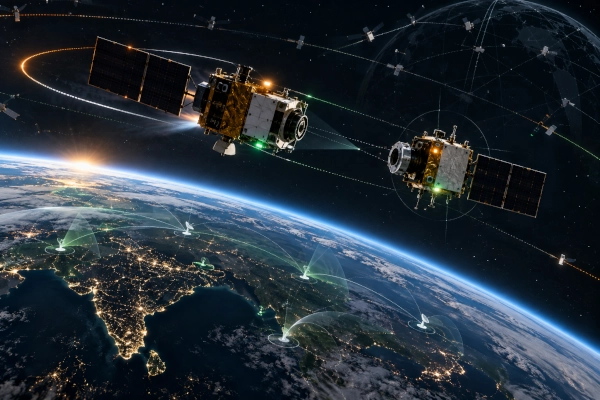
India has already demonstrated that it can physically destroy a satellite in orbit. The successful Mission Shakti anti-satellite test in March 2019 established that capability beyond doubt. What remains far less visible is whether India is also developing systems capable of operating close to another satellite in orbit and, if required, interfering with it without using a ground-launched interceptor.
Official Indian sources do not confirm the existence of an operational co-orbital weapon. They do, however, reveal a growing set of technologies that would be essential for any future co-orbital counter-space capability. These include rendezvous and proximity operations, robotic manipulation, space-based surveillance, satellite tracking, electronic warfare, space-asset jamming and directed-energy systems. Taken together, these programmes show that India’s military-space effort is moving beyond a single anti-satellite missile test towards a broader ability to understand, approach, monitor, protect and potentially contest objects in orbit.
What a Co-Orbital System Actually Is
A co-orbital system differs fundamentally from the direct-ascent anti-satellite missile demonstrated under Mission Shakti. A direct-ascent ASAT is launched from Earth and intercepts a satellite at high speed. It is a short-duration engagement in which the interceptor does not remain in orbit alongside the target.
A co-orbital system is instead placed into space and manoeuvres into an orbit close to another satellite. Such a spacecraft could be designed for entirely peaceful purposes, including inspection, servicing, repair, refuelling or debris removal. The same technologies, however, can also have military applications because a spacecraft capable of approaching another satellite with great precision could potentially inspect it, interfere with its operation, manipulate components or carry another payload intended to disable it.
This dual-use character makes co-orbital technology one of the most sensitive areas of modern military space operations. The same guidance, navigation and control systems required for satellite servicing can also support military proximity operations, making intent difficult to determine from technology alone.
DRDO Officially Lists Rendezvous and Proximity Operations
The most important official indication of India’s interest in the enabling technologies appears in DRDO’s own technology-foresight material. Under its Space Technologies programme, DRDO lists Rendezvous and Proximity Operations technology as a development task associated with robotic-arm technology.
Rendezvous and proximity operations, commonly referred to as RPO, involve bringing one spacecraft close to another and controlling their relative position and movement with very high precision. Such technology is essential for satellite servicing, docking, inspection and orbital maintenance.
The same capability would also be necessary for any future co-orbital system because a spacecraft cannot interact with another satellite unless it can first identify the target, match its orbit and safely manoeuvre within close range. DRDO’s inclusion of RPO in its official technology-development roadmap therefore represents a significant capability-building effort, although it should not be interpreted as proof of an operational weapon.
Robotic Arms Add Another Layer of Capability
The same DRDO technology list associates rendezvous and proximity operations with robotic-arm development. A robotic arm on a spacecraft can have several legitimate applications, including capturing satellites, repositioning components, supporting repair missions, moving payloads and assisting with docking.
These capabilities are increasingly important as nations examine on-orbit servicing and maintenance. A spacecraft equipped with a robotic arm could theoretically extend the service life of satellites, support debris-removal missions or enable more complex assembly operations in orbit.
In a military context, however, a robotic system operating close to another spacecraft could theoretically be used to interfere physically with that spacecraft. Indian official sources do not state that DRDO is developing such a system for offensive use. What they establish is that India is pursuing the underlying technology required for close orbital interaction.
Space Situational Awareness Is the Foundation
A co-orbital spacecraft cannot operate effectively without precise knowledge of what is happening in orbit. DRDO therefore identifies Space Situational Awareness as a dedicated technology-development area within its wider defence-space roadmap.
Its official programme includes adaptive optics for detecting and tracking satellites in Low Earth Orbit, ground- and space-based LiDAR sensors, optical sensors and extremely long-range radars. These systems are intended to detect, identify and track objects in space with increasing accuracy.
For defensive purposes, such awareness allows India to monitor its own satellites, identify potentially threatening objects and understand unusual manoeuvres occurring near critical spacecraft. For military operations more broadly, the ability to maintain an accurate catalogue of satellites and their trajectories is a prerequisite for any deliberate interaction with objects in orbit.
Space-Based Surveillance Is Also Being Developed
DRDO’s official technology roadmap also lists artificial intelligence and machine-learning-based multisensor data-fusion techniques for space-based surveillance. This type of capability allows information from multiple sensors to be combined into a coherent operational picture.
Space surveillance involves far more than detecting a satellite once. Operators must determine its orbit, identify changes in trajectory, estimate future positions and distinguish routine manoeuvres from potentially threatening behaviour.
As the number of satellites in orbit increases, automated data fusion and AI-assisted analysis become increasingly important. This is especially relevant to military space operations because modern armed forces depend heavily on communications, navigation, reconnaissance, missile warning and targeting satellites.
Space Asset Jamming Is Explicitly Listed
One of the clearest official indications of India’s counter-space direction is DRDO’s inclusion of Space Asset Jamming under electronic warfare technologies. Jamming offers a fundamentally different approach from destroying a satellite physically.
Instead of striking the spacecraft, an electronic warfare system can attempt to disrupt the radio-frequency links connecting the satellite with ground stations or users. Depending on the system and operating environment, this could interfere with communications, navigation signals, telemetry or command links.
Jamming can also be reversible because the satellite itself may remain physically intact once the interference stops. This makes electronic counter-space capabilities particularly important because they can potentially provide military effects without creating orbital debris.
DRDO’s public inclusion of space-asset jamming shows that India is examining this area as part of its future defence technology portfolio.
Space-Based High-Power Laser Appears in DRDO Roadmap
DRDO also officially lists a Space Based High Power Laser under directed-energy weapons. This is one of the most notable entries in the organisation’s publicly available technology-foresight programme.
A high-power laser operating in space could theoretically perform several functions depending on power, optics and targeting capability. These could range from dazzling or temporarily affecting optical sensors to more demanding forms of directed-energy engagement.
Official Indian material does not provide technical specifications, development status or operational timelines for this programme. It would therefore be incorrect to describe India as already possessing an operational space-based laser weapon.
Its presence in the development roadmap nevertheless shows that directed energy is part of India’s long-term defence-space research.
Mission Shakti Established the First Hard-Kill Capability
India’s most clearly demonstrated counter-space capability remains Mission Shakti. On 27 March 2019, DRDO successfully used a Ballistic Missile Defence interceptor to engage an Indian satellite in Low Earth Orbit in a hit-to-kill mission.
The Ministry of Defence said the test demonstrated India’s capability to defend its assets in outer space and confirmed that all mission objectives had been achieved. Mission Shakti placed India among the small group of countries that had publicly demonstrated the ability to physically intercept a satellite.
The test involved a direct-ascent interceptor rather than a co-orbital system, but it established important foundations in tracking, guidance, command and control and high-speed interception. Those foundations are relevant to the broader development of military-space capabilities.
DRDO’s ASAT Programme Was Built as an Integrated Weapon System
DRDO’s official account of Mission Shakti shows that the anti-satellite programme involved far more than the interceptor missile itself. The system incorporated long-range boosters, a hit-to-kill vehicle, tracking radars, launchers and command, control, communications, computers and intelligence elements.
The project received formal approval towards the end of 2016, and development work began in 2017. Within roughly two years, DRDO had developed and tested India’s first anti-satellite weapon.
The speed of that programme demonstrated that India had already accumulated a substantial technological base through its ballistic-missile-defence work. It also showed that counter-space capability in India is being built through integration of multiple sensor, guidance and command systems rather than through a single isolated platform.
Defence Space Agency Brings the Operational Dimension
India has also created an institutional structure for military-space operations through the Defence Space Agency. The agency operates under Headquarters Integrated Defence Staff and brings together elements from the Army, Navy and Air Force.
Its responsibilities include coordinating military-space capabilities and improving the integration of space assets into joint operations. The creation of the Defence Space Agency marked an important change because space was no longer being treated solely as a scientific or satellite-support domain.
It became an operational military environment requiring dedicated planning, doctrine and readiness. This institutional framework is essential for managing the increasingly complex relationship between satellites, surveillance, communications, navigation and counter-space threats.
Antariksha Abhyas War-Gamed Threats to Space Assets
This operational shift became more visible during Exercise Antariksha Abhyas-2024, conducted by the Defence Space Agency in November 2024. The Ministry of Defence described it as India’s first exercise specifically designed to war-game growing threats from and to space-based assets and services.
The exercise examined emerging space technologies, space situational awareness, protection of critical assets and the integration of space capabilities into military operations. Participants included representatives from the armed forces, government departments, scientific organisations and academia.
The exercise also examined the future landscape of military-space technologies and challenges associated with defence-space operations. This made it an important indication that India is preparing not only to use satellites in support of military operations but also to operate in an environment where those satellites could themselves become targets.
India Is Developing a Broader Space-Warfare Architecture
Antariksha Abhyas demonstrated that India’s military-space planning is not limited to protecting individual satellites. The exercise focused on interoperability among the services, situational awareness, operational preparedness and development of a roadmap for India’s space doctrine and capabilities.
This broader architecture matters when considering co-orbital systems. A co-orbital capability would require far more than a spacecraft capable of manoeuvring near another satellite.
It would require surveillance networks, tracking systems, command structures, communications links, mission planning and rules governing military action in space. India is now developing many of these supporting elements through the Defence Space Agency, DRDO and other national institutions.
Detection and Tracking Are Equally Important for Defence
Co-orbital technologies also create defensive requirements. If another country manoeuvres a spacecraft close to an Indian military or strategic satellite, India must first be able to detect that approach and understand whether it represents routine activity or a potential threat.
Ground-based and space-based optical sensors, LiDAR and long-range radar therefore serve both offensive and defensive purposes. They allow operators to identify objects, calculate relative trajectories and determine whether a satellite is behaving normally or approaching another spacecraft unexpectedly.
This capability is becoming increasingly important as manoeuvrable satellites become more common and as military reliance on space-based services continues to increase.
Why Co-Orbital Systems Are Difficult to Classify
The principal challenge in discussing co-orbital capabilities is that the underlying technology is inherently dual-use. A spacecraft designed to repair a satellite must be able to approach it accurately, while a spacecraft designed to remove orbital debris must also be able to rendezvous with another object.
A servicing vehicle may carry robotic arms or other mechanisms for physical interaction. The same capabilities can therefore be interpreted very differently depending on mission, payload and behaviour.
For this reason, the existence of rendezvous and proximity technology does not by itself establish the existence of a weapon. India’s official documentation should therefore be read carefully because it confirms development of several relevant technologies but does not describe an operational co-orbital anti-satellite system.
Non-Kinetic Counter-Space Capabilities May Become More Important
Mission Shakti demonstrated a kinetic capability, but future counter-space operations may rely increasingly on methods that do not physically destroy satellites. Kinetic destruction can create debris that may remain in orbit and threaten other spacecraft.
Electronic jamming, cyber operations, sensor interference and directed-energy effects can potentially achieve military objectives without generating the same debris environment.
DRDO’s current technology priorities reflect this broader shift. Space-asset jamming, directed-energy systems, multisensor surveillance and rendezvous technology all point towards a more diverse counter-space toolkit than a single ground-launched missile.
India’s Position Remains Deliberately Cautious
India has historically maintained that outer space should be used peacefully while also insisting that it must be able to protect its national assets. This dual approach was visible after Mission Shakti, which the government presented as a demonstration of defensive capability rather than a declaration of intent to weaponise space.
The same caution remains visible in current official material. DRDO publicly identifies technologies that could support military counter-space operations but generally does not publish operational concepts, deployment status or intended targets.
This reflects the strategic sensitivity of the field and the dual-use character of many of the technologies involved.
No Official Confirmation of an Operational Co-Orbital Weapon
There is currently no official Government of India or DRDO announcement confirming that India has deployed an operational co-orbital anti-satellite weapon. There is also no official statement confirming a satellite specifically designed to approach and physically disable another spacecraft.
Claims that such a weapon already exists would therefore go beyond the available official evidence.
What the official record does confirm is that India is developing several technologies that could eventually support such a capability, including rendezvous and proximity operations, robotic manipulation, space-based surveillance, long-range tracking systems, artificial-intelligence-assisted sensor fusion, space-asset jamming and space-based directed-energy research.
The Enabling Technologies Are Now Visible
India has also demonstrated a direct-ascent anti-satellite capability and established a military institution responsible for space operations. Taken together, these developments show a steady expansion of India’s ability to operate in a contested space environment.
The progression is significant because modern military space power depends not on one weapon but on an interconnected system of sensors, satellites, communications, command networks and counter-space technologies.
India’s emerging architecture therefore appears broader than the Mission Shakti demonstration alone and increasingly reflects the operational realities of military competition in space.
From Satellite Protection to Space Deterrence
India’s military-space evolution is increasingly centred on deterrence and resilience. As the armed forces become more dependent on satellites for communications, navigation, reconnaissance and targeting, protecting those systems becomes a national-security requirement.
The Defence Space Agency, Mission Shakti, Antariksha Abhyas and DRDO’s expanding technology roadmap all form part of this transition.
A future co-orbital capability would fit logically within that architecture, but it has not been publicly confirmed as an operational weapon. For now, India’s officially acknowledged position is more precise: the country has demonstrated one form of counter-space weapon, is developing a much wider set of space-warfare technologies, and is building the surveillance and operational architecture required to protect its interests in orbit.
References
Defence Research and Development Organisation — Space Technologies
https://drdo.gov.in/drdo/en/offerings/technology-foresight/space-technologies
Defence Research and Development Organisation — Space Situational Awareness
https://drdo.gov.in/drdo/en/offerings/technology-foresight/space-situational-awareness
Ministry of Defence / Press Information Bureau — Defence Space Agency Successfully Conducts Exercise Antariksha Abhyas-2024, 13 November 2024
https://www.pib.gov.in/PressReleasePage.aspx?PRID=2073082
Ministry of Defence / Press Information Bureau — First Ever Space Exercise Antariksha Abhyas-2024 Begins, 11 November 2024
https://www.pib.gov.in/Pressreleaseshare.aspx?PRID=2072518
Ministry of Defence / Press Information Bureau — India Joins Select Group of Nations, Destroys Live Satellite in Low Earth Orbit, 27 March 2019
https://www.pib.gov.in/PressReleasePage.aspx?PRID=1569563
Defence Research and Development Organisation — ASAT: Mission Shakti
https://www.drdo.gov.in/drdo/sites/default/files/publcations-document/ASAT_book_English.pdf
Defence Research and Development Organisation — Organisation and Mission
https://drdo.gov.in/drdo/en/organisation
You may also like
-
Voltanova Builds Thermal Batteries to Replace Fossil-Fuel Heat in Indian Industry
-
NIT Calicut Moves From Chip Design to Fabricated Silicon Under India’s Chips to Startup Programme
-
Tata Electronics Brings Malaysia’s Kelington Into Dholera Fab as India–Malaysia Semiconductor Links Deepen
-
BARC Moves Bharat Small Modular Reactor Towards Industry-Led Deployment
-
Russian Fibre-Optic Monitoring Specialist SibSensor Signs India Cooperation Agreement With TVS Group
