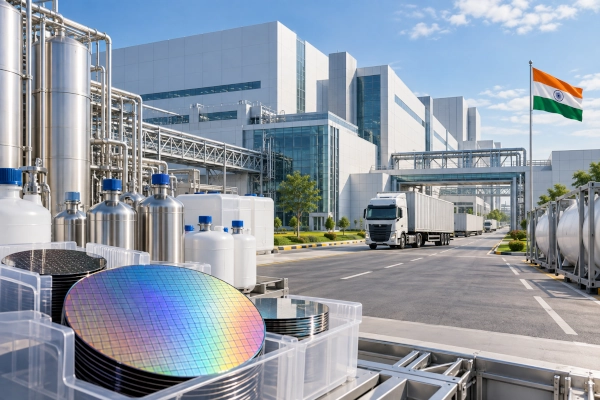
Tata Electronics has signed a Memorandum of Understanding with Japan’s Sojitz Corporation and NRS Corporation to develop a dedicated supply-chain framework for critical semiconductor materials required by its ₹91,000-crore fabrication facility at Dholera in Gujarat.
The agreement, announced on 18 September 2026, focuses on the supply, storage, handling and management of materials used in semiconductor manufacturing. It brings together Tata Electronics’ emerging fabrication capability with Sojitz’s expertise in chemical trading and supply-chain management and NRS Corporation’s experience in transporting and storing chemicals and hazardous materials for the semiconductor industry.
The partnership is aimed at building the physical and logistical infrastructure required to support reliable front-end semiconductor manufacturing in India, where the availability of specialised materials and safe chemical-handling systems will be as important as the fabrication equipment itself.
Building a Dedicated Materials Supply Chain for Dholera
Under the MoU, Sojitz Corporation and NRS Corporation will work with Tata Electronics to explore and validate a supply-chain management framework for critical semiconductor materials needed by the Dholera fab.
The objective is to create a system capable of supporting the safe, reliable and efficient movement of semiconductor materials, including products that require specialised handling because of their chemical properties.
This is particularly important in semiconductor manufacturing because fabs depend on a steady flow of process chemicals, gases and other specialised inputs. Interruptions in any of these supplies can affect production schedules and, in some cases, halt wafer processing altogether.
The Tata–Sojitz–NRS partnership therefore addresses one of the practical requirements of operating a large-scale semiconductor fabrication facility: ensuring that materials arrive on time, are stored safely and can be delivered to production systems under controlled conditions.
Sojitz Brings Semiconductor Chemical Trading Expertise
Sojitz Corporation is one of Japan’s major general trading companies, with business interests spanning chemicals, energy, metals, infrastructure, mobility and consumer sectors.
In the semiconductor sector, the company has experience in trading high-performance chemical products and building international supply chains for specialised materials.
That expertise is relevant to Tata Electronics because semiconductor manufacturing relies heavily on precisely managed imports and distribution networks, particularly during the early stages of ecosystem development when many materials are not yet manufactured locally.
Through the Dholera partnership, Sojitz is expected to contribute its global sourcing, business-development and supply-chain management capabilities to help create a dependable flow of materials into the fab.
NRS Adds Specialised Chemical Logistics Capability
NRS Corporation brings a different but complementary set of capabilities to the partnership.
The Japanese company specialises in chemical logistics and provides storage, transportation and related services for materials that require strict handling standards. It has experience supporting semiconductor-material supply chains across Asia, North America and Europe.
Many chemicals used in semiconductor fabrication must be transported under controlled conditions and handled through specialised infrastructure. Some are hazardous, while others require exceptionally high standards of cleanliness and contamination control.
A conventional logistics network is therefore not sufficient for a semiconductor fab. Storage tanks, warehouses, transport systems, safety procedures and regulatory approvals all have to meet stringent industrial requirements.
NRS’s role could help Tata Electronics establish this specialised logistics layer around the Dholera project.
Site Within Dholera Special Investment Region Under Evaluation
Sojitz and NRS Corporation are also engaging with Dholera Industrial City Development Limited to identify a suitable site within the Dholera Special Investment Region.
The companies are simultaneously assessing the permits, licences and regulatory requirements associated with the import, transportation, storage, handling and management of semiconductor materials.
This indicates that the partnership is not limited to a general supply agreement. The companies are evaluating the physical infrastructure and regulatory framework needed to establish a functioning semiconductor-material logistics base close to the fabrication plant.
Locating storage and handling facilities close to the fab could reduce transport times, simplify inventory management and improve supply-chain resilience.
It could also encourage additional semiconductor-material suppliers to establish operations within the Dholera cluster over time.
₹91,000-Crore Dholera Fab at the Centre of Tata’s Semiconductor Push
Tata Electronics is building India’s first commercial 12-inch, or 300 mm, semiconductor fabrication facility at Dholera in Gujarat.
The project involves an investment of approximately ₹91,000 crore, equivalent to around US$11 billion, and is being developed with technology support from Taiwan’s Powerchip Semiconductor Manufacturing Corporation.
The fab is expected to manufacture chips across process nodes ranging from 28 nanometres to 110 nanometres for applications including automotive electronics, communications, consumer devices, industrial equipment and other high-volume semiconductor markets.
The scale of the project means that Dholera will require an entire supporting industrial ecosystem extending far beyond the fabrication plant itself.
Semiconductor Manufacturing Depends on More Than the Fab
Semiconductor fabs are among the most complex industrial facilities in the world, and their supply chains extend across hundreds of specialised materials, chemicals, components and pieces of equipment.
A fabrication plant requires ultra-pure chemicals for cleaning and processing wafers, specialty gases for deposition and etching, photoresists for lithography and numerous additional materials used at different stages of production.
These supplies must meet strict purity standards and often require dedicated transportation and storage systems.
As a result, the development of a semiconductor industry depends not only on attracting foundries but also on creating a reliable ecosystem of chemical suppliers, logistics providers, warehouses, safety systems and specialised infrastructure.
The partnership with Sojitz and NRS is therefore an important part of making the Dholera fab operational rather than simply completing its physical construction.
Tata Electronics Builds Multiple Partnerships Around Dholera
The Sojitz–NRS agreement is one of several partnerships Tata Electronics has announced to build the industrial ecosystem surrounding the Dholera fab.
On the same day, Tata Electronics signed an MoU with Sumitomo Chemical covering the supply of photoresists, functional chemicals and high-purity process chemicals. The two companies are also exploring local manufacturing of semiconductor materials in India.
Tata Electronics has also announced a collaboration with Malaysia-based Kelington to support the deployment of critical infrastructure and systems required for semiconductor manufacturing and to accelerate operational readiness for wafer production.
A day earlier, Tata Electronics and Fujifilm announced plans to strengthen the semiconductor-material ecosystem at Dholera, including localisation of critical raw materials. Fujifilm also disclosed plans for a semiconductor-materials facility within the Dholera Special Investment Region.
Taken together, these agreements indicate that Tata Electronics is increasingly shifting attention from construction of the fab itself towards the supply chain required to operate it at commercial scale.
Dholera Could Emerge as a Semiconductor Materials Cluster
The development of storage, chemical-handling and logistics infrastructure around the Tata fab could eventually benefit companies beyond Tata Electronics.
As semiconductor manufacturing expands in India, suppliers may find it commercially viable to establish local facilities serving multiple fabs and packaging plants rather than supporting a single customer.
Dholera could therefore evolve from being the location of one large fabrication facility into a wider semiconductor manufacturing cluster containing chemical suppliers, logistics providers, equipment-service companies and specialised engineering firms.
Such clustering is common in established semiconductor centres because proximity reduces logistics costs and allows suppliers to respond quickly to the operational requirements of fabrication plants.
India Moves Deeper Into the Semiconductor Supply Chain
The Tata Electronics–Sojitz–NRS partnership illustrates how India’s semiconductor strategy is beginning to move beyond headline fab investments.
Building a competitive semiconductor industry requires capability across design, wafer fabrication, packaging, chemicals, gases, equipment, logistics and workforce development.
The latest agreement addresses the materials-management layer of that value chain, which is critical to the day-to-day functioning of a semiconductor fab but often receives less attention than chip design or lithography technology.
For Tata Electronics, the partnership strengthens the operational foundation of the Dholera project. For India, it represents another step towards creating the specialised industrial infrastructure required to sustain semiconductor manufacturing at scale.
References
- Tata Electronics — Tata Electronics, Sojitz Corporation and NRS Corporation Announce Partnership to Develop Semiconductor Materials Supply Chain for Dholera Fab, 18 September 2026
https://www.tataelectronics.com/w/tata-electronics-sojitz-corporation-and-nrs-corporation-announce-partnership-to-develop-semiconductor-materials-supply-chain-for-dholera-fab - Tata Electronics — Tata Electronics and Sumitomo Chemical Sign MoU for High-Quality Semiconductor Materials, 18 September 2026
https://www.tataelectronics.com/w/tata-electronics-and-sumitomo-chemical-sign-mou-for-high-quality-semiconductor-materials - Tata Electronics — Tata Electronics and Kelington Collaborate to Accelerate Operational Readiness of Dholera Fab, 18 September 2026
https://www.tataelectronics.com/w/tata-electronics-and-kelington-collaborate-to-accelerate-operational-readiness-of-dholera-fab - Tata Electronics — Tata Electronics and Fujifilm Announce Strategic Partnership to Accelerate Semiconductor Materials Ecosystem in India, 17 September 2026
https://www.tataelectronics.com/w/tata-electronics-and-fujifilm-announce-strategic-partnership-to-accelerate-semiconductor-materials-ecosystem-in-india
You may also like
-
India-Made Semiconductor Products Begin Reaching Global Markets as Domestic Ecosystem Expands
-
Semicon 2.0 Targets 200 Chip-Design Companies and One Lakh Semiconductor Technicians
-
LightSpeed Photonics Plans India Packaging Pilot Line, Targets 50% Local Production by 2028
-
Tata Electronics and Enomoto Partner to Strengthen Advanced Semiconductor Packaging Ecosystem in Assam
-
Cochin Shipyard Lays Keel for Indian Navy’s First Next Generation Missile Vessel
