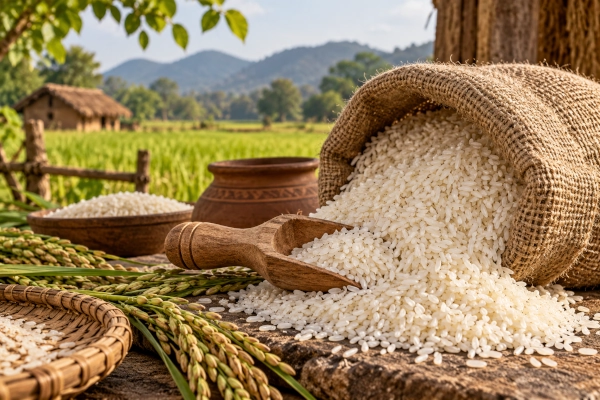
In the rain-soaked hills of southern Maharashtra, where the Western Ghats descend towards the agricultural valleys of Kolhapur district, farmers have preserved a distinctive aromatic rice for generations. Ajara Ghansal Rice, traditionally cultivated around Ajara taluka, is valued for its intense fragrance, delicate grain, pleasant taste and tender but non-sticky texture.
Ghansal is not a Basmati variety. It belongs instead to India’s diverse family of indigenous non-Basmati aromatic rice landraces, many of which developed within very restricted geographical environments. In Ajara, the combination of high rainfall, lateritic soils, cooler conditions near the Sahyadri hills and generations of farmer selection helped create a grain sufficiently distinctive to acquire its own regional reputation.
That relationship between rice and landscape received formal recognition when Ajara Ghansal Rice was registered as a Geographical Indication on 31 March 2016. The registration connects the name with Maharashtra and the traditional producer community represented by the Ajara Taluka Shetkari Vikas Mandal.
The Rice Country of Ajara
Ajara lies in the southern part of Kolhapur district, close to the Western Ghats and the Maharashtra-Karnataka border region. The landscape is markedly different from the drier interiors of Maharashtra. Hills, heavy monsoon rainfall, streams and river valleys create conditions particularly suited to paddy cultivation.
Traditional descriptions of Ajara Ghansal cultivation emphasise the importance of the foothill environment. Aromatic rice grown here matures under relatively cool conditions, while the area’s fertile lateritic soils and cooler, drier weather towards maturity are considered favourable for the development and retention of fragrance.
The Hiranyakeshi and Chitri river systems, together with water descending from the surrounding hills, have historically supported paddy agriculture across the taluka. Ghansal therefore developed not simply as another crop grown in Kolhapur, but as a rice closely associated with the ecological conditions of Ajara.
This close connection explains why geographical identity became central to the variety’s reputation. Ghansal grown elsewhere may resemble it in appearance, but the GI recognises the historic association between Ajara, its agricultural environment and the rice produced there.
A Rice Known Above All for Its Aroma
The defining quality of Ajara Ghansal is its fragrance. Traditional growers and consumers have long regarded aroma as the feature that separates genuine Ghansal from ordinary rice varieties.
Scientific work submitted as part of the GI documentation linked this fragrance particularly with 2-acetyl-1-pyrroline, or 2AP, the aromatic compound also strongly associated with fragrant rice varieties such as Basmati. The GI documentation reported measurable concentrations of 2AP in Ghansal and identified it as an important contributor to the rice’s characteristic aroma.
Fragrance is already noticeable in the standing crop. Farmers in the region have described mature Ghansal fields as producing an aroma sufficiently strong to be detected while walking beside them. The fragrance becomes even more pronounced when the rice is cooked.
It is this combination of field aroma, cooked-rice fragrance and distinctive flavour that has traditionally made Ghansal a premium rice rather than an ordinary staple.
A Small Grain with Distinctive Cooking Quality
Ajara Ghansal does not resemble the long, slender grain generally associated with Basmati. It is a comparatively short-grained aromatic rice with a creamy-white appearance.
Its cooking behaviour is particularly important to its reputation. The GI documentation describes cooked Ghansal as firm yet tender and comparatively non-sticky. It also records the absence of significant chalkiness in the grain, an important quality characteristic because excessive chalkiness can affect both milling quality and the appearance of cooked rice.
When cooked properly, the grains remain pleasantly separate while retaining softness. Combined with the aroma, this produces a rice that can be appreciated even with relatively simple accompaniments, allowing the natural flavour of the grain itself to remain prominent.
These qualities have helped Ghansal maintain a niche premium market despite the availability of modern high-yielding rice varieties that may produce substantially more grain per hectare.
Why Ajara Gives Ghansal Its Character
Traditional aromatic rice varieties frequently express their best qualities only within particular ecological conditions. Ajara Ghansal provides a good example.
The Western Ghats influence the local climate through heavy monsoon rainfall followed by comparatively cooler conditions as the crop approaches maturity. Ajara’s undulating landscape creates numerous small paddy fields receiving water from hill slopes and local streams. Lateritic soils and high atmospheric humidity during the growing period further distinguish the region from Maharashtra’s drier agricultural zones.
Towards maturity, cooler and relatively drier conditions help farmers obtain grain with the aroma and quality traditionally associated with Ghansal. The variety therefore represents an interaction between genetics, microclimate, soil, water and farmer knowledge rather than genetics alone.
This is precisely the kind of relationship geographical indications are designed to recognise.
Preserved by Generations of Farmers
Ajara Ghansal is fundamentally a farmer-conserved landrace. Before formal seed systems and commercial branding became important, growers maintained the variety by selecting desirable plants and preserving seed from one agricultural season to the next.
The original GI documentation states that families in Ajara had cultivated Ghansal for several generations, with some farming families tracing cultivation of the variety for more than a century. At the time the GI application was prepared, cultivation was documented across numerous villages within Ajara taluka.
Researchers working with traditional Ghansal cultivators have likewise highlighted the role of farmers in preserving the variety. Agricultural studies have collected numerous Ghansal accessions directly from farmers’ fields, reflecting the diversity that can survive within a traditional landrace maintained across different villages.
Such farmer-led conservation is particularly important because traditional rice varieties can disappear rapidly when replaced by uniform high-yielding cultivars.
The “King of Paddy” of Ajara
Within Ajara, Ghansal has frequently been described as the “King of Paddy”, a reflection of the esteem in which local farmers and consumers hold the rice rather than an official classification. Regional agricultural descriptions associate the title with the rice’s fragrance, taste and distinctive grain quality.
Its prestige also reflects scarcity. Ghansal is not primarily a high-yielding commercial rice. Traditional varieties may take longer to mature and generally produce lower yields than modern hybrids or improved high-yielding cultivars.
For farmers, this creates an important economic calculation. Ghansal must command a sufficiently higher market price to compensate for lower productivity and the greater care required to maintain seed purity and grain quality.
The GI therefore has practical importance. By distinguishing genuine Ajara Ghansal from ordinary aromatic rice sold under similar descriptions, geographical protection gives farmers a mechanism for building a premium market around quality rather than yield alone.
A Rice for Festivals and Special Meals
Like many of India’s traditional aromatic rice varieties, Ghansal developed cultural importance because it was considered suitable for occasions when ordinary everyday rice was not enough.
Families in the region traditionally used aromatic rice for religious functions, weddings, festivals and meals prepared for honoured guests. Ghansal’s fragrance meant that even relatively simple dishes acquired a distinctive character.
Its cooking qualities make it suitable for traditional rice preparations as well as plain steamed rice. Modern sellers also market it for dishes such as masala bhaat, ghee rice, rice pudding and other Maharashtrian preparations, although its strongest cultural identity remains as an aromatic table rice from Ajara.
The premium attached to such rice therefore developed long before the creation of the modern GI system. Formal recognition merely gave legal protection to a reputation that already existed locally.
The Challenge of Protecting a Traditional Landrace
The greatest threat to traditional rice varieties is often not crop disease or climate alone but economics.
Modern cultivars can offer farmers shorter cultivation periods, higher yields and easier access to procurement markets. When the price premium for a traditional variety becomes insufficient, growers naturally shift towards crops offering more dependable returns.
Recent research on Ajara Ghansal describes precisely this challenge. A field study covering villages across Ajara taluka found that although the rice retains strong cultural and commercial recognition, the area under traditional Ghansal cultivation has faced substantial pressure. Researchers identified market conditions, production economics and changing farming patterns as important factors influencing whether farmers continue cultivating the landrace.
The survival of Ajara Ghansal consequently depends on making conservation economically worthwhile. GI branding, organised marketing, better milling, farmer producer organisations and premium retail channels can all help transform biodiversity conservation into an economically viable agricultural activity.
Why the GI Tag Matters
A geographical indication protects a product whose qualities, reputation or characteristics are connected with a particular geographical origin. In the case of Ajara Ghansal, the protection helps preserve the association between the name and the rice-growing tradition of Ajara.
Without such protection, aromatic rice grown elsewhere could potentially be marketed using a name whose commercial reputation was created by generations of farmers in Kolhapur district. That would reduce the incentive for local producers to maintain the traditional variety.
GI protection can therefore create value at several levels. Farmers gain a distinct market identity, consumers receive greater assurance about origin, and the traditional crop acquires an economic reason to remain under cultivation.
Ajara Ghansal also occupies an important place in Maharashtra’s agricultural GI landscape. It was among the agricultural products from the state formally registered during 2015–16 and remains listed by Intellectual Property India as a registered agricultural GI of Maharashtra.
From Paddy to Premium Produce
Obtaining a GI does not automatically create a premium market. The rice must still be harvested, processed and packaged in a manner that preserves the characteristics consumers expect from genuine Ghansal.
Careful drying is particularly important for aromatic rice because inappropriate moisture levels can affect storage quality and fragrance. Milling must also balance removal of the husk and bran layers against excessive polishing that can diminish the sensory qualities associated with traditional grain.
Producer organisations can play an important role by aggregating small quantities from individual farmers, ensuring varietal purity and creating consistent standards for milling and packaging. This allows farmers who individually produce relatively modest quantities to reach urban and speciality-food markets collectively.
For Ajara Ghansal, such value addition is central to the variety’s future. The crop is unlikely to compete with high-yielding commodity rice on volume. Its strength lies instead in origin, aroma, heritage and quality.
Conserving the Genetic Heritage of the Western Ghats
The importance of Ajara Ghansal extends beyond cuisine.
Western Maharashtra and the adjoining Western Ghats historically supported numerous local rice varieties adapted to different soil conditions, rainfall patterns, altitudes and farming practices. Each traditional landrace represents a collection of genetic traits selected over generations.
Research conducted on Ghansal accessions has stressed the importance of conserving such local genetic resources, particularly as younger farming generations become less familiar with older varieties.
Preserving Ghansal therefore protects more than a commercial product. It maintains part of the agricultural biodiversity of the Sahyadri landscape and preserves genetic material that could prove useful in future rice improvement programmes.
The GI Journey
The effort to secure geographical protection for the rice was led by the Ajara Taluka Shetkari Vikas Mandal, based in Ajara in Kolhapur district.
The organisation filed the application for Ajara Ghansal Rice on 26 March 2014. Intellectual Property India’s current registry records the product under GI Application Number 470, classified as an agricultural good under Class 30.
The application was subsequently published in GI Journal No. 76, which became available on 27 November 2015. After completion of the registration process, Certificate No. 248 was issued on 31 March 2016.
The original registration period expired in March 2024, but the GI was renewed. The current Intellectual Property India record now lists the registration as valid until 25 March 2034, confirming that Ajara Ghansal continues to hold active GI protection.
Geographical Indication: Ajara Ghansal Rice
GI Application Number: 470
Category: Agricultural
Class: 30
State: Maharashtra
Applicant / Registered Proprietor: Ajara Taluka Shetkari Vikas Mandal
Applicant Location: Ajara, District Kolhapur, Maharashtra
Date of Filing: 26 March 2014
GI Journal: No. 76
Journal Availability Date: 27 November 2015
Certificate Number: 248
Certificate Date: 31 March 2016
Current Registration Valid Until: 25 March 2034
From Ajara’s Fields to India’s Heritage-Rice Market
Ajara Ghansal represents a different model of agricultural value from mass-produced rice. Its future does not depend on becoming the highest-yielding variety in Maharashtra. Instead, its strength lies in preserving qualities that cannot easily be separated from the landscape and farming tradition that produced them.
The fields of Ajara, the rainfall of the Western Ghats, the lateritic soils, local water systems and generations of careful seed selection have together created a rice recognised principally by its aroma and eating quality.
GI protection gives farmers an opportunity to convert that inherited reputation into economic value. If cultivation, seed purity, processing and branding are carefully managed, Ghansal can occupy a much larger premium market without losing the characteristics that made it distinctive in the first place.
Ajara Ghansal Rice is therefore more than another regional grain. It is part of Maharashtra’s agricultural heritage, a farmer-conserved genetic resource and a fragrant reminder that some of India’s most valuable crops derive their identity not from industrial scale, but from the intimate relationship between a seed, a landscape and the communities that have preserved it for generations.
You may also like
-
India’s Space Economy Set to Reach $45 Billion as Private Investment Accelerates
-
Mankind Pharma to Acquire 70% Stake in Belgian CAR-T Cancer Therapy Developer for €48 Million
-
India Ranks Third Globally in Contracted Clean Hydrogen Volumes, Secures 3 Lakh Tonnes Annually
-
Government Finalises Airfare Pricing Rules to Protect Passengers from Excessive Ticket Charges
-
India’s Inland Waterway Cargo Movement Reaches 218 Million Tonnes, Surpasses 2030 Target Four Years Early
