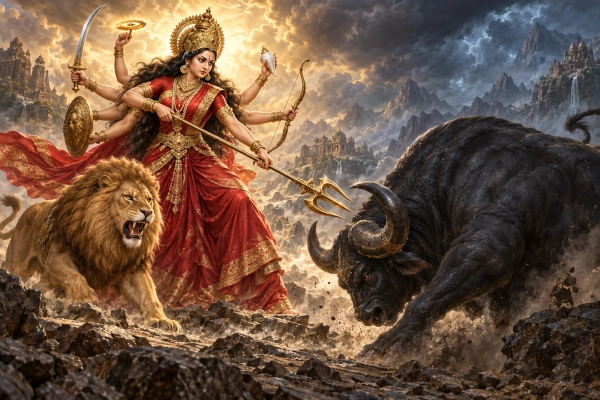
The image of Durga overcoming Mahishasura captures the final moment of a much larger battle. Behind it lies a narrative of defeated gods, massed armies, formidable commanders and an enemy who repeatedly changes his form. In the Devi Mahatmya, victory develops through successive engagements, each revealing a different aspect of the Goddess’s martial power.
This encounter offers a rich study of weapons, mobility, morale and adaptation. The narrative moves from fighting an army to defeating its commanders, before reaching the struggle with Mahishasura himself. Its religious purpose remains central throughout: the Goddess confronts a power that has displaced the guardians of the cosmic order.
The principal account occupies Chapters 2 and 3 of the Devi Mahatmya, followed by the gods’ praise in Chapter 4. These correspond to Chapters 82–84 in F. E. Pargiter’s translation of the Markandeya Purana. The tactical observations below interpret this sacred narrative rather than present it as a historically verifiable campaign.
The Conquest That Displaced the Gods
The account opens with a war lasting a hundred years between the devas and the asuras. Indra leads the gods, while Mahishasura commands their opponents. The asuras prevail, and Mahishasura assumes Indra’s position. His victory extends beyond possession of a throne: he takes over the functions and jurisdictions of other deities, including Surya, Agni, Vayu, Chandra, Yama and Varuna.
Driven from heaven, the gods wander upon the earth and eventually approach Vishnu and Shiva with Brahma at their head. Their defeat establishes the scale of the crisis. Mahishasura has overcome the existing defenders of the divine order and appropriated their authority. The response must therefore confront both his military strength and the domination sustained by it.
The Manifestation of Durga and the Gathering of Weapons
As the gods describe their plight, intense radiance issues from Vishnu, Shiva and the other deities. Their tejas, or divine splendour and power, converges into a single luminous manifestation. From that radiance appears the Goddess, whom the narrative addresses through names including Chandika and Ambika.
The gods then equip her. Shiva gives a trident drawn from his own, and Vishnu provides a discus. Agni gives a spear, while Vayu supplies a bow and arrows. Indra presents a thunderbolt and a bell from Airavata. Varuna contributes a conch and a noose; Yama gives a staff. Kala supplies a sword and shield, and Vishvakarma provides an axe, other weapons and protective armour. Himavat gives the lion that becomes her mount and an active participant in the fighting.
A military reading sees here the concentration of varied capabilities under one directing will. Durga possesses weapons for distant engagement, close combat, restraint and protection. Yet the theological meaning extends further. The concluding hymn honours her as the power pervading the universe. The gods recognise in her the divine power upon which their own capacities depend.
Mahishasura’s Army and the Opening Battle
The Goddess’s roar reverberates through the worlds. Mahishasura advances towards the sound with his forces and encounters a presence whose radiance fills the battlefield. His army includes chariots, elephants, horses and warriors carrying a broad range of weapons. The Sanskrit account explicitly uses chaturanga-bala, the expression for a fourfold army, in its description of the forces associated with Chamara.
Commanders including Chikshura, Chamara, Udagra, Mahahanu, Asiloma, Bashkala and Bidala appear in the account. The enormous numerical descriptions convey the army’s overwhelming scale within Puranic storytelling. They should not be treated as historical troop returns. Likewise, the presence of several arms does not establish a named battlefield formation: these chapters do not describe a Chakravyuha or provide a recoverable deployment map.
The asuras attack with spears, swords, axes, clubs, nooses and other weapons. Durga cuts down their incoming weapons with her own. Her lion moves through the hostile ranks, while troops arise from her exhalations and join the fighting. The narrative therefore presents several simultaneous sources of resistance: the Goddess, her lion and her supporting hosts.
Sound also shapes the encounter. Drums and conches accompany the Goddess’s troops, and the ringing of her bell bewilders enemies. Read through the lens of warcraft, these details draw attention to the relationship between physical attack and psychological disruption. The text presents supernatural effects, but its battlefield imagery recognises that fear and confusion can undermine an army’s ability to resist.
Chikshura: Dismantling a Chariot Warrior’s Advantage
Chikshura’s engagement provides one of the clearest tactical sequences in the battle. Seeing the destruction of his army, he advances and showers Durga with arrows. She intercepts his missiles, then strikes his horses and charioteer. She cuts his bow and raised banner before piercing him with arrows.
This sequence removes the elements that enable him to fight effectively from a chariot. The horses provide movement, the charioteer directs it, and the bow allows him to attack at a distance. Once these are lost, Chikshura must abandon that mode of combat and rush forward with sword and shield.
He strikes the lion and then the Goddess’s left arm, but his sword breaks against her. He follows with a thrown shula, which she destroys with her own, killing him as well. The military significance lies in the progression: Durga defeats his missile attack, removes his mobility and ranged weapon, and overcomes his subsequent attempts at close combat. This reading follows the order of events without assuming that the scripture intended a formal tactical lesson.
Chamara: Bringing Down an Elephant-Mounted Commander
Chamara next approaches on an elephant. He throws a spear, which the Goddess renders powerless with her utterance. When he launches another weapon, she breaks it with arrows. Her lion then leaps onto the elephant and engages Chamara directly.
The struggle carries both combatants to the ground. After further close fighting, the lion springs up and kills Chamara with a blow of its paw. The mount that carries Durga thus exercises an independent combat role, rather than serving merely as her means of transport.
From a tactical perspective, the encounter strips an elephant-mounted commander of the advantage of his elevated position. The lion closes the distance and forces a struggle that ends away from the elephant. Durga’s interception of Chamara’s weapons and the lion’s assault form complementary parts of the engagement, although the text does not describe a spoken command coordinating them.
The Fall of the Remaining Commanders
The narrative then accelerates through the deaths of other asura chiefs. Durga kills Udagra with stones, trees and similar means, and strikes down Uddhata with her mace. Arrows, sword and trident feature in further engagements. The variety reinforces her ability to respond across different distances and forms of combat.
For a warcraft interpretation, this passage shows how the destruction of an army’s leading fighters can accompany the collapse of its wider resistance. However, it does not describe a separately planned operation against a headquarters or command network. The visible sequence is sufficient: commanders fall, the army suffers mounting losses, and Mahishasura enters the next phase of the struggle in buffalo form.
Mahishasura’s Charge: Force Against the Goddess’s Hosts
Mahishasura now turns his buffalo body into a weapon. He strikes the Goddess’s troops with his muzzle, hooves, tail and horns. His rushes, wheeling movements, bellowing and breath cast others to the ground. After attacking her forces, he charges towards her lion.
The scene resembles a shock assault in its narrative effect: overwhelming movement and force disrupt the opposing troops. Mahishasura also threatens the lion that has helped destroy his commanders. His attack therefore reaches beyond Durga herself to the forces supporting her on the battlefield.
The description soon expands to a cosmic scale. His movements disturb the earth, sea, clouds and mountains. These images convey the reach of his destructive power. They also explain why the Goddess must bring the encounter under control: his violence threatens the world around the combatants.
Transformation and Countermeasure
Durga throws her noose and binds Mahishasura. He escapes the constraint by abandoning his buffalo shape and becoming a lion. As she moves to cut off its head, he appears as a man carrying a sword. She attacks this form with arrows, and he becomes an elephant.
In elephant form, Mahishasura seizes and pulls her lion with his trunk. Durga cuts off the trunk with her sword. He then returns to buffalo form and renews his assault. Each transformation changes the immediate threat, requiring a fresh response.
This is the battle’s strongest illustration of adaptation. Restraint answers the charging buffalo; arrows confront the armed human form; a sword counters the grasping elephant trunk. These are literary observations drawn from the sequence, rather than evidence of modern military doctrine. Their relevance is nevertheless clear: Durga continually recognises the changed danger and selects an effective response.
The Final Strike: Preventing Another Escape
In the last stage, Mahishasura hurls mountains with his horns, and Durga breaks them with showers of arrows. She drinks from her cup and laughs, displaying confidence amid the destruction. Her challenge to him declares that his roaring will soon give way to the rejoicing of the gods.
The decisive action follows at close quarters. Durga leaps upon Mahishasura, presses his neck beneath her foot and strikes him with her shula. He begins to emerge from the buffalo’s mouth, but her power prevents him from coming fully out. While he is still partly emerged and fighting, she severs his head with her great sword.
This detail matters to the account. The concluding action combines restraint, a piercing weapon and the sword’s final blow. Through a tactical lens, Durga ends the cycle of transformations by preventing her opponent from completing another emergence. His ability to escape one threatened form for another no longer saves him.
Victory and the Purpose of Power
The gods celebrate Mahishasura’s fall and praise the Goddess. Their hymn returns the reader from the violence of battle to its religious meaning. They honour her as the sustaining power of the world and ask for protection through her weapons, her bell and the sound of her bowstring. The power displayed in combat becomes the assurance of continuing guardianship.
Within the Warcraft in the Puranas series, Durga’s battle offers a study of concentrated capability, the removal of an opponent’s advantages and adaptation to a changing threat. Its most revealing moments involve the choices of weapon and action that shape each encounter. Chikshura loses the means to fight from his chariot; Chamara loses his mounted advantage; Mahishasura finally loses the freedom to transform and escape.
The spiritual meaning gives these martial episodes their purpose. Durga’s victory restores a world disturbed by the seizure and misuse of power. As Mahishasuramardini, she embodies strength capable of confronting domination and protecting the order upon which life depends.
You may also like
-
Kuluta: The Kullu Valley Kingdom of the Mahabharata
-
Trigarta: The Kangra–Jalandhar Kingdom of the Mahabharata
-
Kasmira: The Kashmir Valley and the Northwestern Himalayan World of the Mahabharata
-
Nepala: The Kathmandu Valley and the Central Himalayan World of the Mahabharata
-
Yudhishthira’s Counter-Diplomacy With Shalya: Working With an Ally Who Has Joined the Other Side
