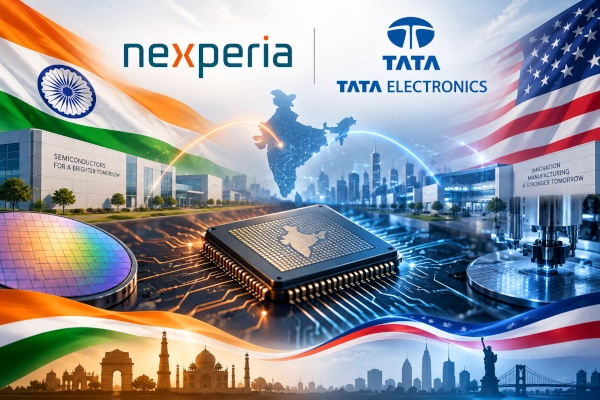
Tata Electronics has entered into a strategic partnership with Dutch semiconductor manufacturer Nexperia that could bring production of Nexperia’s MOSFETs and other discrete semiconductor products into India’s emerging chip manufacturing ecosystem. The agreement covers wafer fabrication at Tata’s upcoming Dholera semiconductor fab, assembly and testing at its Jagiroad facility in Assam, and wider cooperation in semiconductor technology and research.
Announced on September 17, the partnership creates a framework for cooperation across three areas: front-end wafer fabrication, back-end semiconductor assembly and testing, and longer-term technology and ecosystem development. Rather than being limited to a conventional supply agreement, it links Nexperia’s existing semiconductor portfolio with both of Tata Electronics’ major semiconductor manufacturing projects in India.
Under the front-end manufacturing arrangement, the companies will prepare for production of Nexperia’s MOSFET portfolio at Tata Electronics’ upcoming 300-mm semiconductor fab at Dholera in Gujarat. Nexperia’s discrete semiconductor products will also be assembled and tested at Tata Electronics’ semiconductor packaging facility being developed at Jagiroad in Assam.
The partnership gives Tata Electronics a significant international semiconductor customer while providing Nexperia with an additional manufacturing route outside its existing production network. For India, it brings a global semiconductor company’s products directly into the manufacturing capacity now being created under the country’s semiconductor programme.
Nexperia MOSFETs Planned for Dholera Fab
The most significant part of the agreement concerns Tata Electronics’ Dholera fab, where the companies are laying the groundwork to manufacture Nexperia’s MOSFET portfolio.
MOSFETs, or metal-oxide-semiconductor field-effect transistors, are fundamental electronic components used to control and switch electrical power. They are found across automobiles, industrial equipment, consumer electronics, communications equipment, computing systems and power-management applications.
Although they generally receive less public attention than advanced processors used in artificial intelligence or high-performance computing, power and discrete semiconductors are produced in enormous volumes and are essential to modern electronic systems. Electric vehicles, battery systems, renewable-energy equipment, industrial automation and data centres have further increased demand for efficient power-control devices.
Nexperia specialises in this segment of the semiconductor industry. Its portfolio spans MOSFETs, diodes, bipolar transistors, logic devices, ESD protection products and other essential semiconductors used across automotive, industrial, mobile and consumer applications.
The company says it ships more than 100 billion semiconductor products annually. Bringing part of this portfolio into Dholera would therefore connect India’s first commercial semiconductor fab with a large established global market rather than leaving the facility dependent solely on future domestic demand.
Jagiroad to Handle Assembly and Testing
The second part of the partnership concerns Tata Electronics’ semiconductor assembly and test facility at Jagiroad in Assam. Nexperia and Tata plan to collaborate on the assembly and testing of Nexperia’s discrete semiconductor products at the facility.
This creates a manufacturing chain covering both major stages of semiconductor production. Wafers can be processed at the front end in Dholera, while finished semiconductor dies can subsequently move through packaging, assembly and testing operations at Jagiroad.
Packaging is considerably more sophisticated than simply placing a semiconductor inside a protective enclosure. The process establishes the electrical and thermal connections between the silicon die and the system in which it will operate. The packaged device must then undergo testing to ensure that it meets the required electrical, reliability and performance specifications.
These capabilities are particularly important for power and automotive semiconductors, which often operate under demanding electrical and thermal conditions and must maintain high levels of reliability throughout their working life.
Tata Electronics is developing Dholera and Jagiroad as complementary parts of an integrated Indian semiconductor manufacturing chain. The company says the two projects together represent an investment of approximately $14 billion.
Partnership Extends Beyond Manufacturing
Nexperia and Tata Electronics have deliberately structured the agreement more broadly than a manufacturing contract. The companies will also explore cooperation in technology development, research and semiconductor ecosystem initiatives.
Nexperia brings established expertise in discrete, power and analogue semiconductors, while Tata Electronics is building fabrication, packaging, design and electronics-manufacturing capabilities in India. Combining those capabilities gives the companies room to work on future semiconductor technologies in addition to manufacturing products from Nexperia’s existing portfolio.
The companies have not announced financial terms for the partnership or disclosed production volumes. They have also not provided a timetable for the first Nexperia products to emerge from the Indian facilities. The agreement should therefore be viewed as a manufacturing and technology framework rather than an announcement that commercial production has already begun.
Its industrial importance lies in establishing an international product pipeline for the facilities Tata is building. Semiconductor fabs require customers and sustained production volumes to justify their enormous capital costs, making relationships with established chip companies an important part of creating a viable foundry business.
Nexperia Brings a Large Global Semiconductor Business
Headquartered in Nijmegen in the Netherlands, Nexperia employs more than 12,500 people across Europe, Asia and the United States. Its components are widely used in automotive electronics, industrial systems, mobile devices and consumer products.
Unlike companies primarily associated with advanced processors, Nexperia concentrates heavily on the essential semiconductors required throughout electronic systems. These components perform functions such as switching electrical power, protecting circuits, controlling signals and managing energy.
This segment has considerable strategic importance because shortages of relatively inexpensive discrete and power semiconductors can interrupt production of much more expensive products. The automotive semiconductor shortages experienced earlier this decade demonstrated how the absence of comparatively simple chips could halt entire vehicle production lines.
Nexperia’s decision to establish manufacturing pathways through Tata’s Indian facilities consequently adds a different dimension to India’s semiconductor programme. The country is not only pursuing high-value logic and computing chips but is also developing capacity for the enormous market in power, analogue and discrete devices used throughout the electronics economy.
Supply-Chain Resilience Is Central to the Agreement
Both companies have explicitly identified supply-chain resilience as one of the objectives of the partnership. Semiconductor manufacturers have spent the past several years reconsidering highly concentrated production networks after pandemic-era shortages and subsequent geopolitical disruptions exposed vulnerabilities in global electronics supply chains.
Nexperia has particular reasons to diversify its manufacturing network. The company has undergone a major restructuring of its operations following the loss of control over its Chinese subsidiaries in 2025. Its latest financial reporting treats those Chinese operations as deconsolidated from the wider Nexperia group.
The Tata partnership should be understood against that background, but it also fits a wider industry movement towards geographically diversified manufacturing. India is attempting to position itself within this restructuring by creating domestic fabrication and packaging capacity while attracting companies that can supply technology, equipment, materials and production volumes.
For Nexperia, Tata offers access to new manufacturing capacity being constructed in India. Tata, in turn, gains the semiconductor expertise and global customer reach of an established European chip company.
Tata Builds a Network Around Dholera
The Nexperia agreement is one of several international partnerships Tata Electronics has assembled around its semiconductor programme. The company has been building relationships covering process technology, lithography, manufacturing equipment, materials, packaging and semiconductor design.
Earlier this year, Tata Electronics signed a strategic partnership with ASML under which the Dutch semiconductor-equipment company will support the establishment and ramp-up of the Dholera fab with its lithography systems and associated solutions. The partnership also covers local workforce development, R&D infrastructure and supply-chain resilience.
Tata has similarly developed relationships with companies operating across other parts of the semiconductor value chain. At SEMICON India 2026, the company announced another group of partnerships involving firms and institutions from Europe, Japan and India covering manufacturing equipment, materials, chip design, research and workforce development.
The strategy is gradually creating an industrial network around Dholera and Jagiroad rather than treating the two facilities as isolated semiconductor projects.
Dholera and Jagiroad Form the Core of Tata’s Semiconductor Push
Tata Electronics’ Dholera project is being developed as India’s first greenfield commercial semiconductor fab. The facility will use 300-mm wafers and is intended to manufacture chips for customers serving automotive, computing, communications, artificial intelligence and other markets.
Jagiroad provides the back-end counterpart to that facility through semiconductor assembly and testing. Together, the two plants are intended to allow Tata to offer customers an integrated manufacturing route covering wafer fabrication through to packaged and tested semiconductor devices.
That structure is important for India’s semiconductor ambitions. Building only packaging capacity would leave the country dependent on foreign wafer fabrication, while constructing a fab without a surrounding packaging and testing ecosystem would leave another critical manufacturing stage overseas.
Connecting both facilities with an international semiconductor company such as Nexperia provides an early example of how the two parts of Tata’s manufacturing strategy could operate together.
India’s Semiconductor Strategy Moves Towards Actual Production Networks
India’s semiconductor programme is now entering a more difficult phase than attracting investment announcements. The next test is whether the fabs, packaging plants, equipment suppliers and materials companies entering the country can be connected into commercially viable production networks serving real customers.
The Nexperia-Tata partnership is relevant in that context because it links identifiable semiconductor products with specific Indian manufacturing facilities. Nexperia’s MOSFETs are planned for Dholera, while its discrete devices are intended for assembly and testing at Jagiroad.
Production has not yet begun, and the companies have not disclosed volumes or financial commitments under the partnership. Those details will determine the eventual scale of the relationship. Nevertheless, the agreement provides Tata Electronics with another pathway towards building a customer base for its semiconductor facilities while giving Nexperia access to geographically diversified manufacturing capacity.
For India’s semiconductor industry, this is the transition that ultimately matters. Fabs and packaging plants create manufacturing capacity, but a semiconductor ecosystem emerges only when that capacity becomes connected with technology owners, suppliers, customers, engineers and global markets. The Nexperia partnership begins putting some of those pieces together around Tata Electronics’ Dholera and Jagiroad projects.
REFERENCES
- Nexperia, “Nexperia and Tata Electronics announce strategic partnership across semiconductor manufacturing, technology, and innovation,” official press release, 17 September 2026.
https://www.nexperia.com/about/news-events/press-releases/Nexperia-and-Tata-Electronics-announce-strategic-partnership-across-semiconductor-manufacturing-technology-and-innovation - Tata Electronics, “Nexperia and Tata Electronics announce strategic partnership across semiconductor manufacturing, technology, and innovation,” official announcement, 17 September 2026.
https://www.tataelectronics.com/w/nexperia-and-tata-electronics-announce-strategic-partnership-across-semiconductor-manufacturing-technology-and-innovation - Reuters, “After fallout with Chinese parent, chipmaker Nexperia partners with India’s Tata,” 17 September 2026.
https://www.reuters.com/world/china/nexperia-says-it-will-partner-with-tata-chip-production-packaging-india-2026-09-17/ - Tata Group, “Building India’s Semiconductor Backbone,” background on Tata Electronics’ semiconductor partnerships and Dholera ecosystem.
https://www.tata.com/newsroom/business/tata-electronics-business-partners - Tata Group, “Tata Electronics and ASML Announce Strategic Partnership,” 17 May 2026.
https://www.tata.com/newsroom/business/tata-electronics-asml-semiconductor-ecosystem
You may also like
-
India and Nepal Expand Economic Partnership as New Delhi Backs Post-Flood Reconstruction and Power Supply
-
Dr. Reddy’s Launches Made-in-India Nivolumab Biosimilar NIVORZ Across 12 Cancer Indications
-
Semicon 2.0 Draws Nearly ₹1 Lakh Crore in Investment Proposals Across India’s Chip Supply Chain
-
BEL Wins ₹648 Crore in New Orders for Laser Jammers, Cybersecurity, Thermal Imaging and AI Systems
-
Cochin Shipyard Begins Construction of Indian Navy’s Second Next Generation Missile Vessel
