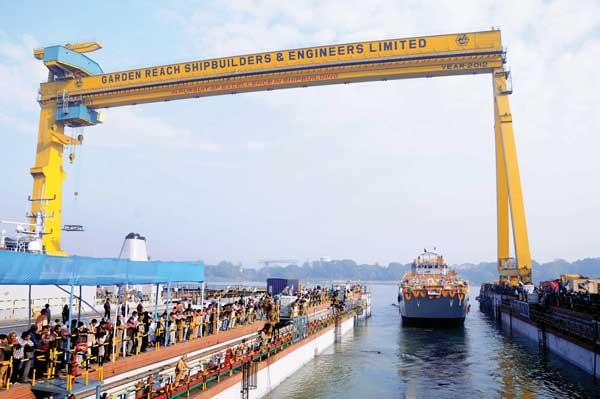
Garden Reach Shipbuilders & Engineers has formally begun physical construction of two specialised Coastal Research Vessels for the Geological Survey of India, marking an important step in expanding India’s capability to map and study mineral resources beneath its coastal and offshore waters.
GRSE laid the keels of the two vessels in Kolkata on September 15, 2026. Geological Survey of India Director General Varsha Ashok Aglawe was the chief guest at the ceremony, which was also attended by senior representatives of GRSE, GSI, TNSL and the Indian Register of Shipping. The keel-laying marks the transition of the project from design and planning into physical ship construction.
The two ships are being developed specifically for marine geological surveys, offshore mineral exploration and environmental research within India’s Exclusive Economic Zone. Once operational, they will give GSI modern platforms capable of conducting sustained scientific work in waters ranging from shallow coastal zones to depths of around 1,000 metres.
64-Metre Research Ships Designed for India’s EEZ
According to details released with the keel-laying ceremony, each Coastal Research Vessel will measure approximately 64 metres in length and 13 metres in width, with a deadweight tonnage of around 461 tonnes.
The vessels will have an endurance of approximately 15 days, a maximum speed of 10 knots, and accommodation for up to 35 personnel, including scientists and crew.
When GRSE originally signed the construction contract with GSI in June 2025, the preliminary specifications listed the vessels at 64 metres long and approximately 12 metres wide with a deadweight of around 450 tonnes. The slightly revised figures released during the 2026 keel-laying indicate that the design has been refined as the programme progressed towards construction.
The vessels are intended to operate throughout India’s EEZ in water depths ranging from approximately 5 metres to 1,000 metres, allowing them to work both near the coast and farther offshore.
Built for Geological Mapping and Mineral Exploration
The ships will support several of the Geological Survey of India’s core marine-science responsibilities.
Their missions will include offshore geological mapping, mineral exploration, dredging-related survey work, ocean-environment monitoring and marine scientific research. Each vessel will carry dedicated laboratories for processing data and analysing samples collected during survey missions.
For GSI, these capabilities are increasingly important as India expands its understanding of geological resources beyond the mainland.
Marine geological surveys can identify seabed formations, sediment structures and potential mineral-bearing areas while also providing information required for coastal planning, environmental assessment and resource management.
Varsha Ashok Aglawe said the new vessels would strengthen India’s ability to explore mineral resources beyond its land boundaries and contribute to the expansion of the country’s offshore mineral-exploration capabilities.
Dynamic Positioning Will Allow Precise Research Operations
One of the important capabilities of the new vessels will be a Dynamic Positioning-1 system.
Dynamic positioning allows a ship to use its propulsion and control systems to maintain a precise location without depending exclusively on anchors. This is particularly useful during oceanographic and geological research, where scientific instruments may have to be lowered to the seabed or samples collected from a specific location.
GRSE says the system will enable the CRVs to maintain their position in conditions up to Sea State 3.
This capability will support operations such as seabed sampling, dredging, geological observations and other scientific activities where uncontrolled vessel movement could affect measurements or equipment.
Diesel-Electric Propulsion for Research Operations
The vessels will use diesel-electric propulsion, with diesel generators supplying electrical power to the ship’s thrusters.
Such an arrangement is particularly suited to specialised research ships because it provides flexible power management and allows propulsion to be precisely controlled during low-speed survey work and dynamic-positioning operations.
The same electrical system can also support laboratories, scientific equipment and other onboard systems without requiring separate propulsion and research-power arrangements.
The choice of diesel-electric propulsion therefore reflects the operational demands of a vessel that may spend significant periods moving slowly along predetermined survey lines or holding station above a particular section of seabed.
From Contract Signing to Physical Construction
GRSE received the Letter of Award for the two vessels from GSI in April 2025, before formally signing the construction contract on June 11, 2025.
At the time, GRSE said the project would support GSI’s marine geoscientific surveys and coastal exploration programmes while strengthening India’s scientific and resource-assessment capabilities.
The September 15, 2026 keel-laying therefore represents the next major milestone in the programme.
GRSE Chairman and Managing Director Cmde P.R. Hari (Retd) said the event marked the movement of the vessels from planning and design into physical construction and expressed confidence that they would be delivered to GSI according to schedule and required quality standards.
GRSE Expands Beyond Warship Construction
GRSE is best known for building frontline vessels for the Indian Navy, but specialised scientific ships have become an increasingly important part of its portfolio.
The Kolkata shipyard is already constructing an Ocean Research Vessel for the National Centre for Polar and Ocean Research, under the Ministry of Earth Sciences, as well as an Acoustic Research Ship for the Naval Physical and Oceanographic Laboratory, a DRDO establishment.
GRSE also has a long history of constructing survey and research platforms.
In 1994, the company delivered the marine acoustic research vessel INS Sagardhwani to NPOL. It also built six survey vessels for the Indian Navy between 1981 and 1993 and has more recently constructed the new generation of Sandhayak-class Survey Vessels (Large).
This experience gives GRSE a specialised capability extending beyond combat vessels into ships designed around scientific sensors, laboratories and survey equipment.
Supporting India’s Search for Offshore Resources
The importance of the two GSI ships extends beyond shipbuilding itself.
India possesses an Exclusive Economic Zone covering a vast maritime area, but understanding the geology beneath those waters requires continuous scientific surveying. Offshore mineral exploration can involve detailed seabed mapping, sediment sampling, geophysical measurements and laboratory analysis before the economic potential of an area can be assessed.
Dedicated research vessels allow scientists to perform these tasks systematically rather than depending on platforms designed primarily for other missions.
The two CRVs will therefore provide GSI with dedicated platforms for extending geological investigations from India’s landmass into its maritime domain.
They could also contribute to broader national efforts involving seabed-resource assessment, coastal studies, environmental monitoring and marine infrastructure planning.
Part of a Growing Indian Research Fleet
India is simultaneously investing in several categories of specialised research and survey vessels.
GRSE’s construction of the GSI Coastal Research Vessels, NCPOR’s Ocean Research Vessel and DRDO’s Acoustic Research Ship shows how indigenous shipbuilding capacity is increasingly being applied to scientific missions as well as defence requirements.
For GRSE, this diversification also broadens its shipbuilding portfolio at a time when the company is expanding into commercial ships, export vessels and offshore-support platforms alongside its traditional naval programmes.
The two GSI vessels are therefore significant on two levels. They strengthen India’s ability to understand and assess the mineral resources beneath its maritime territory, while also demonstrating the ability of an Indian defence shipyard to build increasingly specialised scientific platforms.
With the keels now laid, the programme has moved from design into construction. Once delivered, the vessels will give the Geological Survey of India modern indigenous platforms capable of conducting geological mapping, mineral exploration and marine research across a large part of India’s Exclusive Economic Zone.
You may also like
-
Neuland Expands Commercial Peptide Manufacturing With 6,370-Litre Facility at Bonthapally
-
PM Modi to Inaugurate SEMICON India 2026 as India Expands Semiconductor Manufacturing Ecosystem
-
DRDO Opens Testing, Funding and Software Source Codes to Indian Defence Startups and MSMEs
-
RVNL-TMH Showcase Vande Bharat Sleeper Programme as India-Russia Rail Partnership Expands
-
India’s MIGM Gives Navy an Indigenous Smart Seabed Weapon Against Ships and Submarines
