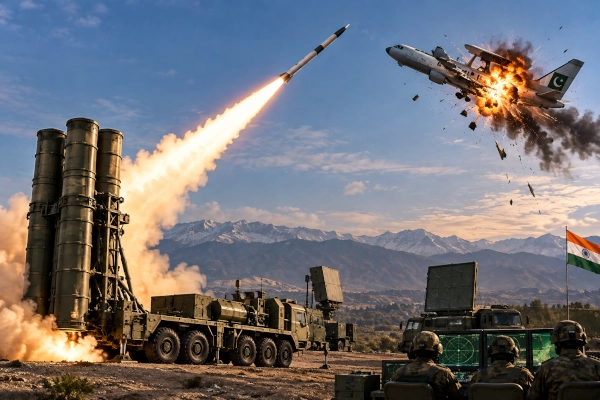
India’s S-400 long-range air-defence system destroyed a Pakistani special-mission aircraft at a distance of 314 kilometres during Operation Sindoor, according to the Ministry of Defence’s Annual Report for 2025-26. The Ministry describes the engagement as the “Longest Surface to Air Kill” and places it within the Indian Air Force’s wider air-defence operations during the four-day confrontation between May 7 and 10, 2025.
The engagement is important not simply because of the distance involved, but because of the type of target and the way the S-400 was employed. At 314 kilometres, the system was not being used as a conventional point-defence weapon protecting an airbase from an aircraft approaching at close range. It was being used to deny the adversary freedom of operation over a much wider area and to threaten a high-value airborne platform operating far from the immediate battle zone.
The Ministry of Defence has not identified the exact Pakistani aircraft involved in the engagement. It describes the target only as a special-mission aircraft, a category that can include airborne early-warning aircraft, surveillance platforms, electronic-intelligence aircraft and other specialised systems. Earlier official accounts had referred more broadly to an airborne early-warning platform, but the Annual Report uses the more cautious description and should therefore be treated as the authoritative wording unless further details are released.
Why the Target Was Important
Special-mission aircraft are among the most valuable assets in a modern air force because they support the wider air campaign rather than operating as ordinary combat aircraft. An airborne early-warning aircraft can use its radar from high altitude to monitor a very large volume of airspace, detect aircraft and missiles at long distances and provide targeting information to fighters. It can also help coordinate interceptions and give commanders a much clearer picture of the developing air battle.
Electronic-intelligence aircraft perform a different but equally important role by detecting and analysing radar and communications emissions. They can help locate air-defence systems, identify operating patterns and build an electronic picture of the battlefield. Because such aircraft improve the effectiveness of many other platforms, their loss can have a much greater operational impact than the destruction of a single fighter.
For this reason, special-mission aircraft are normally kept well behind the frontline and protected by distance, fighter escorts and carefully planned patrol patterns. The 314-km engagement demonstrated that operating deep behind the immediate battle area did not necessarily place such aircraft beyond the reach of India’s long-range air-defence system.
S-400 Used as an Area-Denial Weapon
India signed a contract with Russia in October 2018 for five S-400 long-range air-defence units. The system was acquired to provide the Indian Air Force with a significantly expanded ability to detect and engage aircraft and other aerial threats over large distances.
The S-400 differs from shorter-range air-defence systems that are primarily intended to protect a particular airbase, command centre or military formation. Its value lies in its ability to influence a much wider volume of airspace. Even when it does not fire, the presence of such a system can force hostile aircraft to remain farther away, change their routes or operate at different altitudes.
This is the essence of airspace denial. A long-range air-defence system does not need to destroy every aircraft entering its theoretical engagement zone. Its presence can alter the adversary’s operational planning simply by making certain areas too dangerous for high-value platforms.
The 314-km engagement shows that the Indian Air Force was able to use the S-400 in precisely this manner during Operation Sindoor. A Pakistani special-mission aircraft operating hundreds of kilometres from the firing unit was still considered vulnerable to engagement.
The S-400 Was Only the Final Part of the Kill Chain
A successful interception at such a distance depends on much more than the missile itself. Before an engagement can take place, the target must first be detected, tracked and identified. Its speed, altitude and direction of movement must be established, and sufficient information must be maintained to generate a reliable firing solution.
At ranges exceeding 300 kilometres, this process becomes particularly demanding because the defending force must maintain an accurate picture of the target over a very large area. The target must also be positively identified as hostile before an engagement is authorised, especially when civilian aircraft may be operating within the broader region.
The missile therefore represents only the final component of a much larger chain involving surveillance sensors, communications networks, command centres, trained operators and engagement systems. The significance of the Operation Sindoor interception lies as much in the functioning of this network as it does in the S-400 itself.
IACCS Provided the Common Air Picture
At the centre of India’s air-defence architecture was the Indian Air Force’s Integrated Air Command and Control System, or IACCS. The system brings together information from multiple military and civilian surveillance sensors and provides commanders with a common Recognised Air Situation Picture.
During Operation Sindoor, IACCS acted as the principal command-and-control framework connecting radars, air-defence units and operational nodes. It also allowed information to be coordinated with the Army and Navy through their respective networks.
This integrated approach is critical because a long-range missile system has limited value if it operates in isolation. The firing unit must know where the target is, whether the track is reliable, whether it has been correctly identified and whether engagement has been authorised. By combining information from different sensors and distributing that information through the command network, IACCS made it possible for air-defence units to operate as part of a larger system rather than as independent batteries.
Identification Was as Important as Range
The Defence Ministry’s account also highlights the importance of target identification during the conflict. The Ministry said trained operators at networked tactical nodes played a central role in classifying aerial contacts and ensuring that civilian aircraft were not engaged.
This was particularly important because long-range air defence places a greater burden on identification and command discipline. An engagement launched at hundreds of kilometres cannot rely on visual confirmation, and errors in classification could have serious consequences.
The report also alleged that Pakistan kept portions of its civil airspace open during the hostilities, including the continued operation of civilian flights during military activity. India, according to the Ministry, sought to conduct its air-defence operations in a manner that did not place international civil aviation at unnecessary risk.
Operation Sindoor Tested India’s Layered Air Defence
Operation Sindoor began on May 7, 2025, with Indian strikes against terrorist infrastructure in Pakistan and Pakistan-occupied Jammu and Kashmir following the April 22 Pahalgam terrorist attack. Pakistan subsequently attempted attacks against Indian military installations using drones, missiles and other aerial systems.
The Indian response relied on a layered air-defence architecture rather than a single weapon system. The defensive network included indigenous Akash surface-to-air missiles, counter-drone systems, electronic-warfare equipment, legacy air-defence systems, fighter aircraft, air-defence guns and the S-400.
Each layer was intended to deal with a different category of threat. Small drones present different detection and interception problems from cruise missiles, while high-altitude aircraft require a different response from low-flying targets. A short-range system is well suited to protecting a specific installation, but it cannot perform the same task as a system capable of reaching hundreds of kilometres.
The effectiveness of the overall architecture therefore depended on assigning the right weapon to the right target while connecting all of the systems through a common surveillance and command structure.
Why 314 Kilometres Is Significant
Missile range figures are often presented as fixed numbers, but real combat engagements depend on many variables. Target altitude, speed, flight path, radar visibility, electronic countermeasures and the geometry between the target and the firing unit can all affect the practical engagement envelope.
A successful interception at 314 kilometres therefore demonstrates considerably more than the nominal range of the missile. It indicates that the Indian air-defence network was able to detect the aircraft, maintain a sufficiently accurate track, classify the target, generate a firing solution and support the interceptor over a very long distance.
The Defence Ministry describes the interception as the longest surface-to-air kill. Comparisons with every historical engagement worldwide should nevertheless be treated cautiously because many long-range interceptions remain classified or contested. The operational importance of the Indian engagement does not depend on a world-record claim. A confirmed combat interception beyond 300 kilometres is significant in its own right.
The Missile Variant Has Not Been Disclosed
The S-400 family can use different interceptors intended for different engagement ranges and target types. The Ministry of Defence has not disclosed which missile was used during the 314-km interception.
The correct conclusion is that the long-range component of India’s S-400 system was successfully employed as part of the wider Indian Air Force air-defence network. Until the Ministry of Defence or the IAF releases more detailed information, the specific interceptor should remain unidentified in responsible reporting.
Earlier Accounts Used Different Distance Figures
Public descriptions of the engagement have evolved since Operation Sindoor. Senior Indian Air Force officials initially referred to the destruction of a large Pakistani airborne platform at a distance of roughly 300 kilometres. Later government material associated with the 2026 Republic Day presentation referred to an engagement involving an airborne early-warning platform at approximately 350 kilometres.
The Ministry of Defence Annual Report for 2025-26 now gives a more precise figure of 314 kilometres and describes the target as a special-mission aircraft. For a detailed account of the engagement, this figure should therefore be treated as the most authoritative currently available number.
The variation between earlier rounded figures and the Annual Report also illustrates a broader feature of wartime reporting. Initial statements are often simplified or deliberately general, while later operational reviews may provide more precise information after mission data has been analysed.
The Larger Effect Was to Push High-Value Aircraft Back
The operational effect of a long-range surface-to-air kill extends beyond the aircraft that was destroyed. Once an adversary knows that a special-mission aircraft can be engaged at more than 300 kilometres, similar platforms must operate more cautiously and may have to remain farther from the contested area.
For an airborne early-warning aircraft, this can reduce the effectiveness of radar coverage over the battle zone. The curvature of the earth, terrain and distance all affect the ability of airborne sensors to detect low-flying aircraft and missiles. Pushing such an aircraft farther away can therefore reduce the quality of information available to fighters and air-defence commanders.
Electronic-intelligence and command aircraft face the same problem. If they are forced to operate farther from the area of interest, the information they gather may become less immediate or less detailed. Additional fighters may also have to be committed to their protection, increasing the burden on the attacking force.
This is why the value of the S-400 engagement cannot be measured only by the aircraft destroyed. The threat created by the system can alter how the adversary uses every similar high-value platform afterwards.
Long-Range Air Defence Complicates Stand-Off Attacks
Modern air forces increasingly rely on stand-off weapons to avoid entering heavily defended airspace. Fighters can launch missiles or precision-guided weapons from considerable distances and then withdraw without approaching the target directly.
This approach works only if the launch aircraft can reach a position from which its weapon has sufficient range to reach the intended target. A long-range air-defence system can complicate that calculation by threatening the launch aircraft before it reaches the preferred release point.
The result is a competition between the reach of the attacker’s stand-off weapon and the reach of the defender’s air-defence system. If hostile aircraft are forced farther away, the attacker may need longer-range weapons, more complex routes or additional support from electronic-warfare and suppression-of-air-defence platforms.
The S-400’s role during Operation Sindoor therefore had implications beyond the destruction of one special-mission aircraft. Its presence affected the wider operational space in which Pakistani aircraft could safely function.
The S-400 Was Just One Element of a Larger System
It would be inaccurate to attribute India’s air-defence performance during Operation Sindoor entirely to the S-400. The Ministry of Defence’s own accounts make clear that the response depended on a combination of indigenous and foreign-origin systems.
Akash surface-to-air missiles, counter-UAS systems, electronic-warfare assets, legacy air-defence systems, fighter aircraft, surveillance radars and guns all contributed to the defensive structure. The S-400 provided the longest-range layer, while shorter-range systems handled threats that approached closer to defended areas.
IACCS connected these different layers and allowed commanders to build a common air picture and select the appropriate response for each threat. This type of networked defence is considerably more important than the performance of any single weapon because modern air attacks can include drones, missiles, decoys and aircraft operating simultaneously.
From Advertised Capability to Combat Experience
Before Operation Sindoor, India’s S-400 capability was discussed mainly through procurement timelines, delivery schedules and advertised missile ranges. The May 2025 confrontation changed that by providing the Indian Air Force with combat experience using the system in an active air-defence environment.
The Ministry of Defence has now formally attributed to the S-400 the destruction of a Pakistani special-mission aircraft at 314 kilometres. This moves the discussion from theoretical capability to demonstrated operational performance.
Combat use also provides information that peacetime exercises cannot fully reproduce. Operators gain experience in working through crowded airspace, identifying hostile tracks, coordinating with multiple sensors and making engagement decisions under real operational pressure. Such experience becomes valuable when procedures, training and command structures are refined after the conflict.
The Network Behind the Missile Is the Larger Story
The most important lesson from the 314-km interception is that long-range air defence depends on far more than the missile’s technical range. A surface-to-air missile cannot exploit its full reach unless a wider network can detect, identify and track the target and deliver that information to the firing unit in time.
During Operation Sindoor, the S-400 provided the long-range interceptor, while radars and other sensors supplied surveillance data and IACCS provided the command-and-control framework that connected the wider air-defence network. Trained personnel then made the identification and engagement decisions needed to convert sensor information into an actual interception.
The result was the destruction of a Pakistani special-mission aircraft at a distance that would once have been considered the preserve of fighter aircraft rather than ground-based air defence.
The 314-km engagement therefore represents more than a long-range missile shot. It demonstrates how India’s air-defence architecture is evolving from a collection of individual weapons into a networked system capable of influencing the adversary’s use of airspace far beyond the immediate location of the defending battery.
You may also like
-
IIT Madras Develops Morphing Wing Technology to Improve Aircraft Stall Performance
-
DRDO Develops SWiFT-K High-Speed Stealth Kamikaze Drone as India Expands Indigenous Strike-UAV Programme
-
DRDO’s Electromagnetic Railgun: India Pushes Towards a New Generation of Long-Range Kinetic Weapons
-
IIT Hyderabad Joins Andhra Pradesh’s Drone City Push as Kurnool Builds Full UAV Ecosystem
-
Quad Moves Indo-Pacific Logistics Network Toward Operational Stage With Tokyo Exercise
