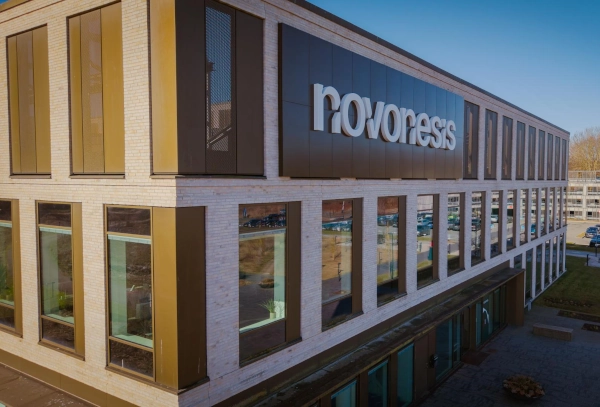
Danish biosolutions major Novonesis has announced a €600-million investment to significantly expand its manufacturing presence at Patalganga in Maharashtra, marking one of the largest recent investments in India’s industrial biotechnology sector. The company plans to develop what it describes as one of the world’s most advanced enzyme-production facilities at the site, strengthening India’s position within its global manufacturing network.
The expanded facility is expected to become fully operational in 2030. Once completed, it will manufacture enzymes used across a wide range of industries, including biofuels, household-care products and food and beverages. Novonesis says the investment will substantially increase its production capacity as global demand for biological solutions continues to grow.
India Becomes a Larger Part of Novonesis’ Global Production Network
The Patalganga project forms part of Novonesis’ broader strategy to expand manufacturing capacity across major growth markets. The company said the Indian facility will become an important part of its global production footprint and help improve both supply-chain resilience and operational flexibility.
Its location also gives Novonesis closer access to customers across India, the Middle East and Africa. The company expects these markets to grow faster than many developed economies in the coming years, making Patalganga strategically important for supplying both domestic and international customers.
Novonesis already operates a network of production and commercial facilities around the world. Its recent global manufacturing investments have included expansion projects in Thailand, the United States, China and Brazil. The Maharashtra project will now place India alongside these major production locations.
Enzymes for Biofuels, Food and Household Products
Enzymes are biological catalysts used to accelerate chemical and industrial processes. Their applications extend across food processing, brewing, detergents, animal nutrition, agriculture, biofuels and industrial manufacturing.
At Patalganga, Novonesis plans to manufacture enzymes serving several of these sectors. Bioenergy is expected to be an important application, with enzymes increasingly used to improve the efficiency of ethanol and other biofuel production processes. The plant will also support demand from household-care manufacturers and the food and beverage industry.
This gives the investment significance beyond conventional chemical manufacturing. Biological processes can often reduce the amount of energy, water or harsh chemicals required in industrial production, making enzyme technologies increasingly important as companies look for more efficient manufacturing methods.
Advanced Manufacturing With Lower Water and Energy Use
Novonesis says sustainability has been incorporated into the design of the expanded Patalganga complex. The facility is being designed to use less freshwater and energy than traditional production systems.
Freshwater recycling systems will reduce the amount of new water that needs to be drawn into the facility, while integrated heat pumps are expected to lower energy consumption. According to the company, these measures will help reduce Scope 1 and Scope 2 emissions associated with manufacturing operations.
The project therefore combines a major increase in manufacturing capacity with improvements in resource efficiency, reflecting the growing use of advanced process engineering in large-scale biotechnology production.
Strengthening India’s Industrial Biotechnology Base
The €600-million investment also strengthens India’s emerging role in advanced biosolutions and industrial biotechnology manufacturing. India already has a large pharmaceuticals, chemicals, food-processing and bioenergy base, creating substantial domestic demand for enzymes and other biological inputs.
Building larger production capacity within India can reduce dependence on imported biological ingredients while creating opportunities for domestic suppliers involved in engineering, specialised equipment, packaging, logistics and industrial services.
The investment also reinforces Maharashtra’s position as one of India’s major manufacturing centres. Patalganga, located within the Mumbai industrial region, already hosts chemicals, pharmaceuticals and other process industries and benefits from access to ports and large domestic markets.
Supporting Growing Biofuel Demand
The decision is particularly relevant to India’s expanding bioenergy sector. Enzymes play an important role in converting agricultural feedstocks and other biological material into fermentable sugars used in ethanol and advanced biofuel production.
As India increases ethanol blending and explores greater production of biofuels from agricultural residues and other feedstocks, demand for specialised industrial enzymes could increase significantly.
Local production at Patalganga could therefore support both Novonesis’ export strategy and customers operating within India’s growing biofuel ecosystem.
A Long-Term Manufacturing Commitment to India
Novonesis described the Patalganga expansion as a major milestone in its long-term growth strategy. The company expects rising demand for biosolutions across industries to require substantial additional global manufacturing capacity.
By committing €600 million to Maharashtra and developing a facility designed to serve India, the Middle East, Africa and wider global markets, Novonesis is positioning India as more than simply a consumer market. The country is becoming an important production base within the company’s international supply network.
The scale of the investment also illustrates a broader evolution in Make in India manufacturing. Foreign investment is increasingly moving beyond assembly operations toward complex process industries, advanced materials, biotechnology and high-value industrial production.
When the Patalganga expansion reaches full operation in 2030, India will host one of Novonesis’ most advanced enzyme-production facilities, giving Maharashtra an important role in the global supply chain for biological solutions used across energy, consumer products and food manufacturing.
You may also like
-
India Demonstrates 60% Recycled Asphalt Technology on Chennai–Tirupati Highway
-
German Cable Major LAPP Makes Bhopal Its Largest Manufacturing Facility Worldwide
-
Syrma SGS and Italy’s Elemaster Open Advanced Electronics Manufacturing Hub in Bengaluru
-
BRICS Currency: How the Bloc Is Building a New Cross-Border Payment Architecture Without a Common Currency
-
Global Investors Representing Over $1 Trillion Gather in New Delhi Alongside BRICS Summit
