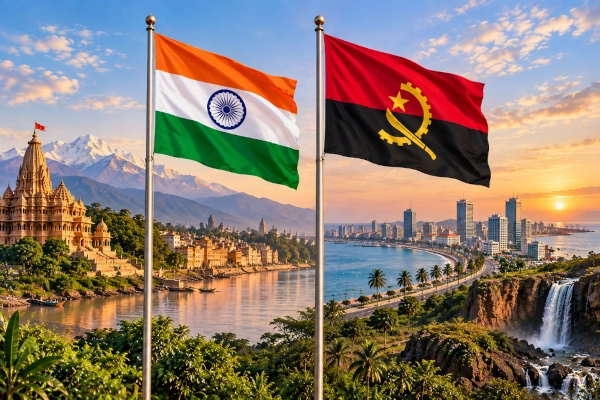
India and Angola are looking to broaden a relationship long dominated by oil into a more diversified economic and strategic partnership, as senior representatives of the two countries held fresh talks on the sidelines of the Non-Aligned Movement gathering in Belgrade.21
Union Parliamentary Affairs Minister Kiren Rijiju met Angola’s Foreign Minister Téte António on September 2, 2026, with discussions focused on strengthening bilateral relations and expanding cooperation for mutual economic development. The meeting formed part of a series of diplomatic engagements held by Rijiju during his visit to Serbia.
No new agreement or investment project was announced at the meeting itself. However, the talks come during a period in which India–Angola relations have expanded rapidly beyond their traditional energy connection.
Angola has long been an important source of crude oil for India. According to the Ministry of External Affairs, India has been among Angola’s three largest trading partners and is its second-largest oil buyer. Petroleum accounts for roughly 90% of bilateral trade, underlining how heavily the commercial relationship has historically depended on energy.
That trade relationship has also grown considerably. Bilateral merchandise trade increased from $4.19 billion in FY2023-24 to $5.03 billion in FY2024-25, a rise of about 20%. Indian exports to Angola during FY2024-25 were valued at approximately $524 million, while imports reached about $4.51 billion, reflecting India’s substantial purchases of Angolan hydrocarbons.
The more important development now is the attempt to diversify this relationship.
A major shift came during Angolan President João Lourenço’s state visit to India in May 2025, the first visit by an Angolan president to India in 38 years. Prime Minister Narendra Modi and Lourenço agreed to expand cooperation across defence, energy, healthcare, diamond processing, fertilisers, critical minerals, digital public infrastructure and space technology.
Defence has emerged as one of the most significant new pillars. India approved a $200-million Line of Credit for modernisation of the Angolan Armed Forces, alongside discussions on the supply, repair and overhaul of military platforms and training for Angolan personnel.
The arrangement creates opportunities for Indian defence manufacturers as Angola seeks to modernise its armed forces. Depending on Angola’s requirements, the credit line could potentially support procurement from India’s expanding defence-industrial base, although specific equipment contracts should not be assumed until formally announced.
Agriculture is another area moving toward structured cooperation. During Lourenço’s India visit, the two governments signed an MoU on agricultural cooperation, reflecting Angola’s drive to expand domestic food production and reduce reliance on imports.
Indian companies could potentially contribute agricultural machinery, irrigation systems, seed technologies, agro-processing equipment and technical expertise. Angola possesses large areas of cultivable land and significant water resources but continues to import substantial quantities of food, creating scope for cooperation focused on agricultural productivity and local processing.
Healthcare has similarly become an important component. India and Angola signed an agreement covering Ayurveda and other traditional systems of medicine, while the broader bilateral agenda includes pharmaceuticals and healthcare cooperation.
Indian generic medicines and affordable medical technologies already occupy an important position across African markets. Expanding pharmaceutical trade, medical education and healthcare infrastructure could therefore provide another route for India–Angola economic diversification.
India has also offered to share capabilities in Digital Public Infrastructure and space technology. These are relatively new areas of cooperation and could eventually include digital public-service platforms, capacity building, satellite applications and technology training.
Critical minerals provide another strategically important opportunity. Angola possesses substantial mineral resources, including diamonds and deposits associated with minerals increasingly important for advanced manufacturing and clean-energy technologies. India has explicitly identified critical minerals and diamond processing among the sectors where bilateral cooperation should deepen.
This fits into India’s wider effort to secure diversified overseas supplies of minerals required for electric vehicles, renewable energy, electronics, advanced manufacturing and defence technologies. For Angola, greater Indian participation could also support its ambition to process more natural resources domestically rather than depending overwhelmingly on raw-material exports.
The relationship received another major political boost in November 2025, when President Droupadi Murmu became the first Indian Head of State to visit Angola. During that visit, India and Angola signed agreements covering fisheries, aquaculture and marine resources, as well as employment arrangements for dependents of diplomatic personnel.
The two countries also agreed to diversify cooperation into technology, agriculture, health, defence, infrastructure and people-to-people exchanges. Angola subsequently joined India-supported international initiatives including the Global Biofuels Alliance and International Big Cat Alliance, adding environmental and energy cooperation to the partnership.
Renewable energy is another emerging connection. Angola became a member of the International Solar Alliance during President Lourenço’s 2025 visit to India. India has also encouraged Angola to participate in initiatives dealing with disaster-resilient infrastructure and biofuels.
Capacity building remains an important part of the relationship as well. Indian training programmes have hosted Angolan government officials, including specialised programmes in information technology and cyber security, while ICCR scholarships continue to provide places for Angolan students at Indian institutions.
The September 2 meeting in Belgrade therefore comes against a much broader transformation in India–Angola relations.
Oil will remain important—Angola is one of Africa’s major petroleum producers and continues to contribute to India’s energy security. But both countries increasingly appear interested in building a relationship that also incorporates defence manufacturing, agriculture, pharmaceuticals, critical minerals, digital technology, space, renewable energy and maritime cooperation.
For India, Angola offers access to a resource-rich economy on Africa’s Atlantic coast and an increasingly important political partner in southern Africa. For Angola, India provides a large market for its energy and minerals as well as relatively affordable technology, medicines, machinery, defence equipment and development expertise.
The latest Rijiju–Téte António meeting did not produce a new treaty or commercial deal, but its significance lies in maintaining momentum behind this diversification.
After four decades of diplomatic relations built largely around energy, India and Angola are increasingly trying to convert their oil relationship into a broader industrial, technological and strategic partnership.
You may also like
-
CNG, Hybrid and Electric Vehicles Overtake Petrol in India’s Passenger Vehicle Market for First Time
-
Made-in-India Nissan Tekton Begins Global Export Journey With First Shipments to South Africa
-
India to Send Multi-Sector Business Mission to Ghana and Nigeria to Expand West African Trade
-
EtherealX Pushes Indian Rocket Reusability With Novel Engine Cycle
-
Mecwin Builds Indigenous 45-HP Electric Tractor Powertrain After 500 Hours of Field Testing
