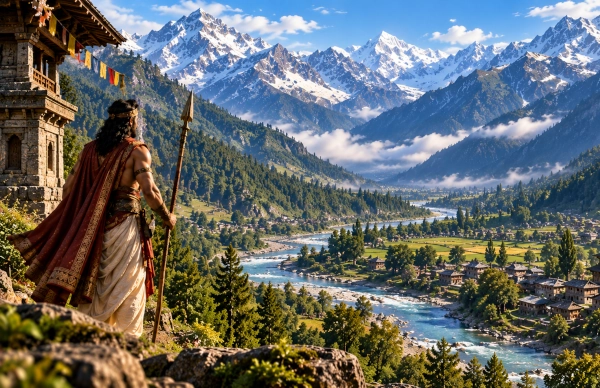
The ancient kingdom of Kuluta occupied the upper valley of the Vipasha, the modern Beas River, in the western Himalayas. Its geographical core corresponds closely with the Kullu Valley of present-day Himachal Pradesh, a long mountain basin enclosed by the Pir Panjal and Greater Himalayan ranges and connected to neighbouring regions through river corridors and high passes. Among the Himalayan countries named in the Mahabharata, Kuluta is one of the more securely identifiable because its ancient name survived in later historical records and developed into the modern name Kullu.
The Government of Himachal Pradesh identifies ancient Kuluta with the upper Beas or Kullu Valley, while the Kullu district administration notes that the name appears on a first-century CE coin carrying the legend of Virayasa, king of Kuluta. Centuries later, the Chinese pilgrim Xuanzang described a country rendered as Kiu-lu-to northeast of Jalandhar, further strengthening the geographical continuity between ancient Kuluta and Kullu.
Kuluta was therefore not simply a vague Himalayan tribal region. The Mahabharata portrays it as an organised mountain kingdom with rulers, towns, military forces and a recognised political identity.
The Upper Beas Valley
The geography of Kuluta was shaped by the Vipasha River, today called the Beas.
The river rises near the high mountains around Rohtang and flows southward through the Kullu Valley, creating one of the largest and most fertile inhabited corridors in this part of the western Himalayas. The modern district remains organised largely around this river system, with tributary valleys such as the Parvati, Sainj and Tirthan opening into the main Beas basin.
Ancient Kuluta should therefore be understood principally as a river-valley kingdom rather than an enormous Himalayan territory. Its secure centre lay in the Kullu Valley, while its influence at different times may have reached into adjoining mountain valleys and passes.
The surrounding mountains gave the country considerable natural protection. Access from the Punjab plains required movement through narrower valleys and foothill routes, while passes to the north connected Kuluta with Lahaul and the higher trans-Himalayan world.
This combination of enclosure and connectivity shaped the kingdom’s character. Kuluta was geographically remote from the great Gangetic capitals, but it was by no means isolated from the political geography of Bharatavarsha.
Kuluta in Arjuna’s Northern Conquest
The clearest Mahabharata episode involving Kuluta comes during Arjuna’s northern digvijaya in the Sabha Parva.
Before Yudhishthira could perform the Rajasuya sacrifice, the Pandava brothers undertook campaigns in different directions to establish his imperial authority. Arjuna travelled northwards and entered a succession of Himalayan and trans-Himalayan territories.
The Sanskrit text states that after conquering mountain regions and bringing their rulers under his authority, Arjuna approached Brihanta, who dwelt among the Kulutas. Brihanta emerged from his city with a fourfold army and fought the Pandava prince. After a considerable battle, however, he was unable to withstand Arjuna and submitted, bringing tribute.
The passage is particularly valuable because it identifies Brihanta not merely as a tribal chief but as a ruler possessing a city and a conventional army consisting of the established divisions of ancient warfare.
The text subsequently describes Arjuna proceeding with the Kulutas and other subdued rulers into additional mountain territories. It even distinguishes northern Kulutas, suggesting either that the name extended over more than one section of the mountain country or that several related Kuluta communities occupied adjoining valleys.
This should not be used to draw an artificially large border around the kingdom. Instead, it points towards the fragmented political geography characteristic of the Himalayas, where a recognised regional identity could include several valleys or local centres.
Brihanta, the Mountain King
Brihanta is the first major Kuluta ruler encountered in the epic.
The Sabha Parva describes him as a parvateshvara, a lord of the mountains. That description fits the physical setting of Kullu remarkably well. His kingdom belonged to terrain where military movement depended upon valleys and passes rather than the broad plains suited to large formations of chariots.
Brihanta nevertheless possessed a substantial army and initially chose to resist Arjuna.
His defeat did not lead to the destruction of Kuluta. Instead, Arjuna established the kingdom under Yudhishthira’s authority and continued northwards accompanied by rulers whom he had already subdued.
The episode reflects an important feature of the Rajasuya campaigns. Their purpose was often not permanent annexation but political submission, tribute and acknowledgement of Yudhishthira’s sovereignty.
Kuluta therefore retained its local ruler and territorial identity.
Kuluta Among the Northern Peoples
The Bhishma Parva also lists the Kulutas among the peoples of Bharatavarsha.
In its extensive geographical catalogue, the epic names the Kasmiras, Sindhu-Sauviras, Gandharas, Abhisaras and Kulutas within the same broad northern and northwestern grouping.
This sequence is geographically coherent.
Kasmira corresponds to the Kashmir Valley. Gandhara lay farther to the northwest. Abhisara occupied hill country associated with the lower western Himalayan approaches. Kuluta lay farther southeast in the upper Beas basin.
Taken together, these references place Kuluta unmistakably within the northwestern Himalayan world of the Mahabharata.
They also show that the epic distinguished individual mountain kingdoms rather than treating the Himalayas as one undifferentiated frontier. Trigarta, Kuluta, Abhisara, Kasmira and Darada each possessed separate geographical identities.
Kuluta and Trigarta
Kuluta’s most important southern neighbour was Trigarta.
Trigarta was centred on the Kangra–Jalandhar region and controlled territory stretching from the western Himalayan foothills into the Punjab plains. Kuluta lay farther up the Beas system, principally within the mountain valley beyond the Kangra country.
The two regions were geographically linked by the river.
The Beas flows from the Kullu Valley southwards before entering the lower hill country associated historically with Kangra. Movement along this corridor connected the mountain communities of Kuluta with the richer agricultural and commercial plains around Trigarta and Jalandhar.
The relationship helps explain why later travellers located Kullu in relation to Jalandhar. The Kullu district’s official history records the account of Xuanzang, who described Kiu-lu-to as lying northeast of Jalandhar.
For ancient travellers approaching from the plains, Trigarta and Jalandhar formed gateways towards the mountain country of Kuluta.
A Himalayan Kingdom with a Recorded Political Identity
The historical importance of Kuluta extends beyond the Mahabharata.
A coin attributed to approximately the first century CE bears the name of Virayasa, king of Kuluta. The Kullu district administration regards this as important evidence for the antiquity of the name and political identity of the region.
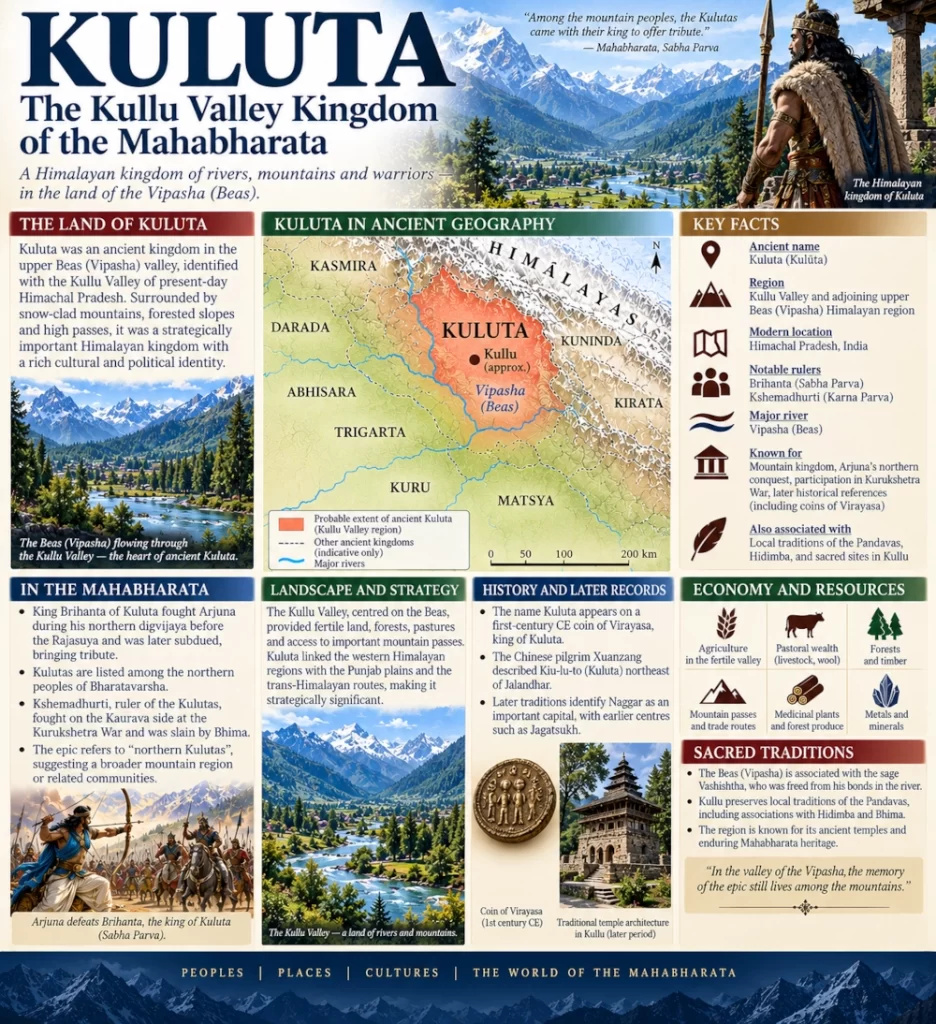
This is especially valuable because numismatic evidence provides an independent historical anchor for a name otherwise known from literary tradition.
The Mahabharata’s Kuluta cannot automatically be equated in every political detail with the later kingdom represented by Virayasa’s coin. The epic underwent composition and transmission over a long period, and political boundaries changed repeatedly.
What remains significant is the persistence of the geographical name.
Kuluta became Kullu without losing its association with the upper Beas Valley.
Few ancient Himalayan place names allow such a straightforward continuity.
Kshemadhurti and the Kulutas at Kurukshetra
Kuluta appears again during the Kurukshetra War.
In the Karna Parva, a warrior named Kshemadhurti is explicitly called the ruler of the Kulutas. He fights on the Kaurava side and encounters Bhima in a dramatic battle fought from elephants.
The confrontation is unusual because both warriors initially fight from elephant-back.
Kshemadhurti strikes Bhima with lances and arrows, while Bhima responds with his own missile weapons. After Bhima’s elephant is brought down, he leaps safely to the ground, attacks Kshemadhurti’s elephant with his mace and kills the Kuluta ruler after he too descends from his mount.
The episode gives Kuluta another clearly named king separate from Brihanta.
It is not necessary to assume that Brihanta and Kshemadhurti ruled at precisely the same time or over exactly the same section of the Kuluta country. Epic genealogies and political titles do not always allow such chronological precision. They may represent different rulers, different branches of the regional polity or traditions incorporated into different layers of the narrative.
What is clear is that Kuluta remained a recognised kingdom in the military geography of the epic.
A Kingdom Capable of Fielding Elephants
Kshemadhurti’s appearance on an elephant is striking for a Himalayan ruler.
Kullu itself is not terrain naturally associated with large elephant populations. The episode therefore suggests that a ruler of Kuluta participating in the great plains war could obtain elephants through political alliances, tribute, trade or military networks extending beyond his home valley.
It also illustrates the degree to which Himalayan kings participated in the broader martial culture of northern India.
Kuluta’s rulers were not portrayed as isolated mountain chieftains armed only for local warfare. Brihanta commands a fourfold army during Arjuna’s northern campaign, while Kshemadhurti fights as a fully integrated Kaurava ally at Kurukshetra.
The kingdom’s mountainous geography therefore did not exclude it from the political and military systems of the plains.
The Vipasha and the Sacred Landscape
The Vipasha, modern Beas, is itself one of the ancient rivers named in the Mahabharata.
The Bhishma Parva includes Vipasha among the important rivers whose waters were known to the peoples of Bharatavarsha.
Later tradition connects the name Vipasha with the sage Vashishtha. According to a story preserved in the Kullu region, Vashishtha entered the river while bound, but its waters freed him from his bonds. The river consequently became known as Vipasha, interpreted as the one that released him from bondage. The Kullu district administration preserves this traditional account in its history of the Valley.
Whatever the historical development of the legend, it demonstrates how deeply the river became embedded in the sacred identity of Kullu.
In Kuluta, geography and sacred tradition were inseparable. Rivers, mountain peaks, caves, forests and passes accumulated associations with rishis, deities and episodes from the epics.
The Pandava Traditions of Kullu
Modern Kullu preserves numerous local traditions connected with the Pandavas and the Mahabharata.
The district administration records traditions linking the Pandavas with several locations in the Valley, including the Hidimba temple at Manali, Shangchul Mahadev in the Sainj Valley and sites around Nirmand. It also records the local belief that Arjuna performed austerities in the region before obtaining the Pashupata weapon.
These traditions belong primarily to the later sacred geography of Kullu rather than to a precise itinerary recoverable from the Sanskrit epic.
They remain culturally important because they show how the Mahabharata became embedded in the physical landscape of the Valley.
Mountains became associated with particular heroes. Caves became places of austerity. Local deities entered narratives connected with the Pandavas. Over centuries, epic memory and Himalayan religious traditions became intertwined.
That process is one reason Kullu later acquired its celebrated reputation as a Valley of Gods.
Hidimba and the Kullu Tradition
Among these traditions, none is more prominent than the association of Hidimba and Bhima with Manali.
In the Mahabharata, Bhima encounters the rakshasa Hidimba and his sister Hidimbi during the Pandavas’ wanderings. Bhima kills Hidimba and later has a son, Ghatotkacha, with Hidimbi.
The Sanskrit epic itself does not securely identify the setting as modern Manali. The geographical association with Kullu belongs to longstanding local tradition.
Within the Valley, however, Hidimba became an important deity. The famous Hidimba Devi Temple at Manali reflects this enduring regional memory, and the Kullu district history records the belief that Bhima killed Hidimba there and married his sister.
The distinction between epic text and later regional identification is important. The Mahabharata securely identifies Kuluta as a northern mountain kingdom; local tradition subsequently connected several individual episodes of the epic with specific places within Kullu.
Together they produced the rich sacred geography for which the Valley remains famous.
Naggar and the Political Centre of Kullu
Later historical tradition identifies Naggar as an important capital of the Kullu kingdom.
The Himachal Pradesh government’s historical overview states that Kuluta was situated in the upper Beas Valley and gives Naggar as its capital. Kullu district’s own history records a more complex sequence in which the early royal centre was associated with Jagatsukh before the capital was moved to Naggar and, much later, to Sultanpur.
It would therefore be too strong to claim that Naggar was definitively the capital of the Kuluta ruled by Brihanta in the Mahabharata.
The epic says that Brihanta came out of his city to confront Arjuna but does not provide enough evidence to identify that city securely with Naggar.
Naggar is best understood as an important later historical capital within the same regional political tradition.
This distinction preserves both the literary evidence and the documented history without forcing them into an artificial continuity.
Mountain Routes and the Northern World
Kuluta’s position gave it access to some of the most important routes through the western Himalayas.
North of the Valley, the Rohtang corridor leads towards Lahaul. From there, routes continue towards the higher Himalayan regions and ultimately towards Ladakh and the trans-Himalayan plateau. Other passes connect Kullu with Mandi, Kangra, Shimla and the Sutlej basin.
These mountain routes were difficult, seasonal and vulnerable to weather, but they were economically important.
Wool, animals, salt, medicinal plants and other products could move southwards from higher regions, while grain and manufactured goods travelled north from the more productive valleys and plains.
Kuluta occupied an intermediate position within this network.
It was neither a high-altitude trans-Himalayan territory nor a lowland Punjab kingdom. It was a middle Himalayan valley state controlling approaches between the two.
That location helps explain why Arjuna passes through Kuluta during a campaign that continues into increasingly distant northern territories.
Forests, Pastures and Valley Agriculture
Kuluta’s economy would have reflected the ecological diversity of its landscape.
The lower valley offered cultivable land along the Beas and its tributaries. Higher slopes supported forests, while alpine zones provided summer grazing. Timber, livestock and mountain products complemented agriculture.
Modern Kullu remains characterised by forested slopes and a broad river valley enclosed by high mountains, although its agricultural economy has changed dramatically over time. Himachal Tourism describes Kullu as a network of valleys, forests and rivers stretching beneath the Greater Himalayas.
The physical basis of ancient Kuluta was therefore unusually favourable by Himalayan standards.
Its rulers possessed a protected agricultural valley while retaining access to forest and pastoral resources farther upslope.
This combination could support a more organised state than would have been possible in many smaller, harsher mountain territories.
Kuluta and the Wider Himalayan Mosaic
The Mahabharata presents the Himalayas as a politically diverse region.
Kuluta existed alongside Trigarta, Kasmira, Abhisara, Darada and numerous other mountain countries. Some were centred on large valleys, while others consisted of smaller chiefdoms controlling particular routes or river basins.
Arjuna’s northern expedition makes this diversity especially visible.
He does not conquer one enormous Himalayan kingdom. Instead, he moves from ruler to ruler, valley to valley and mountain territory to mountain territory. Brihanta of Kuluta is one among several kings who initially resist and subsequently acknowledge Yudhishthira’s authority.
The geography reflects the terrain.
High ridges naturally divided communities, while rivers and passes connected them. Political authority was consequently likely to be concentrated within valleys rather than extending evenly across enormous mountain areas.
Kuluta is an excellent example of this Himalayan political pattern.
From Kuluta to Kullu
The persistence of the name is one of the most compelling aspects of the region’s history.
The official history of Kullu notes that Kuluta appears on a coin of Virayasa dating to approximately the first century CE. Later sources preserve forms of the same geographical name, and Xuanzang’s seventh-century account describes Kiu-lu-to in a position corresponding closely to Kullu.
Over time, Kuluta became Kulu or Kullu.
Political boundaries changed. Capitals shifted. Dynasties rose and fell. Yet the geographical identity centred on the upper Beas Valley endured.
This continuity makes Kuluta particularly valuable when reconstructing the geography of ancient Bharatavarsha.
The identification does not depend solely upon linguistic resemblance or later speculation. Literary references, geographical position, historical records and numismatic evidence all point towards the same valley.
Kuluta in Mahabharata Geography
Ancient name: Kuluta / Kulūta
Core region: Kullu Valley and the upper Vipasha or Beas basin
Modern geographical association: Kullu district and adjoining upper Beas Himalayan areas of Himachal Pradesh, India
Principal river: Vipasha, the modern Beas
Landscape: Mountain valley, forested slopes, river terraces, alpine pastures and high Himalayan passes
Important Mahabharata ruler: Brihanta
Another Kuluta ruler mentioned: Kshemadhurti
Major epic episode: Arjuna defeats Brihanta during his northern digvijaya before Yudhishthira’s Rajasuya
Kurukshetra association: Kshemadhurti, ruler of the Kulutas, fights for the Kauravas and is slain by Bhima
Neighbouring ancient regions: Trigarta and other western Himalayan polities
Later historical evidence: Coin of Virayasa naming him king of Kuluta; subsequent identification of the country with Kullu
Later political centres: Jagatsukh, Naggar and Sultanpur in different periods of Kullu’s history
Kuluta occupies a clear place within the northern geography of the Mahabharata. It was a mountain kingdom, but not an obscure or disconnected one. Its rulers possessed armies, participated in the political contests of Bharatavarsha and maintained an identity recognisable to the composers of the epic.
Its physical setting remains equally recognisable.
The Vipasha still descends through the Kullu Valley, flowing between forested mountains before turning towards the lower hills and Punjab. The same valley that gave ancient Kuluta its agricultural base and access to Himalayan routes continues to define Kullu today.
The Mahabharata remembers Kuluta through Brihanta’s resistance to Arjuna and through Kshemadhurti’s last battle against Bhima. Later history preserves the kingdom through coins, dynastic traditions and the enduring name of Kullu itself.
Among the many kingdoms of the epic whose precise locations remain debated, Kuluta stands on unusually firm geographical ground.
Kuluta was the ancient kingdom of the upper Beas Valley—the Himalayan country remembered today as Kullu, where the Vipasha flows between the mountains of Himachal Pradesh.
You may also like
-
Durga versus Mahishasura: Weapons, Battlefield Tactics and the Triumph of Shakti
-
Trigarta: The Kangra–Jalandhar Kingdom of the Mahabharata
-
Kasmira: The Kashmir Valley and the Northwestern Himalayan World of the Mahabharata
-
Nepala: The Kathmandu Valley and the Central Himalayan World of the Mahabharata
-
Kirata: The Himalayan and Eastern Hill Peoples of the Mahabharata
