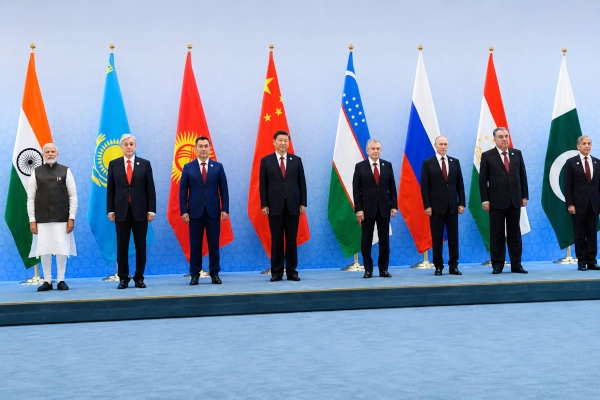
Prime Minister Narendra Modi used India’s literary, musical, textile and artisanal traditions as instruments of cultural diplomacy during his visit to Uzbekistan and the Kyrgyz Republic, presenting carefully selected gifts that reflected both India’s civilisational heritage and areas of cultural resonance with Central Asia.
The gifts ranged from a complete English translation of the Mahabharata and a traditional Ladakhi woollen textile to a sandalwood santoor, Kangra tea, Dokra metalwork, Banarasi silk and intricate Indian marble inlay. Rather than functioning merely as ceremonial presents, many of the objects were chosen to evoke traditions that have parallels in the cultures of India and Central Asia.
Prime Minister Modi visited Uzbekistan on August 29–30, 2026, before travelling to Bishkek in the Kyrgyz Republic for the 26th Shanghai Cooperation Organisation Summit held between August 31 and September 1. The official programme repeatedly emphasised the historical, cultural and people-to-people links connecting India with the region. India and Uzbekistan also adopted a Cultural Exchange Programme for 2026–30 during the visit.
Mahabharata Presented to Kyrgyz President Sadyr Japarov
Among the most culturally significant gifts was a ten-volume English translation of the Mahabharata by the late scholar Bibek Debroy, presented to Kyrgyz President Sadyr Japarov.
Debroy’s edition is a complete and unabridged English translation based on the Critical Edition of the Mahabharata. Extending across ten volumes, it brings together the central account of the Pandavas and Kauravas with the epic’s numerous philosophical discussions, genealogies, legends, political reflections and subsidiary narratives.
Traditionally attributed to Maharshi Ved Vyasa, the Mahabharata is far more than an account of the conflict culminating at Kurukshetra. Questions concerning dharma, justice, political authority, kingship, family, loyalty, war, peace and individual responsibility run throughout the work.
The choice was particularly appropriate in Kyrgyzstan, whose own cultural identity is deeply connected with the Epic of Manas. The two epics emerged from different civilisations and should not be treated as historically equivalent, but both demonstrate how enormous narrative traditions can preserve collective memory, ethical ideas and cultural identity across generations.
That theme also corresponded closely with the cultural message of Modi’s visit to Bishkek. At the SCO Summit, the Prime Minister spoke of shared heritage and people-to-people connections and confirmed that India would host the first SCO Civilisation Dialogue Forum later in 2026.
A Ladakhi Tsug-Dul Links Two Himalayan and Mountain Cultures
President Japarov was also presented with a traditional Tsug-dul from Ladakh, bringing another dimension of India’s Himalayan culture into the diplomatic exchange.
Tsug-dul belongs to Ladakh’s wool-based textile traditions and is associated with the cold, high-altitude environment and pastoral communities of the region. Such textiles combine practical warmth with distinctive patterns and craftsmanship handed down through generations. Government handicraft classifications recognise Tsug-Dul and Tsug-Gdan among the traditional crafts associated with Ladakh.
Its presentation in Kyrgyzstan carried an additional cultural resonance. Both Ladakh and Kyrgyzstan possess strong traditions shaped by mountains, livestock, wool, seasonal movement and communities that historically adapted their material culture to demanding high-altitude environments.
The gift therefore represented more than an Indian textile. It created a subtle cultural bridge between the Himalayan world and the pastoral traditions of Central Asia.
Dokra Musicians Celebrate a Shared Tradition of Folk Art
Kyrgyz Prime Minister Adylbek Kasymaliev received a Dokra sculpture depicting a pair of traditional musicians.
Dokra is one of India’s celebrated metal-casting traditions and uses the ancient lost-wax method to create individually cast figures, animals, ritual objects and representations of everyday life. Its distinctive aesthetic is immediately recognisable through elongated forms, patterned surfaces and detailed handwork.
Choosing musicians as the subject added another layer of cultural meaning. Music, oral storytelling and performance have historically played an important role in transmitting memory in both Indian and Kyrgyz societies.
Kyrgyz culture is particularly associated with rich oral and musical traditions, including the recitation of the Manas epic and a variety of traditional instruments. The Dokra musicians thus conveyed an Indian craft tradition while acknowledging the importance of music within Central Asian cultural identity.
Sandalwood Santoor for Uzbekistan President Shavkat Mirziyoyev
In Uzbekistan, Prime Minister Modi presented President Shavkat Mirziyoyev with a sandalwood Shata Tantri Veena, the instrument popularly known as the santoor.
The santoor occupies a distinctive place in the musical traditions of Jammu and Kashmir. Its characteristic sound is produced by striking its strings with a pair of lightweight wooden mallets, creating a bright and resonant tonal quality.
The Sanskrit expression Shata Tantri Veena refers to the idea of a many-stringed instrument and has long been associated with the santoor tradition.
The choice was especially meaningful because Uzbekistan possesses its own tradition of struck string instruments, particularly the chang. While the Indian santoor and Central Asian instruments evolved within their respective musical systems, their structural similarities offer a natural symbol of the long history of cultural interaction across Asia.
Centuries of movement through the Silk Road and adjoining trade routes carried not only merchandise but also artistic ideas, musical forms, languages, religious traditions and craftsmanship between the Indian subcontinent and Central Asia.
The santoor therefore served as an apt representation of a wider cultural geography in which India and Uzbekistan have interacted for centuries.
Kangra Tea Brings the Himalayas to Tashkent
President Mirziyoyev also received two varieties of premium Kangra tea presented in a carved wooden case: Kangra First Flush Black Tea and Kangra Green Tea.
Cultivated in the Kangra Valley of Himachal Pradesh, Kangra tea represents another distinctive element of India’s Himalayan agricultural heritage. Tea cultivation in the region developed during the nineteenth century, and Kangra subsequently acquired a reputation for delicate and aromatic teas.
The black tea is particularly valued for its light body and floral character, while Kangra green tea offers a fresher vegetal profile. Their inclusion alongside the santoor created a collection that highlighted different dimensions of the western Himalayan region—from music and craftsmanship to agriculture.
A Chess Memento Marking India-Uzbekistan Sporting Links
One of the most unusual gifts presented to President Mirziyoyev was an original handwritten scoresheet associated with Uzbek Grandmaster Javokhir Sindarov’s victory at the 2025 FIDE World Cup in Goa.
Sindarov defeated China’s Wei Yi to win the World Cup in November 2025, becoming its youngest champion. The achievement was particularly significant because the tournament was held in India.
The story subsequently acquired even greater significance. Sindarov went on to win the 2026 FIDE Candidates Tournament, earning the right to challenge India’s reigning World Champion D Gukesh for the world title.
The scoresheet therefore represented more than a sporting souvenir. It connected Uzbekistan’s extraordinary rise in international chess with India, which has itself emerged as one of the principal centres of the modern global chess ecosystem.
It also offered an unusually contemporary counterpart to the traditional cultural gifts presented during the visit. Alongside ancient literature, music and handicrafts, chess represented a modern arena in which India and Uzbekistan are increasingly prominent.
Marble Inlay and Banarasi Silk for Uzbekistan’s First Lady
Prime Minister Modi presented the wife of President Mirziyoyev with a marble inlay casket containing a Banarasi silk stole.
The combination brought together two celebrated Indian craft traditions separated geographically but united by extraordinary levels of artisanal skill.
Indian marble inlay work is particularly associated with Agra, where carefully shaped pieces of coloured stone are inserted into polished marble to create floral and geometric patterns. The technique reached exceptional refinement in Mughal-period architecture and decorative arts.
Banarasi silk, meanwhile, represents the centuries-old weaving heritage of Varanasi. Known for elaborate brocade, zari work and intricate motifs, it remains among India’s most recognisable luxury textile traditions.
The gifted stole featured a rich blue ground decorated with paisley zari work, while the accompanying marble casket carried floral inlay using coloured stones. Together, they presented two different expressions of India’s tradition of highly specialised hand craftsmanship.
Silver Craft for President Mirziyoyev’s Daughter
President Mirziyoyev’s daughter received a finely worked silver brooch featuring a floral bouquet arranged within an ornamental basket.
The piece incorporated detailed openwork and latticework, with individually rendered leaves and flowers complemented by green cabochons and clear stones.
Silver jewellery and decorative metalwork have flourished in different parts of India for centuries. The gift highlighted the precision and delicacy achievable through traditional Indian metal craftsmanship while remaining suitable as a personal diplomatic present.
Indian Marble Inlay for Uzbekistan’s Prime Minister
Uzbek Prime Minister Abdulla Aripov was presented with a decorative marble inlay plate featuring floral and foliate motifs.
Blue, green and red stone elements were set into polished white marble, representing the painstaking inlay tradition for which Indian artisans are renowned.
Floral ornamentation also provides an interesting aesthetic connection between India and Central Asia. Botanical and geometric motifs appear prominently across the architecture, textiles, ceramics and decorative arts of both regions, reflecting centuries of artistic interaction across Eurasia.
Cultural Diplomacy Accompanies a Broader Strategic Partnership
The presentation of the gifts came during a visit that went well beyond ceremonial diplomacy.
India and Uzbekistan expanded cooperation across trade, investment, digital infrastructure, defence, healthcare, pharmaceuticals, critical minerals, agriculture, education, tourism and space. The two countries also signed a Cultural Exchange Programme for 2026–30 and agreed to cooperate in conserving and restoring the ancient Buddhist sites of Fayaz Tepa and Kara Tepa at Termez.
The Buddhist heritage initiative is particularly relevant to the cultural dimension of India-Central Asia relations. Termez was historically an important centre on routes connecting the Indian subcontinent with Central Asia, and its archaeological remains preserve evidence of Buddhist communities that flourished in the region during antiquity.
India’s involvement in their conservation therefore complements the broader diplomatic effort to reconnect contemporary relations with older civilisational interactions.
From Ancient Epics to Modern Chess
Taken together, the gifts presented during the Uzbekistan and Kyrgyzstan visit formed an unusually broad representation of Indian civilisation.
The Mahabharata represented India’s literary and philosophical inheritance. The santoor carried its musical traditions. The Ladakhi Tsug-dul and Banarasi silk represented textile craftsmanship shaped by very different regions of the country. Dokra sculpture, silverwork and marble inlay showcased India’s diverse artisanal traditions, while Kangra tea represented its agricultural heritage.
The Sindarov chess scoresheet brought the story into the present, symbolising a new cultural connection being created through sport between two countries that are becoming major forces in international chess.
More importantly, the gifts were selected in ways that allowed Indian traditions to converse with Central Asian ones—the Mahabharata with Kyrgyzstan’s epic culture, Ladakhi textiles with Central Asian pastoral traditions, the santoor with Uzbekistan’s musical heritage and Indian chess with the remarkable rise of Uzbek players.
That approach reflects a broader feature of India’s engagement with Central Asia. Modern diplomacy is being combined with the rediscovery of older civilisational connections that once linked the subcontinent with the cities, mountain communities and trading networks of the region.
In that context, a book, an instrument, a piece of woven wool or even a handwritten chess scoresheet can carry a diplomatic message of its own: India and Central Asia are building their contemporary partnerships while remembering that their cultural encounters began centuries before the creation of the modern states themselves.
You may also like
-
India and Serbia Explore Wider Partnership as Historic Ties Enter New Economic and Technology Phase
-
India and Armenia Move to Deepen Defence, Technology and Economic Cooperation
-
IAF’s Sarang Team Arrives in Egypt for El Alamein International Airshow 2026
-
India and Denmark Deepen MSME Cooperation in Innovation, Technology and Intellectual Property
-
India’s Roads Beyond Its Borders: The Highways Connecting South Asia, Southeast Asia and Africa
