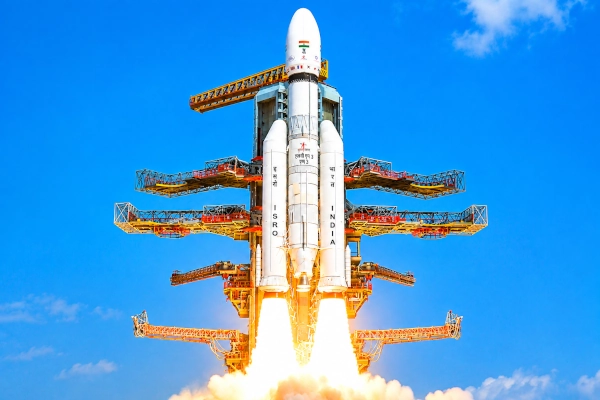
India is preparing for one of the most consequential transfers of space-launch technology in its history, with major industrial groups examining the opportunity to manufacture, launch and eventually commercially operate the Launch Vehicle Mark-3, or LVM3, ISRO’s most powerful operational rocket.
Larsen & Toubro, JSW, Adani Group and Mahindra are among the companies reportedly evaluating participation in the programme. Other potential combinations include JSW with Indian launch-vehicle startup Ethereal Exploration Guild, better known as EtherealX, and a consortium involving Solar Industries, Bharat Forge and INOX India. The companies are considering submitting Expressions of Interest for access to LVM3’s end-to-end technology and know-how.
The development goes considerably beyond outsourcing the manufacture of rocket components. The successful private-sector participant would be expected to absorb the knowledge necessary to manufacture the complete vehicle, integrate its systems, participate in launch operations and ultimately establish the capability to offer LVM3 commercially.
That would move Indian industry from being a supplier to the national space programme towards becoming an operator of one of India’s most complex strategic technologies.
ISRO’s Most Powerful Operational Rocket
LVM3 is India’s heavy-lift operational launch vehicle. It stands about 43.5 metres high, has a lift-off mass of approximately 640 tonnes, and uses three principal propulsion elements: two massive S200 solid strap-on motors, an L110 liquid core stage powered by Vikas engines and a C25 cryogenic upper stage.
The rocket can currently carry approximately 4 tonnes into Geosynchronous Transfer Orbit, while NSIL lists a capability of about 10 tonnes to Low Earth Orbit. NSIL also indicates that improvements are expected to raise its GTO capacity to about 5 tonnes by 2028.
These capabilities place LVM3 in a very different category from India’s smaller launchers. It can carry large communication satellites, substantial spacecraft and clusters of satellites while also supporting missions beyond Earth orbit.
Its importance to India’s space programme has already been demonstrated repeatedly.
LVM3 launched Chandrayaan-2 in 2019 and Chandrayaan-3 in 2023, placing India’s lunar spacecraft on their initial journeys towards the Moon. It also launched two commercial OneWeb missions carrying a combined 72 satellites, establishing the vehicle as a commercial launcher for large satellite constellations.
In November 2025, LVM3 placed the approximately 4,410-kg CMS-03 communications satellite into Geosynchronous Transfer Orbit, then followed it in December with the BlueBird Block-2 commercial mission for US company AST SpaceMobile. That spacecraft became the heaviest payload launched by LVM3 from Indian territory at the time.
The rocket is therefore not an experimental technology being offered to private industry. It is a flight-proven heavy launcher that has already carried lunar spacecraft, Indian communication satellites and major international commercial payloads.
What Exactly Is Being Transferred?
The proposed transfer is much broader than simply giving a private company manufacturing drawings.
According to details of the Expression of Interest reported on 31 August, prospective participants must demonstrate their ability to absorb end-to-end technical know-how covering design, propulsion, avionics, navigation, manufacturing, testing, vehicle integration and launch operations.
This is significant because a launch vehicle is not a collection of independent components that can simply be assembled on a production line. Its propulsion, structural, electronic, software, navigation and ground-support systems must function as a single integrated system.
The selected company or consortium would initially work closely with ISRO and IN-SPACe while absorbing these technologies. The reported framework provides up to 42 months, or until two LVM3 vehicles have been realised and launched, whichever occurs earlier, for the technology-transfer and handholding phase.
The objective is for the industrial participant eventually to establish the infrastructure and technical competence required to independently manufacture LVM3 systems and subsystems.
Private industry would therefore graduate from producing individual rocket stages or components to becoming the organisation responsible for the complete vehicle.
Competition Has Only Begun
The names currently associated with the programme should not be treated as confirmed final bidders.
The latest reporting indicates that the industrial groups are considering Expressions of Interest, which constitute the preliminary stage of the selection process. Submitting an EoI does not necessarily commit a company to submitting the eventual commercial bid.
Formal bidding is expected to follow after the initial qualification process. The final selection is expected to evaluate both technical capability and price, with only applicants crossing the required technical threshold progressing to commercial evaluation.
This distinction is important. There is considerable industry interest in LVM3, but no private company has yet been declared the successful technology recipient under the current process.
L&T Brings Decades of Space-Manufacturing Experience
Among the potential participants, Larsen & Toubro enters with particularly extensive experience within India’s space programme.
L&T has manufactured structures, propulsion-related hardware and precision components for Indian launch vehicles for decades. It is also already part of the consortium with Hindustan Aeronautics Limited responsible for the end-to-end industrial production of PSLV.
NSIL awarded the HAL-L&T consortium a contract to manufacture five PSLV-XL rockets, explicitly shifting industry from its earlier role as a subsystem supplier towards responsibility for producing, assembling and integrating complete vehicles.
An LVM3 programme would represent the next level of complexity.
PSLV established that Indian industry could become an overall launch-vehicle system integrator. LVM3 would test whether private industry can perform the same role for India’s heavy-lift launcher.
Solar Industries Brings Rocket Propulsion Expertise
A second particularly interesting potential combination is centred on Solar Industries India.
The Nagpur-based company has expanded rapidly from industrial explosives into defence and space propulsion. Its subsidiaries have developed solid rocket motors and propulsion technologies relevant to missiles, launch vehicles and other strategic systems.
That experience could be particularly relevant to LVM3 because the vehicle’s two enormous S200 strap-on motors provide the initial thrust required to lift the 640-tonne launcher from the pad.
Each S200 contains roughly 205 tonnes of composite solid propellant, making these motors among the largest solid propulsion systems produced in India.
A consortium pairing propulsion expertise with the precision engineering capabilities of Bharat Forge and the cryogenic and specialised manufacturing capabilities of INOX India would bring together complementary industrial capabilities.
INOX India chief executive Deepak Acharya has also publicly identified the LVM3 opportunity as relevant to the company, particularly as it develops aerospace-certified capabilities applicable to equipment such as propellant tanks.
JSW and EtherealX Would Unite Heavy Industry with a Space Startup
The reported partnership between JSW and EtherealX represents another interesting model.
JSW brings the financial scale, materials expertise and manufacturing experience of one of India’s largest industrial groups. EtherealX, meanwhile, belongs to the country’s emerging generation of private launch companies and is developing advanced launch-vehicle technologies of its own.
A partnership of this kind would combine the industrial depth of an established conglomerate with the specialised engineering culture of a space startup.
It also demonstrates an important secondary effect of ISRO’s technology-transfer strategy. Indian space startups need not participate only by developing completely independent rockets. They can potentially work alongside large industrial companies in absorbing, manufacturing and commercialising mature ISRO technology.
This could expose a new generation of private engineers to heavy-lift launch-vehicle integration at a scale that would otherwise take many years and billions of rupees to develop independently.
Why Adani and Mahindra Could Be Interested
The reported interest from Adani Group and Mahindra also reflects the convergence of India’s defence, aerospace and space industries.
Adani Defence & Aerospace has developed activities involving UAVs, missiles, ammunition, avionics, aircraft services and aerospace maintenance. Moving into launch-vehicle manufacturing would represent an expansion into a substantially more complex space-production business.
Mahindra Aerospace already manufactures aerostructures and precision components for international aerospace customers, giving the wider Mahindra group experience with aerospace certification and global supply-chain requirements.
For large Indian conglomerates, acquiring LVM3 technology would provide something exceptionally difficult to obtain commercially: a flight-proven heavy launch vehicle architecture developed over decades of government-funded research.
Building an equivalent launcher independently would involve enormous capital expenditure, lengthy development cycles and multiple test flights before commercial customers would entrust valuable satellites to it.
Technology transfer dramatically changes that equation.
A Different Approach from the Earlier LVM3 PPP Proposal
India has been working towards industrial production of LVM3 for several years.
In May 2024, NewSpace India Limited issued a Request for Qualification seeking an Indian industrial partner to produce LVM3 under a long-term Public-Private Partnership model.
The original concept envisaged a 14-year programme, including a two-year developmental phase followed by a twelve-year operational phase. Industry was expected eventually to manufacture as many as six LVM3 vehicles annually, with roughly 60–65 rockets projected across the programme.
NSIL subsequently continued discussions on how best to structure the industrial partnership, including engaging IIFCL Projects Limited to examine possible PPP arrangements.
The current technology-transfer initiative represents the broader policy objective reaching a more advanced form: industry is being prepared not simply to execute production orders but to absorb the complete technical capability needed to realise and commercialise the launcher.
PSLV Was the First Major Step
The transformation began with India’s workhorse Polar Satellite Launch Vehicle.
Historically, hundreds of Indian companies supplied components, materials and subsystems to ISRO, but the space agency retained responsibility for overall launch-vehicle integration.
That model began changing when NSIL contracted the HAL-L&T consortium to manufacture five PSLV-XL vehicles end to end.
Under that arrangement, industry assumes responsibility for production, assembly and integration while using existing ISRO infrastructure under a government-owned, contractor-operated model.
The programme marked a conceptual turning point. Instead of asking private companies to manufacture parts according to ISRO specifications, India began asking industry to deliver complete operational rockets.
SSLV Went Further
India then adopted an even more ambitious approach with the Small Satellite Launch Vehicle.
In September 2025, ISRO formally transferred SSLV technology to Hindustan Aeronautics Limited, in a process facilitated by IN-SPACe. The arrangement allows HAL to manufacture, integrate and launch SSLV for commercial and strategic missions.
The technology-transfer process includes the realisation of two vehicles before HAL moves towards greater independent operation.
SSLV therefore established the precedent for transferring an entire launch-vehicle technology rather than merely awarding production contracts.
LVM3 now takes that approach into India’s heavy-launch segment.
Three Major Indian Rockets Could Become Industry-Led
If the LVM3 transfer succeeds, three important members of India’s operational launch fleet would have substantial industry-led manufacturing structures.
PSLV is moving towards complete production by the HAL-L&T consortium. SSLV technology has been transferred to HAL. LVM3 would similarly move towards private industrial realisation and commercial operation.
ISRO would continue playing a crucial role in technology development, upgrades, mission support, qualification and new launch systems, but routine production would increasingly migrate to industry.
That is precisely the direction envisioned by India’s space-sector reforms.
NSIL’s official mandate includes building launch vehicles through Indian industry, providing commercial launch services and transferring space technologies to domestic companies.
Freeing ISRO to Concentrate on the Next Generation
There is a powerful strategic reason for this transition.
An organisation that simultaneously develops new propulsion systems, designs lunar and planetary spacecraft, operates satellites and manufactures established rockets inevitably has to spread its scientific and engineering resources across both innovation and repetitive production.
Transferring mature technologies to industry allows ISRO to concentrate more heavily on programmes where government research institutions remain indispensable.
These include Gaganyaan human spaceflight, reusable launch vehicles, next-generation launch systems, advanced cryogenic propulsion, lunar exploration, planetary missions, space science and India’s planned Bharatiya Antariksh Station.
Industry can progressively manufacture the operational systems already proven by ISRO while the agency focuses on technologies that do not yet exist.
This is similar to the structure employed by mature space powers, where government agencies develop strategic programmes while much of the recurring production and launch activity is performed by industry.
LVM3 Is Also the Foundation of Gaganyaan
The importance of LVM3 extends into India’s human-spaceflight programme.
A specially modified and human-rated version called HLVM3 is being prepared to carry Indian astronauts under the Gaganyaan programme.
Human-rating a launch vehicle requires substantial additional qualification, redundancy and safety engineering. The commercial LVM3 technology-transfer programme does not mean a private company automatically assumes control of human-spaceflight missions, and the human-rated vehicle will remain subject to the exceptionally stringent requirements of Gaganyaan.
Nevertheless, an industrial ecosystem capable of repeatedly manufacturing LVM3 structures, propulsion systems and avionics would strengthen the supply base supporting India’s broader human-spaceflight ambitions.
Higher production volumes can also help establish deeper expertise among suppliers producing motors, tanks, electronics, composite structures, valves and cryogenic equipment.
Commercial Success Will Depend on Launch Frequency
Acquiring rocket technology is only one part of the challenge. The selected company must also develop a viable commercial business.
The EoI reportedly requires applicants to examine domestic and international launch demand and submit business plans covering investment, development and future revenue generation.
This is crucial because heavy launch vehicles are expensive industrial systems. Their economics improve significantly when production rates rise and manufacturing infrastructure is utilised consistently.
NSIL has previously estimated that LVM3 could potentially be produced at rates of up to six vehicles annually under a mature industry programme.
Achieving such volumes would require a combination of Indian government spacecraft, commercial communications satellites, constellation deployments and international launch contracts.
LVM3 Has Already Proven It Can Attract Foreign Customers
LVM3’s strongest commercial evidence came from the two OneWeb missions of 2022 and 2023.
Together they placed 72 OneWeb satellites into orbit and demonstrated that India could use its heavy launcher for major international constellation missions.
The December 2025 launch of AST SpaceMobile’s BlueBird Block-2 provided another important international commercial mission.
NSIL has consequently been marketing dedicated LVM3 launches to international customers and has stated that it is in discussions with potential customers for additional missions.
A private industrial operator would inherit a launcher that has therefore already crossed one of the most difficult thresholds in commercial spaceflight: convincing foreign satellite operators to trust valuable spacecraft to the rocket.
The Global Market Is Becoming More Competitive
The opportunity nevertheless comes with significant competition.
SpaceX’s Falcon 9 has transformed global launch economics through high flight rates and reusable first stages. China is rapidly expanding both state and commercial launch capacity. Europe has introduced Ariane 6, while companies in the United States and elsewhere are developing new medium and heavy launch systems.
LVM3 in its existing form is expendable, meaning its stages are not recovered after launch.
India will therefore have to compete through a combination of reliability, mission flexibility, pricing, geopolitical accessibility and improved production efficiency.
Private-sector manufacturing could help on several of these fronts by increasing production capacity and imposing stronger commercial discipline on supply chains and turnaround times.
Future ISRO technologies, including reusable launch systems and upgraded propulsion, could eventually complement the established LVM3 architecture.
Building a Complete Indian Space Supply Chain
The wider industrial effects could be at least as important as the launch business itself.
A heavy rocket requires large solid motors, liquid engines, cryogenic propulsion, propellant tanks, aluminium and composite structures, navigation computers, inertial systems, telemetry hardware, valves, actuators, sensors, wiring, separation systems and hundreds of other technologies.
An industrial prime contractor responsible for delivering complete LVM3 vehicles would therefore have to coordinate a large domestic supplier ecosystem.
This can create opportunities for established aerospace companies, specialist manufacturers and MSMEs.
The process also encourages technologies developed for the space programme to become embedded within Indian industry rather than remaining concentrated inside government research centres.
From Vendors to Rocket Companies
For decades, India’s private-sector role in space was largely invisible to the public. Companies manufactured components while the completed rocket carried the ISRO identity.
That relationship is undergoing a fundamental change.
The HAL-L&T PSLV programme turned industry into a complete rocket manufacturer. The SSLV transfer gave HAL responsibility for absorbing and commercialising an entire launch technology. Private startups such as Skyroot and Agnikul are independently developing their own launch vehicles.
LVM3 represents the next major step because it places India’s largest operational launcher within reach of industrial production and commercial operation.
The company ultimately selected will not merely become another supplier to ISRO. It could become India’s first industrial organisation entrusted with mastering the complete manufacturing architecture of a proven heavy-lift orbital rocket.
A Major Test of India’s Space Reforms
The transition will not be simple.
Absorbing thousands of drawings, manufacturing processes, software systems, inspection procedures and integration protocols accumulated during decades of ISRO development will require significant investment and engineering manpower.
The selected company must build specialised infrastructure, develop supply chains, retain skilled personnel and satisfy stringent aerospace-quality requirements while simultaneously constructing a commercial market for launches.
Those challenges explain why the EoI emphasises both technical capability and a credible business strategy.
Yet the potential reward is equally substantial.
India has already demonstrated that it can design and launch a heavy rocket. The next question is whether Indian industry can manufacture that rocket repeatedly, operate it commercially and compete for launch contracts internationally.
If the LVM3 technology-transfer programme succeeds, the answer could reshape the structure of India’s space programme.
ISRO would increasingly become the institution that develops the next generation of space technology. Indian industry would become the production and commercial engine that scales proven technology for national and global customers.
The transition from government-built rockets to industry-produced launch vehicles therefore represents much more than privatisation of manufacturing. It is the creation of an indigenous commercial space-industrial base capable of taking technologies born inside ISRO laboratories and turning them into internationally competitive products.
With PSLV already moving into industrial production, SSLV technology transferred to HAL and now LVM3 attracting some of India’s largest engineering and industrial groups, the country is approaching a point where the rockets designed by ISRO could increasingly be built and commercially operated by Indian industry.
That would mark one of the most important structural changes in the history of India’s space programme.
Reference
- NSIL — Official LVM3 RFQ Press Release
- NSIL — Executive Summary of LVM3 PPP Programme
- NSIL — Pre-Bid Conference and Industry Interest
- ISRO — FY2025–26 Achievements, confirming committee for LVM3 technology transfer
You may also like
-
Indian Army Begins First Arjun Mk-1 Overhaul with 26 Mk-1A Upgrades
-
HAL Develops Indigenous Optical Fuel-Sensing and Data-Acquisition Systems for Tejas Mk2
-
India’s GST Collections Rise 14.8% to Nearly ₹2 Lakh Crore in August 2026
-
ONGC to Invest ₹7,000 Crore in 13-Million-Barrel Strategic Oil Reserve at Mangalore
-
India and Denmark Deepen MSME Cooperation in Innovation, Technology and Intellectual Property
