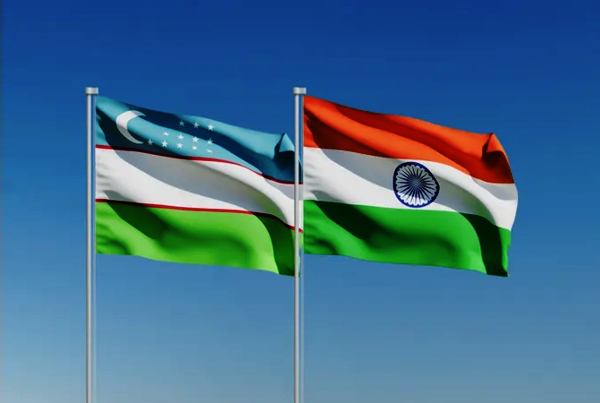
Uzbekistan has announced a 30-day visa-free regime for Indian citizens, opening the way for significantly easier travel between India and the Central Asian country and adding a major people-to-people dimension to the rapidly expanding bilateral relationship.
The decision was highlighted during Prime Minister Narendra Modi’s state visit to Uzbekistan on 29–30 August 2026. Following talks in Tashkent, Uzbek President Shavkat Mirziyoyev said the new visa arrangement, together with expanded air connectivity, would help increase tourism and travel between the two countries. Uzbekistan’s official tourism authorities have also confirmed that a 30-day visa-free regime for citizens of the two countries is expected to become an important driver of tourism growth.
The announcement represents a substantial easing of travel requirements for Indians. Until now, ordinary Indian passport holders have generally relied on Uzbekistan’s electronic visa system, while separate visa-free provisions existed for certain diplomatic passport holders and short transit stays. Uzbekistan’s current official visa information page has not yet fully incorporated the newly announced ordinary 30-day arrangement, indicating that the detailed implementation framework is still being updated.
A Major Boost for India-Uzbekistan Tourism
Uzbekistan has become increasingly popular among Indian travellers because of its Silk Road heritage, historic cities, relatively short flying time from India and expanding air links.
Cities such as Samarkand, Bukhara, Khiva and Tashkent offer a combination of Islamic architecture, Central Asian history, ancient trade routes and cultural links stretching back centuries. The removal of advance visa requirements could make short leisure trips and business visits substantially easier.
The visa announcement coincides with the signing of a Tourism Cooperation Programme for 2026–2028 between India and Uzbekistan. The programme is intended to expand tourist exchanges, develop joint tourism projects and support initiatives such as cultural weeks, film festivals and new travel routes.
Fourteen Weekly Flights to Support Greater Movement
Air connectivity is also being expanded alongside the visa reforms.
President Mirziyoyev said 14 weekly flights between India and Uzbekistan would complement the visa-free regime and help increase tourism. Improved connectivity is important because easier immigration procedures have the greatest impact when travellers also have adequate direct flight options.
Greater flight frequency could benefit tourism, business delegations, students and medical travellers while also supporting cargo and commercial links.
Bilateral Relationship Upgraded
The travel decision came during a broader strengthening of political and economic ties between the two countries.
Following the Tashkent talks, India and Uzbekistan announced that their relationship had reached the level of a Comprehensive Strategic Partnership. The two sides identified energy, critical minerals, healthcare, pharmaceuticals, electronics, mechanical engineering, jewellery and agriculture among the priority areas for future cooperation.
Uzbekistan said bilateral trade had increased by about 33% to $1.3 billion, while both countries have now set a target of increasing trade to $5 billion by 2030.
The visa-free arrangement can support that economic objective by making it easier for company representatives, investors and entrepreneurs to travel between the two markets.
Indian Business Presence Is Expanding
India’s commercial presence in Uzbekistan has grown steadily in areas including pharmaceuticals, healthcare, information technology, education and manufacturing.
Uzbekistan increasingly views India as an important technology and investment partner, particularly because of Indian expertise in software, digital systems, pharmaceuticals and start-ups.
Easier short-term travel could facilitate factory visits, business negotiations, trade exhibitions and investment discussions without the additional time required for pre-travel visa processing.
The measure therefore has implications beyond tourism.
Deep Historical Connections
India and Uzbekistan share unusually deep cultural connections.
For centuries, Central Asia and the Indian subcontinent were linked by trade routes through which merchants, scholars, craftsmen and ideas moved between the two regions. Samarkand and Bukhara were major centres of the wider Silk Road world, while political and cultural exchanges between Central Asia and India left lasting influences on architecture, cuisine, language and art.
Modern cultural ties remain active. Uzbekistan hosts the Lal Bahadur Shastri Centre for Indian Culture and the Mahatma Gandhi Centre, while four Indian universities currently operate in the country. President Mirziyoyev highlighted these institutions while announcing measures designed to expand cultural and humanitarian exchanges.
Yoga and Indian cinema also enjoy significant recognition in Uzbekistan, providing a ready foundation for stronger tourism links.
Uzbekistan Emerging as a Central Asian Destination for Indians
Visa-free access could considerably improve Uzbekistan’s competitiveness as a destination for Indian travellers.
International tourism decisions are influenced not only by attractions and cost but also by how easy it is to enter a country. Removing visa applications, processing periods and associated documentation can encourage spontaneous travel and shorter holidays.
Uzbekistan is particularly well suited to cultural tourism. Samarkand contains monuments associated with the Timurid era, including the Registan and Gur-e-Amir. Bukhara preserves one of Central Asia’s most important historic urban landscapes, while Khiva retains the extraordinary walled city of Itchan Kala.
For Indian travellers interested in history, architecture and the Silk Road, the country offers a geographically compact concentration of major heritage destinations.
Potential Benefits for Medical and Educational Movement
Travel between the two countries is not limited to conventional tourism.
Indian universities and educational institutions have established an increasingly visible presence in Uzbekistan, while students and academics travel between the two countries. Visa liberalisation could simplify short academic visits, conferences and institutional exchanges.
Healthcare is another expanding area of cooperation. Indian hospitals and pharmaceutical companies have established links in Central Asia, while Uzbekistan is seeking greater access to Indian medical expertise and affordable medicines.
A simpler travel regime could therefore support medical consultations, professional exchanges and healthcare partnerships.
A Wider Central Asian Strategy
The development also fits India’s broader engagement with Central Asia.
India has sought stronger relationships with Uzbekistan, Kazakhstan, Kyrgyzstan, Tajikistan and Turkmenistan across energy, connectivity, security, pharmaceuticals, digital infrastructure and education.
Uzbekistan occupies a particularly important position because of its large population, central geographical location and historical role as a commercial hub.
Better travel links can support India’s efforts to build direct relationships in a region where physical connectivity with India remains constrained.
Travellers Should Wait for Final Operational Details
Despite the announcement, Indian travellers should exercise some caution before immediately planning a visa-free trip.
As of 31 August, Uzbekistan’s official visa-information page still lists India within the electronic-visa framework for ordinary travellers and separately notes existing diplomatic-passport and transit provisions. The newly announced 30-day visa-free arrangement has therefore not yet been fully reflected across all official consular guidance.
Travellers should confirm the effective date, passport-validity requirements and any conditions attached to the new regime through Uzbekistan’s official diplomatic or immigration channels before departure.
The political decision, however, is clear. Uzbekistan’s President and tourism authorities have officially announced the 30-day visa-free regime as part of the new India-Uzbekistan tourism framework.
A New Phase in India-Uzbekistan People-to-People Ties
The visa decision may ultimately prove one of the most immediately visible outcomes of the latest India-Uzbekistan engagement.
Trade agreements and investment projects can take years to produce tangible results, but easier travel can quickly affect ordinary citizens, businesses and students.
For Uzbekistan, Indian visitors represent a large and rapidly expanding tourism market. For India, easier access strengthens links with one of Central Asia’s most historically important countries.
Combined with more flights, tourism cooperation, university links and growing economic ties, the 30-day visa-free regime could significantly increase movement between the two societies.
It marks another step in transforming an old civilisational relationship into a more accessible modern partnership built not only on diplomacy and trade, but on the ability of people from both countries to travel, study, invest and engage with each other more easily.
You may also like
-
India to Push Cross-Border Digital Payments and CBDC Linkages at BRICS Summit
-
India and Norway to Deepen Maritime Partnership at September Joint Working Group Talks
-
India to Help Restore Ancient Buddhist Heritage Sites of Fayaz Tepa and Kara Tepa in Uzbekistan
-
X Exposes 200,000-Account China-Linked Bot Network
-
Indian UPI Payments to Work with Uzbekistan’s UZQR Network as India Expands Digital Payments Footprint into Central Asia
