GI Produce of India
Among Kerala’s traditional rice varieties, Navara Rice, also widely written as Njavara, occupies an exceptional place. It is cultivated not merely as a food grain but as a rice deeply woven into Kerala’s Ayurvedic traditions, household diets and agricultural heritage. For generations, Navara has been valued as a special-purpose rice used in nourishing preparations, traditional therapies and ritual contexts, making it markedly different from the high-yielding varieties that dominate modern paddy cultivation.
Navara received Geographical Indication protection as an agricultural product of Kerala, recognising the close relationship between the rice, its traditional cultivation environment and the knowledge preserved by Kerala’s farming communities. The official Geographical Indications Registry records Navara Rice under Application No. 17, filed in 2004 and registered in 2007. Its GI registration has since been renewed and is currently valid until 24 November 2034.
A Rice Rooted in Kerala’s Agricultural Landscape
Navara belongs to Kerala’s remarkable heritage of indigenous rice diversity. Long before a relatively small number of high-yielding cultivars came to dominate paddy fields, farmers across the state maintained numerous local varieties adapted to particular soils, seasons, rainfall patterns and culinary requirements. Some were selected for aroma, some for tolerance to floods or saline conditions, and others for their traditional nutritional and medicinal uses.
Navara belongs principally to this last group. Kerala’s Department of Agriculture identifies Njavara among the traditional medicinal rice varieties that survived despite the disappearance of much of the state’s older rice diversity. The GI itself covers Kerala, although Palakkad has become particularly closely associated with organised conservation and commercial cultivation of the variety.
The Palakkad landscape provides a particularly suitable setting for traditional paddy cultivation. The district lies between the Western Ghats and the plains of central Kerala, with the Palakkad Gap creating distinctive climatic conditions. Paddy fields, irrigation channels and monsoon-fed agricultural lands have historically made the district one of Kerala’s important rice-producing regions.
Navara’s continued cultivation in this landscape demonstrates how traditional agricultural varieties often survive not because they can compete with modern rice solely on yield, but because they possess cultural, culinary or specialised qualities that farmers and consumers continue to value.
An Ancient Rice Remembered in Ayurveda
Navara’s most distinctive characteristic is its longstanding connection with Ayurveda.
Kerala government material identifies Navara with the traditional category known as Shashtika rice and notes references to such rice in classical Ayurvedic works including the Sushruta Samhita and Ashtanga Hridaya. These associations have given Navara an extraordinary cultural reputation extending far beyond ordinary culinary rice.
The Sanskrit word shashtika is associated with rice traditionally understood to mature rapidly, approximately within sixty days. Modern descriptions of Kerala’s Njavara, however, commonly give a somewhat longer crop duration. The Kerala Department of Agriculture lists Navara as a 70–75-day variety, illustrating the difference between the traditional classification and the duration observed in contemporary cultivation.
This short crop duration remains one of Navara’s agriculturally significant characteristics. It distinguishes the variety from many conventional paddy cultivars requiring substantially longer periods in the field.
The Rice Behind Navarakizhi
Perhaps no traditional use has made Navara more famous than Navarakizhi, an Ayurvedic procedure widely associated with Kerala.
Navarakizhi, known more formally in Ayurvedic practice as Shashtika Shali Pinda Sweda, involves specially prepared rice cooked with prescribed liquids and herbs and placed inside cloth boluses. These warm boluses are then used according to traditional Ayurvedic therapeutic practice. Navara Rice has historically been prized for such preparations because of the particular status assigned to Shashtika rice in Ayurvedic literature.
Navara is also associated with Navara Theppu and with various traditional gruels and nourishing rice preparations. Kerala’s official GI information specifically records the importance of Navara Rice in Ayurveda and identifies Navarakizhi and Navaratheppu among its traditional applications.
These uses form an important part of the rice’s cultural heritage. They should, however, be understood as traditional Ayurvedic applications rather than evidence that eating Navara Rice independently cures particular diseases. Its GI status protects its geographical and agricultural identity; it does not constitute medical certification.
Two Traditional Forms — Golden and Black
Navara has traditionally been recognised in yellow or golden-glumed and black-glumed forms.
According to Kerala Department of Agriculture descriptions, the yellow type possesses golden-yellow lemma and palea, while the other form has dark or black glumes. In both forms, the seed coat is brown and the endosperm is described as non-waxy. The grain is also classified as non-scented, an important distinction because Navara’s prestige arises primarily from its traditional nutritional and Ayurvedic identity rather than from fragrance in the manner of aromatic varieties such as Basmati or Wayanad Gandhakasala.
The plants themselves are relatively tall and slender and can be susceptible to lodging. Their panicles are generally described as short to medium in length.
These characteristics are part of the reason traditional varieties such as Navara cannot always be judged by the same commercial criteria applied to modern high-yielding rice. A farmer growing Navara accepts certain agronomic limitations because the grain commands value for qualities that ordinary commodity rice does not possess.
A Brown Rice with a Distinct Identity
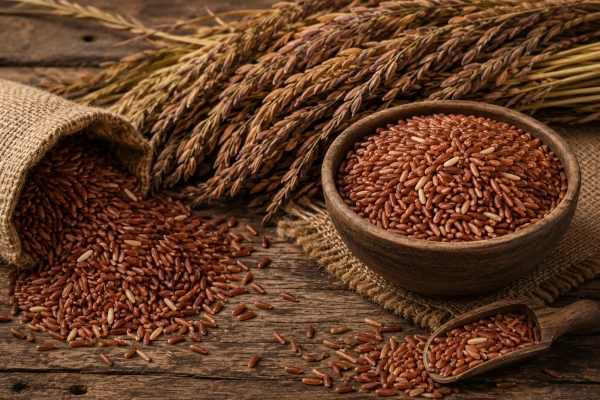
Navara is often consumed with relatively limited polishing so that more of the outer layers surrounding the grain are retained.
The resulting rice can have a brownish or reddish-brown appearance depending on the type and processing method. Unlike polished white table rice, traditional Navara preparations may retain more of the bran layer, giving the cooked grain a fuller flavour and a different texture.
Its appeal is consequently very different from Kerala’s aromatic festival rice varieties. Navara is not prized principally for a perfume that fills the kitchen during cooking. Instead, its reputation comes from traditional use, nutritional value, distinctive grain identity and its association with Ayurveda.
This combination has helped Navara survive at a time when many other indigenous rice varieties have disappeared from active cultivation.
Cultivation Through Kerala’s Monsoon Cycle
Kerala’s agricultural authorities describe Navara as suitable for cultivation as a kharif crop in uplands and as a summer crop in wetlands. The flexibility reflects the variety’s relatively short duration and the diversity of rice ecosystems found within Kerala.
Traditional cultivation begins with careful preservation and selection of seed. This is especially important for an indigenous landrace because its identity depends on maintaining varietal purity across successive generations.
Fields are prepared according to local water conditions before seed is sown or seedlings are established. Farmers must then manage water, weeds and crop nutrition throughout the relatively short growing period. Because Navara plants can be tall and comparatively delicate, crop management and harvesting require attention to prevent lodging and grain losses.
Unlike mass-market varieties supported by enormous commercial seed-distribution systems, traditional rice such as Navara has often depended on relatively small networks of farmers preserving viable seed from one generation to another.
The Importance of Seed Conservation
The survival of Navara has not been assured.
Kerala’s official GI portal records that cultivation declined considerably from the 1990s, with farmers moving away from the crop partly because of limited availability of quality seed and declining market demand. The disappearance of traditional seed stocks created a cycle in which fewer farmers cultivated Navara, making genuine seed still harder to obtain.
The formation of the Navara Rice Farmers Society became an important part of the effort to reverse this decline. The Society, based at Karukamanikalam in the Chittur area of Palakkad, became closely involved with the conservation, production and promotion of Navara and was the applicant recorded for the rice’s GI registration.
This makes Navara an important example of how geographical indications can function as conservation tools as well as commercial protections. Protecting the name creates an economic incentive for farmers to maintain the original crop rather than abandoning it entirely for more productive varieties.
Navara as a Nutritional Rice
Traditional Kerala food culture does not restrict Navara to Ayurvedic treatment centres. The grain is also used as a special nutritional rice.
It can be cooked into porridge and other soft preparations, and powdered Navara is traditionally combined with milk in some household recipes. Kerala agricultural literature describes it as both a nutritional rice and a health food, reflecting the long-standing preference for the variety in diets intended to be nourishing and easily consumed.
Navara also appears in traditional seasonal food practices. Rice gruels become particularly prominent during Kerala’s Karkidakam season, corresponding broadly with the intense southwest monsoon period when traditional households often favour warm, easily digestible preparations.
The relationship between Navara and these foods gives the crop significance beyond commercial rice markets. It belongs to a wider cultural understanding of food in which different rice varieties were traditionally selected for different stages of life, seasons and purposes.
A Grain with Ritual Significance
Navara also possesses a religious and ceremonial dimension.
Kerala’s official GI information notes its use in temple-related and religious practices, another indication that the variety was historically regarded as something more valuable than ordinary staple rice.
Traditional agricultural societies often preserved particular crop varieties because they were required for ceremonies even after their everyday culinary importance declined. Such uses can become an important mechanism of biodiversity conservation.
In Navara’s case, Ayurveda, household nutrition and ritual usage together helped maintain demand for a rice that might otherwise have been displaced completely by more commercially productive cultivars.
From Paddy Field to Navara Rice
After the crop reaches maturity, harvesting must be undertaken carefully because preservation of grain quality and seed purity is particularly important.
Threshing separates the grain from the harvested panicles, after which the paddy is cleaned and properly dried before storage or milling. Farmers preserving seed for the next season must keep selected grain separate from ordinary commercial material to prevent mixing.
Processing can vary depending upon the intended use. Rice intended for traditional therapeutic or nutritional preparations may receive comparatively limited polishing, while commercial products may be sold as whole grain, rice flour or other value-added preparations.
Maintaining identity throughout this chain is essential. A GI product derives value from authenticity, and substitution with ordinary rice would undermine both farmers and consumers.
A Premium Rice Rather Than a Commodity Crop
Navara occupies a fundamentally different market from common table rice.
Ordinary rice is purchased principally as a staple food and traded heavily on yield, milling recovery and price. Navara is produced in much smaller quantities and commands a premium because consumers seek it specifically for its traditional identity, nutritional positioning and Ayurvedic uses.
Kerala’s GI portal notes that organised cultivation revived after farmer groups began conserving and promoting the crop. It also records substantial premiums for Navara compared with ordinary rice, particularly for organically cultivated grain. Exact retail prices naturally vary considerably by season, certification, processing method, packaging and seller, but the broader pattern is clear: Navara functions as a speciality agricultural product rather than a bulk cereal.
This premium is crucial for growers. A traditional variety with lower yield or more demanding cultivation requirements can survive commercially only when its distinctive qualities generate sufficient additional value.
Palakkad and the Modern Navara Ecosystem
Although the GI geographical area is Kerala as a whole, Palakkad has become a particularly important centre for Navara conservation and organised production.
The Navara Rice Farmers Society is based at Karukamanikalam near Chittur in Palakkad district, and the official GI application originated from this farming community.
The modern Navara ecosystem brings together seed conservation, cultivation, processing, direct marketing and links with Ayurvedic institutions. This differs substantially from the industrial supply chains surrounding ordinary rice.
Speciality grain can move from farmer groups to Ayurveda practitioners, traditional medicine establishments, health-food retailers, organic shops and consumers seeking indigenous foods. Rice may also be processed into flour or incorporated into specialised food products.
Such diversification increases the economic value obtainable from a relatively small harvest.
Navara and Kerala’s Vanishing Rice Diversity
Navara’s survival also carries importance for agricultural biodiversity.
Kerala once possessed an extraordinary diversity of indigenous rice cultivars adapted to wetlands, uplands, saline fields, deep-water environments and specialised culinary uses. Kerala Tourism notes that historical accounts speak of more than 2,000 traditional varieties, although many have subsequently disappeared from cultivation.
The decline occurred as paddy acreage contracted and farmers adopted a smaller number of high-yielding varieties. Changes in labour availability, land use, irrigation, food habits and market economics accelerated the disappearance of traditional seed.
Every landrace lost represents more than the disappearance of a particular taste. Traditional varieties contain genetic diversity potentially valuable for future plant breeding, including characteristics related to maturity, disease response, grain quality and adaptation to unusual environments.
Maintaining Navara cultivation therefore preserves both cultural heritage and living rice germplasm.
A Traditional Variety in Modern Agricultural Research
Traditional rice germplasm is also valuable to agricultural scientists.
Kerala Agricultural University continues to characterise indigenous rice collections through field evaluation and molecular research. Its work has included traditional Navara-related material alongside other Kerala landraces, helping document the genetic diversity retained within the state’s surviving rice resources.
Such conservation is especially relevant as rice agriculture faces increasingly variable temperatures, rainfall patterns, pests and diseases.
Not every traditional variety will itself become a major commercial crop. However, traits preserved within indigenous germplasm can become valuable resources for breeding future varieties.
Navara therefore belongs simultaneously to Kerala’s agricultural past and to the genetic resource base from which future rice research may draw.
GI Protection and the Preservation of Authentic Navara
Navara Rice was among Kerala’s relatively early agricultural products to receive a Geographical Indication.
The application was filed on 25 November 2004, and the GI certificate was issued on 23 November 2007. The registration identifies Kerala as the geographical area and places the rice in Class 30 as an agricultural product.
Most importantly, the Intellectual Property India database now records the registration as valid until 24 November 2034, reflecting its subsequent renewal. This is more current than some older catalogues that still display the previous expiry period.
GI protection gives farmers and authorised producers a legal mechanism for protecting the Navara name against misuse. It also helps ensure that the commercial identity of the grain remains connected with Kerala rather than becoming a generic label applied to unrelated rice.
GI Details at a Glance
- Geographical Indication: Navara Rice
- State: Kerala
- Product: Agricultural — Rice
- Class: 30
- Application Number: 17
- Date of Filing: 25 November 2004
- GI Journal: Journal No. 17
- Journal Availability Date: 20 June 2007
- Certificate Number: 40
- GI Certificate Date: 23 November 2007
- Registered Proprietor: Navara Rice Farmers Society, Karukamanikalam, Chittur College P.O., Palakkad, Kerala
- Geographical Area: Kerala
- Registration Valid Until: 24 November 2034
The registration particulars above are taken from the current Geographical Indications Registry of Intellectual Property India, which records Navara Rice as registered and confirms its renewed validity through November 2034.
A Short-Season Grain with a Long Cultural Memory
Navara is remarkable because its physical life in the field is comparatively short while its cultural history is exceptionally long.
The crop can mature in roughly 70–75 days under contemporary Kerala descriptions, yet the tradition surrounding Shashtika rice reaches back into classical Ayurvedic literature. Its golden and black-glumed forms, brown seed coat, non-waxy grain and relatively short crop duration distinguish it agriculturally, while its association with Navarakizhi and traditional nourishing foods gives it a cultural identity unmatched by ordinary rice.
Its survival has depended on farmers who continued preserving seed even when cultivation became economically difficult. The revival led by farming communities in Palakkad and the protection provided through the GI system have given this old rice a new commercial future.
Navara therefore represents much more than a speciality grain from Kerala. It embodies an agricultural tradition in which food, farming, biodiversity and Ayurveda developed together, preserving within a small rice kernel a living connection to Kerala’s fields and knowledge systems across generations.
You may also like
-
Finance Ministry Estimates India’s Q2 FY27 GDP Growth at 7.3%
-
NTPC Green Energy Adds 153.94 MW at Kalasar Solar Project in Rajasthan
-
Vietnam Expands Business and Investment Links Across India’s Major Economic Hubs
-
India’s GST Collections Rise 14.7% to ₹2.04 Lakh Crore in September
-
SberIndia Lending to Indian Companies Quadruples as India-Russia Trade Finance Expands
